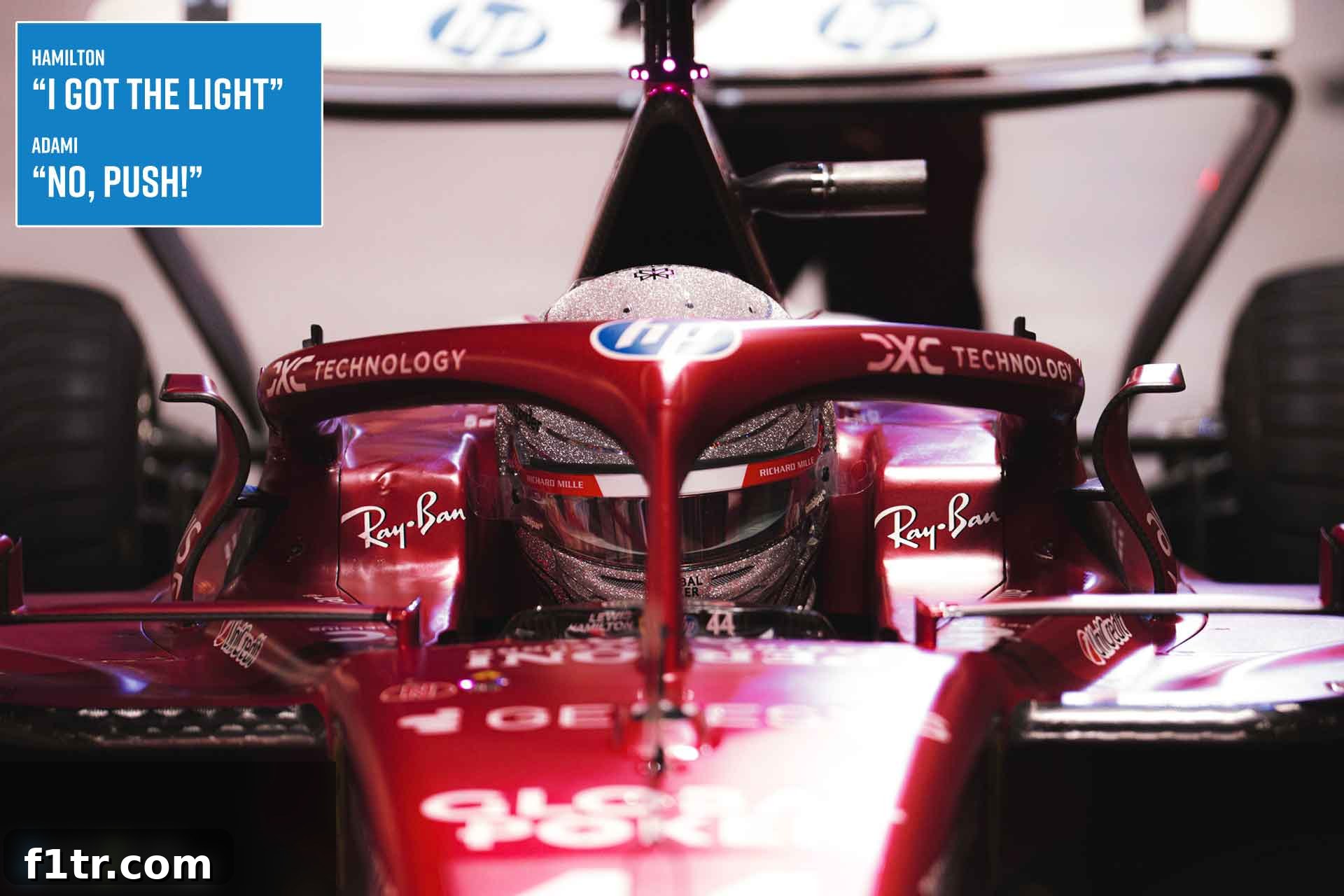
Lewis Hamilton’s Costly Q1 Blunder: A Misunderstanding Leads to Last Place in Las Vegas
Lewis Hamilton, the seven-time Formula 1 world champion, endured a frustrating and highly unusual qualifying session at the Las Vegas Grand Prix, culminating in a last-place start for the main race. The Mercedes-AMG Petronas F1 Team driver found himself at the bottom of the grid after a critical misjudgment on his final flying lap in Q1, a mistake that left both him and his team reeling.
The incident unfolded in the dying moments of the first qualifying segment, a session already fraught with challenges due to the unique street circuit layout and evolving track conditions. As drivers pushed to extract every ounce of performance, Hamilton’s attempt to secure a better grid position was tragically cut short by a misunderstanding regarding the circuit’s timing line and the session-ending chequered flag.
Hamilton had just crossed the official timing line, marking the completion of his lap, mere seconds before the chequered flag signaled the end of Q1. However, in a moment of crucial misinterpretation under immense pressure, he mistakenly believed he had not made it across in time. Reacting instinctively to what he perceived as the session’s conclusion, Hamilton dramatically slowed his car down, effectively abandoning what could have been a vital improvement to his lap time.
This split-second decision proved incredibly costly. At the time of the confusion, Hamilton was sitting in 19th position. With several other drivers still on flying laps and improving their times, his premature slowdown saw him tumble down the order, ultimately finishing the session in 20th and last place. This result meant an immediate and unexpected elimination from Q1, a rare occurrence for a driver of Hamilton’s caliber and a significant blow to Mercedes’ hopes for the Las Vegas event.
The Intricate Dance of Timing Lines and Chequered Flags
Understanding the nuances of the F1 qualifying procedure is key to grasping the magnitude of Hamilton’s error. At many circuits, including the challenging Las Vegas street track, the official timing line is positioned before the physical start/finish line where the chequered flag is waved. This layout often creates confusion, especially during the frantic final moments of a qualifying session when every millisecond counts and drivers are pushing to their absolute limits.
On this occasion, Hamilton correctly crossed the timing line while the session was still officially ‘green,’ meaning his lap was valid and capable of being improved. The gantry lights only turned red, signaling the definitive end of the session, shortly *after* he had passed this crucial point. Had he continued to push, his final sector would have counted, and he almost certainly would have climbed out of the elimination zone. The subtlety of this timing difference, combined with the high-stakes environment, proved to be his undoing.
The lead-up to this fateful final lap was also filled with strategic maneuvers. Hamilton had deliberately backed off earlier in Q1 to create a significant gap to the cars ahead, aiming to gain clean air and allow his tires to come up to optimal temperature for one final, uninterrupted push. This strategy also positioned him to be one of the last drivers to set a time on the drying track, theoretically giving him an advantage as the grip improved. However, further complications arose when he encountered a yellow flag at Turn 14 during this critical phase, forcing him to lift and costing him precious time and momentum.
The Radio Exchange: A Plea to Push
During these tense moments, Hamilton’s race engineer, Ricardo Adami, was acutely aware of the ticking clock and the need for urgency. Adami had been urging his driver to maintain pace, ensuring he reached the timing line before the session’s dramatic conclusion. The radio communications reveal the engineer’s desperate attempts to keep Hamilton focused on pushing through the line, even after he had crossed it to secure an extra lap.
The critical exchange painted a clear picture of the misunderstanding:
Hamilton’s Radio Messages from the End of Q1
| Adami | Approaching turn 17 And keep pushing, keep pushing for an extra lap. |
| Hamilton | Hamilton crosses the timing line and backs off Are we safe? |
| Adami | Keep pushing. |
| Hamilton | No I got the… I got the light. |
| Adami | No, push. |
| Hamilton | Earlier part of message appears to be cut …get the tyres to work. |
| Adami | Yeah, very slippery out there. |
This transcript highlights the crucial moment where Hamilton saw what he believed was a red light signifying the end of the session, prompting him to lift off the throttle. Adami’s immediate response, “No, push,” underscored the fact that the session was still live for Hamilton to complete his lap and improve. FIA timing data subsequently confirmed that Hamilton was not the first driver to take the chequered flag in the session; that distinction went to Gabriel Bortoleto, who was behind him and completed his lap without issue.
Implications for the Las Vegas Grand Prix
Starting from 20th position on the grid is an incredibly challenging prospect for any driver, even one with Hamilton’s unparalleled experience and skill. The Las Vegas Grand Prix circuit, with its long straights and tight corners, presents unique overtaking opportunities but also significant risks. Recovering from the very back will require a flawless strategy, aggressive driving, and a considerable amount of luck, particularly in avoiding any first-lap incidents that often plague the rear of the field.
For Mercedes, Hamilton’s Q1 exit is a major setback. The team will now be forced to devise a race strategy centered around damage limitation and a potential charge through the field, rather than competing for front-running positions. This shifts the focus dramatically and places immense pressure on both Hamilton and the strategists to make daring and unconventional calls to salvage points from the weekend. Fuel management, tire degradation, and safety car timings will all play a magnified role in their efforts.
Such incidents serve as a stark reminder of the razor-thin margins that define Formula 1. The difference between a strong qualifying performance and an early exit can often come down to a fraction of a second or, as in this case, a momentary misinterpretation of track signals. Even seasoned veterans like Lewis Hamilton can fall victim to the extreme pressures and complex rules of the sport.
Looking Ahead: A Test of Resilience
Despite the profound disappointment of qualifying last, Lewis Hamilton and the Mercedes team are renowned for their resilience and fighting spirit. The Las Vegas Grand Prix, with its unique characteristics and the potential for unpredictability on a street circuit, might offer a glimmer of hope for a strong recovery drive. Hamilton has, on many occasions, demonstrated his ability to scythe through the field, and his determination will undoubtedly be at an all-time high as he attempts to mitigate the damage from this costly Q1 error.
The race will not only be a test of Hamilton’s driving prowess but also of Mercedes’ strategic acumen. Every decision, from tire compounds to pit stop timings, will be scrutinized as they aim to navigate the bustling midfield and make significant progress. While the dream of a podium finish might seem distant from P20, the goal will firmly be set on salvaging as many championship points as possible, turning a disastrous Saturday into a memorable Sunday comeback.
2025 Las Vegas Grand Prix
- Losing win through strategy error “hurts more” than Las Vegas disqualification – Piastri
- FIA feels McLaren’s Las Vegas GP disqualification is “draconian”, claims Brown
- Why did McLaren’s messages to Norris and Piastri not mention plank problems?
- McLaren explain Las Vegas disqualifications – including their “counterproductive” reaction
- McLaren’s first double disqualification ended their second-longest points streak
Browse all 2025 Las Vegas Grand Prix articles