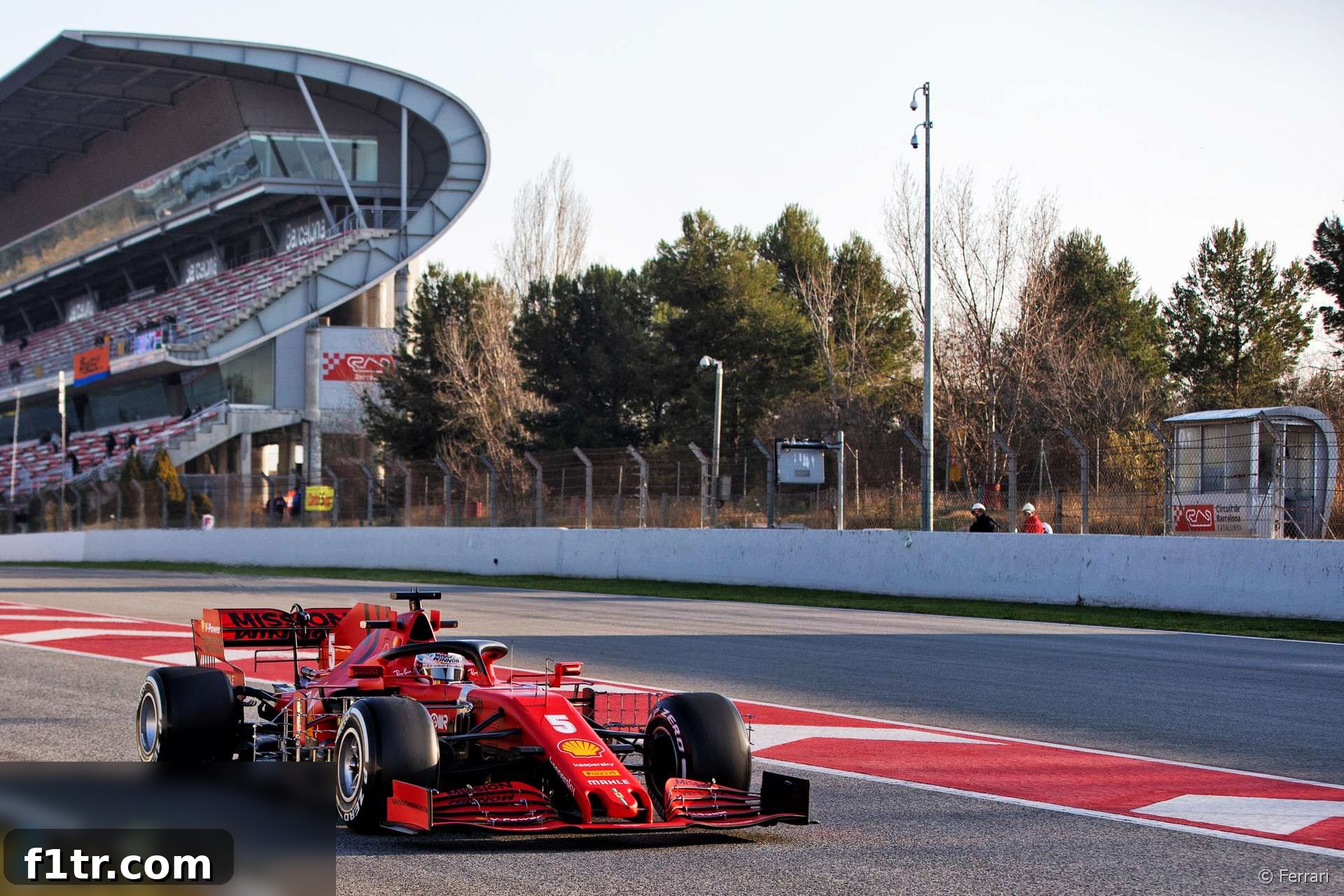
Sebastian Vettel Calls for Fresh F1 Pre-Season Testing Venues Beyond Barcelona
For years, the Circuit de Catalunya, nestled just outside Barcelona, has served as the familiar, almost habitual, home for Formula 1’s crucial pre-season testing. It’s a venue as ingrained in the F1 calendar as the Monaco Grand Prix, albeit for a vastly different purpose. However, a prominent voice within the paddock, that of four-time world champion Sebastian Vettel, has recently sparked a debate, expressing a desire for a change of scenery and a fresh challenge for F1 teams and drivers alike.
Vettel, a veteran who has commenced his 13th full season in the pinnacle of motorsport, acknowledges the merits of the Barcelona track. It’s a circuit revered for its demanding layout and reputation as a comprehensive test of a car’s performance. Yet, the German driver articulated a clear preference for diversity, suggesting that a new testing venue could inject renewed enthusiasm and provide different insights into car development.
The Driver’s Perspective: A Quest for Variety and New Challenges
“I’d probably enjoy testing on a different track,” Vettel openly stated. “Nothing against Barcelona. But it’s just we’ve been here for so many times.” His sentiment isn’t born of disdain for the Spanish circuit but rather a natural yearning for novelty and a deeper exploration of the machinery he pilots. He highlighted the intrinsic satisfaction derived from the collaborative effort with engineers to uncover a car’s full potential, an aspect he genuinely enjoys.
However, the repetitive nature of testing on the same corners, year after year, can diminish some of that exploratory thrill. “As I said if it wasn’t always for the same corners, then maybe [I’d enjoy it] a bit more. But it’s part of the drill,” Vettel added, encapsulating the mixed feelings many drivers might harbor. While the Circuit de Catalunya offers a broad spectrum of corner types – from fast sweeps to slow hairpins – and a long main straight ideal for aerodynamic evaluation, its constant presence means that new car characteristics are always measured against the same, well-understood baseline. A change of venue could force teams and drivers to adapt more, revealing different aspects of a car’s handling and reliability under varying track conditions and layouts.
For drivers, the mental challenge of dissecting a new car’s behavior on an unfamiliar track, or at least one less frequently visited for testing, could sharpen their senses and provide a more nuanced understanding of its limits. It’s a test of adaptability not just for the car, but for the human element behind the wheel, encouraging a fresh approach to problem-solving and setup optimization.
Circuit de Catalunya: The Enduring Charm and Practicality
Despite Vettel’s call for change, the Circuit de Catalunya has held its position as F1’s primary pre-season testing ground for compelling reasons. The last time the full F1 grid gathered for a pre-season test at a different venue was at Jerez back in 2015. Barcelona’s consistent appeal stems from a combination of factors that make it an almost unparalleled choice for intensive development work.
Firstly, its geographical location in Catalonia generally offers stable and predictable weather conditions in late winter/early spring, minimizing disruptions from rain or extreme cold. This reliability is paramount for teams seeking to complete extensive mileage and gather consistent data on car performance, aerodynamics, and tire degradation without the variables introduced by fluctuating weather. Secondly, the circuit’s layout is renowned for being a comprehensive test bed. Its mix of high-speed corners, flowing sections, and technical turns, coupled with a long main straight, allows teams to evaluate a wide range of car characteristics – from aerodynamic efficiency to mechanical grip and engine performance. It’s often considered a benchmark circuit, with a car that performs well here typically performing well elsewhere on the calendar.
Furthermore, Barcelona offers excellent logistical advantages. Its modern facilities, proximity to a major international airport, and relatively easy access for European-based teams contribute significantly to its practicality. The infrastructure surrounding the circuit is well-equipped to handle the complex operations of multiple F1 teams, making the demanding logistics of pre-season testing slightly less arduous.
Exploring Alternatives: The Case for Paul Ricard and Beyond
Among the potential alternatives frequently discussed, the Paul Ricard circuit in France stands out. Having made its return to the F1 calendar in 2018, Paul Ricard is a modern facility known for its distinctive blue and red run-off areas and flexible track configurations. On paper, it presents an appealing option for pre-season testing, offering different challenges and a fresh perspective.
However, the idea of relocating testing to the French circuit is not without its detractors, particularly among team principals. Franz Tost, the seasoned team principal of Toro Rosso (now AlphaTauri), voiced his reservations, articulating a preference for Barcelona. “I prefer here,” he stated, referring to Catalunya. Tost elaborated on the technical differences, noting that “Ricard from the corners, from the surface, it’s not so optimal as here in Barcelona.” This highlights a critical point from an engineering perspective: the specific characteristics of a track’s asphalt and corner profiles can significantly impact the relevance and quality of data gathered for car development. Paul Ricard’s smoother surface and distinctive corner designs might not provide the same representative data as Barcelona, especially regarding tire wear and degradation, which are crucial aspects of modern F1.
Weather is another significant concern. While Paul Ricard can offer good conditions, Tost recounted less favorable experiences: “And the weather it could be good there but I have been a couple of times in Ricard with very, very cold [conditions]. The Mistral [wind] in summer, it looks like in winter as well, but very cold and I didn’t have so good experience in the past.” The notorious Mistral wind, a strong, cold, dry wind that sweeps through the Rhône Valley, can be a major disruptor, creating highly inconsistent aerodynamic conditions and making precise data collection extremely difficult. Such variability runs counter to the primary objective of pre-season testing: to gather reliable, repeatable data in a controlled environment.
Beyond Paul Ricard, other venues could theoretically host testing, but each presents its own set of challenges. Historically, tracks like Jerez offered different layouts, but they often came with logistical hurdles or less consistent weather. The notion of testing further afield, such as in Bahrain, is sometimes floated due to its guaranteed warm weather, but the increased costs and logistical complexities for European-based teams generally make it an unfeasible option for all but a single test session, as seen in some recent seasons.
The Team’s Imperative: Consistency and Controlled Variables
The dichotomy between a driver’s desire for variety and a team’s need for consistency underscores the fundamental purpose of F1 pre-season testing. For engineers and strategists, testing is a highly scientific endeavor aimed at understanding every nuance of their new challenger. This requires minimizing variables as much as possible, a task for which Barcelona is particularly well-suited.
Teams strive to gather vast amounts of data – on aerodynamics, engine performance, tire behavior, suspension settings, and driver feedback. To make this data comparable and actionable, a consistent environment is key. Unpredictable weather, varying track surfaces, or drastically different corner characteristics at a new venue could introduce noise into the data, making it harder to draw definitive conclusions about car performance and development directions. The ability to directly compare current data with historical benchmarks at the same track allows teams to gauge their progress accurately and identify areas for improvement more efficiently.
Furthermore, the financial and logistical implications of changing testing venues are substantial. Relocating equipment, personnel, and infrastructure to a new circuit incurs significant costs and time. For smaller teams, especially, these additional burdens could detract from their ability to maximize their limited testing days. The proximity of Barcelona to many F1 factory bases in the UK and Italy also facilitates quicker turnaround times for parts and personnel, which is invaluable during the intense pre-season development phase.
Evolution of F1 Testing and Its Future
Formula 1 testing has undergone a dramatic evolution over the past two decades. Gone are the days of unlimited in-season testing, where teams could spend weeks perfecting their cars. Today, pre-season testing is heavily restricted, typically to just a handful of days shared between two drivers. This compressed schedule places immense pressure on teams to be efficient and extract maximum value from every lap.
In this high-stakes environment, the choice of testing venue becomes even more critical. Teams cannot afford to waste precious track time due to adverse weather or unfamiliar track conditions. The rise of sophisticated simulation tools and virtual testing has mitigated some of the reliance on physical track time, but the real-world validation provided by pre-season testing remains irreplaceable. It’s the only opportunity for drivers to get a true feel for the car, for engineers to correlate simulation data with reality, and for the entire team to practice pit stops and race procedures.
Will F1 ever heed the call for more varied testing locations? The debate highlights a perennial tension between the desire for innovation and challenge, and the practical demands of a highly technical and competitive sport. While a permanent shift away from Barcelona for all testing might be impractical for the reasons outlined, a rotational system or occasional visits to alternative circuits could offer a compromise, blending the benefits of familiarity with the excitement of new challenges. The future of F1 pre-season testing will likely involve a continuous balancing act, seeking the optimal blend of tradition, efficiency, and the ever-present quest for performance.
Advert | Become a RaceFans supporter andgo ad-free
This space for advertising content.
Related Formula 1 Content
- Grosjean to make F1 test return tomorrow for first time since Bahrain horror crash
- Pictures: Wrecked chassis from Grosjean’s Bahrain fireball crash to go on display
- Bottas vs Rosberg: Hamilton’s Mercedes team mates compared after 78 races each
- F1 revenues fell by $877 million in Covid-struck 2020 season
- Hamilton and Mercedes finally announce new deal for 2021 season
Browse all 2020 F1 season articles