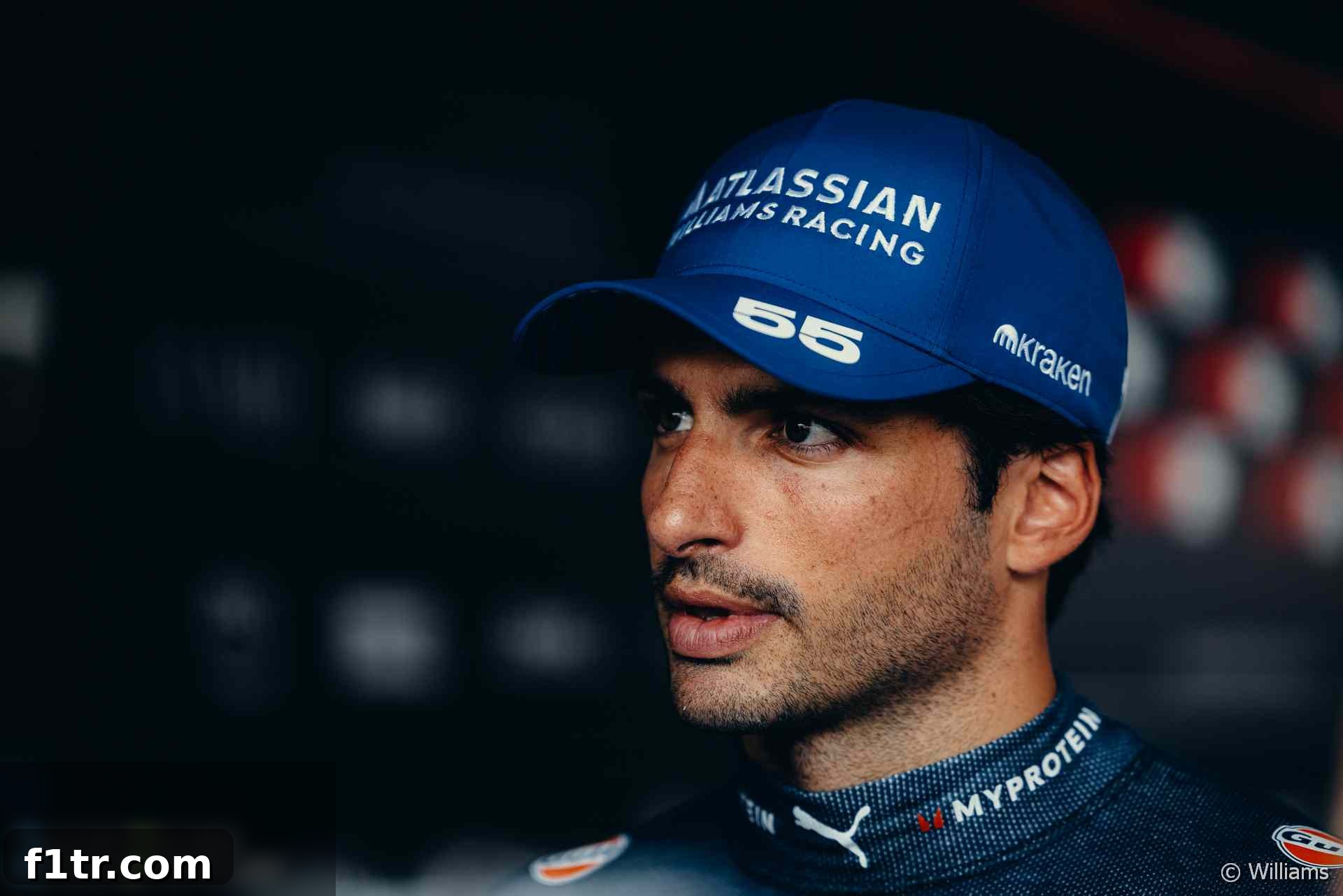
Carlos Sainz Jnr has openly expressed his profound dissatisfaction and frustration with his performance and lack of meaningful results since making the high-profile switch to the Williams Racing team earlier this year. The accomplished Spanish driver, who brings a wealth of experience from his prior tenure at Ferrari, is currently navigating a challenging period marked by unexpected hurdles and a significant gap in points compared to his teammate. This candid admission underscores the immense pressure and competitive spirit inherent in Formula 1, where every driver is constantly striving for optimal performance and tangible success.
Advert | Become a Supporter & go ad-free
With merely one round remaining before the much-anticipated summer break, Sainz finds himself positioned 16th in the highly competitive Drivers’ Championship standings. This contrasts sharply with the impressive performance of his teammate, Alexander Albon, who has managed to secure 54 points, placing him in a commendable eighth position. Sainz’s current tally of 16 points highlights a disparity that neither he nor the team had anticipated, especially considering his reputation as a consistent and formidable competitor throughout his career. The substantial point difference between the two Williams drivers has naturally raised questions and intensified the focus on Sainz’s adaptation process and the team’s overall strategic direction.
Sainz acknowledged that transitioning to a new team after four successful and formative years at Ferrari would inevitably require a period of adjustment. He understood that familiarizing himself with a new car philosophy, a different engineering approach, and an entirely new team dynamic would not happen overnight. Despite these expectations, he emphasized that while he has identified “plenty of positives” in Williams’ dedicated approach and meticulous preparation for the upcoming seasons, the on-track results have fallen far short of his personal benchmarks and the team’s collective aspirations. This gap between internal progress and external performance is a core source of his current frustration, suggesting a disconnect that the team is working diligently to bridge.
In a revealing interview with the official Formula 1 channel, Sainz articulated the depth of his disappointment, stating, “Everything that has happened actually on-track in terms of results has been incredibly frustrating and very disappointing.” This powerful declaration underscores the emotional toll that underperformance can take on a driver of Sainz’s caliber, especially one accustomed to regularly competing at the sharp end of the grid. His comments reflect a profound internal struggle to reconcile his demonstrated speed and competitive nature with the challenging circumstances he currently faces. The expectation was that, following a reasonable period of acclimatization to the FW47 chassis, results would naturally begin to materialize, aligning with his proven pace and consistency. However, for a multitude of reasons, those anticipated results have yet to emerge, fueling his public frustration.
Sainz remains resolute in his belief that a turnaround is imminent, expressing confidence that, “But I’m sure it will come at a point in the season.” This unwavering optimism is characteristic of top-tier athletes who understand that resilience and perseverance are key components of success in elite sports. His conviction suggests that despite the current struggles, he and the team are actively working towards uncovering the root causes of their performance deficit. The pursuit of understanding why results are not aligning with their internal data and potential is a continuous process in Formula 1, often requiring meticulous analysis, experimental changes, and a strong collaborative effort between driver and engineers.
The previous race weekend offered a microcosm of Sainz’s season so far – a mix of promising signs and frustrating setbacks. Following a significantly disrupted single practice session, which severely limited his track time and data gathering, Sainz demonstrated remarkable resilience to qualify strongly for the sprint race, securing an impressive sixth position. This performance hinted at the underlying pace of both the driver and the car when conditions align. In the sprint race itself, he managed to maintain his position, crossing the finish line in sixth, thereby adding valuable points to his tally. Such a rebound from a challenging start showcased his ability to adapt quickly and extract performance under pressure, reaffirming his inherent talent.
Advert | Become a RaceFans supporter andgo ad-free
However, the momentum from the sprint race did not carry over into the crucial grand prix qualifying session. A surprising turn of events saw Sainz exit in the first round of qualifying (Q1), a result that was deeply disappointing given his earlier pace. This immediate drop-off highlighted the fine margins in Formula 1 and how quickly fortunes can change. For the main grand prix on Sunday, a strategic decision was made to switch to a wet-weather setup, anticipating challenging conditions. Unfortunately, this gamble did not pay off as expected. The rain either did not materialize with the intensity required or the chosen setup compromised the car’s performance too significantly, leaving Sainz unable to make substantial progress through the field during the race. This scenario perfectly encapsulates the unpredictable nature of F1 strategy and the delicate balance required to make critical setup calls.
Looking ahead, Sainz is pinning his hopes on a return to the conventional race weekend format at the Hungaroring. This iconic circuit, known for its tight, twisty layout and demanding technical characteristics, is often dubbed “Monaco without the walls.” It presents a unique challenge that typically favors cars with strong aerodynamic efficiency and excellent mechanical grip. Sainz believes that the Hungaroring will provide Williams with an invaluable opportunity to thoroughly assess and better comprehend the efficacy of the critical upgrades they introduced at the last event. “I think it’s a weekend that is a good track to test, a track that all teams know very well,” he remarked, emphasizing the circuit’s suitability for comparative analysis and detailed performance evaluation.
The introduction of the upgraded car has steered Williams towards what Sainz describes as “a bit of a different set-up direction for the future.” This implies a fundamental shift in how the team approaches car configuration and optimization, moving away from previous conventions. It becomes paramount, therefore, that this upcoming weekend at the Hungaroring is utilized to its fullest potential to meticulously “understand those” changes. The team’s engineers and drivers need to gain a comprehensive grasp of how the new components interact with the car’s overall dynamic and aerodynamic package. Sainz further elaborated on the necessity of this understanding, recalling the previous event: “We saw from the sprint [race] to the [grand prix] when we did a few set-up changes that didn’t do what we expected to the car and now we need to understand that.” This statement highlights the intricate and often counter-intuitive nature of Formula 1 car development, where seemingly logical adjustments can sometimes yield unexpected or even detrimental outcomes. The Hungaroring, with its consistent conditions and vast historical data, offers the ideal environment to isolate variables and precisely quantify the impact of their latest developments.
The task at hand for Carlos Sainz and Williams is not merely about immediate results, but about building a robust foundation for future performance. Every F1 team operates on a continuous cycle of development, and the feedback from a driver of Sainz’s calibre is instrumental in guiding that process. His ability to articulate precise car characteristics and identify areas for improvement is a significant asset, even amidst his personal frustrations. The team’s commitment to understanding their upgrades at the Hungaroring signals a proactive approach to rectifying their current performance deficit and unlocking the car’s full potential. The tight schedule of Formula 1 means that every track session, every data point, and every strategic decision carries immense weight, especially as teams vie for crucial championship points and technical superiority.
The journey from frustration to consistent performance is often a test of character, technical acumen, and unwavering dedication. Sainz’s move to Williams was intended to mark a new chapter of success, and while the initial pages have been challenging, his resolve remains unbroken. The Hungaroring Grand Prix thus stands as a critical juncture for both driver and team. A strong showing, coupled with a deeper understanding of their upgraded package, could provide the necessary catalyst to propel Sainz and Williams towards a more competitive second half of the season. His belief that results “will come at a point in the season” is not just hope, but a reflection of his confidence in his own abilities and the collective effort of his new team to overcome these early setbacks and translate their hard work into tangible on-track achievements. The Formula 1 community will be watching closely to see if this pivotal weekend in Hungary can mark the turning point in Carlos Sainz Jnr’s challenging but determined season with Williams.
Go ad-free for just £1 per month>> Find out more and sign up
Miss nothing from RaceFans
Get a daily email with all our latest stories – and nothing else. No marketing, no ads. Sign up here:
2025 Hungarian Grand Prix
- Leclerc admits problem which struck Ferrari in Hungary is likely to recur
- Permane impressed by Lawson’s progress after “breakthrough” in Austria
- Albon expects “dogfight” as Williams aim to hold fifth place
- Mercedes eye more wins post-break after dropping revised rear suspension
- McLaren pair equal Senna and Prost’s run in second-fastest ever Hungarian GP
Browse all 2025 Hungarian Grand Prix articles