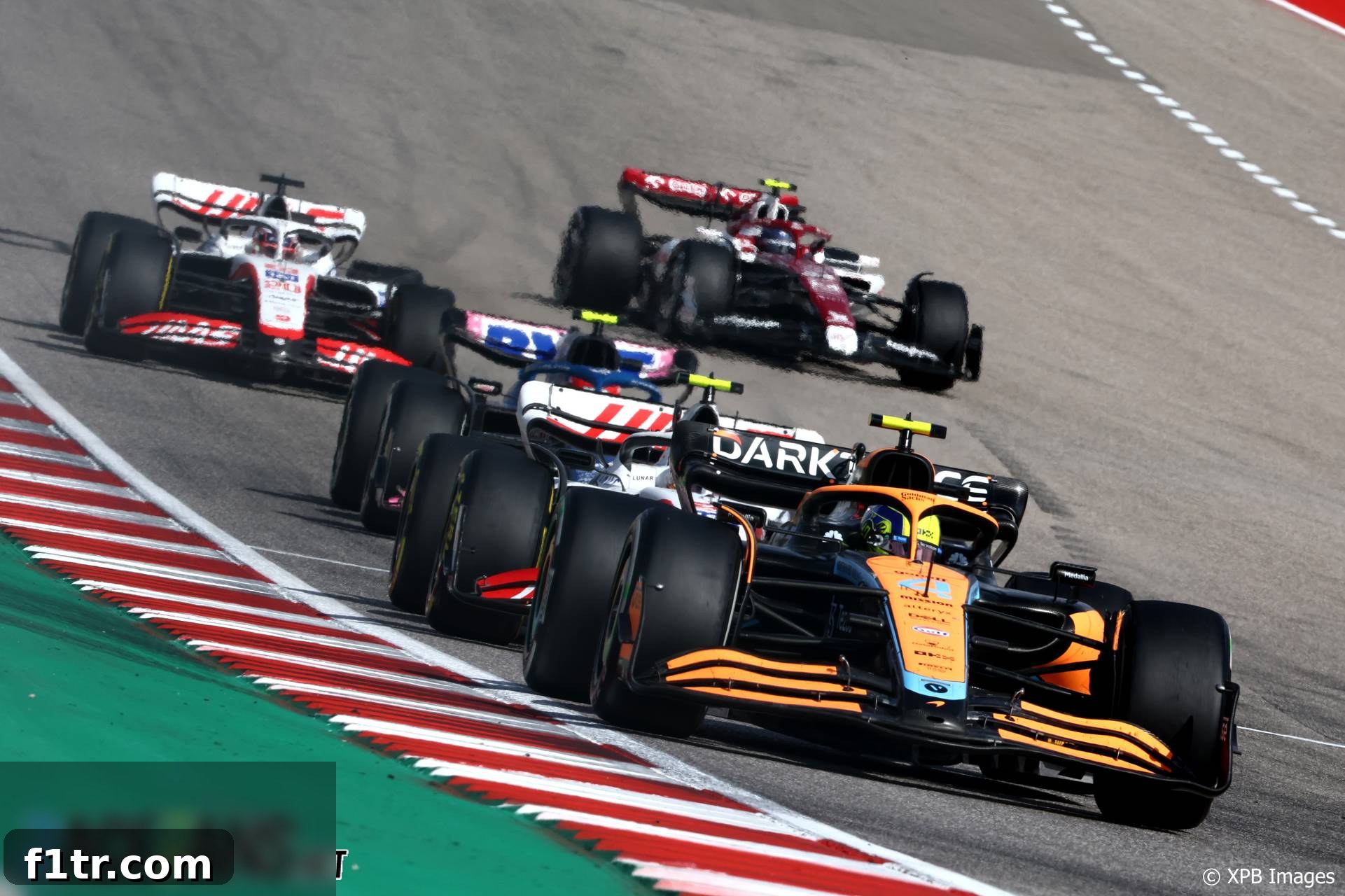
Lando Norris, the highly regarded McLaren driver, recently revealed the extreme physical toll exacted by the notoriously bumpy track surface at the Circuit of the Americas during the United States Grand Prix weekend. His candid comments shed light on the demanding nature of modern Formula 1, where even top athletes are pushed to their absolute limits, sometimes requiring medical intervention.
Advert | Become a Supporter & go ad-free
Norris, who impressively secured a sixth-place finish in yesterday’s intense race, confessed to being “heavily dosed up on headache tablets” throughout the event. This wasn’t merely a minor discomfort; the relentless pounding from the circuit’s imperfections resulted in what he described as “internal bruising on my head.” Such an admission underscores the severity of the challenge faced by drivers, transforming a high-speed spectacle into a grueling test of endurance and pain management.
“I struggled a lot with that this weekend,” Norris shared with media, including RaceFans, after the race. “Have you seen how hard my head hits? I’ve got internal bruising on my head or something, so it’s really not nice.” His remarks paint a vivid picture of the relentless vibrations and impacts transmitted through the car’s chassis directly to the driver’s body, particularly the head and neck. This constant jarring can lead to severe headaches, disorientation, and long-term health concerns, highlighting a critical area for improvement in track design and maintenance.
The Persistent Problem of COTA’s Bumps
The bumpiness of the Circuit of the Americas is not a new phenomenon; it has been a recurring point of contention among Formula 1 drivers and teams for several years. While the track owners have made commendable efforts, undertaking various improvements to the surface ahead of F1’s return last week, these interventions appear to be a temporary balm rather than a definitive cure.
The fundamental issue, according to Norris and many others in the paddock, lies in the nature of the cars themselves. The new technical regulations introduced for the 2022 season mandated stiffer, lower-riding cars designed to harness ground effect aerodynamics more efficiently. This design philosophy, while delivering incredible performance, also means the cars are inherently less forgiving over uneven surfaces. “Some bits were less [bumpy], so I’m very happy they did that,” Norris acknowledged, recognizing the efforts made. “But they resurfaced half of it. That half is a little bit better. Not as good as it needs to be, especially in these cars; I think in last year’s cars we wouldn’t be complaining. With this year’s cars we complain about everything.” This sentiment perfectly encapsulates the exacerbated challenge, where modifications that might have been sufficient in previous seasons now fall short against the backdrop of the current generation of F1 machinery.
The constant debate surrounding track surfaces and car design underscores the delicate balance F1 must strike between raw speed, driver safety, and spectator entertainment. While the 2022 regulations aimed to improve racing, they inadvertently amplified issues at tracks like COTA, forcing drivers to endure unprecedented physical discomfort.
Advert | Become a RaceFans supporter andgo ad-free
A Call for Comprehensive Track Remediation
Norris didn’t mince words when discussing the future of the Circuit of the Americas, asserting that more comprehensive work is unequivocally needed to bring the track up to the exacting standards expected of a Formula 1 venue. His observations from a driver’s perspective offer a stark reality check on the current state of certain sections of the circuit.
“Half of it was re-done, I’m happy with that, but the bits which were not re-done, I think if you just go and walk on the track, you can see we’re tearing apart the circuit. There’s massive gaps, there’s massive holes, it’s just not the standard it needs to be for Formula 1,” he emphasized. These aren’t minor imperfections; they are significant structural deficiencies that not only pose a direct safety risk but also fundamentally detract from the integrity and quality of the racing experience. The continuous stress placed on the asphalt by powerful F1 cars, combined with environmental factors, can quickly degrade even newly laid surfaces if the underlying structure is compromised. For a sport that prides itself on precision and peak performance, a track surface riddled with “massive gaps and holes” is simply unacceptable.
The FIA and event organizers face an ongoing challenge in maintaining circuits worldwide to meet ever-evolving safety and performance benchmarks. COTA, a relatively modern purpose-built F1 facility, now finds itself in a position where significant investment and meticulous planning are required to ensure its long-term viability on the Formula 1 calendar. The cost and logistical complexity of a full resurfacing project are substantial, but the alternative—driver discontent and potential safety incidents—is far less appealing.
Resilience and Strategy: Norris’s Sixth Place Finish
Despite the physical discomfort and the challenges posed by the track, Lando Norris delivered a truly commendable performance at the United States Grand Prix. His sixth-place finish was a testament to his skill, strategic acumen, and sheer determination. He found himself in a particularly tricky situation when he made his final pit stop, dropping him to a daunting 15th position with a significant amount of ground to recover.
“I thought more people would box,” Norris admitted, reflecting on the mid-race strategy calls. “So when he said I had 20 laps to go, I’m like 18 behind Fernando [Alonso], I was like, ‘oh, no’. I didn’t think it would be possible to do especially because I had to overtake four other cars. So it was tough.” His honest assessment reveals the high-stakes calculations and psychological pressure faced by drivers during a Grand Prix. To claw back nine positions against a field of elite competitors, all vying for every inch of track, requires flawless execution and unwavering focus.
A crucial factor in Norris’s remarkable comeback was the effectiveness of the Drag Reduction System (DRS). “The thing DRS was huge today. We had such a big headwind on the back straight as you had DRS you could gain six tenths or even more in one lap. So it helped me, made my life a little bit easier. But I think if I made one too many mistakes, it wouldn’t have been possible,” he explained. The powerful headwind on COTA’s long back straight amplified the DRS advantage, allowing drivers to significantly reduce drag and achieve higher top speeds, thereby facilitating overtaking maneuvers that might otherwise have been impossible. Norris leveraged this to perfection, demonstrating his ability to adapt his driving style and strategy to the prevailing conditions.
A Thrilling Duel with Fernando Alonso
The climax of Norris’s race was a captivating battle with two-time World Champion Fernando Alonso for sixth place. This enthralling duel captivated fans in the closing laps, showcasing the pinnacle of F1 racing. Norris managed to catch and eventually pass Alonso with just two laps remaining, but it was far from an easy feat.
“Even when I got to him, it wasn’t like I went straight past,” Norris explained. “I got a bit stuck, he pulled away a little bit. Then he made one mistake in Turn 11 and I managed to get past him there.” This description highlights the intense cat-and-mouse game between two highly skilled drivers, each pushing the limits of their machinery and their own abilities. The slightest error can create an opportunity, and in high-pressure situations, even the most experienced drivers can falter for a fleeting moment.
Beyond the immediate competition, Norris also offered a profound insight into the respect shared among top-tier drivers. “It was tough, we had some close ones, I looked in my mirror and it looked like we were going to make some contact. But if there’s one guy I trust more than anyone on track it’s Fernando at the end of the day. He’s the last guy I want to race against with two laps to go but also the most fair and respectful.” This statement is a powerful testament to Alonso’s reputation for hard but clean racing, a quality highly valued in the cutthroat world of Formula 1. It also underscores the high regard Norris has for his veteran competitor, acknowledging the fine line between aggressive racing and dangerous driving. Such mutual respect ensures spectacular wheel-to-wheel action without compromising safety, enhancing the drama and enjoyment for spectators.
Advert | Become a RaceFans supporter andgo ad-free
Looking Ahead: The Future of Track Standards and Driver Well-being
Lando Norris’s experience at the Circuit of the Americas serves as a potent reminder of the myriad challenges faced by Formula 1 drivers beyond just managing their car’s performance. The physical demands, exacerbated by suboptimal track conditions and the unique characteristics of the 2022 regulations, add a significant layer of complexity to an already demanding sport. The need for drivers to resort to pain medication during a Grand Prix weekend is a stark indicator that the current situation at COTA is unsustainable for long-term driver health and optimal performance.
The dialogue initiated by Norris’s comments is crucial for the ongoing evolution of Formula 1. It compels track owners, the FIA, and F1 management to continuously review and enhance circuit standards, not just for safety, but also for driver well-being and the quality of the competition. As the sport continues to push technological boundaries, ensuring that the foundational elements, such as track surfaces, meet the highest possible specifications becomes paramount. Future events at the Circuit of the Americas, and indeed other F1 venues, will undoubtedly be scrutinized through the lens of driver feedback regarding track conditions. The hope is that Norris’s candid reflections will accelerate efforts towards a more permanent solution, ensuring that future United States Grand Prix weekends are remembered for the thrilling on-track action rather than the pain endured by its stars.
2022 United States Grand Prix: Further Insights
- Steiner annoyed by lack of apology from race director over COTA protest error
- How many victory chances did Hamilton have in his first winless F1 season?
- Income from new title sponsor will bring Haas up to cost cap level – Steiner
- Mexico’s first home win or Verstappen’s record 14th? Six Mexican GP talking points
- Mercedes doubt tyre strategy cost Hamilton chance to beat Verstappen to win
Browse all 2022 United States Grand Prix articles