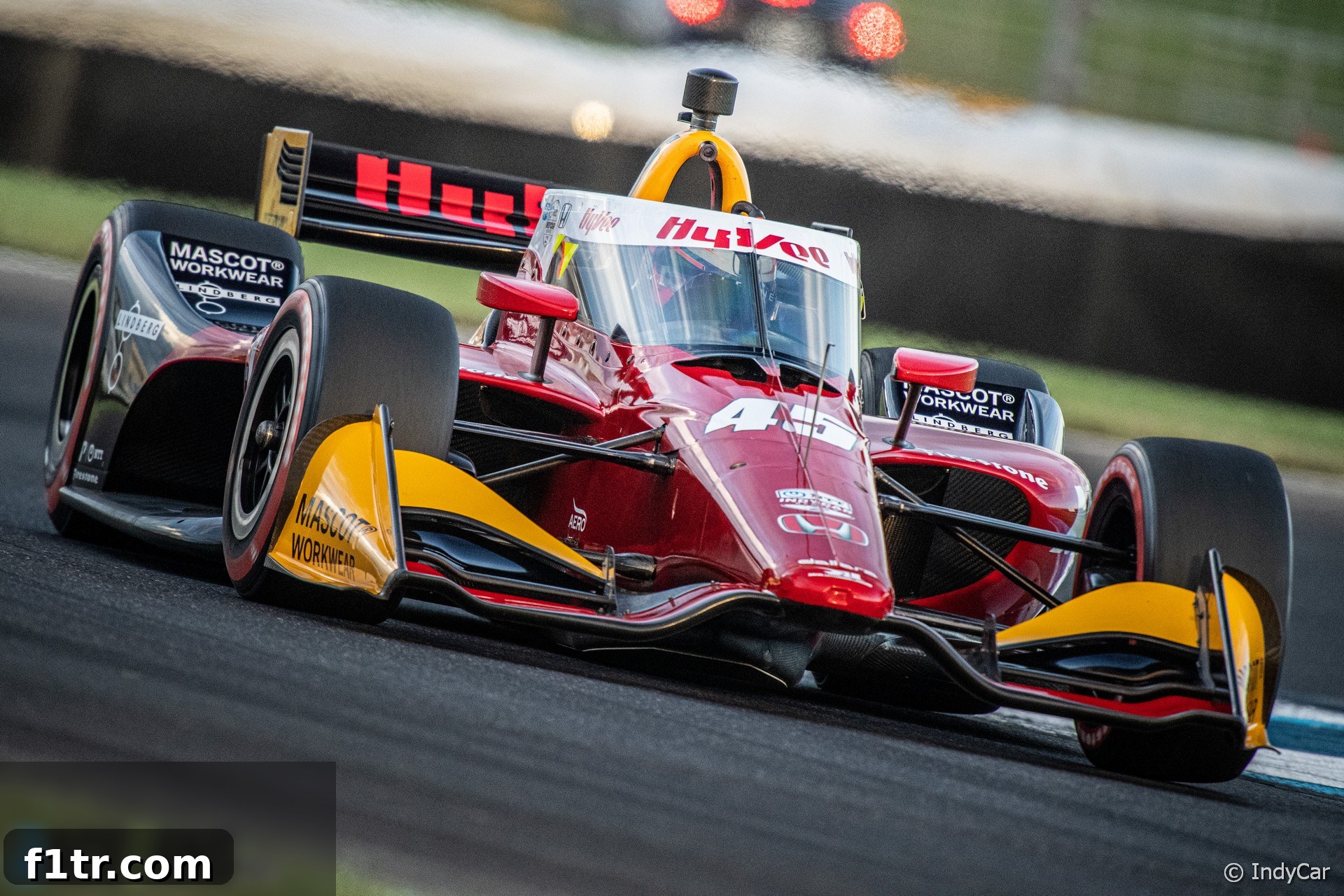
Christian Lundgaard, a rising star in the motorsport world, has articulated his profound attraction to the “pure racing” opportunities presented by IndyCar, following his landmark decision to sign with Rahal Letterman Lanigan (RLL). This strategic move, set to commence once his Formula 2 season concludes, marks a significant pivot in the career trajectory of the highly-touted Danish driver, as he seeks a fresh challenge and a vibrant competitive environment in North America’s premier open-wheel series.
Christian Lundgaard’s Transition: From Formula 2 Aspirations to IndyCar Realities
At just 20 years old, Christian Lundgaard, a valued member of the prestigious Alpine driver academy, found himself at a crucial juncture in his racing career. The traditional path to Formula 1, often seen as the ultimate goal for young talents in Europe, appeared increasingly congested and uncertain. Faced with limited viable options for progression beyond Formula 2, Lundgaard meticulously evaluated his future, exploring diverse avenues including sports car racing, before ultimately making the bold decision to transplant his ambitions to the United States and embrace the unique world of IndyCar.
His move mirrors that of fellow ex-Formula 2 competitor Callum Ilott, who has also successfully secured a full-time IndyCar seat for the upcoming season. With the grid for the 2022 Formula 1 season offering only a solitary vacant spot, Lundgaard anticipates a burgeoning trend of more European drivers from the F2 ranks considering IndyCar as a compelling and rewarding alternative. This shift underscores a broader re-evaluation of motorsport career pathways, highlighting IndyCar’s increasing allure as a destination for top-tier talent.
Christian Lundgaard’s impressive performance at the Indianapolis Motor Speedway road course, where he qualified on the second row despite battling food poisoning, was a testament to his raw talent and adaptability. This single-race appearance with RLL proved to be a pivotal moment, solidifying his decision to commit to the series full-time.
The Allure of “Pure Racing”: Why IndyCar Stands Out
Lundgaard passionately articulated his rationale for choosing IndyCar, emphasizing its unfiltered competitive spirit. “I’m sure there will be more European drivers coming over here, let’s say, pre-F1,” he stated. “Nowadays we’ve seen a lot of ex-F1 drivers come over, but I still believe that it’s something you can take as a step towards F1.” This perspective suggests that IndyCar isn’t just an alternative, but potentially a complementary or even preparatory stage for top-level open-wheel racing, even if F1 ultimately remains a distant goal for some.
He continued, highlighting the intrinsic appeal of the series: “For me the series is great. Looking at me and Callum, we’ve competed in F2, we know each other, and over here it’s pure racing. I like the racing over here, that’s what attracts me, the racing itself, so I’m definitely positive for next year.” The phrase “pure racing” encapsulates the essence of what draws drivers like Lundgaard: a focus on driver skill, intense on-track battles, and a level playing field without the overwhelming political or technological complexities often associated with other top-tier categories. The variety of circuits – from high-speed ovals to challenging road courses and demanding street circuits – further contributes to the series’ unique competitive landscape.
Bobby Rahal’s Perspective: IndyCar as Motorsport’s Golden Age Echo
Bobby Rahal, the esteemed team principal of Rahal Letterman Lanigan and a three-time CART champion with a brief Formula 1 stint in 1978, strongly echoes Lundgaard’s sentiments, offering a veteran’s insight into the fundamental differences between global motorsport series. Rahal profoundly believes that “IndyCar is what Formula 1 used to be, to a large degree.” This statement carries significant weight, implying a nostalgia for an era when F1 was perceived as more accessible and less burdened by external factors.
Rahal elaborated on this comparison, explaining, “Clearly we don’t have the politics. There’s a lot of things that don’t exist in the IndyCar paddock that exist in the Formula 1 paddock.” This candid assessment points to a more straightforward, driver-centric environment in IndyCar, where the focus remains squarely on the racing action rather than off-track machinations. The relatively open and friendly atmosphere within the paddock, coupled with a spec chassis rule that levels the playing field, ensures that driver talent remains the paramount factor in achieving success. This environment fosters genuine competition and promotes a camaraderie that can be less prevalent in other highly commercialized series.
The F2 Bottleneck and the IndyCar Solution
The conversation inevitably turned to the dilemma faced by many talented young drivers in Europe. Rahal keenly observed, “You look at how many really good guys are in F2 who maybe are frustrated now because they can’t make that next step, and yet they’ve kind of proven their abilities.” This highlights the significant bottleneck at the pinnacle of European single-seater racing. Despite showcasing immense potential and winning championships in junior categories, many F2 graduates find the path to Formula 1 blocked by a combination of limited seats, contractual obligations, and substantial financial requirements.
For these drivers, IndyCar presents a compelling and credible alternative. “If I’m a young guy in Europe I think the potential for my career is much greater here in IndyCar than it is there,” Rahal asserted. This perspective is gaining traction, as the series offers not only highly competitive racing but also a stable career path and a chance to compete against some of the world’s best drivers in equally matched machinery. The opportunity for a long and successful career in top-level motorsport is often more attainable in IndyCar than in the hyper-competitive and often short-lived F1 environment.
Rahal further predicted a broader trend: “I fully expect, as we once had a number of years ago where we had a number of Europeans and Brazilians in IndyCar racing, I see a greater representation from countries in Europe, countries in South America towards IndyCar.” This historical context adds depth to the current movement, suggesting a cyclical nature to talent migration in motorsport. As the global appeal of IndyCar continues to grow, fueled by thrilling races and accessible stars, it naturally attracts a more diverse international roster of drivers.
Lundgaard’s Debut: A Glimpse into the Future
Lundgaard’s potential in IndyCar was strikingly evident during his one-off appearance for RLL at the Indianapolis Motor Speedway road course. Despite the considerable challenge of adapting to a new car and series, and reportedly battling food poisoning, he qualified on the second row of the grid, impressively lining up alongside experienced ex-F1 driver and fellow IndyCar rookie Romain Grosjean. This stellar debut performance underscored his raw talent and quick adaptability, proving that his skills would translate seamlessly to American open-wheel racing. It was this initial experience that profoundly shaped his decision to fully commit to the series.
Reflecting on that pivotal moment and the series as a whole, Lundgaard echoed Rahal’s assessment with a youthful but profound understanding. “What IndyCar is now is probably what I would think F1 was before I was born,” said Lundgaard. “It’s the proper racing I want to do.” This statement speaks volumes about a younger generation’s perception of motorsport, where the emphasis on raw competition and driver skill trumps the perceived complexities of modern F1.
Rediscovering the “Spark” for Racing
Lundgaard shared a particularly poignant reflection on his rediscovered passion for racing: “I spoke to some drivers a few days ago that have been in IndyCar and they say here you come, you enjoy, you like driving. But [at] first, when you begin in Europe, you have the proper feeling of racing that you enjoy, but the more you do it you kind of die, the spirit die[s].” This speaks to a common sentiment among drivers who have experienced the intense, often stifling, pressures of the European ladder system.
In contrast, his experience in IndyCar reignited his love for the sport. “Where for me, over here, it just continues. That’s what I had when I came for the race in August, that this is just so different. It’s a complete new spark that just fired in me, and I wanted to continue with that.” This “new spark” is perhaps the most compelling reason for his move, highlighting a shift from the often-grueling grind of career progression to a joyous re-engagement with the fundamental act of racing. It’s a pursuit of genuine enjoyment and passion, away from the intense scrutiny and political maneuvering that can sometimes overshadow the sport.
With palpable excitement for his future, Lundgaard affirmed his conviction: “I think it will. I’m pretty sure it will. IndyCar is the place to be, and I’m perfectly happy with where I am with RLL.” This statement encapsulates his optimism and satisfaction with the direction of his career, suggesting that he has found not just a new series, but a new home for his racing ambitions. His journey represents a growing narrative in global motorsport, where IndyCar offers a vibrant and fulfilling alternative for drivers seeking pure competition and a renewed passion for the sport.
Exploring the World of IndyCar
IndyCar continues to captivate audiences and drivers alike with its thrilling races, diverse tracks, and competitive spirit. For those interested in delving deeper into the series and its dynamic landscape, further articles and insights are readily available.
- IndyCar driver McLaughlin cleared of injury after crashing through barrier at Barber
- Schumacher says his IndyCar feels like ‘an F2 car, just with better tyres’
- IndyCar “way faster than Formula 1” in some corners, says Grosjean
- FIA to award more F1 superlicence points to IndyCar drivers from 2026
- Schumacher to race full-time in IndyCar with RLL in 2026
Browse all IndyCar articles