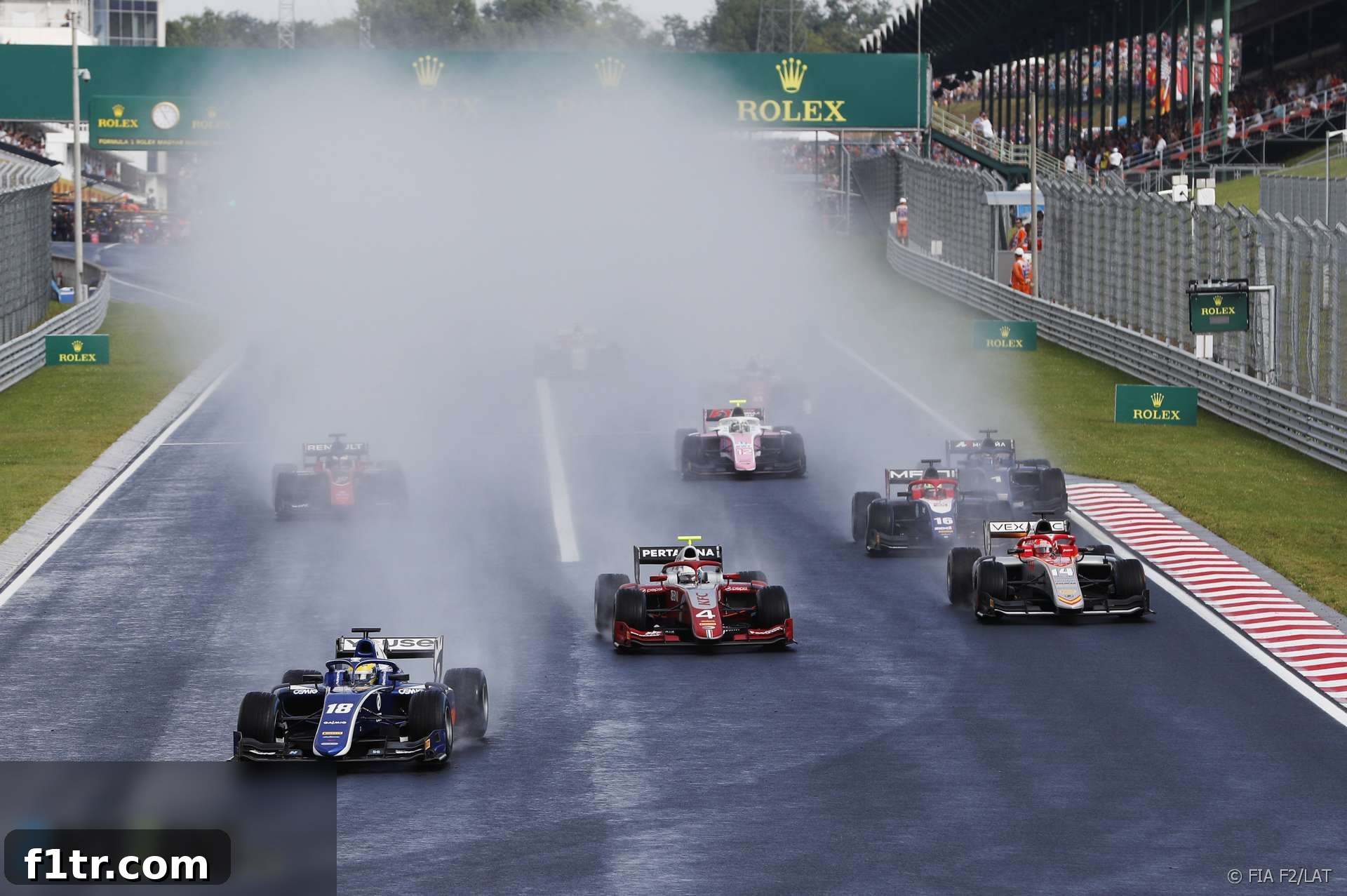
The Hungaroring, a circuit often dubbed ‘Monaco without the walls’ due to its tight, twisty nature, set the stage for a Formula Two feature race that delivered unprecedented drama, strategic genius, and heart-stopping wheel-to-wheel action. In a testament to raw talent and impeccable timing, Nyck de Vries emerged victorious, outmaneuvering Lando Norris in a captivating battle on a treacherously slippery track that progressively dried throughout the race, culminating in a triumph for Prema Racing.
This pivotal Hungarian round marked the two-thirds point of the intense F2 calendar, with 340 of the maximum 576 points already contested. Heading into the feature race, the championship standings were finely poised, with George Russell holding a substantial 37-point lead over Norris and Alexander Albon in third. However, yesterday’s qualifying had already sprung a surprise, as Sergio Sette Camara dramatically broke Russell’s impressive three-round streak of pole positions, securing the fastest lap and signaling that the weekend would be anything but predictable.
Advert | Become a Supporter & go ad-free
The pre-race atmosphere was thick with anticipation and trepidation. Thunderstorms during Formula One qualifying had drenched the Hungaroring, transforming it into a high-stakes lottery for the F2 drivers who, unlike their F1 counterparts, operate without the luxury of intermediate tyres, relying solely on slicks or full wets. Adding to the tension were persistent clutch issues plaguing the new F2 cars throughout the season, necessitating two rounds of rolling starts under the Safety Car and 100km of testing for each team. This led driver Jack Aitken to predict a “quite varied across the field” start under the new system, a prophecy that would soon prove accurate in spectacular fashion, injecting an unpredictable element into the initial race phase.
The drama began even before the lights went out. Championship leader George Russell was conspicuously absent from the grid, his ART car afflicted by mechanical problems that forced him to start from the pit lane – a crushing blow that relegated him from a promising second-row start. Following three cautious formation laps behind the Safety Car, the race director made the crucial decision to green-light a standing start, adding another layer of unpredictability to the already challenging conditions, demanding pinpoint precision from every driver.
When the lights finally extinguished, Sette Camara and De Vries launched off the line with exceptional starts, carving through the spray with precision and immediately establishing themselves at the front. In contrast, Aitken found himself dropping back to fourth, losing out to a surging Luca Ghiotto. Further down the field, Nirei Fukuzumi displayed remarkable skill, rocketing from eleventh to seventh position in the opening sector alone. However, the treacherous conditions quickly claimed their first victims. Gunther, Ralph Boschung, and Dorian Deletraz all suffered early damage, forcing them into immediate pit stops and leaving them forty seconds adrift of Alessio Lorandi at the tail of the main pack. It was a brutal reminder of the fine margins and unforgiving nature of wet racing.
ART’s challenging day continued as Lando Norris, displaying formidable pace and daring, began his relentless charge through the field. On lap five, he decisively overtook Aitken, setting his sights on the podium positions. What followed was a fierce wheel-to-wheel battle with Ghiotto for third, a duel Norris ultimately won before setting his sights on De Vries for second. With breathtaking speed, Norris was consistently lapping a full second faster than any other driver on the circuit, save for Russell, who was valiantly but futilely attempting to recover from nineteenth. By lap nine, Norris had slashed Sette Camara’s lead to less than one and a half seconds, his Carlin machine seemingly dancing on the edge of adhesion and finding grip where others struggled.
The very next lap saw Norris execute a truly gutsy maneuver around turn five, catching the Brazilian leader off guard and leaving him unable to defend. Norris, now lapping three seconds quicker than Sette Camara, effortlessly pulled away, establishing a commanding lead that seemed to solidify his control over the race, at least in the challenging wet phase. His performance was a masterclass in wet-weather driving, reminiscent of his dominant form in the earlier rounds of the season where he often appeared to be competing in a league of his own, a true prodigy in the making.
Go ad-free for just £1 per month>> Find out more and sign up
Despite the initial soaking conditions, a mandatory pit stop is a cornerstone of any F2 feature race. With no intermediate tyre option available and the rain having subsided, the focus dramatically shifted to strategy. Dry lines began to visibly emerge on the track by lap 11, pushing the full wet tyres beyond their optimal operating window and causing them to struggle with overheating and degradation. This season had already highlighted how uncomfortable F1 drivers, with their significantly higher downforce, were with wet or intermediate tyres in transitional conditions, making the F2 teams’ dilemma even more acute. When to switch to slicks became the million-dollar question, a gamble that could make or break a race, as the timing had to be absolutely perfect.
Lap 13 delivered another devastating blow to George Russell’s championship hopes. Despite showing flashes of pace in his crippled ART, he hadn’t managed to climb beyond the backmarkers. He was forced to pit and retire, explaining to his engineer that the car was simply “not possible to stop and too dangerous to drive,” underscoring the severity of his earlier mechanical issues. It was a bitter end to what had been a promising weekend, further illustrating the unpredictable and sometimes cruel nature of motorsport, even for a talent as bright as Russell’s.
By lap 14, an intense battle for second place had ignited between De Vries and Antonio Fuoco, the latter having skillfully navigated his way up the field from twelfth position, often following in Norris’s potent wake and showcasing impressive car control. With standing water still glinting in the ridges of the kerbs, the pit window for slick tyres was tentatively opening. Teams and drivers faced a crucial decision: risk an early switch to slicks, which would necessitate navigating a very restricted, narrow dry line, or endure the rapidly degrading and overheating full wets for longer, hoping the track would dry out sufficiently to make the gamble worthwhile. The tension on the pit wall was palpable, as every second and every strategic calculation counted.
Tadasuke Makino of Russian Time was the first to blink, boldly diving into the pits for slicks. As he exited, a dramatic rooster-tail spray erupted from the rear of his car, a clear indicator of the lingering dampness off the racing line. However, the immediate improvements in his lap times were undeniable, a welcome turn of events for a driver whose weekend had been marred by an early crash in free practice. His courageous decision would serve as a crucial benchmark for the other teams, subtly influencing their own strategy calls as they watched his times improve.
Lando Norris, still leading, opted for his mandatory pit stop on lap 17, a critical point in the race. He rejoined the race in third, behind only the wet-tyre-shod Fuoco and Latifi. Neither driver presented a significant obstacle to Norris, who quickly found his rhythm on the fresh rubber, returning to the dominant form he had showcased at the season’s outset. His speed and control were truly exceptional, and it seemed only a matter of time before he regained the lead, demonstrating his natural ability to adapt to changing track conditions.
However, the extreme limitations of the dry line became brutally apparent on lap 18 when Antonio Fuoco finally made his long-awaited pit stop. His exit was fraught with peril, nearly colliding with Sette Camara and being forced dramatically off the meticulously crafted dry racing line. The remainder of his lap was an exercise in pure survival, his car twitching and snapping on the damp sections, exhibiting what one observer eloquently described as “supermarket trolley qualities” even on the straights. Sean Gelael and Artem Markelov also endured dramatic excursions, visibly highlighting the stark difference in grip between the relatively damp sectors one and three, and the rapidly drying middle sector. These moments underscored the immense skill and bravery required to manage a car on the knife-edge between wet and dry conditions.
Despite the harrowing difficulties with grip, the on-track battles lost none of their intensity. A thrilling five-way fight for fourth position raged for several laps between Fuoco, Aitken, Albon, Merhi, and Fukuzumi, each driver pushing the limits of adhesion in a desperate bid for crucial championship points. The air was thick with competitive spirit, illustrating the relentless, unforgiving nature of Formula Two racing where every position is hard-earned.
Meanwhile, Nyck de Vries, who had been restored to second place following the various pit stops, began his relentless pursuit of Norris. He started seriously eating into the Carlin driver’s hard-won lead, consistently gaining half a second per lap. De Vries had already pulled an impressive nine-second gap ahead of Sette Camara in third, freeing him to unleash the full potential of his Prema machine in pursuit of the leader. This period of the race truly showcased Prema’s evolving speed as the track dried, a stark contrast to Carlin’s early wet-weather dominance, and signaled a significant shift in momentum.
Norris’s seemingly unassailable dominance from the wet phase of the race began to look increasingly fragile on lap 25 when De Vries’s teammate, Sean Gelael, started setting blisteringly fast sector times. Often not rated as the most reliable for sheer speed, Gelael’s performance was a clear indicator of how effectively the Prema team had adapted to the drying conditions. This resurgence culminated just three laps later, on lap 28, when Nyck de Vries executed a decisive overtaking maneuver on Norris, seizing the lead and turning the race on its head. It was a masterful move, demonstrating Prema’s strategic brilliance and De Vries’s composed aggression under immense pressure.
With no DRS available throughout the entire race, drivers were forced to rely solely on their skill, bravery, and judgment in pure wheel-to-wheel combat. Every overtake was a testament to who dared to push the absolute limits of the narrow, unforgiving dry lines. Alexander Albon, in a bold attempt to overtake Aitken for fifth, strayed onto the sopping wet runoff area, aquaplaning dramatically back onto the track. The unfortunate incident resulted in a collision with Merhi, who then capitalised on the chaos to overtake Albon, further highlighting the perilous nature of the drying track and the high stakes involved in every decision.
Advert | Become a RaceFans supporter andgo ad-free
By lap 29, De Vries had astonishingly extended his lead over Norris to a colossal seven seconds. Norris’s tyres were visibly degrading, his car sliding precariously, allowing his teammate Sette Camara to close in rapidly. Just a few laps prior, Norris had enjoyed a nearly twenty-second buffer over Sette Camara, a stark illustration of how quickly fortunes can change in Formula Two when tyre management becomes paramount and track conditions evolve.
Incredibly, until lap 31, George Russell remained the sole retirement of the race. However, drama struck again when Nicolas Latifi’s DAMS car ground to a halt on track, prompting the deployment of a Virtual Safety Car (VSC). This neutralised the final laps of the race, momentarily appearing to offer Norris a lucky escape as his second place, under full racing conditions, looked extremely threatened by the charging pack. The VSC period provided a brief respite, allowing drivers to gather their thoughts, but the action was far from over.
A swift retrieval of Latifi’s car meant racing resumed, and Norris immediately found himself struggling once more with his worn tyres. Tenth-placed Artem Markelov, meanwhile, was menacing Fukuzumi for ninth, both drivers desperate to overtake Ghiotto for the coveted reverse-grid pole position for tomorrow’s sprint race. Markelov, showing incredible late-race pace, managed to get the job done on the penultimate lap, swiftly moving past Fukuzumi and immediately setting his sights on Merhi, determined to gain every possible point.
As the final laps unfolded, Antonio Fuoco injected himself into the tense battle between the Carlin teammates for second place. With a daring move up the inside, he seized third position from Sette Camara, who had momentarily attempted to challenge his own teammate, Norris. Fuoco’s opportunistic move added another layer of excitement to an already thrilling conclusion, demonstrating his sharp race craft.
Norris looked seriously threatened by Fuoco’s relentless pressure right up until the very moment De Vries passed the chequered flag to claim a superb victory. In a dramatic twist, immediately after the race conclusion, Sette Camara collided with Fuoco, spinning the Italian’s car on track. For this post-race incident, Sette Camara was swiftly issued a 10-second penalty on the cool-down lap. This penalty tragically cost him a hard-fought podium, reinstating Fuoco to the third and final podium spot. It also meant that Sette Camara, despite his strong qualifying and early race performance, was left with barely a point from a race where he had started on pole – a cruel irony and a harsh lesson in maintaining composure.
Nyck de Vries’s triumphant drive not only earned him valuable championship points but also propelled him up the standings, solidifying his position as a serious title contender in the Formula Two championship. Lando Norris, despite a challenging end to the race, still managed to close the gap to championship leader George Russell to just 19 points, now standing at 151, keeping his title hopes very much alive with more races to come. Ralph Boschung ultimately secured the points for the fastest lap, clocking an impressive 1’32.473 on the penultimate go-round, a testament to his late-race pace and determination.
The podium ceremony saw a jubilant Nyck de Vries taking the top step, flanked by Lando Norris in second and Antonio Fuoco in third, a well-deserved reward after the post-race penalty. Aitken, Albon, and Ghiotto finished ahead of the penalised Sette Camara, who salvaged some points in seventh. Artem Markelov secured eighth position, granting him the coveted reverse-grid pole for the upcoming sprint race. Honda juniors Tadasuke Makino and Nirei Fukuzumi completed the top ten, rounding out a truly unforgettable and strategically complex Formula Two feature race at the Hungaroring, a spectacle that will long be remembered for its drama and brilliant driving.
Advert | Become a RaceFans supporter andgo ad-free
Formula Two
- Formula 2 to debut in Miami and Montreal after Iran war cancellations
- Ex-McLaren junior Dunne’s move to Alpine finally confirmed
- Schumacher says his IndyCar feels like ‘an F2 car, just with better tyres’
- The Formula 2 team with an older driver line-up than almost half the F1 grid
- FIA to award more F1 superlicence points to IndyCar drivers from 2026
Browse all Formula 2 articles