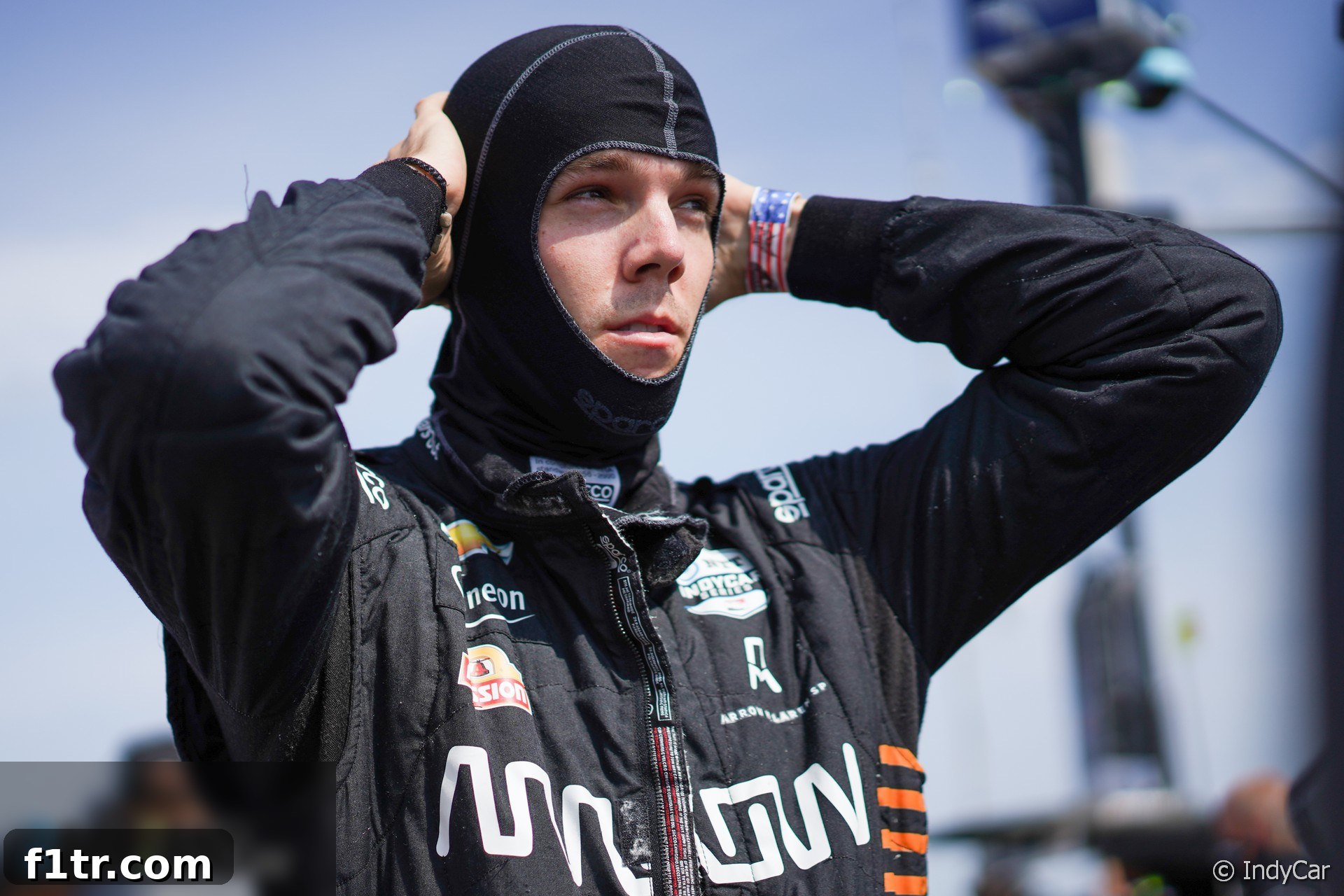
Oliver Askew Replaces Injured Felix Rosenqvist for Detroit Grand Prix Race 2
In a dramatic turn of events at the Detroit Grand Prix, rising talent Oliver Askew has been called upon to substitute for the injured Felix Rosenqvist in the second race of the weekend at the iconic Belle Isle street circuit. Rosenqvist’s participation was cut short after a severe crash during yesterday’s opening race, necessitating a last-minute driver change for the Arrow McLaren SP team.
Advert | Become a Supporter & go ad-free
Felix Rosenqvist’s High-Impact Crash and Recovery Update
The incident involving Felix Rosenqvist occurred yesterday during the challenging Detroit IndyCar opener on the Belle Isle track. The Swede experienced a heavy crash which not only brought his race to an abrupt halt but also caused a significant stoppage in the event. Following the impact, Rosenqvist was immediately transported to DMC Detroit Receiving Hospital, where he remained overnight for observation and evaluation.
Thankfully, his team, McLaren SP, provided a reassuring update this morning. In an official statement, they confirmed that an initial medical assessment revealed “no life or limb threatening injuries.” This news brought immense relief to the motorsport community, particularly given the visible severity of the impact. While still recovering, Rosenqvist is expected to be discharged from the hospital today, allowing him to begin his recuperation process.
The nature of the Belle Isle circuit, known for its unforgiving concrete walls and tight corners, often leads to high-consequence incidents. Rosenqvist’s crash served as a stark reminder of the inherent dangers in top-tier open-wheel racing, even as modern safety measures continue to advance. His swift recovery is paramount, and the team will undoubtedly prioritize his health above all else as they monitor his progress in the coming days and weeks.
Oliver Askew’s Unexpected Return to IndyCar Action
Stepping into the cockpit for Race 2 is Oliver Askew, marking an unexpected return to the IndyCar series for the young American driver. Askew made his IndyCar debut with McLaren SP just last year, showcasing flashes of his potential. However, his rookie season was not without its challenges. He endured a heavy impact in a crash during the prestigious Indy 500 earlier in the 2020 season, which later led to medical grounds forcing him to sit out two races on the road circuit at Indianapolis Motor Speedway late in the year.
Askew’s last appearance for the team came in the season finale at St Petersburg. Following the 2020 season, Askew ultimately lost his full-time place in the McLaren SP line-up to none other than Felix Rosenqvist during the off-season. This makes his sudden call-up to substitute for Rosenqvist a poignant moment, bringing his career full circle, albeit under unfortunate circumstances for his colleague.
His return presents a significant challenge. Askew will drive the car for the first time today during qualifying, with just over three hours separating that session from the start of the race. This compressed timeline leaves little room for adaptation, demanding immediate performance and concentration from a driver who hasn’t been in competitive IndyCar action for some time. Despite the pressure, it’s an invaluable opportunity for Askew to demonstrate his capabilities and remind the paddock of his talent and resilience.
Reunited with Pato O’Ward and the Mystery of the Crash
Oliver Askew’s return also means a reunion with his 2020 teammate, Pato O’Ward. The talented Mexican driver, who finished an impressive third in yesterday’s race after starting from pole position, was among the first to express concern and support for Rosenqvist. O’Ward spoke to reporters yesterday, offering his perspective on the incident and emphatically stating his belief that Rosenqvist was not to blame for his heavy crash at turn six.
“The main point for me today is Felix is okay,” a visibly relieved O’Ward shared with the media. “That was a nasty crash. Nothing he could have done there. He was just a passenger, it was out of his control.” O’Ward’s immediate assessment pointed towards a mechanical issue rather than a driver error, a sentiment echoed by many after reviewing the replays.
Video replays of the crash offered intriguing clues, indicating that Rosenqvist’s throttle appeared to be still open as his car sped towards the barrier. O’Ward elaborated on this observation: “He popped off the brake. If you see the replays, you hear it out, the engine just goes flat out. I know him. I’m pretty sure that wasn’t him doing that with his own throttle.” This suggests a potentially stuck throttle or another electronic or mechanical malfunction that prevented Rosenqvist from controlling the car.
The implications of such a failure are serious. O’Ward highlighted the critical nature of the crash location: “I feel for him. It sucks. If you think about it, if it [had] been in turn seven, turn three, that’s ugly. I really hope they find what caused it because that can be really bad. It was really ugly.” His concern underscores the potential for far worse outcomes on a street circuit like Belle Isle, where run-off areas are minimal. The team, along with IndyCar officials, will undoubtedly conduct a thorough investigation to determine the precise cause of the mechanical anomaly, ensuring such an incident is prevented in the future.
The close bond between IndyCar drivers was palpable in O’Ward’s comments. “I’m really happy he’s okay. We’re like brothers. I was definitely asking for updates,” he concluded, emphasizing the camaraderie and mutual respect within the competitive paddock. This incident highlights not only the physical demands but also the strong community spirit among those who push the limits of speed.
The Detroit Grand Prix: A Test of Skill and Endurance
The Detroit Grand Prix, hosted on the temporary street circuit of Belle Isle Park, is renowned as one of the most challenging and unforgiving events on the IndyCar calendar. Its bumpy surface, tight corners, and proximity to concrete barriers demand absolute precision and commitment from drivers. Race 2 promises another spectacle, with the added intrigue of Askew’s last-minute insertion into the field.
For Arrow McLaren SP, the focus for Race 2 will be multifaceted: ensuring Askew gets up to speed quickly, securing valuable championship points, and continuing to build on O’Ward’s strong performance in Race 1. The team will be working tirelessly to prepare the car and support Askew as he navigates the demanding track under intense pressure. This race weekend in Detroit serves as a microcosm of the entire IndyCar season – a blend of speed, strategy, unexpected challenges, and the unwavering spirit of competition.
Advert | Become a RaceFans supporter andgo ad-free
More IndyCar News and Updates
- IndyCar driver McLaughlin cleared of injury after crashing through barrier at Barber
- Schumacher says his IndyCar feels like ‘an F2 car, just with better tyres’
- IndyCar “way faster than Formula 1” in some corners, says Grosjean
- FIA to award more F1 superlicence points to IndyCar drivers from 2026
- Schumacher to race full-time in IndyCar with RLL in 2026
Browse all IndyCar articles