The 2018 Formula 1 Chinese Grand Prix delivered a captivating spectacle of strategic brilliance, raw speed, and dramatic overtakes. Amidst the twists and turns of the Shanghai International Circuit, Red Bull Racing’s Daniel Ricciardo emerged as the undisputed star, orchestrating a stunning charge from sixth on the grid to clinch a memorable victory. His triumph was underscored by setting the fastest lap of the race for the second time that year, a testament to his exceptional pace and the optimal performance of his car.
Ricciardo’s winning margin and the context of his fastest lap highlighted Red Bull’s formidable performance. His best time was an impressive two-thirds of a second quicker than any of his rivals from other teams, demonstrating a clear advantage in ultimate race pace when it mattered most. This dominance was a critical factor in his ability to carve through the field after a mid-race safety car provided an opportunistic pit stop for fresh tyres, catapulting him into contention for the lead.
Beyond Ricciardo’s heroics, the race was rich with strategic battles, particularly between the championship contenders, Mercedes and Ferrari. A pivotal moment unfolded during the pit stops, where Mercedes strategically outmaneuvered Ferrari to get Valtteri Bottas ahead of Sebastian Vettel. This decisive move was significantly aided by Bottas’s pit crew executing the fastest complete pit stop of the entire race, clocking in almost a full second quicker than Vettel’s. Such marginal gains underscore the immense importance of flawless team execution in modern Formula 1, where every millisecond counts and can directly influence the outcome of a battle for position.
Key Strategic Decisions and Pit Stop Dynamics
The efficiency of pit stops proved to be a critical differentiator throughout the Grand Prix. While Mercedes demonstrated surgical precision, other teams faced challenges. McLaren’s pit stops, for instance, were notably on the slower side. This conservative approach appeared to be a direct consequence of a recent incident involving an unsafe release of Stoffel Vandoorne’s car during practice sessions. The team prioritized safety, which unfortunately came at the cost of crucial time in the pits. Fernando Alonso, despite his exceptional race craft, recorded one of the slowest complete pit stops of the race, excluding Pierre Gasly’s stop, which included a mandated 10-second penalty for an earlier infringement.
However, Alonso’s resilience shone through, as he ended the race having gained the most places of any driver, climbing an impressive six positions from his starting grid slot. This highlights not just his skill in managing his tyres and executing overtakes on track, but also his ability to make the most of every opportunity despite potential setbacks from the pit lane. In contrast, Lance Stroll showcased an equally strong start, gaining six places on the very first lap alone. While an excellent initial burst, he ultimately struggled to maintain this momentum, losing two of those hard-fought positions by the checkered flag.
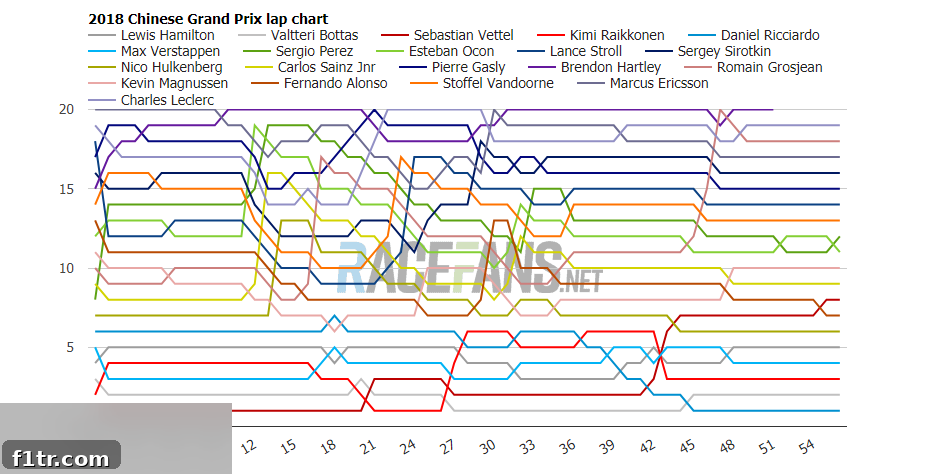
Understanding the intricacies of the 2018 Chinese Grand Prix requires a deep dive into the race’s core data. Below, we’ll explore various aspects of driver performance, strategic choices, and the minute-by-minute evolution of the race. While interactive charts are not present, we can analyze what such data typically reveals about a Formula 1 event.
(Note: Any post-race time penalties are not reflected in the immediate race statistics, focusing on on-track performance.)
Race Progression: Unveiling the Lap-by-Lap Story
Analyzing the lap-by-lap positions of each driver offers invaluable insights into the race’s narrative. A comprehensive lap chart would visually depict the ebb and flow of the competition, illustrating every overtake, every strategic pit stop, and how drivers gained or lost ground. Such a chart would be instrumental in identifying key moments where positions changed hands, whether due to on-track battles, errors, or crucial strategic calls that impacted a driver’s standing relative to their rivals.
Gaps and Pace: A Closer Look at Race Dynamics
Similarly, a race chart that illustrates the gaps between each driver relative to the leader’s average lap time provides a profound understanding of race pace and strategy. This data would highlight periods of strong performance, moments of struggle, and the effectiveness of different tyre compounds. Very large gaps are often omitted to maintain clarity, allowing focus on the core competitive battles. Such charts are critical for observing how safety cars compress the field, how pit stops alter strategic windows, and how drivers manage their tyres to either close in on or pull away from their competitors.
Position Change: A Summary of Driver Progress
The final positions often belie the journey drivers undertake during a Grand Prix. The following table clearly outlines how each driver’s starting position compares to their finish, detailing the gains or losses made from the grid and specifically on the chaotic first lap. This is crucial for evaluating a driver’s ability to capitalize on opportunities or recover from setbacks.
| Driver | Start position | Lap one position change | Race position change |
|---|---|---|---|
| Lewis Hamilton | 4 | -1 | 0 |
| Valtteri Bottas | 3 | 1 | 1 |
| Sebastian Vettel | 1 | 0 | -7 |
| Kimi Raikkonen | 2 | -2 | -1 |
| Daniel Ricciardo | 6 | 0 | 5 |
| Max Verstappen | 5 | 2 | 0 |
| Sergio Perez | 8 | -6 | -4 |
| Esteban Ocon | 12 | -1 | 1 |
| Lance Stroll | 18 | 6 | 4 |
| Sergey Sirotkin | 16 | 1 | 1 |
| Nico Hulkenberg | 7 | 0 | 1 |
| Carlos Sainz Jnr | 9 | 1 | 0 |
| Pierre Gasly | 17 | -2 | -1 |
| Brendon Hartley | 15 | -2 | -5 |
| Romain Grosjean | 10 | 1 | -7 |
| Kevin Magnussen | 11 | 1 | 1 |
| Fernando Alonso | 13 | 2 | 6 |
| Stoffel Vandoorne | 14 | -2 | 1 |
| Marcus Ericsson | 20 | 0 | 4 |
| Charles Leclerc | 19 | 1 | 0 |
The “Race position change” column reveals significant shifts. Fernando Alonso’s gain of six places stands out, showcasing his ability to recover and advance through the field. Conversely, Sebastian Vettel and Romain Grosjean both lost seven positions, indicating a particularly challenging race for them. Lance Stroll’s initial six-place gain on lap one, settling for a four-place gain by race end, still demonstrates a robust start from the back of the grid.
2018 Chinese Grand Prix Lap Times: Analyzing Driver Pace
Individual lap times are a fundamental measure of driver and car performance. A detailed chart of all drivers’ lap times (excluding very slow laps due to incidents or penalties) allows for a precise analysis of consistency, peak performance, and the effects of tyre degradation or fuel load changes throughout the race. Observing these patterns can highlight moments where drivers pushed exceptionally hard or conserved their tyres, offering another layer of insight into their race management strategies.
Fastest Laps: The Ultimate Speed Test
Beyond race completion, the fastest lap competition is a clear indicator of a car’s raw speed potential and a driver’s ability to extract maximum performance. Daniel Ricciardo’s quickest lap, a 1’35.785 on lap 55, not only secured him the bonus point but also underscored Red Bull’s blistering pace in the latter stages of the race. His teammate Max Verstappen was also remarkably quick, placing second, further cementing Red Bull’s speed advantage. Ferrari’s Kimi Raikkonen also demonstrated strong pace, rounding out the top three, while Mercedes’ Lewis Hamilton and Valtteri Bottas featured within the top six, indicating a highly competitive field at the sharp end.
| Rank | Driver | Car | Fastest lap | Gap | On lap |
|---|---|---|---|---|---|
| 1 | Daniel Ricciardo | Red Bull-TAG Heuer | 1’35.785 | 55 | |
| 2 | Max Verstappen | Red Bull-TAG Heuer | 1’36.206 | 0.421 | 50 |
| 3 | Kimi Raikkonen | Ferrari | 1’36.456 | 0.671 | 48 |
| 4 | Lewis Hamilton | Mercedes | 1’36.878 | 1.093 | 20 |
| 5 | Nico Hulkenberg | Renault | 1’36.881 | 1.096 | 56 |
| 6 | Valtteri Bottas | Mercedes | 1’36.987 | 1.202 | 50 |
| 7 | Fernando Alonso | McLaren-Renault | 1’37.234 | 1.449 | 56 |
| 8 | Romain Grosjean | Haas-Ferrari | 1’37.410 | 1.625 | 51 |
| 9 | Sebastian Vettel | Ferrari | 1’37.479 | 1.694 | 24 |
| 10 | Sergio Perez | Force India-Mercedes | 1’37.673 | 1.888 | 54 |
| 11 | Carlos Sainz Jnr | Renault | 1’37.754 | 1.969 | 54 |
| 12 | Esteban Ocon | Force India-Mercedes | 1’37.985 | 2.200 | 47 |
| 13 | Stoffel Vandoorne | McLaren-Renault | 1’38.137 | 2.352 | 54 |
| 14 | Kevin Magnussen | Haas-Ferrari | 1’38.152 | 2.367 | 54 |
| 15 | Pierre Gasly | Toro Rosso-Honda | 1’38.367 | 2.582 | 54 |
| 16 | Marcus Ericsson | Sauber-Ferrari | 1’38.386 | 2.601 | 52 |
| 17 | Lance Stroll | Williams-Mercedes | 1’38.500 | 2.715 | 54 |
| 18 | Sergey Sirotkin | Williams-Mercedes | 1’38.624 | 2.839 | 47 |
| 19 | Charles Leclerc | Sauber-Ferrari | 1’38.808 | 3.023 | 23 |
| 20 | Brendon Hartley”>Brendon Hartley | Toro Rosso-Honda | 1’39.376 | 3.591 | 50 |
2018 Chinese Grand Prix Tyre Strategies: The Game of Compounds
Tyre strategy is often the lynchpin of a successful Grand Prix performance. The Chinese Grand Prix featured a variety of approaches, with teams juggling the Ultra Soft, Soft, and Medium compounds. Many drivers, including the race winner Daniel Ricciardo and his teammate Max Verstappen, opted for a three-stint strategy, utilizing Ultra Softs for an aggressive start, followed by Mediums, and then Softs for a strong finish after the safety car reset the field. Others, like Valtteri Bottas and Kimi Raikkonen, settled for a two-stint race, maximizing the durability of the Soft and Medium compounds. The choice of compounds and the timing of pit stops were crucial for managing tyre degradation and optimizing track position, ultimately dictating the flow of the race for many.
| Stint 1 | Stint 2 | Stint 3 | |
|---|---|---|---|
| Daniel Ricciardo | Ultra soft (17) | Medium (14) | Soft (25) |
| Valtteri Bottas | Soft (19) | Medium (37) | |
| Kimi Raikkonen | Soft (27) | Medium (29) | |
| Lewis Hamilton | Soft (18) | Medium (38) | |
| Max Verstappen | Ultra soft (17) | Medium (14) | Soft (25) |
| Nico Hulkenberg | Ultra soft (13) | Medium (18) | Soft (25) |
| Fernando Alonso | Soft (29) | Medium (27) | |
| Sebastian Vettel | Soft (20) | Medium (36) | |
| Carlos Sainz Jnr | Ultra soft (12) | Medium (19) | Soft (25) |
| Kevin Magnussen | Soft (24) | Medium (32) | |
| Esteban Ocon | Soft (11) | Soft (20) | Ultra soft (25) |
| Sergio Perez | Ultra soft (12) | Soft (20) | Soft (24) |
| Stoffel Vandoorne | Soft (22) | Medium (34) | |
| Lance Stroll | Soft (23) | Medium (33) | |
| Sergey Sirotkin | Soft (28) | Medium (5) | Soft (23) |
| Marcus Ericsson | Soft (29) | Medium (27) | |
| Romain Grosjean | Ultra soft (16) | Medium (30) | Ultra soft (10) |
| Pierre Gasly | Medium (20) | Soft (11) | Ultra soft (25) |
| Charles Leclerc | Soft (21) | Medium (35) | |
| Brendon Hartley | Ultra soft (10) | Medium (20) | Soft (21) |
Pit Stop Times: The Race Against the Clock
The speed and efficiency of pit stops can make or break a driver’s race. A quick stop can elevate a driver, while a slow one can erase hard-earned track position. Valtteri Bottas’s Mercedes crew demonstrated this perfectly with the fastest pit stop of 22.097 seconds, directly contributing to his strategic gain over Sebastian Vettel. The pit stop times illustrate the fine margins involved, with teams vying to shave off every tenth of a second. Conversely, Pierre Gasly’s extended stop of 34.650 seconds, which included a 10-second penalty, shows the severe impact such delays can have on a race outcome. McLaren’s consistently slower pit times for drivers like Fernando Alonso and Stoffel Vandoorne, compared to the frontrunners, underscore the areas where teams seek continuous improvement.
| Driver | Team | Pit stop time | Gap | On lap | |
| 1 | Valtteri Bottas | Mercedes | 22.097 | 19 | |
| 2 | Sergio Perez | Force India | 22.334 | 0.237 | 32 |
| 3 | Lewis Hamilton | Mercedes | 22.464 | 0.367 | 18 |
| 4 | Max Verstappen | Red Bull | 22.596 | 0.499 | 31 |
| 5 | Esteban Ocon | Force India | 22.637 | 0.540 | 31 |
| 6 | Lance Stroll | Williams | 22.661 | 0.564 | 23 |
| 7 | Daniel Ricciardo | Red Bull | 22.691 | 0.594 | 31 |
| 8 | Max Verstappen | Red Bull | 22.715 | 0.618 | 17 |
| 9 | Sergey Sirotkin | Williams | 22.723 | 0.626 | 33 |
| 10 | Marcus Ericsson | Sauber | 22.785 | 0.688 | 29 |
| 11 | Sergio Perez | Force India | 22.856 | 0.759 | 12 |
| 12 | Kimi Raikkonen | Ferrari | 22.913 | 0.816 | 27 |
| 13 | Kevin Magnussen | Haas | 22.973 | 0.876 | 24 |
| 14 | Romain Grosjean | Haas | 22.981 | 0.884 | 16 |
| 15 | Sebastian Vettel | Ferrari | 23.009 | 0.912 | 20 |
| 16 | Daniel Ricciardo | Red Bull | 23.042 | 0.945 | 17 |
| 17 | Carlos Sainz Jnr | Renault | 23.117 | 1.020 | 31 |
| 18 | Brendon Hartley | Toro Rosso | 23.172 | 1.075 | 10 |
| 19 | Esteban Ocon | Force India | 23.281 | 1.184 | 11 |
| 20 | Nico Hulkenberg | Renault | 23.297 | 1.200 | 31 |
| 21 | Charles Leclerc | Sauber | 23.392 | 1.295 | 21 |
| 22 | Nico Hulkenberg | Renault | 23.654 | 1.557 | 13 |
| 23 | Sergey Sirotkin | Williams | 23.716 | 1.619 | 28 |
| 24 | Stoffel Vandoorne | McLaren | 23.730 | 1.633 | 22 |
| 25 | Romain Grosjean | Haas | 23.735 | 1.638 | 46 |
| 26 | Carlos Sainz Jnr | Renault | 23.935 | 1.838 | 12 |
| 27 | Pierre Gasly | Toro Rosso | 23.950 | 1.853 | 20 |
| 28 | Brendon Hartley | Toro Rosso | 24.070 | 1.973 | 30 |
| 29 | Fernando Alonso | McLaren | 24.110 | 2.013 | 29 |
| 30 | Pierre Gasly | Toro Rosso | 34.650 | 12.553 | 31 |
2018 Chinese Grand Prix – Further Insights
The 2018 Chinese Grand Prix stands as a classic example of how a combination of raw driver talent, brilliant strategy, and a timely safety car can dramatically alter the course of a race. Daniel Ricciardo’s victory was a masterclass in aggressive yet controlled driving, perfectly capitalizing on Red Bull’s strategic acumen. The race also highlighted the critical role of pit stop execution and tyre management in the tight confines of modern Formula 1. Each element, from fastest laps to position changes and tyre choices, contributed to a richly detailed narrative that captivated fans and provided ample data for post-race analysis.
- Top ten pictures from the 2018 Chinese Grand Prix
- Ricciardo denies Bottas a badly-needed win
- 2018 Chinese Grand Prix Star Performers
- Hamilton breaks Raikkonen’s record for consecutive points finishes
- Paddock Diary: Chinese Grand Prix day four
Browse all 2018 Chinese Grand Prix articles