The 2024 Formula 1 Japanese Grand Prix kicked off under overcast skies and cool conditions at the iconic Suzuka International Racing Course, marking a rare April appearance for this beloved event. The challenging figure-of-eight circuit, renowned for its high-speed corners like the Esses and 130R, once again promised an exhilarating weekend of racing. From the very outset of the first free practice session (FP1), it was clear that Red Bull Racing, with their formidable RB20, intended to continue their dominant run. Reigning world champion Max Verstappen wasted no time asserting his authority, posting the quickest time in a session that was punctuated by unexpected drama.
Advert | Become a Supporter & go ad-free
Verstappen Leads Red Bull’s Charge as Perez Shows Strong Pace
Max Verstappen, fresh off a powerful start to the 2024 season, immediately showcased why he is the benchmark in Formula 1. Navigating the demanding Suzuka circuit with characteristic precision and aggression, he set a blistering pace of 1’30.056. This impressive lap time placed him comfortably at the top of the leaderboard, signaling Red Bull’s strong intent for the weekend. The efficiency and balance of the RB20 around Suzuka’s fast, flowing corners appeared unmatched, allowing Verstappen to extract maximum performance with apparent ease. His performance underscores Red Bull’s continued supremacy, especially at a track that rewards aerodynamic excellence and driver skill and has historically been a stronghold for the team.
Crucially for Red Bull, Verstappen was not alone in demonstrating the team’s strength. His teammate, Sergio Perez, delivered a highly competitive performance, finishing just under two tenths of a second behind the Dutchman with a 1’30.237. Perez’s strong showing indicates that Red Bull possess a robust package capable of challenging at the very front with both cars, a critical factor for their Constructors’ Championship campaign. This early demonstration of pace from both drivers paints a formidable picture for the Austrian squad, suggesting they will be difficult to beat over the course of the Japanese Grand Prix weekend.
Hot on the heels of the Red Bulls was Carlos Sainz Jnr, who continued his impressive form for Ferrari, securing third fastest with a time of 1’30.269. Sainz, a winner at the previous Grand Prix, proved that Ferrari are genuine contenders, particularly given their recent strategic improvements and overall car development. His ability to split the Red Bulls on occasion and maintain pressure on them will be vital for Ferrari’s hopes. The tightly packed times at the top suggest that while Red Bull holds an initial advantage, the competitive landscape behind them remains vibrant and unpredictable, promising an intense battle for the podium.
Sargeant’s Costly Crash Triggers Red Flag and Williams Concerns
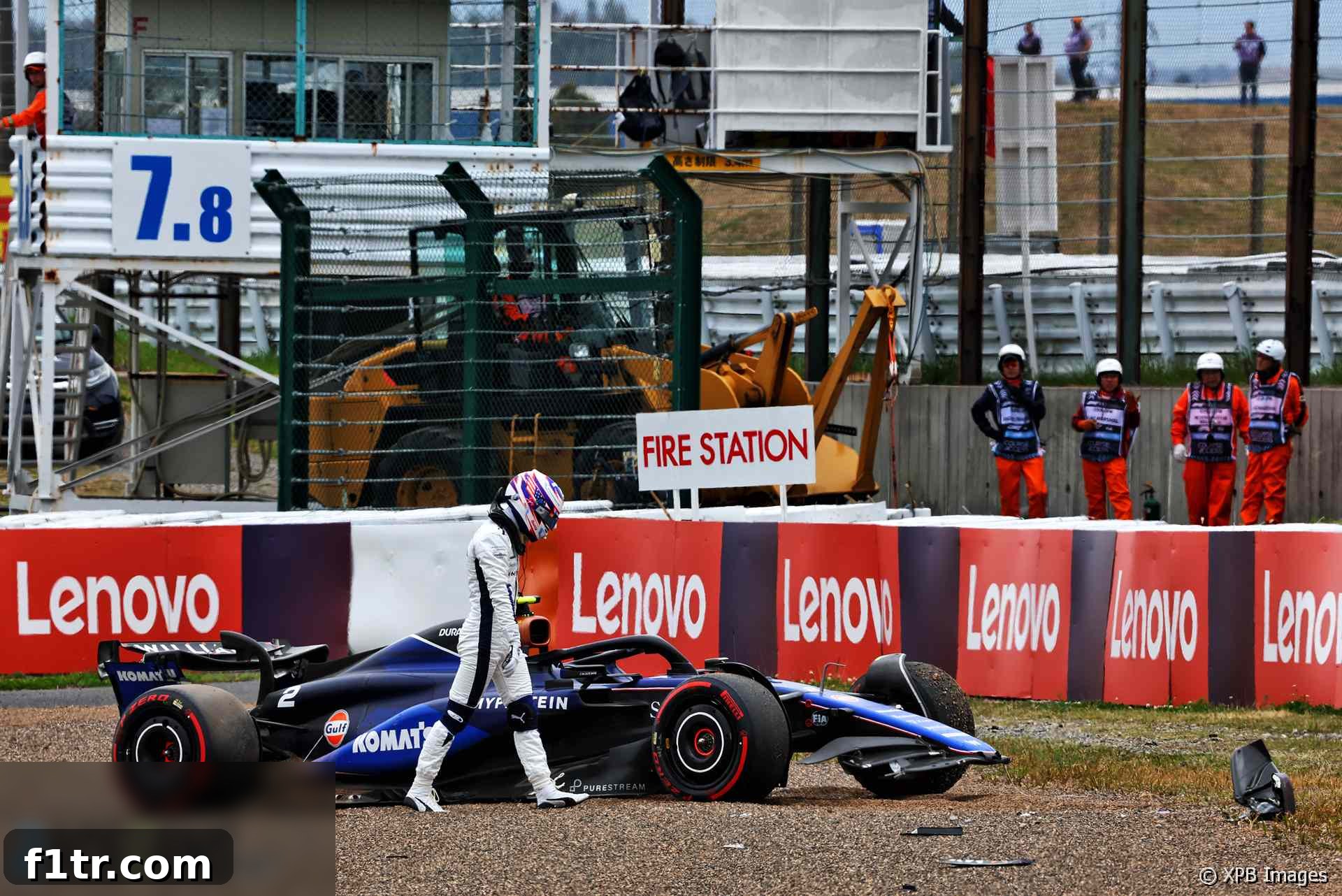
The session, however, was overshadowed by a significant incident involving Logan Sargeant. The American driver suffered a dramatic crash that brought the practice session to a halt under a red flag. Sargeant ran wide at the notoriously challenging Dunlop Curve, a high-speed left-hander that demands precision, losing control as he touched the grass. The resulting spin sent his Williams FW46 veering into the barriers, causing substantial damage to both the front and rear of the car. This incident not only cut short his session after just ten laps but also raised serious concerns for the Williams Racing team, whose season has already seen its share of challenges.
The crash is particularly problematic for Williams, who are already grappling with a severe shortage of spare chassis. Just two weeks prior, at the Australian Grand Prix, Alexander Albon had a major accident, leaving the team without a spare chassis for the current racing season. Sargeant’s latest mishap exacerbates this precarious situation, potentially leaving Williams in a difficult position should further damage occur during the remainder of the Japanese Grand Prix weekend. The financial and logistical strain of such incidents, especially for a smaller team like Williams, cannot be overstated. It places immense pressure on the mechanics to perform repairs efficiently and on the drivers to avoid any further costly errors, highlighting the brutal realities of Formula 1’s budget and operational constraints.
The red flag period, lasting approximately ten minutes, interrupted the flow for all teams, forcing a pause in their testing programmes and tire evaluation. While an inconvenience for some, for others, it provided a brief respite to review data and adjust strategies for the remaining twenty minutes of the session. Such interruptions are a common feature of practice sessions, yet their timing can significantly impact a team’s ability to gather crucial setup information, especially at a complex circuit like Suzuka where optimal car balance is paramount.
Early Highlights and Mid-Session Developments
The Suzuka circuit offered a unique atmosphere for the first Grand Prix session held here in April, with the cooler temperatures and overcast skies presenting different challenges compared to the usual autumn fixture. These conditions meant teams had to adapt their tire management and car setups accordingly, with graining and thermal degradation being critical considerations. The cooler track temperatures often translate to less grip initially but can also allow for more aggressive pushing on certain compounds, offering a different dynamic for tire strategy throughout the weekend.
A notable appearance in FP1 was that of Red Bull junior driver Ayumu Iwasa, who took over Daniel Ricciardo’s RB car. For Iwasa, a highly-rated Japanese talent, this was a dream opportunity to drive on home soil in a Formula 1 session, in front of his home crowd. Despite a slight delay at the start while mechanics finalised adjustments, he was able to complete a comprehensive programme, gaining invaluable experience and impressing with his composed performance. He finished 16th overall, a commendable effort for a rookie in his first official F1 outing, showing his potential and providing valuable data for the RB team.
Lewis Hamilton showcased an early glimpse of Mercedes’ potential, emerging as the quickest driver at the midpoint of the session. He was the first, and for a period, the only driver to complete a meaningful lap on the soft tyres, pushing the limits of the W15. His early pace suggested that Mercedes might be finding a more stable platform for their car, a sentiment that the team has been keen to emphasize recently. However, his strong run was soon followed by the red flag caused by Sargeant’s crash, which unfortunately disrupted many teams’ soft tire runs, including those of McLaren, potentially affecting their final positions.
Post-Red Flag Sprint and Final Standings
When the session resumed with just under 20 minutes remaining, there was a flurry of activity as teams scrambled to complete their planned programmes, focusing primarily on soft tire runs to simulate qualifying pace. It was in this crucial final segment that Max Verstappen once again demonstrated his class, consolidating his position at the top with his dominant 1’30.056 lap. This final run cemented his advantage over the field, confirming Red Bull’s initial supremacy at Suzuka and setting a formidable benchmark for the competitors.
The final standings saw Verstappen leading a Red Bull 1-2, with Sergio Perez securing second place, just 0.181 seconds adrift. This strong team performance provides Red Bull with an excellent foundation for the rest of the weekend. Carlos Sainz Jnr continued to shine for Ferrari, taking third place and proving the Scuderia’s competitiveness. The Mercedes duo of George Russell and Lewis Hamilton followed, securing fourth and fifth positions respectively, indicating an improved understanding of their W15 and a potentially closer fight with Ferrari as the weekend progresses.
Ferrari’s Charles Leclerc finished sixth, closely followed by veteran Fernando Alonso in his Aston Martin in seventh. Alonso, ever the master of Suzuka, managed to extract maximum performance from his AMR24, highlighting the consistent strength of the Aston Martin package on challenging tracks. The gap between the top seven drivers was remarkably tight, underscoring the competitive nature of the field and promising an exciting battle for pole position and race victory in the upcoming sessions.
Midfield Battles and Lap Count Insights
The McLaren pair, who had shown exceptional qualifying pace at Suzuka in the previous year’s event, found themselves further down the order in FP1. Their initial soft tire runs, which often reveal a car’s true single-lap potential, were unfortunately compromised by Logan Sargeant’s crash. Oscar Piastri managed to secure eighth place, with Lando Norris completing the top 10. The disruption suggests McLaren might have more pace in hand than the timesheets reveal, and they will undoubtedly be looking to maximize their performance in subsequent sessions, particularly qualifying, to challenge for higher grid positions.
The top ten was rounded out by Yuki Tsunoda in his RB car, securing ninth place. Tsunoda, a local hero, consistently performs well at his home Grand Prix, and his strong showing in FP1 bodes well for RB. Ayumu Iwasa, in the sister RB, finished 16th, a respectable position for his maiden F1 free practice outing, having completed 22 laps and gaining valuable experience on one of the sport’s most demanding circuits.
Lap counts provide an interesting insight into team programmes and session disruptions. Unsurprisingly, Logan Sargeant completed the fewest laps, just ten before his accident, significantly hindering his data gathering for the crucial Suzuka weekend. Among drivers who completed the entire session, Lance Stroll had the fewest with 17 laps, despite his Aston Martin carrying new development parts which would typically require more running time for evaluation. In contrast, Lewis Hamilton, Oscar Piastri, and Pierre Gasly were among the busiest drivers, each completing an impressive 23 laps. Their high lap counts suggest successful and uninterrupted data collection programmes, crucial for fine-tuning car setups for the demanding Suzuka circuit and optimizing performance for qualifying and the race.
Hulkenberg’s Pit Exit Incident and Other Notable Mentions
In a minor incident that caught the attention of race control, Nico Hulkenberg received a black-and-white warning flag. The Haas driver was penalized for crossing the white pit exit line while simultaneously overtaking Yuki Tsunoda as they joined the track. This type of infringement, though often minor, is taken seriously by race stewards to ensure safety and fair play during track entry and exit procedures. Hulkenberg’s swift warning serves as a reminder to all drivers about the strict adherence required to track limits and procedural rules, which are meticulously enforced in Formula 1.
Other teams and drivers focused on various test items, from aerodynamic evaluations to tire compound comparisons. Esteban Ocon, Alexander Albon, Valtteri Bottas, Guanyu Zhou, and Kevin Magnussen all completed their programs, gathering essential data for their respective teams in preparation for the remainder of the Japanese Grand Prix weekend. The competitive nature of the midfield ensures that every tenth of a second and every piece of data collected in practice can be crucial for unlocking performance and improving their standing in a tightly contested field.
Advert | Become a RaceFans supporter andgo ad-free
2024 Japanese Grand Prix First Practice Result – Detailed Analysis
The complete results from the first free practice session at Suzuka offer a comprehensive overview of the pecking order and individual performances. Max Verstappen’s commanding lead, coupled with Sergio Perez’s strong P2, underscores Red Bull’s formidable start. Ferrari’s robust presence with Carlos Sainz Jnr in third and Charles Leclerc in sixth highlights their consistent threat. Mercedes, with George Russell and Lewis Hamilton in fourth and fifth respectively, appear to be making steady progress with their W15 package. The table below provides the full breakdown of times, gaps, and lap counts, allowing for a detailed examination of each driver’s performance in this crucial opening session.
| P. | # | Driver | Team | Model | Time | Gap | Laps |
|---|---|---|---|---|---|---|---|
| 1 | 1 | Max Verstappen | Red Bull-Honda RBPT | RB20 | 1’30.056 | 18 | |
| 2 | 11 | Sergio Perez | Red Bull-Honda RBPT | RB20 | 1’30.237 | 0.181 | 18 |
| 3 | 55 | Carlos Sainz Jnr | Ferrari | SF-24 | 1’30.269 | 0.213 | 20 |
| 4 | 63 | George Russell | Mercedes | W15 | 1’30.530 | 0.474 | 18 |
| 5 | 44 | Lewis Hamilton | Mercedes | W15 | 1’30.543 | 0.487 | 23 |
| 6 | 16 | Charles Leclerc | Ferrari | SF-24 | 1’30.558 | 0.502 | 18 |
| 7 | 14 | Fernando Alonso | Aston Martin-Mercedes | AMR24 | 1’30.599 | 0.543 | 20 |
| 8 | 81 | Oscar Piastri | McLaren-Mercedes | MCL38 | 1’31.165 | 1.109 | 23 |
| 9 | 22 | Yuki Tsunoda | RB-Honda RBPT | 01 | 1’31.230 | 1.174 | 20 |
| 10 | 4 | Lando Norris | McLaren-Mercedes | MCL38 | 1’31.240 | 1.184 | 22 |
| 11 | 31 | Esteban Ocon | Alpine-Renault | A524 | 1’31.935 | 1.879 | 19 |
| 12 | 23 | Alexander Albon | Williams-Mercedes | FW46 | 1’31.943 | 1.887 | 18 |
| 13 | 27 | Nico Hulkenberg | Haas-Ferrari | VF-24 | 1’31.958 | 1.902 | 19 |
| 14 | 77 | Valtteri Bottas | Sauber-Ferrari | C44 | 1’32.054 | 1.998 | 17 |
| 15 | 18 | Lance Stroll | Aston Martin-Mercedes | AMR24 | 1’32.055 | 1.999 | 17 |
| 16 | 40 | Ayumu Iwasa | RB-Honda RBPT | 01 | 1’32.103 | 2.047 | 22 |
| 17 | 10 | Pierre Gasly | Alpine-Renault | A524 | 1’32.277 | 2.221 | 23 |
| 18 | 24 | Zhou Guanyu | Sauber-Ferrari | C44 | 1’32.638 | 2.582 | 18 |
| 19 | 20 | Kevin Magnussen | Haas-Ferrari | VF-24 | 1’32.803 | 2.747 | 21 |
| 20 | 2 | Logan Sargeant | Williams-Mercedes | FW46 | 1’33.204 | 3.148 | 10 |
Advert | Become a RaceFans supporter andgo ad-free
Further Coverage of the 2024 Japanese Grand Prix
For more in-depth analysis and the latest updates on the 2024 Japanese Grand Prix, explore the linked articles below. Stay informed on team strategies, driver performances, and all the behind-the-scenes action from Suzuka.
- “Am I in a race here or what?”: How Ferrari aced their Suzuka strategies
- Suzuka showed Mercedes “have a more stable platform” now
- Ferrari’s strategy gains in 2024 are “purely down to the car” – Sainz
- Tsunoda ‘at Verstappen and Alonso’s level’ with Suzuka performance – Marko
- Japan was first race where Red Bull’s winning margin was bigger than last year
Browse all 2024 Japanese Grand Prix articles