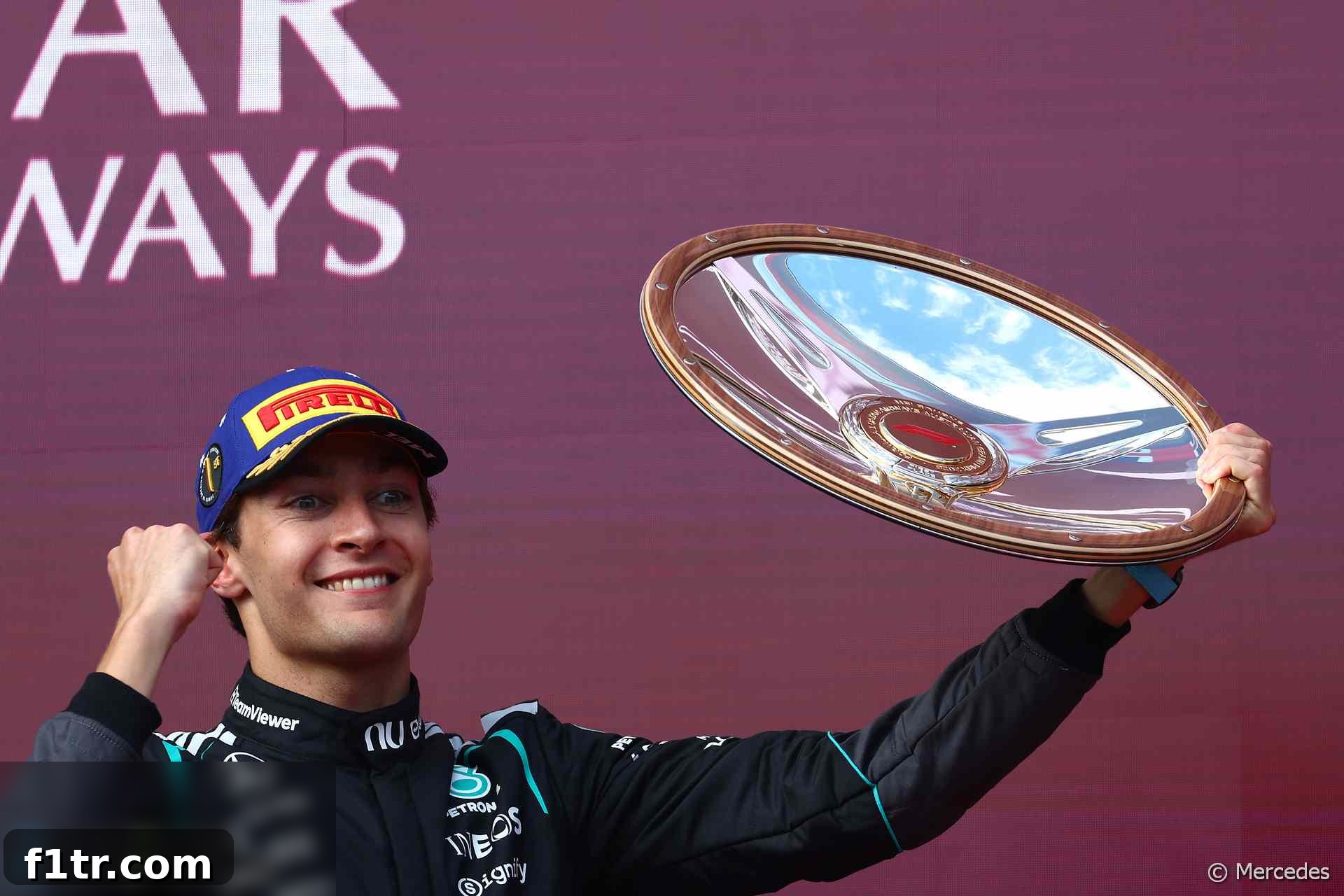
The Australian Grand Prix recently delivered a captivating spectacle, marked by significant milestones and the potential dawn of a new era in Formula 1. At the heart of this excitement was George Russell, whose commanding victory not only propelled him to the top of the Drivers’ Championship standings for the very first time in his illustrious career but also ignited discussions about his potential path to a world title.
Russell’s Ascent: Leading the Championship Pack
Russell’s triumph in Australia wasn’t just another race win; it was a statement. This achievement places him in a unique echelon of Formula 1 drivers, becoming only the 68th individual in the 77-year history of the world championship to lead or share the lead of the points standings. While a substantial number, it’s a slightly smaller, more exclusive group that has yet to convert that early lead into a coveted world championship title. For now, Russell belongs to this contingent, poised on the brink of what could be a career-defining season.
In the current competitive landscape, George Russell joins an interesting mix of drivers who have tasted the lead but not yet the ultimate glory. Alongside established champions like Lewis Hamilton, Max Verstappen, Fernando Alonso, and Lando Norris, the grid features other talents who have previously led the points standings: Oscar Piastri, Charles Leclerc, and Valtteri Bottas. Each of these drivers represents a narrative of ambition and potential, with their past championship leads serving as a reminder of their capabilities and the unforgiving nature of the sport. Valtteri Bottas, for instance, famously led the championship during his tenure at Mercedes, notably in 2020, demonstrating his raw speed and consistency before ultimately yielding to his then-teammate Hamilton.
Russell’s impressive Australian weekend kicked off with the ninth pole position of his career. While Formula One Management’s official records might discount his 2022 Brazilian Grand Prix pole position from his grand prix win statistics, the sheer achievement of securing a pole position underscores his growing prowess. The subsequent victory marked his sixth Grand Prix win, placing him alongside a remarkable group of racers who have also achieved six victories. This list includes a formidable array of names such as Sergio Perez (who made a strong return to the grid after a year’s hiatus), as well as legendary figures from F1’s past like Tony Brooks, John Surtees, Jochen Rindt, Gilles Villeneuve, Jacques Laffite, Riccardo Patrese, and Ralf Schumacher. Russell’s inclusion in such esteemed company firmly solidifies his status as a formidable force in contemporary Formula 1, further hinting at his potential for future championship glory.
Mercedes’ Resurgence and Historical Battles
The Australian Grand Prix also heralded a significant resurgence for Mercedes-AMG Petronas F1 Team. The team secured a spectacular one-two finish, with rookie sensation Andrea Kimi Antonelli equalling the best result of his short career by clinching second place. This impressive performance marked Mercedes’ 61st one-two finish in Formula 1 history, a testament to their enduring excellence and engineering brilliance.
Following a challenging four-year period under the previous regulatory framework, Mercedes’ return to winning ways appears to be perfectly timed. Their recent triumphs are crucial in preventing Red Bull Racing from completely overhauling their historical victory tally. At the beginning of the 2022 season, Mercedes boasted 124 victories compared to Red Bull’s 75. However, Red Bull’s dominance in recent years narrowed this gap considerably, reaching a critical point of 131-130 by the close of the last season. With their recent success, Mercedes has managed to pull two wins clear, pushing the count to 133-130. Despite this positive shift, the German constructor still faces a considerable journey to catch McLaren, who hold 203 victories, and the sport’s unparalleled record-holders, Ferrari, with a staggering 248 Grand Prix wins. The battle for historical supremacy remains a compelling narrative within the sport.
In a parallel statistical battle, Mercedes’ record for the most front-row lock-outs was precariously close to Ferrari’s prior to the Australian weekend. With their strong qualifying performance, Mercedes extended their lead to 85 front-row lock-outs compared to Ferrari’s 83, further cementing their legacy in one-lap pace and strategic advantage. These statistical benchmarks not only highlight the intense competition at the pinnacle of motorsport but also underscore Mercedes’ relentless pursuit of excellence and their unwavering commitment to reclaiming their position at the forefront of Formula 1.
Driver Numbers, Debutants, and Evolving Regulations
The Australian Grand Prix also brought attention to intriguing developments concerning driver numbers, a relatively new tradition in Formula 1. Two prominent drivers, Lando Norris and Max Verstappen, showcased new numbers on their cars. Norris, as the reigning world champion, proudly sported the number one. This convention, allowing the world champion to use the prestigious number one plate, has been a cherished tradition in Formula 1 since the 1970s, symbolizing their reign at the summit of the sport. His choice continued a long line of champions who have adorned their cars with this iconic digit.
Max Verstappen, on the other hand, made history by becoming the first driver to change his permanent career number since the current rules were introduced in 2014. Opting for the number three, Verstappen’s decision was a significant talking point. Interestingly, this number was famously adopted by Daniel Ricciardo when the permanent number regulations first came into effect, and he carried it with distinction until his temporary departure from the F1 grid two years prior. Verstappen’s switch adds another layer to the narrative of driver identity and the evolving traditions within Formula 1.
The race also saw a remarkable debut from Arvid Lindblad, who scored a superb eighth place, securing valuable points for his team. At 18 years and 212 days old, Lindblad became the third-youngest driver in F1 history to score points on debut. The record for this achievement remains firmly with Max Verstappen, who was an astonishing 17 years old when he first achieved points-scoring success. Verstappen’s record gained an almost unbreakable status when the FIA subsequently introduced a minimum age limit of 18 for Formula 1 drivers. However, recent developments have seen the governing body agree to relax that limit for 17-year-olds in special circumstances, opening a potential pathway for future young talents to challenge existing records. This demonstrates the dynamic nature of F1 regulations, always balancing safety with the desire to foster emerging talent.
Adding another layer of historical intrigue to Lindblad’s debut was his chosen car number. Even the oldest driver currently on the grid wasn’t present when the number 41 last appeared in a Grand Prix. The last driver to race with number 41 was Geoff Lees in the 1980 Dutch Grand Prix, a full year before the legendary Fernando Alonso was even born. While other drivers have utilized this number in practice sessions since, Lindblad’s choice brings a rare and nostalgic element to the modern grid, connecting present-day racing with a distant past.
Another highly anticipated debut was that of Audi, who successfully scored points on their inaugural outing courtesy of Gabriel Bortoleto. This marked a positive start for the new manufacturer, signaling their serious intent in Formula 1. The presence of new teams and manufacturers promised a fuller grid, with expectations that the arrival of Cadillac would lead to the first 22-car grid since the 2016 Abu Dhabi Grand Prix. Unfortunately, circumstances intervened, preventing this historic milestone. The absence of Bortoleto’s teammate, Nico Hulkenberg, due to a power unit problem, combined with Oscar Piastri’s unfortunate pre-race crash, meant that only 20 cars ultimately took to the grid. This highlights the unpredictable nature of motorsport, where even the best-laid plans can be altered at the last minute.
For Oscar Piastri, who made his Formula 1 debut in 2023 without ever having appeared as a ‘practice driver’ prior, the Australian Grand Prix marked a new, unfortunate first: participating in a Grand Prix weekend but failing to start the race. While a frustrating experience, it’s a stark reminder of the challenges drivers face. Nico Hulkenberg, however, had a more unfortunate statistical parallel, as this marked his second ‘did not start’ (DNS) in just 10 races, having suffered a pre-race hydraulic failure at Monza last year. Coincidentally, Hulkenberg also failed to start his first race for his current team prior to its rebranding as Audi, an incident that also occurred in Melbourne back in 2013, adding a strange sense of déjà vu to his recent misfortune.
A Shifting Landscape: Engine Manufacturers in F1
The Australian Grand Prix also underscored a significant shift in the Formula 1 landscape concerning engine manufacturers. For the first time since 2009, when Mercedes, Ferrari, BMW, Renault, and Toyota all competed, F1 now boasts the most engine manufacturers on the grid. The established powerhouses of Mercedes and Ferrari are now joined by Audi, Red Bull-Ford, and Honda. Honda’s re-entry is particularly noteworthy, marking their fifth distinct stint as an F1 power unit supplier, showcasing their enduring commitment and passion for the sport. This influx of manufacturers promises an exciting era of technological innovation and intense competition, benefiting both teams and fans alike.
However, amidst this growth, there was a poignant absence: for the first time since the year 2000, there were no Renault-powered cars on the grid. Renault has a long and storied history in Formula 1, both as a constructor and an engine supplier, having powered multiple championship-winning teams and drivers. Their absence, while temporary given their continued involvement with Alpine, marks the end of an era for the time being, underscoring the constant evolution and competitive pressures within Formula 1’s engine development landscape.
Conclusion: A Race of Records and New Beginnings
The Australian Grand Prix was far more than just a race; it was a tapestry woven with historical milestones, personal triumphs, and significant shifts in the Formula 1 narrative. George Russell’s ascent to the championship lead, Mercedes’ resurgence, the intriguing tales of new driver numbers and impressive debutants, and the evolving landscape of engine manufacturers all contributed to an unforgettable event. As the season progresses, the ripples from this race will undoubtedly continue to influence the championship battles and shape the legacies of those involved. It was a race that promised much for the future, hinting at a season filled with unexpected turns and fierce competition at every level.
Over to you
Have you spotted any other interesting stats and facts from the Australian Grand Prix? Share them in the comments below.
Miss nothing from RaceFans
Get a daily email with all our latest stories – and nothing else. No marketing, no ads. Sign up here:
2026 Australian Grand Prix
- Briatore “not happy at all” with Alpine’s “very weak” performance
- Drivers want rules changes to cut “dangerous” risk of crash at start
- Russell becomes the 68th different Formula 1 driver to lead the world championship
- Hadjar told Red Bull his car’s performance was “embarrassing” and “just c***”
- “How did you not call the pit?” Ups and downs in Hamilton’s first race with new engineer
Browse all 2026 Australian Grand Prix articles