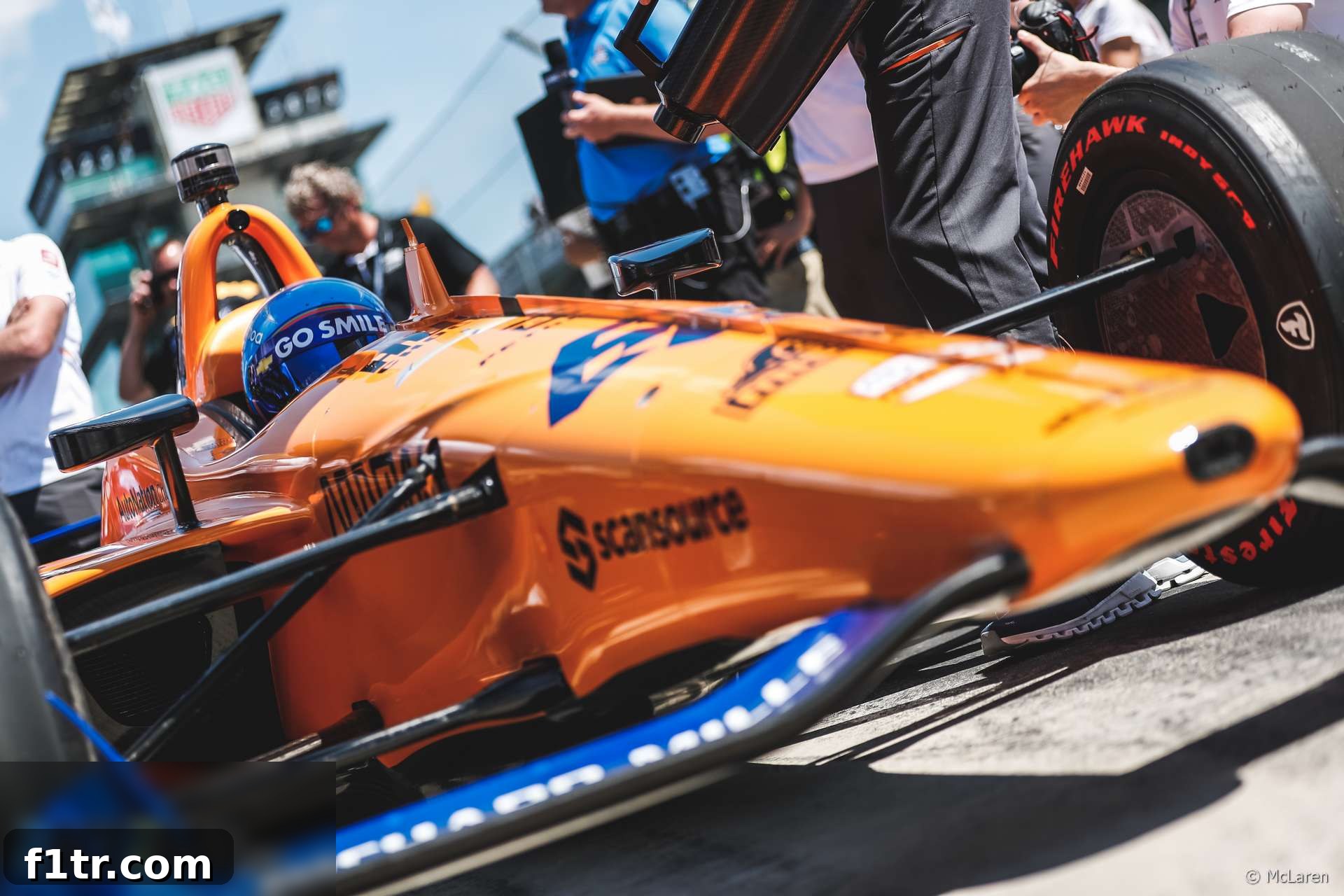
In a significant strategic move that underscores the evolving landscape of global motorsport, McLaren Racing is exploring opportunities for its IndyCar drivers to participate in official Formula 1 rookie test days. This potential cross-pollination of talent was confirmed by McLaren Racing CEO Zak Brown, highlighting the synergistic vision behind the team’s expanded presence in the NTT IndyCar Series.
The announcement follows McLaren’s recent revelation of a formidable new alliance with Schmidt Peterson Motorsports, a well-established entity in the American open-wheel racing scene. This collaboration will see two full-time McLaren-branded cars compete in the IndyCar championship from next year. While the driver lineup for the newly formed team remains an eagerly anticipated announcement, Brown’s comments suggest an exciting pathway for talent development across the two premier racing categories.
Advertisement
Forging a New Talent Pathway: IndyCar to F1 Rookie Tests
The F1 rookie test regulations are clear: teams must field a driver who has participated in no more than two Formula 1 Grand Prix races. This rule creates a unique window for promising young talents and drivers from other high-level series to gain invaluable experience in an F1 car. For McLaren, integrating its IndyCar drivers into this testing program offers a dual benefit.
“We currently have a rookie driver who is under obligation of some rookie tests in Formula 1, and certainly if we feel that one of our IndyCar drivers has a credible chance in Formula 1, then for sure, we would look to put that driver in for some rookie testing,” Zak Brown stated. This declaration signifies more than just a passing thought; it represents a tangible commitment to fostering talent within the wider McLaren racing ecosystem.
The criteria for a “credible chance” would undoubtedly be rigorous, encompassing not only raw speed and talent but also adaptability, technical understanding, and the ability to provide precise feedback. A successful F1 rookie test could dramatically elevate a driver’s profile, opening doors to future opportunities in Formula 1, or significantly enhancing their standing within IndyCar. This strategic initiative serves as a powerful incentive for drivers joining the McLaren-Schmidt Peterson IndyCar effort, knowing that exceptional performance could lead to a coveted F1 opportunity.
Synergy Across Series: Optimizing Resources Under the F1 Budget Cap
Zak Brown elaborated on the broader implications of McLaren’s combined Formula 1 and IndyCar ventures, particularly in light of Formula 1’s impending budget cap. “I think that’s one of the exciting things about a combined Formula 1 and IndyCar effort is it will create opportunities for drivers, engineers, especially as we look into the budget cap and Formula One will start to change. There will be different ways to deploy our resources.”
The introduction of a budget cap in Formula 1, designed to promote financial sustainability and a more level playing field, fundamentally alters how teams operate and allocate resources. In this new era, innovative strategies for maximizing efficiency and talent utilization become paramount. McLaren’s multi-series approach offers a clever solution.
For engineers and technical personnel, the opportunity to work across both Formula 1 and IndyCar programs presents an unparalleled learning curve. This cross-disciplinary exposure can lead to a richer pool of expertise, fostering innovation and adaptability. Ideas and solutions developed in one series could potentially be adapted and applied to the other, leading to overall performance gains. Moreover, under the budget cap, McLaren can strategically deploy personnel between its F1 and IndyCar operations, optimizing workloads and ensuring that valuable human capital is fully utilized without breaching financial limits.
This integrated approach also creates a more robust talent pipeline for drivers. Instead of seeing IndyCar as an entirely separate career path, McLaren is positioning it as a potential stepping stone or an alternative high-level proving ground for F1 aspirants. This broadens the scope for driver identification and development, allowing McLaren to nurture talent from a wider pool and provide varied opportunities for progression.
Driver Dynamics at Schmidt Peterson: Hinchcliffe’s Future and Ericsson’s Ineligibility
The current driver lineup for Schmidt Peterson Motorsports includes Marcus Ericsson and James Hinchcliffe. However, with the new alliance and a switch to Chevrolet power from Honda, the dynamics are shifting. Marcus Ericsson, as a former Formula 1 driver with 97 Grand Prix starts, is not eligible to participate in the F1 rookie test. His experience, while valuable for the IndyCar program, falls outside the specified F1 rookie criteria.
The focus, therefore, naturally turns to James Hinchcliffe, a fan-favorite and experienced IndyCar racer. A key question surrounding the team’s engine switch from Honda to Chevrolet was the potential impact on Hinchcliffe, who has long-standing commercial ties with Honda. However, team co-owner Sam Schmidt provided reassurance regarding Hinchcliffe’s future.
“James has been a great asset to the team for the last five years,” said Schmidt. “He’s a brilliant ambassador for all of our partners.” Schmidt’s praise underscores Hinchcliffe’s significant value beyond his on-track performance. His charismatic personality, strong fan base, and ability to connect with sponsors make him a crucial asset for the team’s commercial success and public image. In modern motorsport, a driver’s marketability and ambassadorial qualities are often as important as their outright speed.
Addressing the intricacies of Hinchcliffe’s personal sponsorship with Honda, Schmidt acknowledged the unique nature of the arrangements. “It’s one of those unfortunate things, when you do what’s best for the team, but the relationship with Honda Canada and American Honda was direct between James and them, and so we don’t even know – we don’t even know what those details were, what those obligations were.” This statement highlights the complex web of relationships in professional motorsport, where driver contracts often run parallel to personal endorsement deals, sometimes independently of the team’s primary partnerships.
Despite these complexities, Schmidt expressed confidence in Hinchcliffe’s continued tenure. “We don’t anticipate it having an effect on the final year of his contract as far as we’re concerned, but yeah, we’re excited to have him on our team.” This commitment signals stability for Hinchcliffe within the McLaren-Schmidt Peterson framework, providing a strong foundation as the team embarks on its new chapter with Chevrolet engines. For McLaren, retaining experienced and popular drivers like Hinchcliffe is key to a successful entry into the highly competitive IndyCar series.
McLaren’s IndyCar Ambitions: Two Cars, a Third for Indy, and the McLaren Orange
McLaren’s commitment to its IndyCar program is further evidenced by the tangible transfer of assets and clear operational plans. All equipment purchased by McLaren for its challenging, ultimately unsuccessful, standalone attempt at the Indianapolis 500 will be moved to Schmidt Peterson’s headquarters. This immediate integration ensures a strong operational base for the new alliance.
The team will field two full-time entries in the IndyCar Series, proudly adorned in the iconic McLaren orange livery, symbolizing a full-fledged return and dedication to American open-wheel racing. Beyond the regular season, Schmidt confirmed plans for a third car specifically for the prestigious Indianapolis 500, a race that holds immense significance for McLaren’s racing heritage and global brand.
“There certainly will be a third car in Indy, but I think our priority first and foremost is to position the two cars with identical liveries and every opportunity that those two cars have to win, win races, win the Indy 500, win a championship,” Schmidt explained. This statement outlines a pragmatic and ambitious strategy. The primary focus is squarely on the two full-time entries, aiming for championship contention from the outset. This systematic approach ensures that the foundation of the program is solid before expanding further.
The decision to run a dedicated third car for the Indy 500 highlights the unique importance of “The Greatest Spectacle in Racing.” It’s a race that can elevate a team’s global profile and provide significant marketing value, justifying the additional logistical and financial investment. While a third full-time entry is not currently on the immediate radar, Schmidt did not rule it out for the future, signaling McLaren’s long-term vision and potential for growth within the IndyCar Series.
This comprehensive strategy, from driver development pathways and resource optimization to strong operational plans and a clear focus on winning, paints a vivid picture of McLaren Racing’s bold and calculated push into the heart of American motorsport. It’s a move that promises to create exciting opportunities for drivers, engineers, and fans alike, forging stronger connections between Formula 1 and IndyCar and enriching the global racing landscape.
Advertisement
More IndyCar Insights
- IndyCar driver McLaughlin cleared of injury after crashing through barrier at Barber
- Schumacher says his IndyCar feels like ‘an F2 car, just with better tyres’
- IndyCar “way faster than Formula 1” in some corners, says Grosjean
- FIA to award more F1 superlicence points to IndyCar drivers from 2026
- Schumacher to race full-time in IndyCar with RLL in 2026
Browse all IndyCar articles