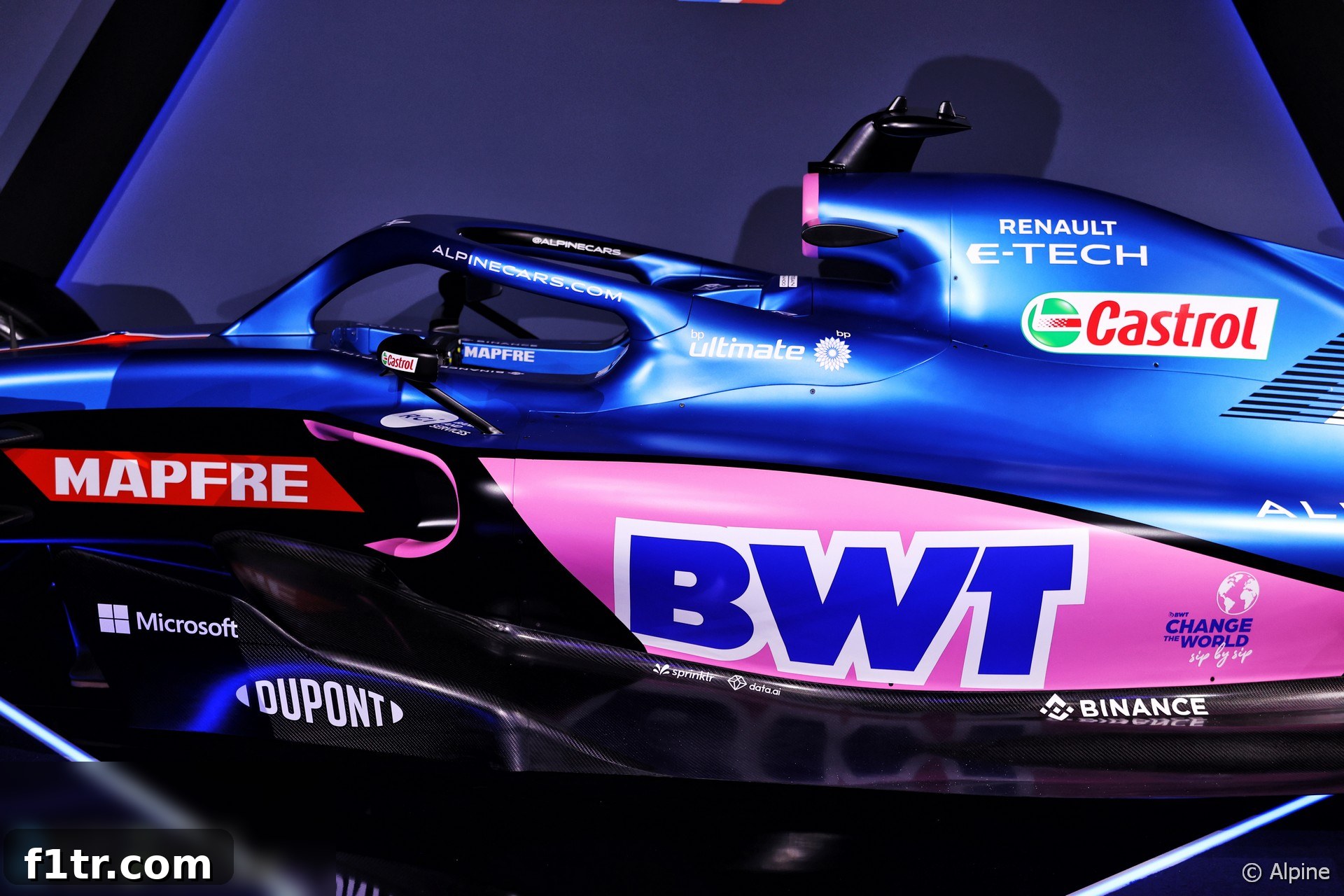
Alpine’s Revolutionary 2022 Power Unit: Unlocking Significant Performance Gains with Renault
The highly anticipated 2022 Formula 1 season marked a pivotal moment for teams, with radical new technical regulations shaking up car design from the ground up. Amidst this overhaul, Alpine, in collaboration with its power unit supplier Renault, unveiled a completely reimagined powertrain designed to push the boundaries of performance. According to Matt Harman, Alpine’s Technical Director, this extensive re-think of the power unit has yielded substantial gains, setting a promising trajectory for the team.
For several seasons, rival manufacturers like Mercedes and Honda had successfully employed an innovative power unit layout, separating the turbocharger and compressor and connecting them via a shaft. This configuration offered significant packaging and aerodynamic advantages. Renault, acknowledging these benefits, openly indicated its intention to adopt a similar philosophy for its 2022 power unit design. This strategic shift formed the cornerstone of Alpine’s ambitious engineering project, aiming to capitalize on every possible area of improvement.
A Deep Dive into the New Power Unit Architecture
Matt Harman confirmed that the Alpine A522, the team’s challenger for the 2022 season, was born from a holistic and fundamental re-evaluation of its power unit strategy. “At the very beginning of these regulations, we actually started with the power unit, mainly because it does set some of the key areas of the car aerodynamically,” Harman explained. This proactive approach underscored the critical understanding that a power unit is not an isolated component but an integral part of the overall vehicle performance equation.
The review undertaken by Alpine and Renault was comprehensive, spanning every facet of the power unit. Harman elaborated, “We did a full review of this area of the car and we decided to change the architecture of that power unit extensively in all areas, including the internal combustion engine, the ERS system, the turbo and its positioning in the car.” This wasn’t merely an incremental update but a profound architectural transformation. The decision to separate the turbo and compressor, for instance, allowed engineers greater flexibility in positioning these components within the chassis, optimizing weight distribution and creating more favorable conditions for aerodynamic flow.
The advantages of such an extensive redesign quickly became evident. Harman highlighted the direct impact on the team’s ability to innovate structurally and aerodynamically. “That has given us some real gains in terms of our ability to express ourselves aerodynamically and achieve the ultimate lap time of the car.” By creating a more compact and aerodynamically efficient power unit, engineers could sculpt the surrounding bodywork with greater freedom, enhancing airflow to crucial areas like the rear wing and diffuser, ultimately contributing to higher downforce and reduced drag.
Integrated Design: Beyond Raw Power
The pursuit of performance at Alpine extended beyond simply enhancing the power unit’s raw output. A key focus was its seamless integration within the wider car structure. The modern Formula 1 car is a complex ecosystem where every component must work in perfect harmony. The power unit, being one of the largest and most critical elements, has an outsized influence on the car’s overall balance, cooling, and aerodynamic efficiency.
“The RE22 is a power unit that we’ve reviewed back-to-front,” Harman stated, emphasizing the meticulous scrutiny applied to every detail. “We have looked at every aspect of it in terms of its integration into the chassis, its base performance and the combination of the two.” This approach signifies a profound understanding that peak performance is achieved not by maximizing individual components in isolation, but by optimizing their synergistic relationship. An incredibly powerful engine that negatively impacts the car’s aerodynamics or weight distribution would ultimately be detrimental to lap time.
The engineers delved deep into specific systems. “We’ve looked at the ERS system and its attributes. We’ve looked at the ICE, we’ve looked extensively on the structures that support the ICE. We’ve also looked at some of the electrical machines in terms of the MGU-K and also the turbo, making some quite big changes in that area to complement the A522 architecture and again, to allow us to extract maximum performance from both the power unit, the chassis and the combined product of the two.” The Energy Recovery System (ERS), comprising the Motor Generator Unit – Kinetic (MGU-K) and Motor Generator Unit – Heat (MGU-H, though not explicitly mentioned by Harman, it’s part of a full ERS), plays a vital role in modern F1, converting kinetic and heat energy into electrical power, which can then be deployed for extra boost or stored for later use. Optimizing its efficiency and integration can provide significant competitive advantages.
The changes to the MGU-K and turbo, in particular, were designed to align perfectly with the A522 chassis. This level of granular detail and cross-disciplinary engineering collaboration is essential in Formula 1, where margins of victory are often measured in milliseconds. The result is a power unit that doesn’t just produce horsepower but is finely tuned to enhance every dynamic aspect of the car, contributing to a stable, predictable, and ultimately faster race package.
Strategic Vision: Navigating the Power Unit Freeze
Adding another layer of complexity to Alpine’s development process was the impending power unit specification freeze. Under the 2022 regulations, F1 power units would be homologated and frozen, meaning manufacturers would be unable to revise them until new regulations take effect in 2026. This presented a unique strategic challenge: the 2022 power unit had to be robust, efficient, and versatile enough to support future aerodynamic and chassis developments over several seasons, without the possibility of significant internal upgrades.
Harman highlighted the foresight required for this ambitious program: “It’s been an interesting programme because essentially with the power unit and also the integrated powertrain that supports it, we’ve had to look at what the performance of that power unit and how that will work for the car over the next X number of years. And that’s given us some engineering challenges because we don’t fundamentally know everything about how we’re going to operate it.” This implies an extensive predictive modeling effort, using advanced simulations to anticipate various operating conditions, chassis iterations, and performance demands years into the future.
The inability to make fundamental changes to the power unit’s internal combustion engine, ERS components, or turbo configuration meant that designers had to consider longevity, reliability, and adaptability from the outset. Every decision in the 2022 design phase had long-term implications. “So we’ve had to make some simulations and we’ve taken some conclusions from that to enable us not only to design the power unit, but also design the transmission that is linked to it and how that transmission will need to change based on the aerodynamic developments that we’ll continue moving through, even though the power unit may be homologated and frozen at the 2022 stage.”
This strategic foresight extended to designing the transmission and other powertrain elements with inherent flexibility, allowing them to evolve alongside aerodynamic refinements even if the core power unit remained constant. It’s a testament to the intricate planning and sophisticated engineering required in modern Formula 1, where immediate performance gains must be balanced with long-term strategic viability.
Conclusion: A Foundation for Future Success
Alpine’s monumental effort in redesigning its Renault power unit for the 2022 season underscores the relentless pursuit of excellence in Formula 1. The strategic decision to overhaul the power unit architecture, particularly adopting the separated turbo/compressor layout, has unlocked significant aerodynamic freedoms and performance benefits. Coupled with a meticulous focus on holistic integration with the A522 chassis, the team aimed to create a finely tuned machine optimized for every aspect of lap time performance.
Furthermore, the challenge of the power unit freeze necessitated a forward-thinking approach, ensuring that the 2022 design would serve as a robust and adaptable foundation for years to come. By leveraging advanced simulations and comprehensive engineering analysis, Alpine and Renault positioned themselves not just for immediate gains but for sustained competitiveness under evolving regulations. This bold technical endeavor highlights Alpine’s ambition to climb the ranks in Formula 1, built on a bedrock of innovative engineering and strategic foresight.
2022 F1 season
- Mercedes told me “you’re wrong” about 2022 car’s problems – Hamilton
- FIA confirms all 10 F1 teams complied with 2022 cost cap
- Steiner “not ashamed” of panning “slow” Schumacher in Drive to Survive
- Albon believes year out of F1 improved him as a driver
- Hamilton sees diversity gains in F1 years on from his ‘traumatising’ experience of racism
Browse all 2022 F1 season articles