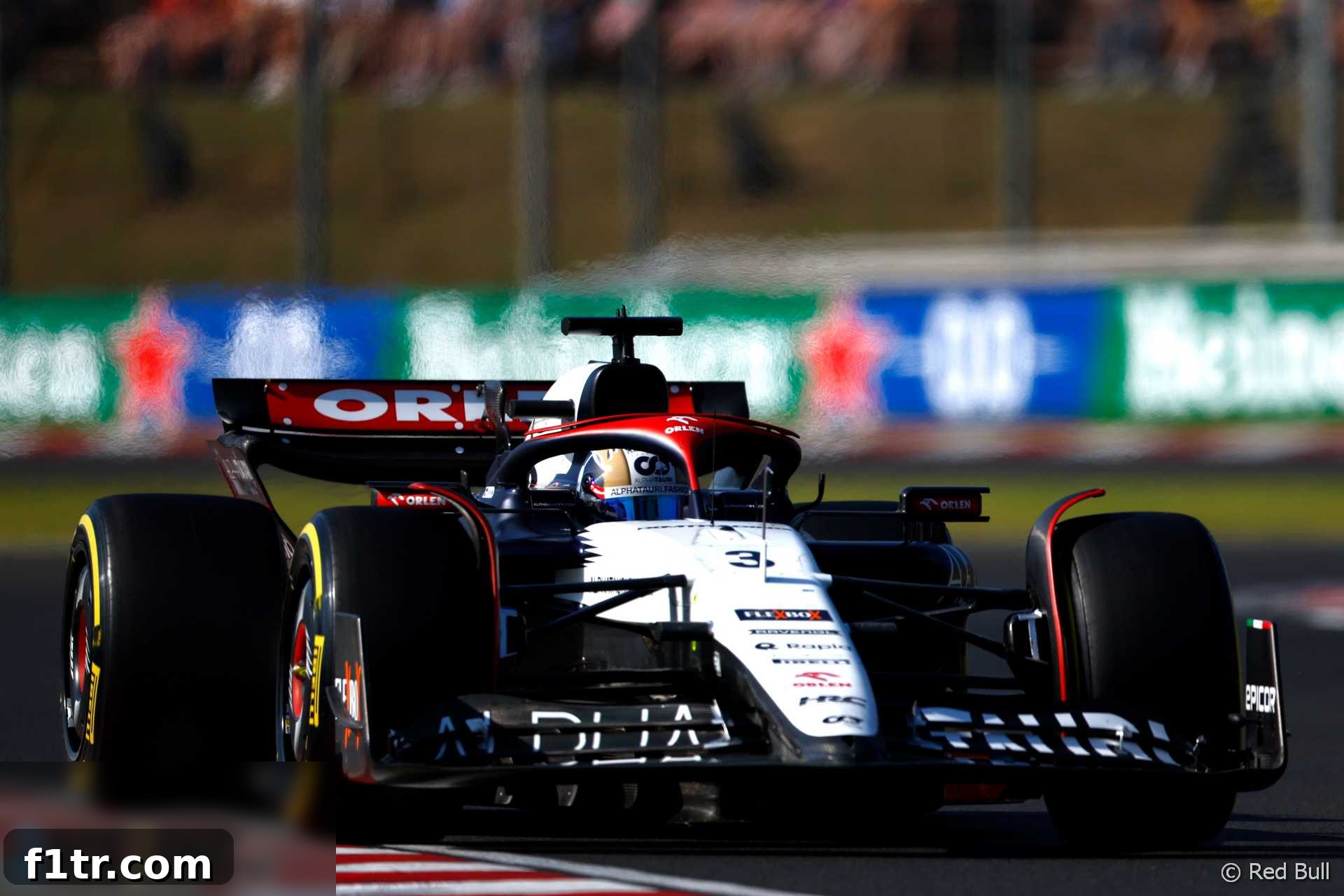
Daniel Ricciardo’s Triumphant F1 Return: Rekindling the Passion at AlphaTauri
The familiar sensation of pushing a Formula 1 car to its absolute limits, flat-out and on the edge, is a feeling Daniel Ricciardo had sorely missed. After a sabbatical from full-time racing, the charismatic Australian driver made a highly anticipated return to the F1 grid with AlphaTauri at the Hungarian Grand Prix. Reflecting on his first qualifying session back, Ricciardo spoke with palpable enjoyment about rediscovering that unique thrill, a clear sign that his passion for the sport has been fully reignited.
His immediate impact was undeniable. Securing 13th position on the grid for Sunday’s race, the new AlphaTauri driver wasted no time in making a statement. In a tight battle, he out-qualified his teammate, Yuki Tsunoda, by an incredibly narrow margin of just 0.013 seconds on his very first competitive attempt. This impressive performance, following months away from the pressures of F1 racing, immediately signaled that Ricciardo is back and means business.
Managing Expectations and Embracing the Challenge
Ahead of his comeback weekend, Ricciardo revealed he had consciously worked to keep his expectations in check. Understanding the inherent challenges of stepping back into the fiercely competitive world of Formula 1 after a break, he adopted a pragmatic approach.
“Of course coming into the weekend, I knew there would be a bit of a hill to climb,” he shared, acknowledging the steep learning curve involved in adapting to a new car, a new team, and the physical demands of high-performance racing. “I was trying not to get caught up on how I go this weekend but, of course, I’m a race car driver, so I’m always going to expect something out of myself.” This internal conflict between realistic assessment and innate competitive drive is a testament to the mindset of an elite athlete.
However, beyond the statistics and the pursuit of performance, Ricciardo’s primary goal was a deeper, more personal one: reconnecting with the pure joy of racing. “But truthfully I was really trying to remove as much of that as I could and just make sure that this is the place that makes me feel like myself again. Jumping in the car in qualifying, I felt actually really relaxed,” he explained. This newfound sense of calm and happiness behind the wheel speaks volumes about his mental state and how rejuvenated he truly feels.
The Sabbatical: A Crucial Period of Rediscovery
Ricciardo elaborated on the profound impact his time away from racing had on his mindset. The pressures of the sport, particularly during his final years at McLaren, had taken their toll, dimming some of the enjoyment he once felt. His sabbatical, though shorter than initially anticipated, proved to be a vital reset.
“Not taking it lightly, but just happy – happy to be back and happy to be able to push a car on the limit again. This is something that I obviously didn’t always have the last year or two and that’s why I think the time off was needed for me,” he articulated. This candid admission highlights the mental and emotional toll that continuous high-pressure performance can exert, even on the most experienced drivers.
Originally envisioning a longer break of a full year, Ricciardo found that even six or seven months were sufficient for him to achieve his goal. “I thought I was going to get 12 months, in the end it was only about six or seven or whatever, but fortunately it was enough. I felt like I had enough time to fall back in love,” he stated. This period allowed him to step back, gain perspective, and once again find the unadulterated passion that propelled him into Formula 1 in the first place. His return isn’t merely a contractual obligation; it’s a genuine desire to race, to compete, and to experience the thrill of F1 anew.
Assessing Performance and the Teammate Benchmark
Despite his respectable 13th place finish in qualifying, Ricciardo is careful not to place too much emphasis on his exact grid position at this early stage of his comeback. His focus remains firmly on familiarizing himself with his new car and gauging his progress against a known quantity.
“I had no idea where to expect to be on the grid,” he admitted. “So the 13th place, in a way, feels somewhat irrelevant, I think.” This demonstrates a mature, process-oriented approach, prioritizing the foundational aspects of his return over immediate, isolated results.
For now, his primary reference point is his AlphaTauri teammate, Yuki Tsunoda. Ricciardo holds Tsunoda in high regard, recognizing the Japanese driver’s significant development and competitive spirit. “Of course my reference is Yuki for now and I think he’s also – watching from the outside – a good reference. Because not only this year, but I think already the second half of last year, I could see with Pierre [Gasly] he was starting to be a lot more competitive,” Ricciardo observed. Measuring himself against an improving and established teammate like Tsunoda provides a crucial and immediate metric for Ricciardo’s own performance and adaptation. Being so closely matched with Tsunoda, especially after limited preparation, is undoubtedly a positive sign for the Australian.
Adapting to the AT04: Quick Comfort Despite Limited Track Time
One of the most impressive aspects of Ricciardo’s return has been his rapid adaptation to the AT04 chassis. He only had his first taste of the car during Friday’s practice sessions, with the initial session at the Hungaroring even being affected by rain, further limiting his crucial track time. Yet, despite these challenges, he reported feeling comfortable surprisingly quickly.
“Yesterday we only really got one session,” he recalled. “I was a bit off the pace, but I kind of knew where I was missing and it was quite self-explanatory where I could find the pace. So I felt quite confident in the car.” This ability to quickly identify areas for improvement and feel confident in unfamiliar machinery underscores his vast experience and innate talent as an F1 driver. It suggests that the synergy between driver and car is developing rapidly, which is critical for future performances.
While the initial comfort level is high, Ricciardo acknowledges that the real work lies in extracting the absolute maximum performance. “But we can probably all of us get to 95% quite easily at this level – it’s in those last few percent,” he elaborated. “I think I found a little bit in quali, but for sure there’s still a little bit more.” This pursuit of the final, elusive percentage points is what separates the good from the great in Formula 1, and Ricciardo is clearly eager to embark on that challenging journey once again.
Looking Ahead to Race Day: The Grand Prix Challenge
Heading into his first Grand Prix race in more than six months, Ricciardo anticipates a significant challenge over the 70 demanding laps of the Hungarian Grand Prix. Predicting whether he will be able to fight for points remains an open question, given his limited preparation and understanding of the AT04 in race trim.
“It’s really hard [to predict],” he admitted candidly. “I’ve done probably only maybe an eight-lap run or something at the moment, so even for me I think there’s going to be a lot of things for me to learn tomorrow in terms of tyre management, and also the car with [full] fuel, as the tyres go off.” Tyre degradation, fuel consumption, and managing the car’s balance over a long stint are all critical aspects of F1 racing that require extensive experience and fine-tuning. The Hungaroring, with its twisty layout and often high temperatures, only amplifies these factors.
Ricciardo expects the race to be a continuous learning experience, revealing more about the AT04’s characteristics under varying conditions. “I think I’ll start to probably discover a bit more about the car and obviously then, in those conditions, the weaknesses,” he explained. This candid outlook highlights his realistic approach, understanding that he will encounter moments of struggle as he adapts. “I don’t want to say that negatively, but inevitably there’s going to be still a handful of things to pick up on,” he added.
Despite the steep learning curve, Ricciardo remains optimistic and focused on his core objectives. “Hopefully I can be a fast learner and if we find our way in the points, then that would be huge. But I think for now, obviously as a team we need to get points, but it’s really just making sure that I’m on top of the car, at one with the car and then that’s the first box I need to check,” he concluded. For Daniel, becoming fully integrated with the car is paramount, paving the way for consistent performances and, ultimately, a push for championship points for AlphaTauri.
The Broader Impact of Ricciardo’s F1 Comeback
Daniel Ricciardo’s return to Formula 1 is more than just a personal journey; it carries significant implications for both AlphaTauri and potentially for Red Bull Racing’s future driver lineup. For AlphaTauri, bringing in a driver of Ricciardo’s caliber and experience provides an invaluable asset. His feedback on car development, strategic insights, and sheer race craft will be crucial for a team looking to improve its standing in the competitive midfield. His presence also brings a wave of positive morale and global attention to the Italian outfit.
From Red Bull’s perspective, Ricciardo’s performance at AlphaTauri serves as a crucial evaluation. With Sergio Perez’s contract discussions looming, and the perennial question marks over driver progression within the Red Bull academy, Ricciardo’s ability to perform consistently and at a high level could open doors for a sensational return to the senior team. This added layer of intrigue makes every lap and every result from Ricciardo intensely scrutinized.
For the fans, Ricciardo’s comeback is a captivating narrative. His infectious personality, coupled with his aggressive and exciting driving style, has always made him a beloved figure in the sport. Witnessing him rediscover his passion and competitive edge offers a compelling storyline of resilience and reinvention. The F1 paddock, and indeed the entire motorsport world, will be watching closely as Daniel Ricciardo navigates this new chapter, eager to see if the Honey Badger can not only reclaim his form but perhaps even reach new heights.
The Hungarian Grand Prix thus marks a pivotal moment in Ricciardo’s career. While points would be a welcome bonus, the true success of this weekend will lie in his continued adaptation, his growing confidence, and the undeniable joy he expresses when pushing an F1 car to its absolute limits once more. His journey back to the grid is a testament to the enduring allure of Formula 1 and the unwavering spirit of its most captivating characters.
2023 Hungarian Grand Prix Related Articles
- Was F1’s Alternative Tyre Allocation test successful? Drivers and teams have their say
- How far can McLaren climb with car rivals now say is the second-fastest in F1?
- Why Ricciardo says McLaren’s car “speaks Lando’s language” – but Norris disagrees
- Mercedes reveal cooling error behind loss of pace in Hungarian GP
- Perez answered critics in Hungary but needs to qualify better – Horner
Browse all 2023 Hungarian Grand Prix articles