The 2014 Formula 1 season marked a pivotal moment in the sport’s history, with sweeping technical regulations promising a seismic shift in performance and design. As teams gathered at the Jerez circuit in Spain for the crucial pre-season testing, anticipation was exceptionally high. Among the first contenders to break cover and hit the track was the Caterham CT05, a machine that not only embodied the team’s ongoing ambitions but also presented a distinctive interpretation of the radically altered rulebook. Its inaugural appearance at Jerez signaled the beginning of a challenging yet utterly fascinating journey for the Leafield-based squad, as they prepared to navigate the complexities of a new era in motorsport.
Unveiling the Caterham CT05: A New Chapter in Formula 1’s Hybrid Era
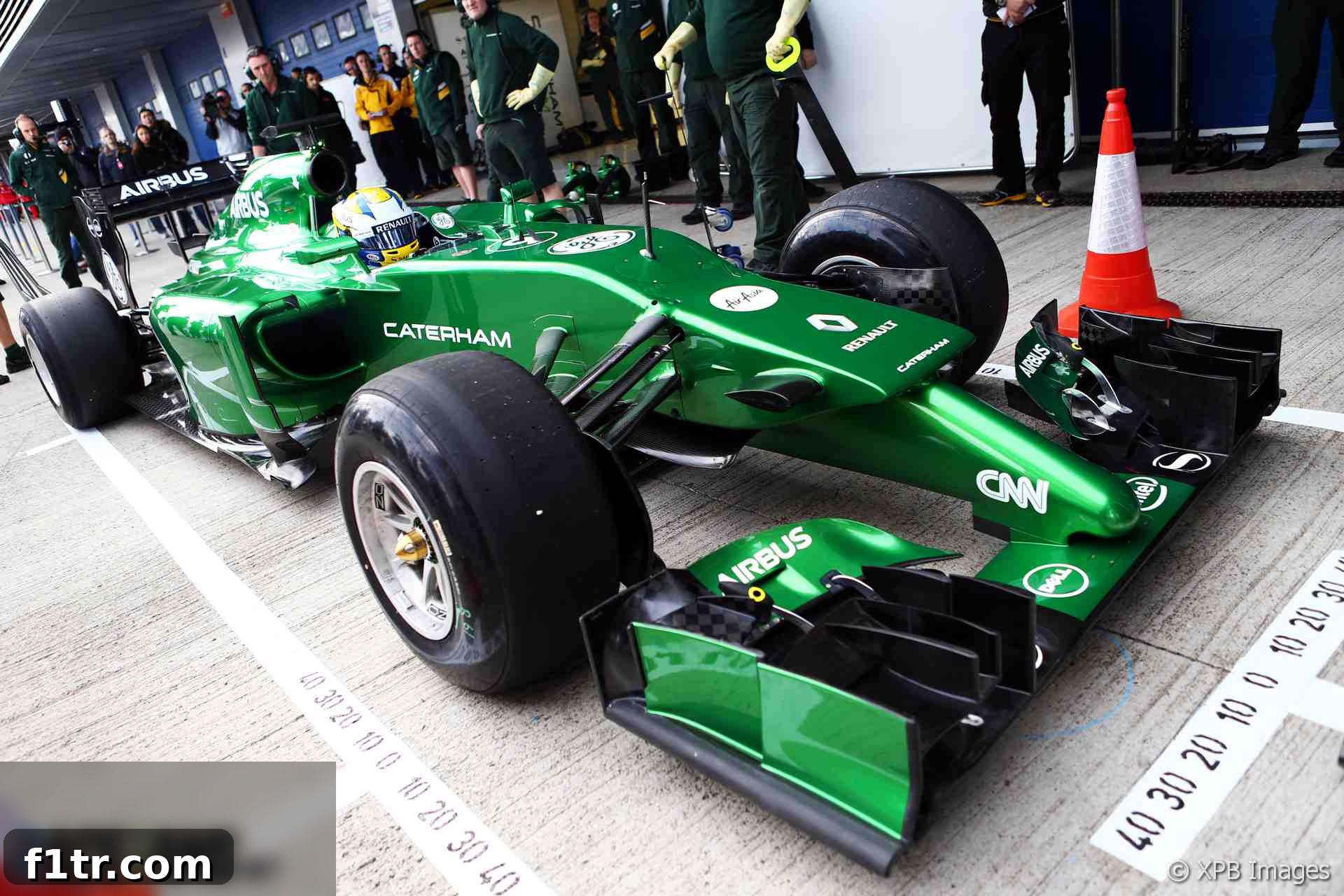
The highly anticipated debut of the Caterham CT05 at Jerez offered the first public glimpse of the team’s challenger for the 2014 Formula 1 World Championship. This season introduced the most significant technical revolution in decades, shifting the sport towards a V6 hybrid turbo power unit era. The CT05, revealed amidst the hustle and bustle of pre-season preparations, was tasked with proving Caterham’s ability to adapt and compete against well-established and financially superior rivals. From its distinctive nose design to its new powertrain, every aspect of the CT05 was scrutinized, highlighting the immense pressure on all teams to master the intricate new regulations.
Caterham F1: A Journey Through Formula 1’s Ranks
Caterham F1, a team that rebranded from Lotus Racing in 2012, was embarking on its sixth season in the pinnacle of motorsport. Originally entering Formula 1 in 2010 under the banner of Lotus Racing, conceived by entrepreneur Tony Fernandes, the team aimed to revive the legendary Lotus name. They were part of a wave of new entrants alongside Hispania Racing (HRT) and Virgin Racing (later Marussia). Despite genuine passion and consistent effort from its dedicated personnel, the team had, until the 2014 season, struggled to break into the coveted points-scoring positions, consistently finishing at the lower end of the Constructors’ Championship standings. This persistent lack of tangible on-track success underscored the immense financial and technical hurdles inherent in competing as an independent team against Formula 1’s established giants, who often boasted significantly larger budgets and greater resources. The transformation from the iconic green and yellow livery to the vibrant green and blue of Caterham not only marked a change in brand identity but also symbolized a renewed commitment to finding a competitive edge in a relentlessly challenging environment. The comprehensive rule changes introduced for 2014 presented a potential reset button, offering a glimmer of hope that smaller, agile teams could leverage innovative designs and strategic thinking to potentially disrupt the existing pecking order and climb closer to the mid-field.
Introducing the CT05: First Glimpse at Jerez
The Jerez circuit in southern Spain has long served as a traditional proving ground for new Formula 1 machinery, and it was against this historic backdrop that the Caterham CT05 made its public debut. Pre-season testing is far more than a mere shakedown; it represents a critical phase for validating design concepts, understanding the intricacies of new and complex systems, and gathering vast amounts of data essential for the entire season. For the CT05, its inaugural laps under the Spanish sun were subjected to intense scrutiny by engineers, media, and fans alike. The car, adorned in its distinctive green and blue colors, represented countless hours of meticulous design, advanced manufacturing, and tireless dedication from the entire team. Every single component, from the intricately crafted chassis to the aerodynamically optimized surfaces, was specifically engineered to exploit the nuances of the new 2014 regulations. The primary objective during these initial test days was not to achieve blistering lap times, but rather to prioritize fundamental reliability and extensive data acquisition. Ensuring that all systems functioned harmoniously as intended, particularly the revolutionary new V6 hybrid turbo power unit, was paramount. This methodical approach laid the groundwork for future performance enhancements and confirmed the integrity of the new design.
A Dynamic Driver Lineup: Experience Meets New Talent
For the demanding 2014 season, Caterham assembled an intriguing blend of experience and fresh talent, a strategic move designed to maximize both immediate feedback and future potential. Making a much-anticipated return to Formula 1 after a year out of the sport was the popular Japanese driver, Kamui Kobayashi. Renowned for his aggressive driving style, spectacular overtaking maneuvers, and fearless approach, Kobayashi brought with him a wealth of F1 experience garnered from his previous stints with Toyota and Sauber. His return was a significant boost for Caterham, providing the team with invaluable technical feedback, a strong performance benchmark, and a marketable personality. Sharing the cockpit and making his eagerly awaited Formula 1 debut was Swedish newcomer Marcus Ericsson. Ericsson arrived with a commendable track record in junior categories, most notably GP2, and his progression to F1 marked a monumental career milestone. For any rookie, adapting to the immense power, sophisticated aerodynamics, and sheer complexity of a modern F1 car – especially one featuring the ground-breaking new hybrid technology – presents a formidable challenge. Together, Kobayashi and Ericsson faced the dual task of not only familiarizing themselves with the nuances of the CT05 but also guiding its crucial development throughout a season where technological evolution and rapid learning would be constant. Their combined efforts, translating track performance into actionable data for the engineering team, would be absolutely critical for Caterham’s aspirations.
The Dawn of a New Power Era: V6 Hybrid Turbos and Renault Partnership
The 2014 regulations ushered in the most significant technical overhaul in Formula 1 in several decades, fundamentally transforming the sport’s powertrain philosophy. The shift from naturally aspirated V8 engines to highly complex 1.6-liter V6 hybrid turbo power units was not merely a change in engine size; it represented a paradigm shift encompassing sophisticated energy recovery systems (ERS), powerful turbochargers, and stringent fuel flow limits. This mandated a completely new approach to powertrain design, integration, and management. Caterham wisely continued its technical partnership with Renault, one of Formula 1’s most historically successful engine manufacturers. Renault had supplied championship-winning engines to Red Bull Racing in the preceding years, and their engineering expertise was highly valued across the paddock. However, the radical new regulations presented an incredibly steep learning curve for all engine suppliers, even the most experienced. The reliability, efficiency, and outright performance of these new power units were expected to be absolutely paramount, potentially dictating the season’s outcome more decisively than raw chassis aerodynamics, particularly in the early races. For customer teams like Caterham, securing a strong and reliable engine from a proven supplier such as Renault was a foundational element for any hope of success. In a season where simply finishing races would prove to be a significant challenge for many, a robust power unit offered a crucial competitive advantage.
Revolutionary Design: Caterham’s Answer to F1’s Nose Regulations
Among the most visually striking and, indeed, controversial changes introduced for the 2014 season were the new nose regulations. Designed primarily with safety in mind – specifically to lower the front of the car and reduce the likelihood of cars overriding one another in impact scenarios – these rules inadvertently led to a variety of aesthetically challenged and often ridiculed nose designs. Most teams adopted designs featuring a narrow, elongated protrusion extending from the main chassis bulkhead to meet the minimum height requirements. These solutions were derisively dubbed “anteater” or “phallic” noses by media and fans due to their unusual appearance. Caterham, however, presented an unusual and distinctly different solution with their CT05. Instead of a separate, thin appendage purely for regulatory compliance, their design incorporated a more substantial, integrated extension that ingeniously doubled as a primary mounting point for the front wing. This innovative approach aimed to manage airflow more effectively around the critical area where the nose meets the front wing assembly, potentially offering subtle aerodynamic advantages while still fully complying with the new safety standards. This design decision vividly highlighted the intricate dance between regulatory compliance, safety mandates, and the relentless pursuit of performance optimization that defines Formula 1 engineering. Whether Caterham’s unique interpretation would prove aerodynamically superior, or simply remain a distinctive visual characteristic, was one of the many intriguing questions that would be answered as the demanding 2014 season unfolded.
Battling for Survival: Caterham’s Competitive Outlook for 2014
Caterham’s journey in Formula 1 had, unfortunately, been characterized by consistent effort overshadowed by unyielding competitive struggle. In the intensely fought 2013 Constructors’ Championship, the team finished in the last position, failing to score a single point – a disheartening pattern that, regrettably, had defined all their previous seasons. The financial implications of this lack of on-track success are profound and far-reaching; Formula 1’s prize money distribution heavily favors teams scoring points and finishing higher in the standings, creating a difficult and often insurmountable cycle for smaller, independent teams. Their closest and often most direct competitor throughout their F1 tenure was fellow 2010 entrant Marussia. The battle between these two backmarker teams was frequently as fierce, if not more so, than the fights occurring at the very front of the grid, as securing eleventh place in the Constructors’ Championship carried significant financial benefits and prestige. For the 2014 season, Marussia had made a strategic and potentially game-changing switch to Ferrari power units, a move widely anticipated to give them a considerable performance boost. This engine change added another layer of challenge for Caterham, who would not only need to extract maximum performance and reliability from their Renault power unit but also contend with a potentially stronger Marussia. The season promised to be a relentless fight for every position, every tenth of a second, and every precious opportunity to potentially break their long-standing points-scoring drought.
Pre-Season Testing: The Crucible of Innovation and Reliability
The pre-season tests at Jerez and the subsequent sessions in Bahrain were not merely about showcasing new cars; they were absolutely vital, especially in a year marked by such profound regulatory and technical changes. For all teams, these tests provided an indispensable opportunity to conduct initial shakedowns of entirely new cars, thoroughly test the reliability of their immensely complex V6 hybrid power units, and understand the intricate interaction between the engine, chassis, and radically revised aerodynamic packages. Data collection during these periods was paramount, with engineers meticulously analyzing every lap to identify potential weaknesses, optimize settings, and validate simulation models against real-world performance. Critical areas of focus included fuel consumption management under the new flow limits, tire degradation characteristics under increased turbo torque, and the flawless functionality of the sophisticated energy recovery systems (ERS). For the drivers, it was an intensive period of adaptation to the significantly different driving characteristics of the 2014 cars – the increased low-end torque from the turbo engines, the complex energy management strategies, and the altered braking dynamics due to ERS regeneration. Every successful lap without incident was considered a small victory, while any significant reliability issues could severely derail a team’s entire preparation, putting them at a considerable disadvantage even before the first Grand Prix.
Anticipating the Season Ahead: Hopes and Challenges for Caterham
As the Caterham CT05 turned its first cautious laps at Jerez, the entire Formula 1 world watched with keen interest. For Caterham, the 2014 season represented a renewed bid for respectability, improved performance, and, most crucially, the elusive points. The technical revolution sweeping through the sport offered a glimmer of hope that the established order might be disrupted, potentially opening doors for agile, innovative teams capable of adapting quickly. The combination of an experienced driver like Kamui Kobayashi and the raw, unproven talent of Marcus Ericsson, coupled with the proven yet newly complex Renault power unit and a distinctive aerodynamic philosophy, positioned Caterham as a team to watch – if only to observe their unique interpretation of the new rules and their ability to overcome immense obstacles. However, the challenges ahead were immense: ensuring the reliability of the unproven hybrid power unit, optimizing the unique CT05 chassis, and consistently outperforming their closest rivals in a highly competitive field. The journey of the Caterham CT05 through the 2014 season promised to be a true test of endurance, ingenuity, and sheer spirit in the ever-demanding, high-stakes world of Formula 1.
Caterham CT05 Gallery: A Closer Look
29.01.2014. Formula One Testing, Day Two, Jerez, Spain.
© Copyright: Batchelor / XPB Images
28.01.2014. Formula One Testing, Day One, Jerez, Spain.
© Copyright: Batchelor / XPB Images
28.01.2014. Formula One Testing, Day One, Jerez, Spain.
© Copyright: Batchelor / XPB Images
28.01.2014. Formula One Testing, Day One, Jerez, Spain.
© Copyright: Batchelor / XPB Images
28.01.2014. Formula One Testing, Day One, Jerez, Spain.
© Copyright: Batchelor / XPB Images
28.01.2014. Formula One Testing, Day One, Jerez, Spain.
© Copyright: Moy / XPB Images
More from Formula 1
- F1 returning to India soon after 2027 sounds like wishful thinking
- Verstappen loathes F1’s new generation of cars – but what do his rivals reckon?
- The ‘throwback weekend’ is back in fashion. But it’s a flawed concept – especially for F1
- Is Formula 1’s double race cancellation a blessing in disguise?
- Todt admits Schumacher crashed on purpose – but did it really cost him two titles?
Browse all Formula 1 articles