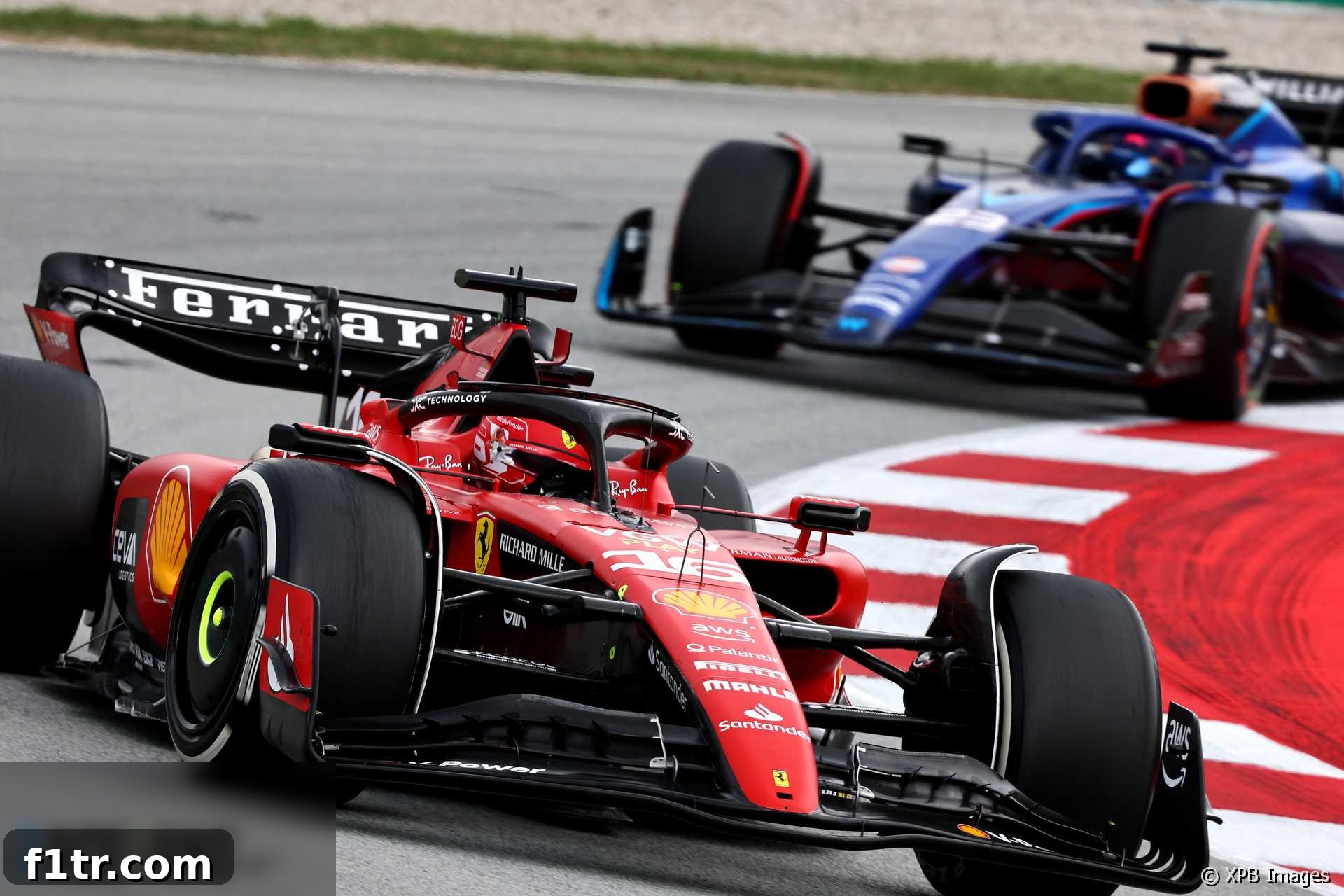
Ferrari’s SF-23 Updates: A Step Forward, Yet Inconsistency Remains a Challenge
Following the recent aerodynamic updates introduced at the Spanish Grand Prix, Ferrari team principal Frederic Vasseur has acknowledged that while the SF-23 demonstrated a step forward in potential, the team still faces a substantial journey to achieve consistent top-tier performance. The Maranello-based squad is relentlessly pushing to bridge the gap to their rivals, with a particular focus on transforming their qualifying pace into formidable race results.
Advert | Support Independent Journalism & Go Ad-Free
The highly anticipated SF-23 unveiled a series of significant modifications, including reshaped sidepods and a revised engine cover, at the Circuit de Catalunya. These changes were not merely cosmetic; they represented a concerted effort by the Scuderia to address fundamental handling characteristics that have plagued the car since the start of the season. The primary goal was not to achieve immediate, dramatic gains in single-lap speed, but rather to mitigate the car’s ‘peaky’ and unpredictable handling, a trait that both star drivers, Charles Leclerc and Carlos Sainz Jnr, have repeatedly voiced concerns about throughout the early part of the campaign.
Evaluating the Impact of the Updates: A Mixed Picture
Vasseur conveyed a sense of cautious optimism, noting that the team could draw some encouraging conclusions from the car’s performance at the Spanish Grand Prix, particularly when benchmarked against previous rounds at circuits offering similar performance characteristics. The Barcelona track, with its blend of high-speed corners, technical sections, and a demanding final sector, often serves as a reliable barometer for a car’s overall aerodynamic efficiency and balance.
“I believe we have indeed made a step forward in terms of our car’s inherent potential,” Vasseur stated. “If we use Miami as a reference point for qualifying pace, where we managed to put Carlos on the front row, then in Spain, we saw a noticeable improvement. This signifies progress.”
However, the nuanced reality of Formula 1 performance means that potential does not always translate directly into race day dominance. Vasseur quickly tempered expectations, emphasizing the persistent challenges that lie ahead. “In the race, one might observe a step forward compared to Aston Martin, which is positive. But it is by no means enough. We still have a substantial performance delta when compared to Mercedes, particularly when transitioning from qualifying to race pace. This is precisely where we must direct the entire focus and resources of our company if we aspire to reclaim our competitive edge and secure strong results consistently.”
The Unpredictable Nature of the SF-23: A Deep Dive into Inconsistency
One of the most perplexing issues highlighted by both Ferrari drivers during the Spanish Grand Prix was the significant and often inexplicable variations in lap times they experienced throughout the race. This inconsistency was evident even between stints where they were running on the same tyre compounds, making it incredibly challenging for the drivers to find a rhythm and push the car to its limits with confidence.
“I think the primary concern for us is not necessarily the ultimate potential of the car in specific corner types, but rather its profound inconsistency,” Vasseur explained, shedding light on the team’s biggest headache. He provided concrete examples to illustrate the problem. “On Charles’ car, for instance, between his first and third stints, despite using the identical tyre compound, the balance was completely off the pace in one, while the latter felt much more agreeable. Similarly, Carlos had a decent first stint, followed by a strong final stint, but in the middle phase of the race, he inexplicably lost somewhere between 15 and 20 seconds to his direct competitors. This level of variance is unacceptable and severely hampers our race strategy and overall performance.”
The Elusive Cause: A Thousand Minds at Work
The root cause of this debilitating inconsistency remains a puzzle for the Ferrari engineers. Vasseur candidly admitted the complexity of the situation: “Honestly, if I knew the exact reason, it would already be fixed. We currently have over a thousand dedicated individuals across our entire organization intensely focused on understanding and resolving this issue.”
He elaborated on the diagnostic challenge: “It’s exceptionally difficult to comprehend and rectify because the problem isn’t always manifesting in the same way, nor is it always the same underlying issue. This variability makes it a moving target for our technical teams.”
Another factor that potentially exacerbates these problems is the differing aerodynamic conditions between qualifying and race scenarios. “It is also true that in qualifying, you are typically operating in clean, undisturbed air, whereas in the race, you are constantly battling in the turbulent wake of other cars,” Vasseur pointed out. “I believe, for example, Charles struggled considerably in his first stint, but he was also running much closer to the car ahead of him. This ‘dirty air’ effect is likely an area where we must make significant progress to improve our car’s sensitivity and performance in traffic.”
Universal Challenges Across Tracks
Despite Sainz’s personal feeling that the SF-23 was not particularly well-suited to the specific characteristics of the Circuit de Catalunya, Vasseur asserted that the core problem of inconsistency transcends individual track layouts. While different circuits present varying demands on tyres, aerodynamics, and car balance, the underlying issue for Ferrari appears to be a systemic one.
“It’s challenging to draw direct comparisons because the demands from track to track vary immensely. You simply cannot equate Miami with Barcelona in terms of track layout, tarmac abrasiveness, or the energy loads placed on the tyres,” Vasseur explained. “However, I would argue that the global picture, the overarching pattern, remains largely the same wherever we go. The fundamental issue is that we are highly competitive, often at the sharp end, during qualifying sessions, but we consistently struggle to maintain that level of performance in the actual race. Furthermore, we exhibit inconsistency within the same car, not only between different tyre compounds but sometimes even when utilizing the identical compound across different stints.”
The Path Forward: Sustained Development and Strategic Focus
Ferrari’s commitment to continuous development is clear, but the complexity of the SF-23’s issues underscores the intricate nature of modern Formula 1 car design and performance optimization. Resolving the inconsistency will require a multi-pronged approach, encompassing further aerodynamic refinement, chassis setup optimization, and a deeper understanding of tyre interaction under varying conditions. The pressure is undoubtedly immense, as every race weekend represents a crucial opportunity to gather data, test new hypotheses, and inch closer to their championship aspirations.
The lessons learned from the Spanish Grand Prix updates and the subsequent analysis will be critical in guiding Ferrari’s development trajectory for the remainder of the season and into the future. Success in Formula 1 is not merely about raw speed; it’s about the ability to deliver that speed consistently, under pressure, and across diverse racing environments. For Frederic Vasseur and his dedicated team, the journey to unlock the full, consistent potential of the SF-23 is far from over.
Supporting Independent Motorsport Journalism
Providing insightful and timely coverage directly from the heart of Formula 1 requires significant resources. Independent motorsport journalists strive to deliver authentic narratives, expert analysis, and exclusive content to passionate fans around the globe.
By contributing a small amount monthly or annually, you can play a vital role in sustaining high-quality, independent journalism. Your support helps cover essential costs such as travel to race venues, research, writing, content creation, website hosting, and continuous development.
For over a decade, our dedicated readers have been the cornerstone of our ability to deliver unbiased and in-depth reporting. If you value independent perspectives and comprehensive coverage of Formula 1, please consider becoming a supporter today. As an added benefit, supporters often enjoy an ad-free browsing experience.
- Become a Supporter
- Supporter FAQ & Information
Advert | Support Independent Journalism andGo Ad-Free
Related Motorsport Articles & Insights
- Concerns Raised Over Grid Safety and Overcrowding at Races
- Ferrari’s Design Philosophy: Discipline Over Copying in Updates
- Mercedes on Spanish GP Collision: Seeking Tow Led to Incident
- Red Bull’s Spanish GP Diffuser Update Inspired by Rivals
- McLaren’s Doubts on Spanish GP Points Despite Strong Start
Browse all F1 Grand Prix Reviews and Analysis