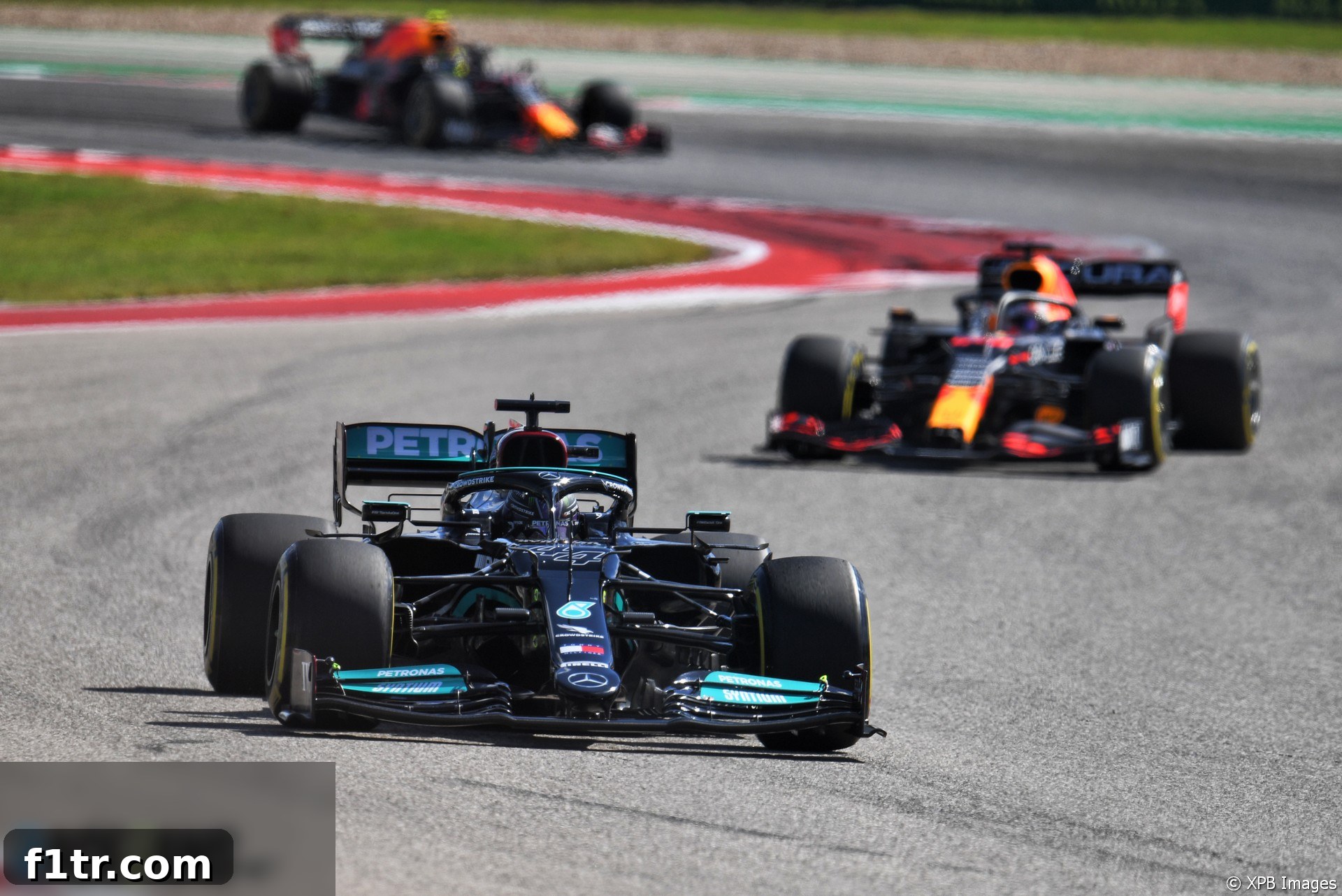
The United States Grand Prix at the Circuit of the Americas (COTA) presented a gripping spectacle of Formula 1 racing, a true testament to the intense rivalry between Mercedes and Red Bull. While Lewis Hamilton ultimately finished second behind Max Verstappen, Mercedes team principal Toto Wolff candidly admitted that a victory was within their grasp, making the outcome a source of considerable reflection for the Silver Arrows.
The race saw Hamilton seize an early lead, expertly navigating the challenging Austin track. However, a crucial strategic gambit by Red Bull saw Verstappen execute a decisive undercut during the first round of pit stops, shifting the advantage. Despite Hamilton’s relentless pursuit and a valiant charge in the latter stages of the race on hard compound tyres, he couldn’t quite reclaim the top spot. The narrow margin of victory for Verstappen highlighted the razor-thin differences that define modern F1, leaving Mercedes to ponder what might have been.
Mercedes Reflects on Missed Opportunity at COTA
For Toto Wolff, the sentiment was clear: the United States Grand Prix was a race that Mercedes ‘could have won.’ This powerful statement underscores the team’s belief in their potential and the performance of their W12 challenger, even in the face of Red Bull’s formidable pace. The immediate aftermath of the race triggered a detailed review within the Mercedes camp, a process fundamental to their continuous pursuit of perfection in Formula 1.
“I think we could have won the race, of course, because we were in the lead and we had a very strong pace on the hard compound tyres in the final stint,” Wolff stated, articulating the mixture of encouragement and frustration. He emphasized the necessity of a comprehensive analysis of the entire race weekend, from the practice sessions on Friday through to the chequered flag on Sunday. “Where did we misjudge? Where did we get it wrong? What did we do well? There will be plenty of discussion, positive discussions, about what to learn from this weekend.” This introspective approach is characteristic of a team that consistently operates at the pinnacle of motorsport, never resting on its laurels, even when securing podium finishes.
The Strategic Battle: Undercut and Tyre Management
The tactical masterclass unfolded vividly through the pit stop strategies. Red Bull orchestrated two critical undercuts, pitting Verstappen before Hamilton on both occasions. This aggressive strategy, though requiring Verstappen to manage older tyres for longer stints, proved instrumental in gaining track position. Wolff acknowledged the brilliance of their rivals’ approach: “You could see the different strategies, one team that went for the undercut out of necessity and a very courageous move because it was very early – and the second time again – and to their advantage.” This candid admission highlights the respect between the two championship-contending teams and the high level of strategic thinking involved in modern F1.
Mercedes, on the other hand, found themselves on the back foot, particularly with their performance on the medium compound tyres during the initial phase of the race. Wolff elaborated on the dilemma they faced: “We were just on the back foot because the car was not fast enough in the first stint on the medium. We couldn’t possibly have gone for an early stop because, based on the data we had on the medium, it didn’t look like we could finish the race on that stage with an early stop.” This reveals the intricate balance between aggression and prudence, where real-time data and predictive analysis dictate strategic choices. The early performance deficit on the medium tyre effectively limited Mercedes’ strategic flexibility, forcing them into a reactive rather than proactive stance.
Hamilton’s Tenacity and Verstappen’s Calculated Pace
Despite the strategic hurdles, Lewis Hamilton delivered an outstanding performance, particularly in the latter half of the race. Having dropped several seconds behind Verstappen after the second round of pit stops, Hamilton showcased his characteristic blend of speed and tyre management. “Lewis did drive awesomely,” praised Wolff. “He brought the [hard] tyre in – remained calm even though we had six-and-a-half and, on the second stop, eight-and-a-half seconds to Max – brought it in, increased the pace and at a certain stage there was just a massive difference.” The veteran Briton methodically reeled in his rival, demonstrating exceptional control and raw speed as the hard tyres came alive beneath him.
However, Max Verstappen’s drive was equally commendable, marked by tactical acumen and improved tyre preservation. Wolff observed, “Particularly in the last stint, you could see he had learned from the second stint not to damage the tyres too early because he had something left at the end.” This insight underscores the evolution of Verstappen’s racecraft, combining his natural aggression with a more measured approach to tyre degradation. The battle between the two drivers was a masterclass, with both pushing their machinery and their mental limits to the absolute maximum, creating a thrilling spectacle for fans worldwide. The race was a vivid illustration of why the 2021 season was one of the most compelling in recent memory, a true clash of titans.
The Fine Margins: Pit Stops and the Final Push
Ultimately, victory often comes down to the smallest details in Formula 1. While Hamilton’s late-race surge was breathtaking, it wasn’t quite enough. The critical difference was forged not only on track but also in the pit lane. “When you follow a car you start to suffer a bit,” Wolff explained, referring to the aerodynamic turbulence that hinders chasing cars. He added the poignant thought that often echoes in motorsport post-mortems: “I think if we would have had two laps more, who knows. But it is what it is and you need to congratulate Red Bull for their [pit] stops.” Red Bull’s consistently swift and precise pit stops were a silent but significant weapon in their arsenal, ensuring that every strategic gamble paid off optimally.
The narrative of “two more laps” has become a familiar lament for teams that narrowly miss out on victory. It speaks to the agonisingly fine margins at the pinnacle of motorsport, where milliseconds and metres can define championships. For Mercedes, the US Grand Prix served as a stark reminder that while their performance was strong, perfection is required to overcome a rival as formidable as Red Bull. The intense pressure of the championship battle meant that every decision, every pit stop, and every lap carried immense weight, shaping the destiny of the title.
Looking Ahead: Lessons from Austin for the Championship Battle
The outcome of the United States Grand Prix had significant implications for the drivers’ and constructors’ championships. For Mercedes, it was a moment to regroup, analyse, and come back stronger. The insights gained from Austin regarding tyre performance, strategic timing, and the car’s behaviour under various conditions would be crucial for the remaining races of the season. The team’s commitment to continuous improvement means that every challenge is viewed as an opportunity to learn and refine their approach.
The Hamilton-Verstappen rivalry intensified further with this race, setting the stage for an even more thrilling conclusion to the season. Each race became a chess match, not just between drivers on track, but between strategists in the pit wall. The ability to extract maximum performance from the car, make instantaneous data-driven decisions, and execute flawlessly under immense pressure defined the contenders. Mercedes, despite the disappointment of a missed victory, took valuable lessons from COTA, fueling their determination to fight for every single point in the remaining races and ultimately, the championship crown. The unwavering focus on data, simulation, and team cohesion would be paramount as the season hurtled towards its dramatic finale.
2021 United States Grand Prix Related Articles
- Mercedes encouraged despite ‘toughest race for a long time’ in Austin
- For the sake of the title fight, F1 must get a grip on its track limits problem
- Pit stop problems costing Ferrari “quite a lot of points” – Sainz
- Sold-out crowd of 380,000 at COTA shows F1 can add third US race – Brawn
- While the pressure’s off I can “push myself” more – Russell
Browse all 2021 United States Grand Prix articles