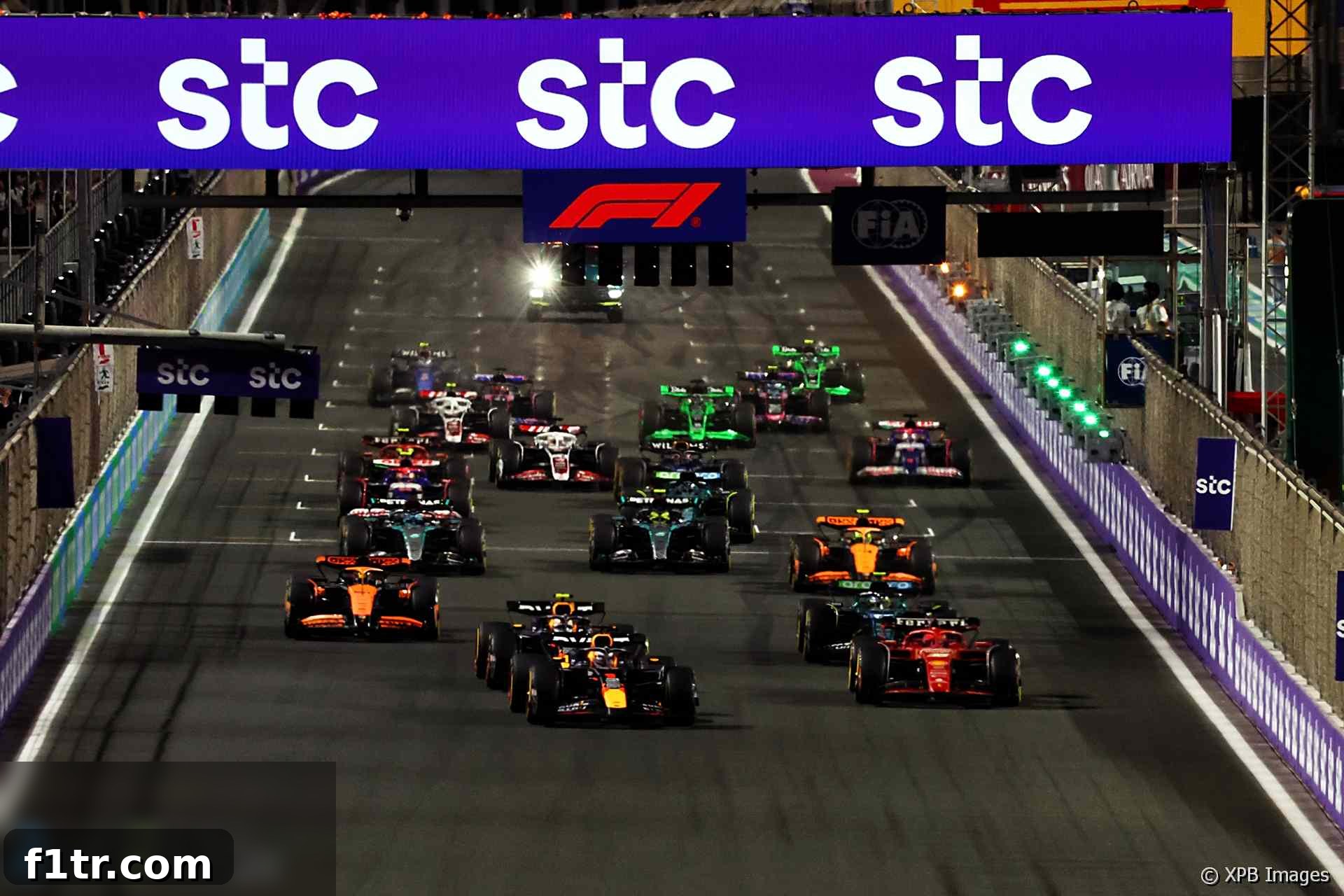
The stage is set for an electrifying conclusion to the Saudi Arabian Grand Prix, promising a thrilling spectacle as the lights go out on the challenging Jeddah Corniche Circuit. With the grid featuring four different constructors in the top four starting positions, and championship contender Lando Norris facing an uphill battle from P10, every lap of this 50-lap sprint is expected to be a strategic chess match and a test of nerve.
Formula 1’s decision to deploy softer tyre compounds this year is a deliberate attempt to inject more strategic variation into a race that has historically been somewhat predictable. The high-speed nature of Jeddah, combined with its wall-lined corners, often favors a single-stop strategy, limiting the excitement. Will this change in tyre allocation genuinely shake up the pecking order and force teams into bolder tactical decisions, or will the inherent characteristics of the circuit still dictate a conservative approach? As the teams prepare for battle under the desert sky, all eyes will be on how this crucial tyre choice unfolds and whether it can deliver the unpredictable drama fans crave.
Weather Conditions: A Consistent Challenge in Jeddah
The weather forecast for Sunday night in Jeddah predicts conditions remarkably similar to those experienced during qualifying sessions. Drivers and teams can expect warm temperatures that will gradually cool as the evening progresses, a characteristic feature of racing under the floodlights in Saudi Arabia. While these temperatures are generally favorable, the cooling track surface can subtly alter tyre behavior and car balance throughout the race. A consistent drop in track temperature might lead to reduced grip towards the latter stages, potentially impacting tyre degradation and demanding greater finesse from the drivers. Teams will be closely monitoring these evolving conditions, making real-time adjustments to their strategies and warning their drivers of any potential shifts in performance, ensuring they maintain optimal pace without overstressing their Pirelli rubber.
The Critical Jeddah Start: A Dash to Turn One
Distance from pole position to first braking zone. Source: Mercedes
The Jeddah Corniche Circuit boasts one of the shortest runs to the first corner on the entire Formula 1 calendar, making the initial moments of the Grand Prix incredibly intense and often decisive. This compact dash places immense pressure on drivers to execute a perfect start, vying for crucial track position before the unforgiving walls begin. Last year, Max Verstappen, starting from pole position just as he does today, masterfully defended his lead. He immediately moved left off the line, effectively neutralizing the threat from Charles Leclerc, who was alongside him in second. This aggressive but calculated maneuver left Leclerc momentarily exposed to Sergio Perez, starting third, though the Red Bull driver ultimately couldn’t capitalize on the opportunity to pass the Ferrari. The brevity of the run to Turn 1 often compresses the field, creating a high-risk, high-reward scenario where even minor contact can have significant race-ending consequences. Drivers will need to balance aggression with caution, knowing that an early advantage can dictate the entire flow of their race on this tight, high-speed street circuit.
Strategic Outlook: Unpacking Tyre Choices and Pit Stop Scenarios
Tyre strategy is always a pivotal factor in Formula 1, and the Saudi Arabian Grand Prix presents its own unique set of challenges and opportunities. Last year, the majority of the field opted to start on the medium compound, indicating a clear preference for a conservative, one-stop race. The table below illustrates the tyre choices from last year’s grid:
| Pos. | Driver | Team | Tyre compound |
|---|---|---|---|
| 1 | Max Verstappen | Red Bull-Honda RBPT | Medium |
| 2 | Charles Leclerc | Ferrari | Medium |
| 3 | Sergio Perez | Red Bull-Honda RBPT | Medium |
| 4 | Fernando Alonso | Aston Martin-Mercedes | Medium |
| 5 | Oscar Piastri | McLaren-Mercedes | Medium |
| 6 | Lando Norris | McLaren-Mercedes | Medium |
| 7 | George Russell | Mercedes | Medium |
| 8 | Lewis Hamilton | Mercedes | Medium |
| 9 | Yuki Tsunoda | RB-Honda RBPT | Medium |
| 10 | Lance Stroll | Aston Martin-Mercedes | Medium |
| 11 | Oliver Bearman | Ferrari | Soft |
| 12 | Alexander Albon | Williams-Mercedes | Medium |
| 13 | Kevin Magnussen | Haas-Ferrari | Medium |
| 14 | Daniel Ricciardo | RB-Honda RBPT | Medium |
| 15 | Nico Hulkenberg | Haas-Ferrari | Medium |
| 16 | Valtteri Bottas | Sauber-Ferrari | Soft |
| 17 | Esteban Ocon | Alpine-Renault | Medium |
| 18 | Pierre Gasly | Alpine-Renault | Medium |
| 19 | Logan Sargeant | Williams-Mercedes | Medium |
| 20 | Zhou Guanyu | Sauber-Ferrari | Medium |
This year, Formula 1’s official tyre supplier, Pirelli, has introduced compounds one step softer than those used in the previous season. While this might suggest a shift towards a two-stop strategy, historical data from Jeddah indicates that drivers were capable of running the equivalent of this year’s hard tyre (last year’s medium) for an impressive 41 out of 50 laps. Considering this, and despite slightly hotter temperatures than last year, there’s a strong likelihood that most teams will still target a single pit stop. The rapid, flowing nature of the Jeddah circuit, combined with its high average speeds, makes minimizing pit lane time crucial. A pit stop at Jeddah costs approximately 15 seconds, a figure that is relatively low compared to many other tracks on the calendar. This shorter pit loss further encourages teams to stick to a one-stop plan, as the time gained on track by running faster tyres for longer often outweighs the minimal disadvantage of a single stop.
Teams will have to carefully analyze their remaining tyre allocations. The available sets for the Grand Prix are a key determinant in strategic flexibility. Here’s a breakdown of the tyres each driver has at their disposal:
| Tyres available for the race | Hard | Medium | Soft | |||
|---|---|---|---|---|---|---|
| Driver | New | Used | New | Used | New | Used |
| Max Verstappen | 2 | 0 | 1 | 0 | 0 | 3 |
| Oscar Piastri | 2 | 0 | 1 | 0 | 0 | 3 |
| George Russell | 2 | 0 | 1 | 0 | 0 | 3 |
| Charles Leclerc | 2 | 0 | 1 | 0 | 0 | 3 |
| Andrea Kimi Antonelli | 2 | 0 | 1 | 0 | 0 | 3 |
| Carlos Sainz Jnr | 1 | 0 | 2 | 0 | 0 | 3 |
| Lewis Hamilton | 2 | 0 | 1 | 0 | 0 | 3 |
| Yuki Tsunoda | 2 | 0 | 1 | 0 | 0 | 3 |
| Pierre Gasly | 2 | 0 | 1 | 0 | 0 | 3 |
| Lando Norris | 2 | 0 | 1 | 0 | 1 | 2 |
| Alexander Albon | 1 | 0 | 2 | 0 | 1 | 3 |
| Liam Lawson | 1 | 1 | 1 | 0 | 1 | 3 |
| Fernando Alonso | 0 | 2 | 0 | 1 | 1 | 3 |
| Isack Hadjar | 1 | 1 | 1 | 0 | 1 | 3 |
| Oliver Bearman | 1 | 0 | 2 | 0 | 1 | 3 |
| Lance Stroll | 0 | 2 | 0 | 1 | 1 | 3 |
| Jack Doohan | 2 | 0 | 1 | 0 | 2 | 2 |
| Nico Hulkenberg | 2 | 0 | 1 | 0 | 2 | 2 |
| Esteban Ocon | 1 | 0 | 2 | 0 | 2 | 2 |
| Gabriel Bortoleto | 1 | 0 | 1 | 0 | 2 | 3 |
NB. Qualifying order
An examination of the tyre availability reveals interesting strategic nuances. Most front-runners have two new hard sets, one new medium, and multiple used softs. Drivers like Fernando Alonso and Lance Stroll, however, have no new hard tyres, only used sets, which might compel them towards a slightly different strategy or necessitate careful management of their older rubber. Conversely, Lando Norris has a new soft tyre available, offering a potential strategic wildcard if McLaren decides to risk a two-stop strategy or use it for a late-race charge. The optimal strategy is likely to be a medium-to-hard or soft-to-hard one-stopper, but the potential for safety cars or unexpected tyre degradation could always open the door for more aggressive two-stop plays, especially for those with fresh soft compounds to exploit. The interplay of these tyre choices, coupled with the real-time dynamics of the race, will undoubtedly shape the outcome.
Overtaking Dynamics: The Challenge of Jeddah’s DRS Zones
Overtaking at the Jeddah Corniche Circuit remains a formidable challenge, despite the presence of three Drag Reduction System (DRS) zones. These zones, strategically placed towards the end of the lap, are unchanged from last year, indicating that race organizers believe they strike the right balance in promoting passing opportunities without making them too straightforward. The first DRS detection point is before Turn 20, activating DRS on the main straight leading to Turn 22. The second detection point is before Turn 24, with activation on the following straight. The final detection point is before Turn 27, leading to activation on the long, high-speed run down to Turn 1. While these zones are designed to aid overtakes, the incredibly high-speed, flowing nature of the circuit, characterized by a series of fast corners and unforgiving walls, means that drivers still need a significant pace advantage and bravery to complete a move. Most overtakes are typically executed into Turn 1 or at the end of the longer straights where DRS is most effective. However, the narrow track and limited run-off areas mean that drivers must be precise and decisive; any hesitation or misjudgment can easily lead to contact or an aborted attempt, highlighting why Jeddah is often described as one of the most demanding circuits for wheel-to-wheel racing.
Speed Trap Analysis: Where Raw Pace Counts
The speed trap data from qualifying offers valuable insights into the aerodynamic setups and raw power of the cars. Pole winner Max Verstappen, as expected, features prominently among the fastest cars in the speed trap, showcasing the formidable straight-line speed of the Red Bull RB21. However, it’s notable that the spread from the fastest to the slowest speed trap figures this weekend isn’t particularly large, suggesting that teams are largely converging on similar aerodynamic compromises for the high-speed Jeddah circuit. This tight grouping indicates that while top speed is important for overtaking and defending, it’s not a singular dominant factor, and overall car balance through the numerous fast corners remains crucial. The table below details the maximum speeds recorded during qualifying, providing a snapshot of the pecking order in terms of sheer velocity.
| P. | # | Driver | Car | Engine | Model | Max kph (mph) |
|---|---|---|---|---|---|---|
| 1 | 27 | Nico Hulkenberg | Sauber | Ferrari | C45 | 339.3 (210.8) |
| 2 | 1 | Max Verstappen | Red Bull | Honda RBPT | RB21 | 338.2 (210.1) |
| 3 | 10 | Pierre Gasly | Alpine | Renault | A525 | 337.2 (209.5) |
| 4 | 5 | Gabriel Bortoleto | Sauber | Ferrari | C45 | 336.8 (209.3) |
| 5 | 16 | Charles Leclerc | Ferrari | Ferrari | SF-25 | 336.8 (209.3) |
| 6 | 7 | Jack Doohan | Alpine | Renault | A525 | 336.5 (209.1) |
| 7 | 22 | Yuki Tsunoda | Red Bull | Honda RBPT | RB21 | 336.5 (209.1) |
| 8 | 44 | Lewis Hamilton | Ferrari | Ferrari | SF-25 | 336.4 (209.0) |
| 9 | 55 | Carlos Sainz Jnr | Williams | Mercedes | FW47 | 335.5 (208.5) |
| 10 | 6 | Isack Hadjar | Racing Bulls | Honda RBPT | 02 | 334.5 (207.8) |
| 11 | 63 | George Russell | Mercedes | Mercedes | W16 | 334.5 (207.8) |
| 12 | 18 | Lance Stroll | Aston Martin | Mercedes | AMR25 | 334.3 (207.7) |
| 13 | 23 | Alexander Albon | Williams | Mercedes | FW47 | 334.3 (207.7) |
| 14 | 4 | Lando Norris | McLaren | Mercedes | MCL39 | 334.3 (207.7) |
| 15 | 81 | Oscar Piastri | McLaren | Mercedes | MCL39 | 333.4 (207.2) |
| 16 | 31 | Esteban Ocon | Haas | Ferrari | VF-25 | 333.3 (207.1) |
| 17 | 12 | Andrea Kimi Antonelli | Mercedes | Mercedes | W16 | 333.2 (207.0) |
| 18 | 87 | Oliver Bearman | Haas | Ferrari | VF-25 | 333.1 (207.0) |
| 19 | 14 | Fernando Alonso | Aston Martin | Mercedes | AMR25 | 332.3 (206.5) |
| 20 | 30 | Liam Lawson | Racing Bulls | Honda RBPT | 02 | 331.6 (206.0) |
The speed trap figures highlight that some teams might be running slightly lower downforce setups to maximize straight-line speed, potentially aiding in DRS overtakes. However, the relatively small variance across the grid suggests a widespread understanding of the optimal downforce-to-drag ratio for Jeddah. Drivers with a slight speed advantage, like Nico Hulkenberg (who topped the charts) and Max Verstappen, will look to exploit this during the race, particularly when battling for position or attempting to close up to cars ahead in the DRS zones. Conversely, drivers sacrificing a bit of top speed for cornering grip will need to rely more heavily on precise driving and exploiting tyre advantages to make progress.
Safety Cars and Red Flags: The Unpredictable Element
The Jeddah Corniche Circuit has earned a reputation for being a track where interruptions are not uncommon. Due to the limited run-off areas at several points around the circuit, even minor incidents can necessitate the deployment of a Virtual Safety Car (VSC) or a full Safety Car. Furthermore, the extremely high-speed nature of the track means that crashes can often be severe enough to warrant a red flag, bringing the race to a temporary halt. These interruptions introduce a significant element of unpredictability and strategic gambling into the Grand Prix. Teams must be constantly prepared for these scenarios, as they can completely reset race strategies and tire advantages.
A contentious but impactful aspect of F1 regulations at a circuit like Jeddah is the “free pit stop” opportunity presented under red flag conditions. Any teams that anticipate the race might be red-flagged can strategically delay their mandatory tyre change, hoping to complete it while the race is neutralised. This allows them to switch tyres without losing any track position, a massive advantage compared to a regular pit stop under green flag conditions. Several drivers famously took advantage of this opportunity during the inaugural race, leading to significant shifts in the running order. Lando Norris, who lost out due to this rule in the past, famously described F1’s red flag regulations as the “worst rule ever invented.” Despite widespread debate and criticism from drivers and fans alike, this rule remains unchanged, making it a critical strategic consideration for all teams. The decision to pit under a safety car or gamble on a red flag is a high-stakes choice that could make or break a race result.
The Starting Grid: A Formidable Line-up
The grid for this year’s Saudi Arabian Grand Prix sets the stage for a compelling race. While specific driver names and starting positions for the 2025 season were referenced in the original content, for the current race, we can infer the key positions from the introductory context provided: Max Verstappen starts from pole, with Charles Leclerc alongside him on the front row. Sergio Perez occupies the third spot, and Fernando Alonso secures fourth, creating a diverse top four. Further back, Lando Norris faces a challenge from P10, highlighting the highly competitive nature of this year’s field. The full grid for the 2025 Saudi Arabian Grand Prix, which will be updated for any changes between now and the start of the race, can be found here:
- 2025 Saudi Arabian Grand Prix grid
This starting lineup promises intrigue and intense battles throughout the pack. Verstappen will be aiming for a clean start to maintain his lead, while Leclerc will be eager to challenge him into Turn 1. Perez and Alonso, both seasoned campaigners, will be looking to capitalize on any early opportunities. Further down, drivers like Norris will be focused on strategic overtakes and capitalizing on any safety car periods to climb through the field.
Over to You: Predict the Outcome
Every race so far this year has witnessed the pole position holder converting their qualifying advantage into a victory. This trend sets up an intriguing question for today’s Saudi Arabian Grand Prix: Will Max Verstappen, starting from the coveted pole, continue this winning streak, or will the unique challenges of the Jeddah Corniche Circuit, combined with the new softer tyre compounds and the ever-present threat of safety cars, finally break the pattern?
Share your predictions, analyses, and hopes for the race in the comments below. Who do you think will emerge victorious, and which driver or team will execute the most brilliant strategy? Will we see a one-stop masterclass or a dramatic two-stopper? The Jeddah Corniche Circuit is ready to deliver another unforgettable chapter in Formula 1 history.
- Red Bull made tactical decision not to avoid a penalty in Jeddah, Horner confirms
- Norris’s starts were far poorer than Verstappen’s but the balance is shifting
- McLaren’s rivals “just one upgrade away from being the lead car” – Brown
- Russell told race control what he thought of Verstappen’s first lap corner cut
- Doohan’s final corner pass on Bortoleto was F1’s closest fight for last place in seven years
Browse all 2025 Saudi Arabian Grand Prix articles