Williams F1 Battles the Elements: Russell and Latifi Address Aerodynamic Sensitivity Ahead of Azerbaijan Grand Prix
The highly anticipated Azerbaijan Grand Prix in Baku, known for its unique blend of ancient city walls and ultra-modern architecture, often delivers unpredictable racing. However, for teams like Williams Racing, the challenge extends beyond the unforgiving street circuit itself. This weekend, the focus for drivers George Russell and Nicholas Latifi is firmly on the forecast strong winds and their car’s notorious aerodynamic sensitivity. With gusts potentially reaching up to 50kph on race day, the Williams duo and their technical team face a critical test of their adaptability and car setup, hoping to convert a potential disadvantage into an unexpected opportunity on this demanding street circuit.
Advert | Become a Supporter & go ad-free
The Persistent Aerodynamic Challenge for Williams
Williams’ 2021 challenger, the FW43B, has previously demonstrated a notable susceptibility to windy conditions, a trait that can significantly impact its performance envelope. A prime example occurred earlier in the season at the Portuguese Grand Prix in Algarve. George Russell, an exceptionally talented driver often praised for extracting maximum performance from his machinery, managed to place an impressive seventh fastest during the calmer conditions of first practice. Yet, as the weekend progressed and the winds picked up, creating gustier and more challenging environments, Russell found it impossible to replicate that pace. This stark contrast highlights a fundamental aerodynamic characteristic of the car that can dramatically shift its performance window depending on external factors, making consistent performance difficult in varying conditions.
The impact of wind on modern Formula 1 cars is profound. These machines generate immense downforce, largely through intricate aerodynamic surfaces designed to channel airflow precisely across and under the car. When strong crosswinds or unpredictable gusts interfere with this meticulously managed airflow, the delicate aerodynamic balance is severely disturbed. This disturbance can lead to a significant loss of downforce, compromised stability, and a general lack of confidence for the driver, making it harder to push the car to its absolute limits. For a team like Williams, striving to climb the competitive grid and maximize every single lap, aerodynamic instability becomes a particularly potent hurdle to overcome, demanding precise setup changes and exceptional driver skill.
Baku’s Unique Wind Dynamics: A Double-Edged Sword?
Despite the historical struggles with wind, George Russell expressed a cautious yet intriguing optimism about how the Baku City Circuit might interact with the expected conditions. While candidly acknowledging that Williams “do struggle with the wind,” he pointed out the distinctive environmental nature of the Azerbaijani track, suggesting it might not suffer the same fate as more exposed venues.
“It is a bit unique here between the walls, between the buildings,” Russell explained, offering a key insight into his thinking. “I think the wind almost follows the circuit around due to [its] nature.” This intriguing hypothesis suggests that the towering buildings and narrow street sections could create a sheltering effect, or even more interestingly, channel the wind in a more predictable, perhaps less disruptive, manner along the track. Instead of chaotic, unpredictable gusts that buffet the car from multiple directions, the wind might be funneled in a way that, while still challenging, is less detrimental than the open, exposed circuits where the FW43B has previously struggled.
“Today we had huge gusts which, ordinarily, would not have been nice for us,” Russell continued, reflecting on early impressions from the paddock before getting on track. “But I think this is a unique circuit and it probably won’t be as bad as it feels standing in the paddock. So we’ll have to wait and see.” This sentiment underscores the unpredictable nature of street circuits, where the urban environment itself can become a dynamic and influential component of the racing challenge, potentially altering the perceived impact of meteorological conditions.
Latifi’s Perspective: Tunneling Effects and Fluctuating Intensity
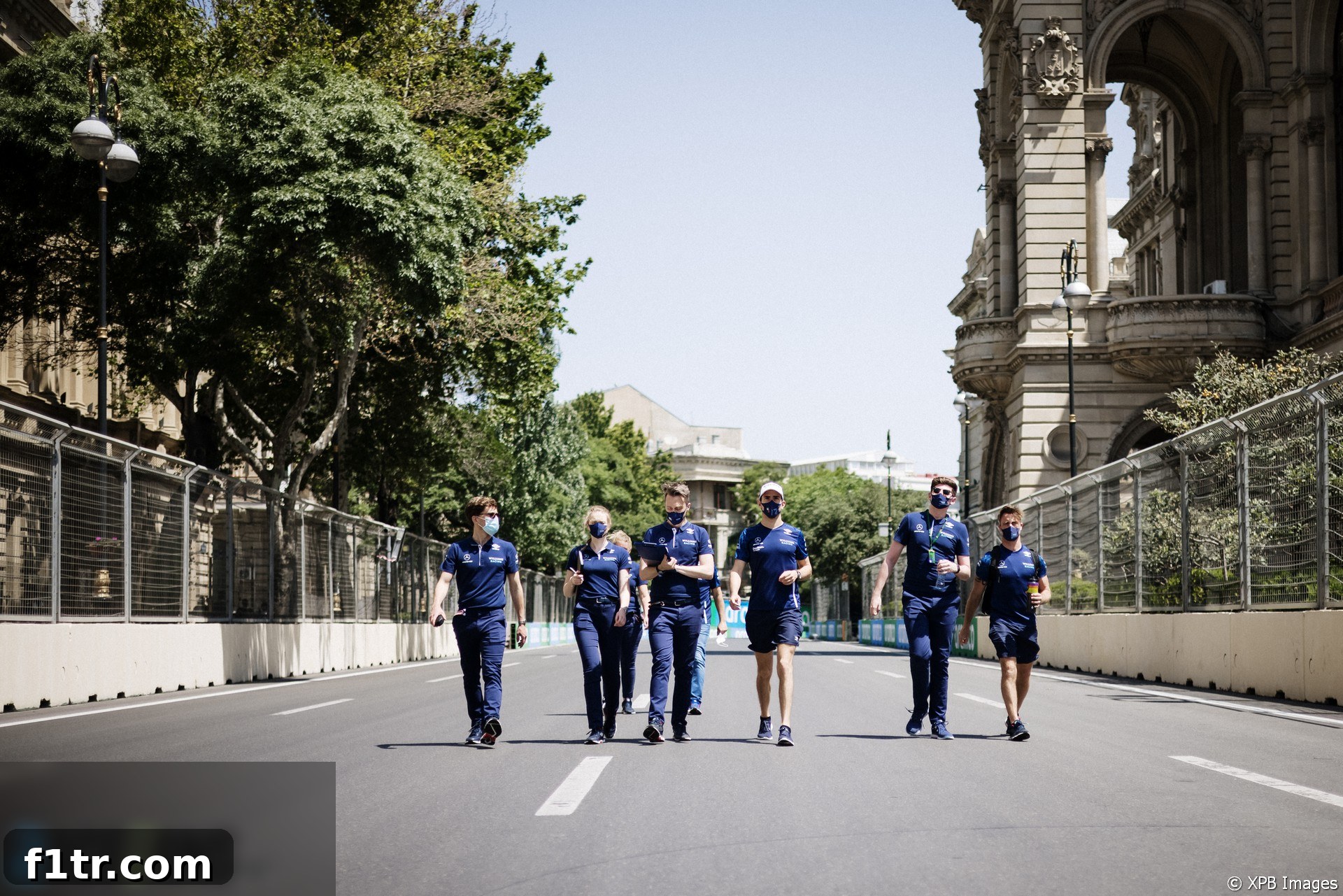
Nicholas Latifi, who possesses valuable prior experience on the Baku track from his Formula 2 days, echoed his teammate’s observations, adding further intricate detail to the complex wind patterns expected across the demanding circuit. “It’s obviously very, very windy but normally in street races you tend to get sheltering around the track, as was the case on the track walk this morning,” Latifi noted. His insight aligns perfectly with Russell’s idea that the surrounding urban structures would significantly influence and potentially mitigate the wind’s direct impact on the cars.
However, Latifi also highlighted another significant phenomenon: “You had some places, as well, where you get a lot of tunnelling, so it’s actually quite strong in some areas, but then it’s pretty much nonexistent in others. So it can be an issue depending on which direction and where you actually feel it.” This “tunnelling effect” suggests a highly localized and variable wind experience for the drivers. While some sections of the circuit might offer temporary respite from the wind, others, particularly narrow straights or sections between closely packed buildings, could experience intensified gusts, creating unpredictable aerodynamic loads. Such variability poses a significant challenge for drivers, as car balance and grip levels could change drastically from one corner to the next, requiring constant micro-adjustments and exceptional car control.
Adding a crucial note of hope and expectation, Latifi also shared his belief that the overall wind intensity would diminish over the course of the race weekend. “We’ll have to see in FP1, but I think it should die down over the next [few] days. Today is very, very extreme but hopefully it’s not the case when we get out there driving.” A reduction in wind strength and variability would undoubtedly be a welcome development for Williams, potentially mitigating their car’s inherent aerodynamic sensitivity and allowing them to focus more effectively on optimal car setup for the track’s unique characteristics.
Baku vs. Monaco: A Different Challenge, New Opportunities
Coming off the notoriously tight, low-speed, and exceptionally demanding Monaco Grand Prix, where overtaking is a rarity and track position is paramount, Nicholas Latifi expressed a palpable sense of optimism for Baku’s potential to offer a more competitive outing for Williams. While Monaco’s slow, bumpy characteristics tend to expose the FW43B’s inherent weaknesses, Baku presents a distinctly different kind of street circuit challenge, potentially playing more to Williams’ strengths.
“A lot of the corners here are quite all very similar, very slow 90-degree corners. We tend to struggle a bit more in the slow speeds,” Latifi candidly admitted, acknowledging a known vulnerability of the Williams car. This struggle with low-speed performance was clearly evident in Monaco, a circuit dominated almost entirely by such demanding sections, leaving little room for recovery.
However, Baku’s unique layout offers several contrasting characteristics that could significantly play into Williams’ hands. “It’s no secret, that was the case in Monaco. But at the same time, there are slightly different characteristics. It’s not as bumpy here. It’s obviously much longer straights,” Latifi elaborated. The smoother track surface in Baku reduces the disruption to aerodynamic flow caused by bumps, which can be absolutely critical for maintaining consistent downforce and preventing the car from becoming unsettled. More significantly, the much longer straights, including the record-breaking 2.2-kilometer main straight, provide ample opportunities for overtaking and allow cars to truly stretch their legs, potentially offsetting some of the losses experienced in the slower, tighter, more technical sections of the track.
This challenging blend of incredibly slow, technical corners and blistering, high-speed straights demands a very specific and often compromised car setup from all teams. Engineers must find a delicate balance between the need for high downforce to maximize grip and cornering speed in the technical sections and low drag for achieving maximum straight-line speed on the long straights. “So I think it’ll definitely be quite a different set-up requirement from the car and I think it’ll be interesting to see how everyone tries to tackle that here,” Latifi remarked, highlighting the strategic depth required.
“But I hope it could be more competitive than Monaco and if opportunities present themselves, obviously it is a track you can overtake and make something happen,” Latifi concluded. The inherent potential for Safety Cars, red flags, and genuine overtaking moves on the Baku circuit makes it a race where unexpected results are always a possibility. For Williams, a team often reliant on strategic gambles and capitalizing on the chaos that often unfolds on street circuits, these opportunities could prove invaluable for breaking into the points-scoring positions, a crucial step in their ongoing development.
Advert | Become a RaceFans supporter andgo ad-free
The Stakes for Williams Racing in Azerbaijan
For Williams Racing, a team with a storied history in Formula 1 but currently navigating a significant rebuilding phase, every race weekend is an invaluable opportunity to demonstrate progress and close the gap to their midfield rivals. While a championship challenge remains a distant prospect, securing championship points, or even just consistently outperforming direct competitors, is crucial for team morale, driver development, and securing vital prize money that fuels future innovations. The Azerbaijan Grand Prix, with its high potential for drama, unexpected incidents, and significant strategic variations, often allows smaller teams to punch above their weight, making it a pivotal event on the calendar.
The careful management of aerodynamic sensitivity in the face of strong, unpredictable winds, coupled with a shrewd car setup that expertly balances the conflicting demands of slow corners and exhilarating long straights, will be paramount for Williams’ success. George Russell, consistently lauded for his exceptional qualifying prowess and his remarkable ability to elevate the Williams car beyond its inherent pace, will undoubtedly be looking to capitalize on any advantage the circuit or conditions present. Nicholas Latifi, growing steadily in confidence and experience with each race, will be focused on delivering a clean race, minimizing errors, and seizing any opportunities that arise from the unique and often chaotic Baku conditions. Their collective efforts and strategic decisions could ultimately determine if Williams can truly turn the formidable challenges of the wind and the circuit into a platform for a stronger, more competitive performance than their recent outings, signaling a positive trajectory for the team’s future.
2021 Azerbaijan Grand Prix Coverage
- Aston Martin also confirms it followed Pirelli’s tyre restrictions before crash
- Pirelli confirm teams not to blame for Baku tyre failures following investigation
- “Tyres should not explode like that” says Villeneuve as Pirelli prepares to reveal findings
- Why Alonso is able to enjoy F1 more now than when he left
- Penalty for Safety Car error was just one of Latifis frustrations in Baku
Browse all 2021 Azerbaijan Grand Prix articles