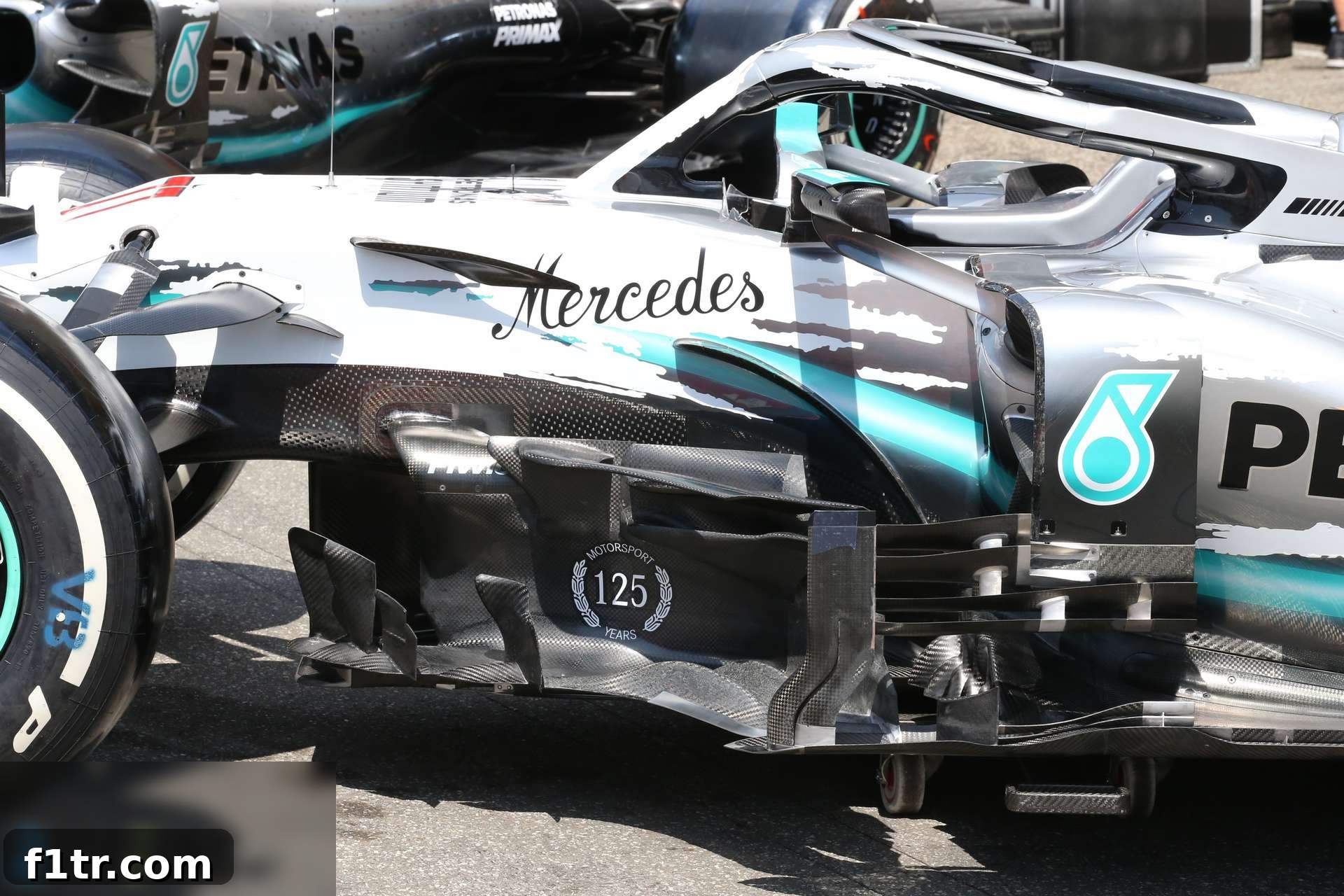
Mercedes Confronts Critical Cooling Challenge Ahead of High-Stakes German Grand Prix
The formidable Mercedes-AMG Petronas Formula 1 team, an undisputed titan of the 2019 season, found itself in an unusual predicament, grappling with a significant vulnerability that threatened to undermine its otherwise flawless campaign. As the Formula 1 circus prepared for the German Grand Prix at the iconic Hockenheimring, a familiar and troublesome adversary loomed: soaring ambient temperatures. This challenge had already exposed a rare chink in the armor of their dominant W10 challenger, prompting both anticipation and apprehension within the Silver Arrows camp.
Mercedes’ near-perfect season had been marred by only a single defeat prior to Hockenheim, and that loss, suffered in Austria, was directly attributable to severe cooling issues. The combination of intense heat and the Red Bull Ring’s above-average altitude created a perfect storm, pushing the W10’s thermal management systems beyond their operational limits. Both reigning champion Lewis Hamilton and his teammate Valtteri Bottas were forced into a compromising strategy, deliberately backing off the throttle for as much as 400 meters per lap. This drastic measure was necessary not to gain a strategic advantage, but simply to ensure their power units and crucial components survived the entire race distance without overheating. Such a concession was virtually unheard of for the meticulously engineered Mercedes machine, highlighting the gravity of the problem.
The Austrian Anomaly: A Deep Dive into the W10’s Vulnerability
The Styrian mountains had delivered a stark reminder that even the most dominant teams can face unforeseen hurdles. The Red Bull Ring, situated at an altitude of approximately 700 meters, presents a unique set of challenges for Formula 1 cars. The thinner air at higher elevations reduces the efficiency of cooling systems, as there is less dense air passing over radiators and intercoolers to dissipate heat. When coupled with scorching ambient temperatures, as experienced during the Austrian Grand Prix, this atmospheric phenomenon amplifies the thermal stress on critical components such: as the engine, turbocharger, MGU-H, and even the brakes and gearbox.
For Mercedes, a team renowned for its engineering prowess and meticulous attention to detail, the performance deficit caused by these conditions was particularly jarring. The W10, while an aerodynamic marvel and a powerhouse in most circuits, seemed to possess an inherent characteristic that made it less efficient in shedding heat compared to some of its rivals. The mandate to “lift and coast” for significant portions of the lap effectively meant sacrificing raw pace, turning what should have been a dominant performance into a damage limitation exercise. This incident not only cost them a potential victory but also ignited urgent discussions within the team about how to mitigate such vulnerabilities in future hot weather races. The looming threat of similar conditions at Hockenheim added immense pressure to find an effective solution.
Technical Remedies and Driver Reservations
In response to the identified cooling Achilles’ heel, Mercedes engineers worked tirelessly to introduce a raft of new components for the German Grand Prix. Valtteri Bottas, speaking ahead of the race weekend, confirmed the arrival of these updates, expressing cautious optimism about their potential impact. “We know our car is perhaps not the most efficient in hot conditions,” Bottas admitted, acknowledging the team’s ongoing struggle. “But we have some new bits for the cooling. Also, a pretty nice new aero package which should provide a general performance uplift to the car.”
The introduction of “new bits for the cooling” likely refers to modifications aimed at improving heat exchange efficiency. This could involve revised radiator designs, enhanced ducting to channel airflow more effectively through the sidepods, or even subtle changes to the engine cover geometry to optimize thermal exhaust. The simultaneous deployment of a “new aero package” suggests Mercedes wasn’t solely focused on cooling; they were also pursuing general performance gains, a standard practice in Formula 1’s relentless development race. An improved aerodynamic package could reduce drag, increase downforce, or enhance overall car balance, potentially offsetting some of the performance losses previously incurred due to cooling-induced backing off.
However, despite the technical team’s efforts, Lewis Hamilton, known for his incisive understanding of the car’s behavior, tempered expectations. The five-time world champion conveyed a more pessimistic outlook regarding the immediate impact of these new components, suggesting that the problem ran deeper than what simple upgrades could address. “There’s not really much we can do,” Hamilton stated with a hint of resignation. He emphasized, “This is a much bigger design issue than we have when it gets hot. So it’s not so easy to change it. We are working towards it, but it’s very, very small steps and small increments which are not making a massive difference.”
Hamilton’s assessment pointed towards a fundamental architectural characteristic of the W10. A “bigger design issue” could imply that the cooling problem is intrinsically linked to the car’s overall aerodynamic philosophy, its internal packaging, or the fundamental layout of its power unit and ancillaries within the chassis. Changing such core design elements mid-season is exceptionally difficult, if not impossible, due to the prohibitive costs, time constraints, and the complexities of F1 regulations. It would necessitate a substantial redesign of significant portions of the car, which is typically reserved for a new car concept in subsequent seasons. Therefore, Hamilton’s realism stemmed from the understanding that while incremental improvements are always pursued, a complete overhaul of this inherent vulnerability might be beyond the scope of in-season development. This perspective underscored the tension between engineering ambition and practical limitations, a constant balancing act in elite motorsport.
The Crucial Role of Weather: A Double-Edged Sword
Amidst the technical discussions and driver assessments, the weather forecast emerged as an equally significant, if not more critical, factor for Mercedes’ prospects at the German Grand Prix. With temperatures initially predicted to soar to an oppressive 39°C at Hockenheim, the specter of Austria loomed large. However, a glimmer of hope appeared in the form of a revised forecast indicating a potential drop in temperatures for Saturday’s qualifying session and, crucially, the likelihood of rain during Sunday’s race.
Lewis Hamilton candidly expressed his reliance on this meteorological reprieve. “Hopefully this weekend will be okay in that sense,” he remarked, acknowledging the team’s predicament. “I’d imagine if it stays this hot we’re going to be in trouble. If the next race is hot we’re going to be in trouble, just on the edge, as we were in Austria. But fingers crossed the weather comes.” Lower ambient temperatures naturally reduce the thermal load on the car’s systems, making cooling more efficient and allowing the W10 to run closer to its optimal performance window without fear of overheating. This would effectively mask, or at least significantly mitigate, the car’s inherent cooling deficiency.
Valtteri Bottas echoed Hamilton’s sentiments regarding the weather, expressing an almost eagerness for the rain to arrive. “We haven’t had any proper wet running this year, so it would be nice to try,” he stated, highlighting the strategic opportunities presented by challenging conditions. “I wouldn’t mind if it happens here.” Rain, while introducing its own set of complexities such as reduced grip and visibility, often acts as a great equalizer. It can shuffle the competitive order, potentially favoring teams that are adept at managing wet conditions, or those whose core dry-weather weaknesses are less exposed. Mercedes, generally strong in all conditions, might even see this as an advantage, providing a chance to prove their versatility and potentially catch rivals off guard. The unpredictability of a wet race could also create scenarios where strategic gambles pay off, adding another layer of intrigue to the German Grand Prix.
Bottas further elaborated on the collective hope for cooler conditions: “We definitely wish [the temperature’s] going to be less than tomorrow. But I’m sure these kind of extreme temperatures we will not be the only team struggling, and like I said, also with the new parts in terms of the cooling it should make our life easier.” This observation is crucial: if Mercedes is struggling, it’s plausible that other teams, especially those pushing their cars to the limit, could also encounter similar thermal challenges. While Mercedes might have a specific Achilles’ heel, extreme heat tests the limits of every F1 machine. In a scenario where multiple teams are battling overheating, the relative disadvantage of the W10 might be lessened, or even inverted if their new parts provide a marginal but critical improvement.
Championship Implications and the Road Ahead
The 2019 Formula 1 season had, until this point, been largely defined by Mercedes’ unwavering dominance. Yet, the persistent cooling issues at high temperatures represented the most significant threat to their championship aspirations. While comfortably leading both the Drivers’ and Constructors’ standings, the team knew that every vulnerability offered an opportunity for rivals like Ferrari and Red Bull Racing to close the gap. The German Grand Prix, with its unique challenges, was therefore not just another race, but a critical test of Mercedes’ adaptability and resilience.
The team’s ongoing pursuit of solutions, from incremental cooling updates to comprehensive aerodynamic revisions, underscores the relentless pace of development in Formula 1. Each race weekend is a microcosm of engineering ingenuity, strategic foresight, and driver skill. For Mercedes, navigating the Hockenheimring’s expected heat and potential rain would be a delicate balancing act, requiring optimal car setup, shrewd race strategy, and faultless execution from Hamilton and Bottas. Their ability to manage this specific technical challenge would not only determine their performance in Germany but also provide crucial insights for the remainder of the season, particularly as the F1 calendar often features races in equally demanding hot climates.
The Hockenheimring, with its blend of high-speed straights and technical stadium section, promised a thrilling spectacle. Whether Mercedes would finally conquer its cooling demons, or if the extreme conditions would once again expose their W10’s rare weakness, remained the burning question. The German Grand Prix was set to be a captivating chapter in the 2019 championship battle, with the weather forecast adding an extra layer of strategic complexity and drama to an already high-stakes affair.
Explore More F1 Insights:
- In-depth Technical Review: The Mercedes W10’s Strengths and Weaknesses
- Race Report: The 2019 Austrian Grand Prix and Mercedes’ Cooling Struggles
- Lewis Hamilton: A Career Defined by Dominance and Adaptability
- The 2019 F1 Championship Battle: Key Moments and Turning Points
- Understanding Cooling Systems: How F1 Teams Manage Extreme Temperatures
Browse all 2019 F1 season articles
Support our independent Formula 1 coverage