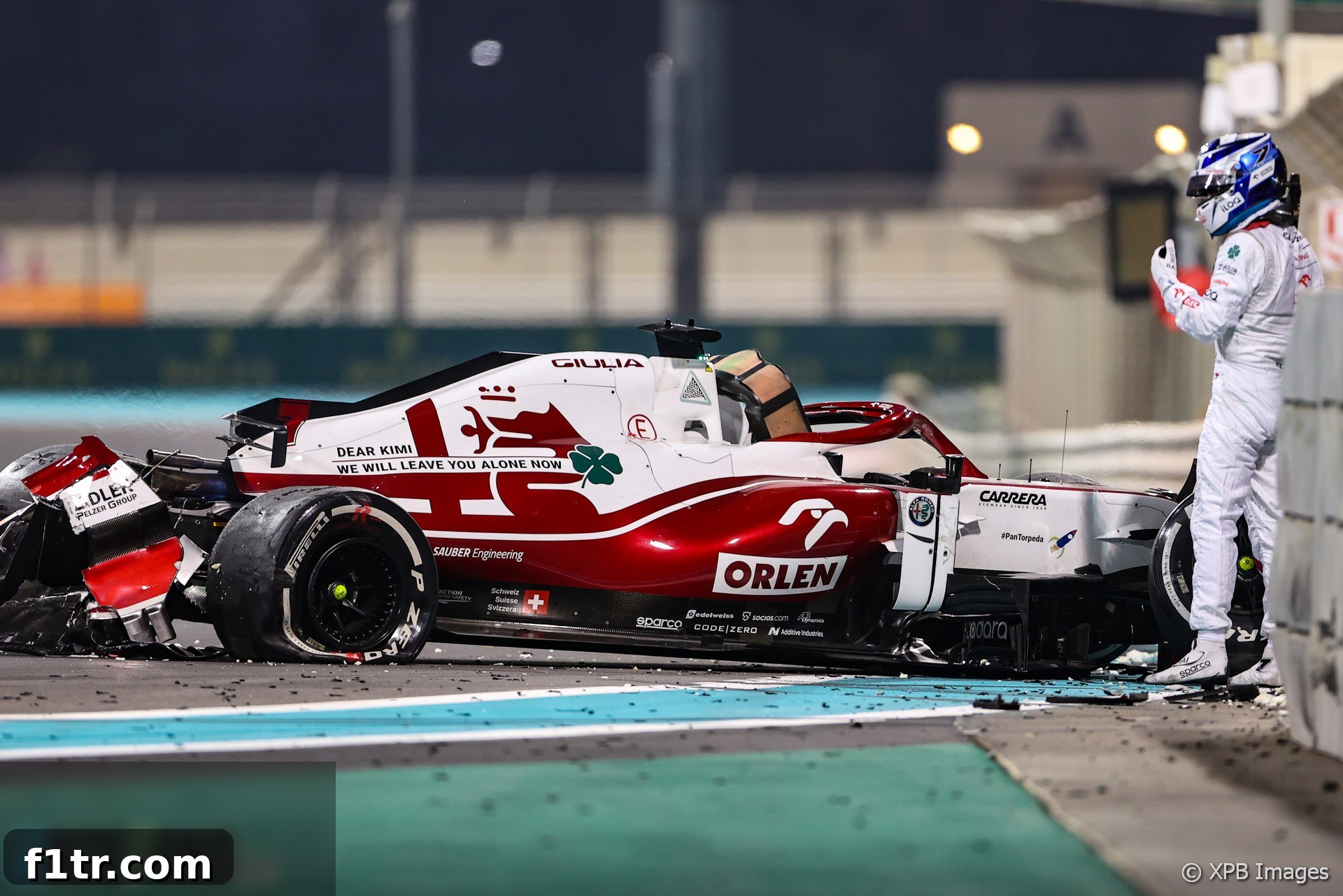
The electrifying Formula 1 Abu Dhabi Grand Prix, the ultimate showdown poised to crown either Lewis Hamilton or Max Verstappen as the 2021 World Champion, kicked off with a dramatic Friday practice session. Mercedes’ Lewis Hamilton asserted his authority by topping the timesheets, signaling a formidable start to his title assault. In a turn of events, Esteban Ocon unexpectedly secured the second-fastest time for Alpine, showcasing impressive pace. However, the session wasn’t devoid of incident, culminating in a significant crash for Kimi Raikkonen during his final Grand Prix weekend.
Hamilton Takes Command: Mercedes Displays Early Dominance
As the setting sun cast long shadows across the recently modified Yas Marina Circuit, Lewis Hamilton wasted no time in making his intentions clear. The seven-time world champion delivered a blistering lap of 1’23.691, a benchmark that placed him a substantial three-tenths of a second ahead of Esteban Ocon and a significant six-tenths clear of his fierce championship adversary, Max Verstappen. This commanding performance from Hamilton and the Mercedes-AMG Petronas F1 Team sent an unequivocal message to the paddock, instilling a crucial sense of confidence and momentum as they head into the decisive stages of the season.
The revitalized Yas Marina layout, featuring a reprofiled Turn 9 hairpin and a faster, sweeping section through the hotel area, was specifically designed to enhance overtaking opportunities and increase overall speeds. Drivers quickly discovered that while these changes promised more excitement, they also introduced new layers of complexity. The fresh tarmac offered exceptional grip, but demanded absolute precision and commitment, particularly through the tighter, re-engineered corners and the high-speed chicanes. Mercedes appeared to have unlocked the secrets of these modifications with remarkable efficiency, with both Hamilton and his teammate, Valtteri Bottas, exhibiting strong pace and a finely tuned car setup throughout the practice session. Their ability to quickly adapt to the circuit’s nuances underscores their formidable engineering prowess and driver talent.
Ocon’s Alpine Shines, While Verstappen Battles Track Limits
While Lewis Hamilton’s P1 was largely anticipated, the true revelation of the session came from Esteban Ocon. The Alpine driver, piloting his A521, propelled himself to an astonishing second-fastest position. This was not a fleeting moment of glory; Ocon consistently demonstrated strong performance, hovering near the top of the leaderboard throughout the session. His impressive pace suggests that Alpine may have found an optimal setup for the Abu Dhabi circuit, positioning them to challenge the leading teams or at least consolidate their standing in the fiercely competitive midfield battle. Such a strong showing boosts Alpine’s morale and indicates their potential to disrupt the established order.
In stark contrast to the stellar performances from Mercedes and Alpine, Max Verstappen and Red Bull Racing appeared to be grappling with challenges in extracting maximum performance. The championship leader concluded the session in fourth place, trailing both Mercedes cars. A recurring point of concern for the Red Bull contingent was the issue of track limits. Verstappen had his fastest lap of the initial phase of the session invalidated for exceeding track limits in the final corner. This problem wasn’t unique to him, as other drivers, notably Fernando Alonso, also faced multiple lap deletions for similar infractions. These penalties underscore the unforgiving nature of the revamped circuit, where even marginal errors can lead to significant time losses and jeopardize positions. Red Bull will undoubtedly be working diligently to fine-tune their car setup and help Verstappen master the optimal racing lines to avoid such costly errors in Saturday’s crucial qualifying and Sunday’s main event.
On-Track Incidents: Bottas’s Scare and Latifi’s Heavier Impact
The newly reconfigured sections of the Yas Marina Circuit quickly revealed their demanding character, catching out several drivers throughout the practice session. Just ten minutes into the running, Valtteri Bottas, competing in his farewell race weekend with Mercedes, experienced a tense moment. He oversteered on the exit of Turn 14, a corner nestled under the circuit’s iconic hotel section, and momentarily brushed the unforgiving wall. The incident necessitated an immediate pit stop, where Mercedes mechanics meticulously inspected his right-rear wheel for any potential damage. Fortunately, after a brief delay of just over five minutes, Bottas was given the all-clear to return to the track, a testament to the robust construction of the Mercedes W12 and the rapid response of his dedicated pit crew. He swiftly regained his composure and pace, even managing to momentarily top the timesheets later in the session.
However, not all drivers emerged from their encounters with the circuit’s barriers as unscathed. Nicholas Latifi endured a more substantial collision. The Williams driver lost control of his car and spun through Turn 13, backing heavily into the barriers. Despite the considerable impact, Latifi displayed commendable composure, skillfully managing to extricate his damaged Williams from the wall and guide it back to the pit lane under his own power. This incident served as a stark reminder of the circuit’s challenging limits, especially as drivers push their machines to the absolute edge to extract maximum performance. Latifi’s mechanics were consequently faced with a busy evening, assessing and repairing the extensive damage to his car in preparation for Saturday’s critical practice and qualifying sessions. These incidents highlighted the fine line between pushing for pace and overstepping the mark on the demanding Abu Dhabi circuit.
Session Evolution: From Early Laps to Critical Race Simulation
The Friday practice session at Yas Marina unfolded as typically expected, beginning with initial installation laps and early runs conducted on medium compound tires. Lewis Hamilton set the early benchmark with a 1’24.126 on the mediums, as the sun began its majestic descent, bathing the circuit in a warm, golden glow. Valtteri Bottas, after his earlier brush with the wall, quickly regained his rhythm and confidence. He steadily improved his lap times, even briefly leapfrogging Hamilton to go fastest by almost half a tenth, underscoring Mercedes’ impressive baseline speed and their ability to adapt rapidly to changing conditions.
As the session matured and the track surface began to rubber in, teams transitioned to the softer compound tires for their crucial performance runs. It was during this phase that Hamilton truly unleashed the full potential of his Mercedes W12, breaking into the 1’23s for the first time and reclaiming the top spot from Esteban Ocon, who had briefly enjoyed the lead. The transition from broad daylight to twilight is a critical environmental factor at Yas Marina, as ambient and track temperatures steadily drop, significantly influencing grip levels and tire behavior. Teams painstakingly collected data throughout this period, simulating the exact conditions they anticipate for Sunday’s main race. The latter part of the session then saw a crucial shift in focus from raw single-lap pace to longer, more representative race simulation runs. These extended stints are vital for evaluating tire degradation, understanding fuel efficiency impacts, and gathering comprehensive data essential for crafting the optimal race strategy. The insights gained from these long runs are paramount for strategists in plotting their attack plan for the high-stakes, championship-deciding finale.
Raikkonen’s Unfortunate Farewell Moment
In a truly poignant moment during what was his penultimate Formula 1 Friday practice session, veteran driver Kimi Raikkonen suffered a crash that ultimately brought the session to a premature end under yellow flags. On what would be his final flying lap of the day, the 2007 World Champion lost control of his Alfa Romeo through the notoriously challenging Turn 14 – the very same corner where Bottas had earlier experienced a light touch with the wall. Raikkonen’s car spun violently, making primary contact with the wall at the rear before an unfortunate secondary impact damaged the front. Fortunately, the resilient “Iceman” was able to extricate himself from the heavily damaged C41 unassisted and unharmed, a powerful testament to the continually evolving safety standards in modern Formula 1.
However, the incident casts a long shadow over his dedicated mechanics. They now face the arduous and demanding task of repairing substantial damage to his Alfa Romeo before Saturday’s critical third practice and qualifying sessions. For a driver who has graced the pinnacle of motorsport for two illustrious decades, it was an undeniably unfortunate and somewhat symbolic conclusion to his final Friday at a Grand Prix, underscoring the relentless demands of Formula 1 even for its most experienced and legendary competitors. Despite this setback, the entire paddock and his legions of fans will undoubtedly be wishing for a stronger, safer, and more fitting farewell for Kimi Raikkonen in his last ever Grand Prix race.
Championship Decider Intensifies After FP2
With Friday practice for the Abu Dhabi Grand Prix now complete, the stage is meticulously set for an utterly thrilling and potentially historic race weekend. Lewis Hamilton’s dominant performance in FP2 provides Mercedes with a significant psychological and on-track boost, hinting at a potential performance advantage as the championship battle reaches its absolute climax. However, Max Verstappen and Red Bull are renowned for their incredible resilience and capacity to respond under pressure. They will undoubtedly be working tirelessly through the night, meticulously analyzing data, fine-tuning their car setup, and searching for every fraction of a second to unlock more pace. The track limit penalties incurred by both Verstappen and Alonso serve as a stark warning, unequivocally emphasizing the paramount need for surgical precision and disciplined driving around the challenging, revamped Yas Marina Circuit.
The various incidents involving Valtteri Bottas, Nicholas Latifi, and Kimi Raikkonen further underscore the demanding nature of the circuit, where even the slightest misjudgment or error can lead to significant consequences. Esteban Ocon’s surprising second-place performance adds an intriguing variable to the mix, suggesting that the midfield battle could be fiercely contested and potentially influence the intricate strategies of the front-runners. As all teams pour over the reams of data collected from the crucial long runs conducted under race-like conditions, the immediate focus will now shift intently to Saturday’s qualifying session. This session will be instrumental in determining the critical grid positions for Sunday’s monumental championship decider, which promises an unforgettable and dramatic conclusion to one of Formula 1’s most enthralling and fiercely fought seasons in recent memory.
2021 Abu Dhabi Grand Prix Second Practice Result
| Pos. | No. | Driver | Car | Best lap | Gap | Laps |
|---|---|---|---|---|---|---|
| 1 | 44 | Lewis Hamilton | Mercedes | 1’23.691 | 26 | |
| 2 | 31 | Esteban Ocon | Alpine-Renault | 1’24.034 | 0.343 | 29 |
| 3 | 77 | Valtteri Bottas | Mercedes | 1’24.083 | 0.392 | 29 |
| 4 | 33 | Max Verstappen | Red Bull-Honda | 1’24.332 | 0.641 | 25 |
| 5 | 11 | Sergio Perez | Red Bull-Honda | 1’24.400 | 0.709 | 26 |
| 6 | 14 | Fernando Alonso | Alpine-Renault | 1’24.495 | 0.804 | 27 |
| 7 | 22 | Yuki Tsunoda | AlphaTauri-Honda | 1’24.532 | 0.841 | 26 |
| 8 | 16 | Charles Leclerc | Ferrari | 1’24.557 | 0.866 | 29 |
| 9 | 55 | Carlos Sainz Jnr | Ferrari | 1’24.844 | 1.153 | 29 |
| 10 | 10 | Pierre Gasly | AlphaTauri-Honda | 1’24.940 | 1.249 | 27 |
| 11 | 3 | Daniel Ricciardo | McLaren-Mercedes | 1’24.959 | 1.268 | 26 |
| 12 | 99 | Antonio Giovinazzi | Alfa Romeo-Ferrari | 1’25.108 | 1.417 | 27 |
| 13 | 4 | Lando Norris | McLaren-Mercedes | 1’25.153 | 1.462 | 27 |
| 14 | 5 | Sebastian Vettel | Aston Martin-Mercedes | 1’25.195 | 1.504 | 27 |
| 15 | 18 | Lance Stroll | Aston Martin-Mercedes | 1’25.385 | 1.694 | 26 |
| 16 | 7 | Kimi Raikkonen | Alfa Romeo-Ferrari | 1’25.440 | 1.749 | 23 |
| 17 | 63 | George Russell | Williams-Mercedes | 1’25.549 | 1.858 | 29 |
| 18 | 6 | Nicholas Latifi | Williams-Mercedes | 1’25.687 | 1.996 | 22 |
| 19 | 47 | Mick Schumacher | Haas-Ferrari | 1’25.784 | 2.093 | 27 |
| 20 | 9 | Nikita Mazepin | Haas-Ferrari | 1’26.336 | 2.645 | 26 |
Second practice visual gaps
Lewis Hamilton – 1’23.691
+0.343 Esteban Ocon – 1’24.034
+0.392 Valtteri Bottas – 1’24.083
+0.641 Max Verstappen – 1’24.332
+0.709 Sergio Perez – 1’24.400
+0.804 Fernando Alonso – 1’24.495
+0.841 Yuki Tsunoda – 1’24.532
+0.866 Charles Leclerc – 1’24.557
+1.153 Carlos Sainz Jnr – 1’24.844
+1.249 Pierre Gasly – 1’24.940
+1.268 Daniel Ricciardo – 1’24.959
+1.417 Antonio Giovinazzi – 1’25.108
+1.462 Lando Norris – 1’25.153
+1.504 Sebastian Vettel – 1’25.195
+1.694 Lance Stroll – 1’25.385
+1.749 Kimi Raikkonen – 1’25.440
+1.858 George Russell – 1’25.549
+1.996 Nicholas Latifi – 1’25.687
+2.093 Mick Schumacher – 1’25.784
+2.645 Nikita Mazepin – 1’26.336
Drivers more than ten seconds off the pace omitted.
2021 Abu Dhabi Grand Prix Related Articles
- Masi ‘basically gifted the championship’ to Verstappen says 2021 FIA steward Sullivan
- Norris called out F1 over its farcical 2021 finale. Will it get it right this time?
- Why Mercedes put ‘a reminder of joy and pain’ on display in their factory lobby
- Hamilton would be an eight-time champion if Whiting was still alive – Steiner
- Verdict on error in GT race suggests Mercedes would have lost 2021 Abu Dhabi GP appeal
Browse all 2021 Abu Dhabi Grand Prix articles