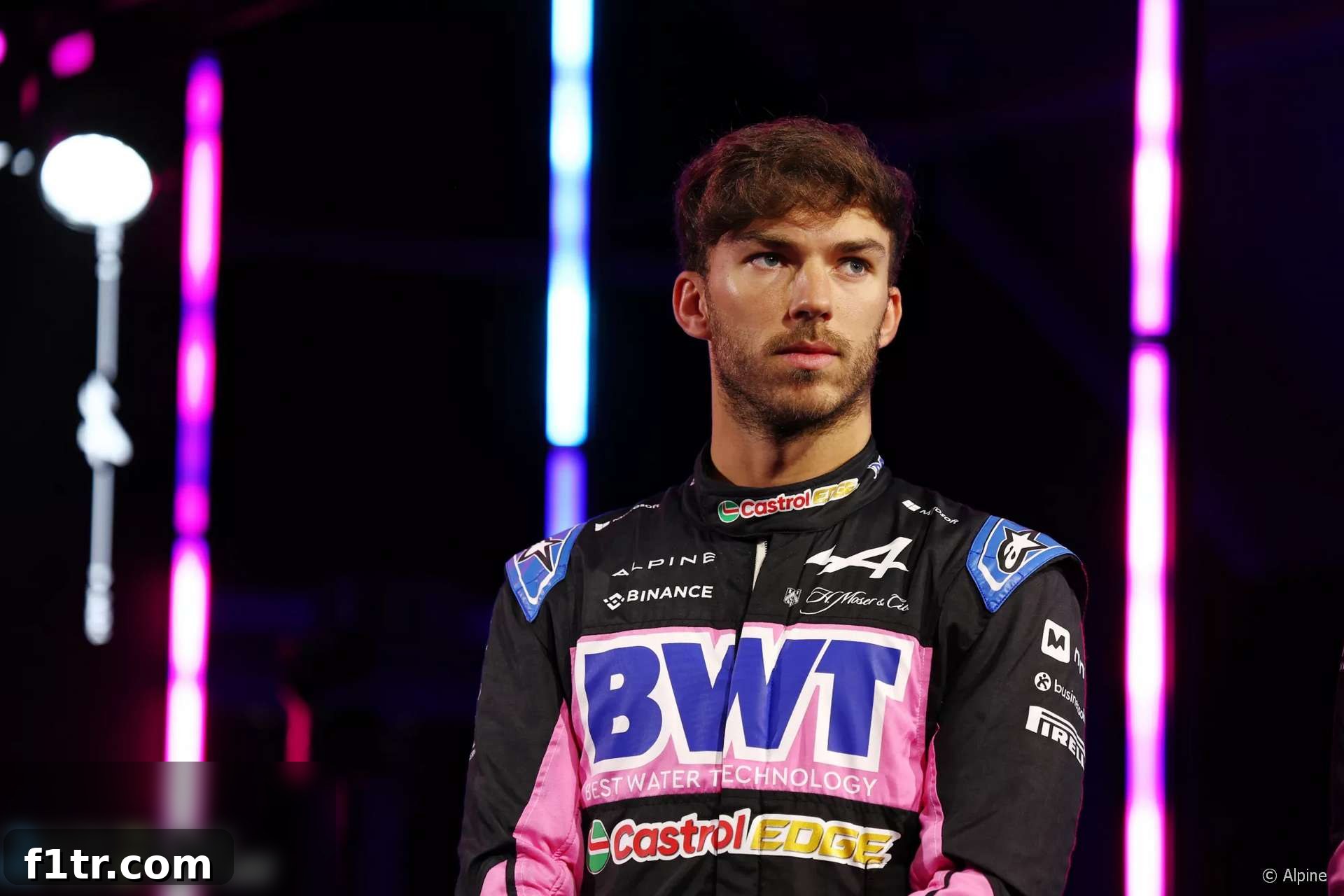
Pierre Gasly Ready for Stronger Second Season with Alpine F1 Team
As the roar of a new Formula 1 season approaches, Pierre Gasly stands on the precipice of his second year with the Alpine F1 Team. The French driver expressed palpable optimism and heightened confidence during the team’s car launch, a stark contrast to the initial tentative steps taken just 12 months prior. His rookie season with the Enstone-based outfit was a period of intense adaptation, but the groundwork laid in 2023 now promises a more integrated and performance-focused campaign. Gasly anticipates starting this season in a significantly better position, armed with a deeper understanding of his team and a clearer vision for success.
The Challenging Genesis: Adapting to a New F1 Home
Stepping into a new Formula 1 team, particularly one with the heritage and scale of Alpine, is far more complex than it appears from an outsider’s perspective. Twelve months ago, Gasly transitioned from AlphaTauri (now known as RB), a team where he had spent a significant portion of his F1 career, to a completely different environment. This move wasn’t merely about changing garages or wearing a different race suit; it involved a profound immersion into a new organizational culture.
“Last year, coming into a new team, it’s a much bigger task than what it seems like from the outside,” Gasly candidly explained to media, including RaceFans, at the recent car unveiling. This monumental task encompassed understanding every facet of the team’s operations – from the dynamic interplay between departments to the intricate organizational structures and the precise processes that govern every decision and action. It meant deciphering the unique way engineers communicate feedback, strategists devise race plans, and mechanics execute pit stops.
The learning curve was steep and demanding. Gasly highlighted how every interaction, every piece of information, and every adaptation required an extra layer of cognitive effort. “You’ve just got to understand the dynamic of the team and the organisations and the processes, the way of working, the way of communicating. Everything just drains you slightly more, it takes a bit more energy out of you. You’ve got to double-check everything.” This constant need to assimilate, cross-reference, and confirm information inevitably took a toll, diverting precious mental energy away from pure driving focus. It was a foundational year, essential for building the bedrock of future performance, but undoubtedly challenging.
Building Synergy: The Advantages of Continuity
Fast forward a year, and the landscape has dramatically shifted for Pierre Gasly. Having navigated the complexities of his initial integration, he now reaps the rewards of continuity and an established presence within the Alpine F1 Team. The unfamiliarity and constant questioning of his first year have been replaced by a deep-seated knowledge and mutual understanding with his colleagues.
“I know pretty much every single person in that room and every single people in the building behind you,” Gasly stated, underscoring the profound sense of belonging and familiarity he now feels. This extensive network of relationships, built over countless hours of collaboration and problem-solving, is invaluable in the high-pressure world of Formula 1. It means faster communication, intuitive cooperation, and a shared vocabulary when discussing car setup, race strategy, or performance analysis.
This established synergy allows Gasly to elevate his focus beyond the operational mechanics of the team. “I’m in a much better place now. I know all of that. I don’t need to worry about any of this and really focus on myself as an athlete, as a driver, really being fully focused on the physical side of things, working with the guys and figuring out this long season.” He can now channel his entire energy into optimizing his personal performance, refining his driving technique, and working seamlessly with his engineering crew to extract every ounce of potential from the car. The mental overhead of adaptation has vanished, leaving him free to concentrate on what he does best: driving at the absolute limit. This sense of being truly “in good shape” and “in a great place for the team” bodes well for a more impactful and consistent 2024 campaign.
On-Track Progress: A Strong Finish and Promising Foundations
The latter half of the 2023 season offered tangible proof of the growing cohesion between Pierre Gasly and the Alpine F1 Team. Despite the initial challenges, Gasly demonstrated his formidable talent by out-scoring his highly competitive teammate, Esteban Ocon, by four points over the season. A particular highlight was his stellar performance at the Dutch Grand Prix, where he secured a well-deserved podium finish – a crucial moment that injected confidence into both driver and team.
“I think we definitely made a step in the second part of the year,” Gasly reflected, attributing this improvement not just to his own adaptation but to a mutual understanding that developed within the technical staff. This wasn’t merely about Gasly learning the team, but the team learning Gasly. “That’s why I say I’m in a much better place because that time last year the team had no clue about what I need in terms of driving style, in terms of processes, in terms of communication.”
This dynamic learning process meant that as the season progressed, engineers began to better understand Gasly’s specific preferences and requirements for the car. His feedback became more precise, and the team’s responses became more targeted. This iterative loop of communication and technical adjustment was vital in refining the car’s setup to better suit his aggressive yet nuanced driving style. “I really felt like we made a big step forward on that side of things,” he emphasized. The culmination of this effort was a stronger finish to the year, leaving both parties with a positive outlook. “We were in a great place at the end of the year. I think we’re in an even better place now 12 months later. And that’s why I’m looking forward and feeling much more confident in that second year with the team.” This confidence is not just personal but deeply intertwined with the tangible progress made in their collaborative efforts.
A Blank Canvas: The New Concept Car and Driver Input
While the synergy between Pierre Gasly and the Alpine F1 Team has deepened, the introduction of a “completely new concept” car for the upcoming season presents a fresh set of challenges and opportunities. This radical departure from last year’s design means that drivers have had limited direct input during its formative stages, a natural consequence of developing a fundamentally different aerodynamic and mechanical platform.
“It was a completely new concept so we didn’t have much impact,” Gasly confirmed. Unlike incremental developments where drivers can guide specific adjustments based on known car characteristics, a ground-up redesign often relies heavily on simulation data, computational fluid dynamics (CFD), and wind tunnel testing in its initial phases. The design brief prioritizes maximizing theoretical performance and rectifying inherent weaknesses of the predecessor, rather than fine-tuning for individual driver preferences.
Despite this, the team’s understanding of both Gasly and Esteban Ocon’s general preferences still informs the design philosophy. “With Esteban obviously there’s constant feedback about what we want, what we need in the car to go faster. But based on last year’s car, this year is a completely different concept. They kind of get an idea of what car behaviour we want, but when you start from scratch like that, there’s so much unknown.” The core traits desired by drivers – such as stable rear end, responsive front end, or predictable braking – are always in mind, but the physical manifestation of these in a completely new package remains to be seen.
The true moment for driver influence will arrive with pre-season testing in Bahrain. This critical period allows the team to correlate simulation data with real-world performance and for drivers to provide tangible feedback on the car’s actual behavior. “I think it will basically come into play once we test the car in Bahrain and tell them what we need, what are the weaknesses what are the strengths of that car and what they’ve got to work on,” Gasly explained. Bahrain testing will be the crucible where theoretical design meets track reality, and where Gasly and Ocon will begin to shape the new A524 into a competitive racing machine, identifying critical areas for immediate development and long-term optimization.
Forward Momentum: Hopes, Hurdles, and High Expectations
As Pierre Gasly looks towards the looming 2024 Formula 1 season, his sense of renewed confidence is palpable, underpinned by a year of deep integration and mutual understanding with the Alpine F1 Team. While the new car concept introduces an element of the unknown, Gasly’s established rapport with his engineers and his clearer mental space mean he is exceptionally well-prepared to tackle whatever challenges lie ahead.
Alpine’s aspirations for the season are high, aiming to improve on their previous championship standings and consistently challenge for stronger points finishes. The transition from adaptation to execution for Gasly is crucial to realizing these ambitions. His ability to hit the ground running, provide incisive feedback from day one of testing, and work closely with the team to rapidly develop the A524 will be paramount.
The Formula 1 grid remains fiercely competitive, with every team striving for marginal gains. However, Gasly’s personal growth within Alpine, coupled with the team’s commitment to a bold new design, sets the stage for what could be a significantly more productive and rewarding season. The journey begins in Bahrain, where the collective effort of driver and team will define the initial trajectory of their 2024 campaign, fueled by the conviction that the foundations for success have been firmly laid.