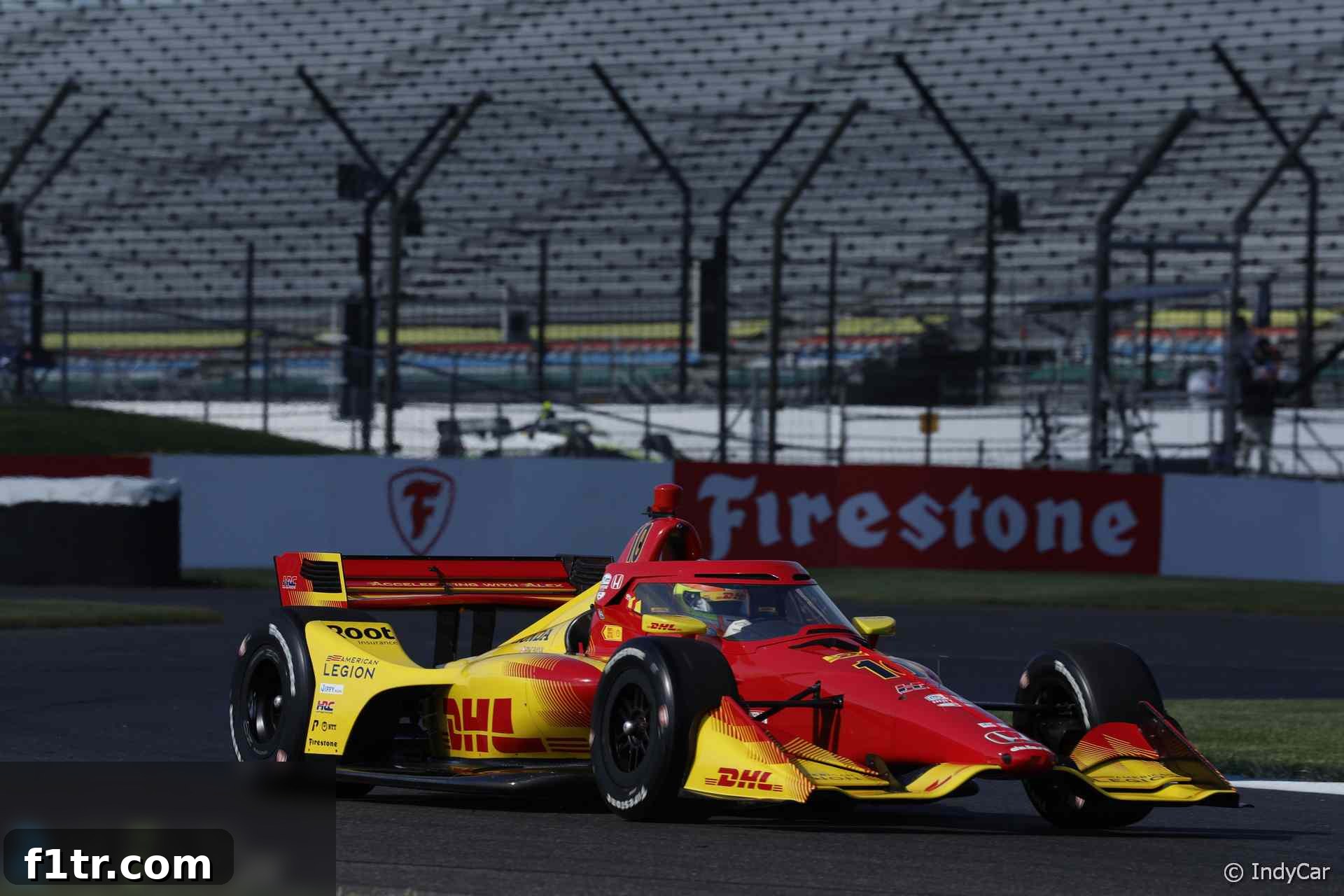
The exhilarating 2024 NTT IndyCar Series season continued its tradition of fierce competition and unpredictable outcomes as Alex Palou, driving for Chip Ganassi Racing, secured a stunning pole position for the upcoming IndyCar Grand Prix at the iconic Indianapolis Motor Speedway. In a qualifying session defined by microscopic margins and high-stakes drama, Palou’s precision and nerve ultimately prevailed, further extending the exciting streak of different pole-winners this year and setting a compelling stage for Sunday’s race.
The road course at Indianapolis, a challenging blend of the famous oval’s turns and a technical infield section, demands absolute perfection from drivers and engineers alike. With lap times consistently dipping below the 70-second mark, fractions of a second separated the contenders, turning every corner into a potential make-or-break moment. This intense pressure was palpable throughout the qualifying stages, culminating in a nail-biting Fast Six shootout where the slightest error could cost a coveted spot on the front row and impact crucial championship points.
Alex Palou Claims Hard-Fought Pole Amidst Intense Indianapolis Qualifying
Alex Palou’s journey to pole position was a masterclass in controlled aggression and meticulous execution. While several rivals showcased blistering pace, it was Palou who pieced together the perfect lap when it mattered most. His final effort in the Fast Six session was a testament to his growing stature in the series, navigating the 2.439-mile circuit with remarkable accuracy to edge out his closest competitors by mere hundredths of a second. This pole is not just a personal triumph for Palou but also a significant statement from Chip Ganassi Racing, underscoring their consistent performance and strategic prowess in a highly competitive championship.
The session proved to be a harsh mistress for even the most seasoned drivers, with at least two of Palou’s primary contenders seeing their chances for pole position evaporate due to critical errors in the final moments of their fastest laps. Such is the unforgiving nature of IndyCar qualifying, where the pursuit of perfection often pushes drivers to the very limit, sometimes just beyond it, highlighting the razor-thin margins that define success in top-tier motorsport.
Rivals’ Near Misses: Will Power and Christian Lundgaard’s High-Stakes Errors
One of the most dramatic narratives of the session unfolded around two-time IndyCar champion Will Power. The Team Penske driver, known for his qualifying prowess and an impressive record of 70 career poles, arrived at the Fast Six with a clear strategic advantage, having preserved two fresh sets of the softer alternate tyres – a tactical move designed to give him an edge when grip was at its premium. Power initially set a formidable benchmark, leading the early runs and indicating he was a strong candidate for pole position. However, his lead was short-lived as Christian Lundgaard, representing Rahal Letterman Lanigan Racing, temporarily snatched the top spot with a blistering lap.
Lundgaard himself was on an incredibly strong run, building a significant advantage of several tenths of a second through the early sectors of his final flying lap. Yet, the young Dane, in his eagerness to maximize performance, squandered this precious lead with a crucial misjudgment in the notoriously tricky final sector of the circuit, losing precious time. The pendulum then swung back towards Palou, who, with an immaculate display of car control and precision, managed to pip Lundgaard’s time by a mere nine-hundredths of a second, an almost imperceptible margin that decided the provisional pole.
Yet, the drama was far from over. Will Power still had one final run left, a golden opportunity to reclaim pole position and add to his legendary tally. As he pushed the limits, attempting to extract every last ounce of speed, Power admitted to becoming “a little too greedy” with the kerb in Turn 10. This particular corner, following a fast straight, demands precise entry and a smooth exit. The subsequent necessity for a dab of correction on the way out of the turn, a momentary lift or steering adjustment, proved devastatingly costly. This minute error bled precious tenths of a second from his lap time, enough to deny him pole and extend his wait for a first pole position of the current season, leaving him visibly frustrated with what could have been. These instances perfectly encapsulate the razor-thin margins that define IndyCar competition, where every millisecond counts and the difference between glory and disappointment is often imperceptible to the naked eye.
The Fast Six Showdown: Front Row Glory and Championship Contenders
The culmination of the qualifying session, the Fast Six shootout, presented a compelling grid for the IndyCar Grand Prix. Alex Palou’s exceptional performance earned him the coveted pole position, placing him at the very front of the field. This dominant starting spot provides him with the strategic advantage of clear track ahead, crucial for managing tires and fuel in the early stages of the race. Alongside him on the front row, a career-best qualifying effort saw Christian Lundgaard secure a strong second place. This front-row pairing sets up an intriguing battle, with both drivers eager to convert their raw pace into a race victory.
The second row features two formidable forces from Team Penske: Will Power, despite his qualifying error, still demonstrated incredible pace to secure third, showcasing his consistent speed. His teammate Josef Newgarden, the reigning Indianapolis 500 champion and a proven winner on road courses, qualified in fourth. Their presence on the second row ensures that Team Penske will be a significant threat, bringing their strategic acumen and proven race craft to the forefront of the competition. Occupying the third row are two drivers who have already tasted victory in the opening rounds of the championship: Pato O’Ward, winner of the season opener, and the veteran six-time champion Scott Dixon. Their positions, though not on the front two rows, are still strong starting points from which they can launch their assaults on the leaders, further highlighting the depth of talent and competitive balance in the NTT IndyCar Series, promising a truly unpredictable race.
Tight Margins Define Fast 12: High Stakes, High Pressure in Midfield Battle
The intensity of the qualifying session was perhaps most acutely felt during the Fast 12 segment, where the battle for progression into the final Fast Six was incredibly fierce. The margins were astonishingly narrow, with drivers separated by mere hundredths of a second across the board. Graham Rahal, for instance, found himself in ninth position, but was only a tenth of a second shy of claiming fifth place – a stark illustration of the brutal competitiveness where a fraction of a second can mean the difference between a prime starting spot and a challenging midfield position. Such small differences can have significant implications for race strategy, track position, and ultimately, championship points as the season progresses.
Drivers who successfully navigated this challenging stage to secure spots ahead of Rahal included Alexander Rossi, who continues to show strong form and consistency since his move to Arrow McLaren, and Marcus Armstrong, who is steadily building momentum in his rookie IndyCar career for Chip Ganassi Racing. However, for others, the Fast 12 marked the end of their qualifying aspirations. Felix Rosenqvist, a consistent front-runner in previous sessions and a known talent on road courses, along with Pietro Fittipaldi and Rinus Veekay, unfortunately failed to progress beyond this penultimate stage. Their earlier exits mean they will have a harder task in Sunday’s race, needing to overcome more traffic and fight for track position from deeper in the field, making their race strategy all the more critical.
Unexpected Exits: Championship Leader and Race Winners Face Challenges
The qualifying session also delivered several major surprises and disappointments in the earlier rounds, shaking up the expected grid order and creating fascinating storylines for the main event. The most notable casualty was championship leader Colton Herta, who failed to reach the Fast 12. In a costly miscalculation by his Andretti Global team, Herta opted to stay out for an extra lap in their attempt to improve his time, only to run out of fuel before he could complete a valid flying lap. This strategic blunder, a rare but impactful error, will see one of the championship’s leading contenders starting much further back than anticipated, creating a significant challenge for him to overcome on race day and potentially impacting his championship standing early in the season.
Joining Herta in an unexpectedly low starting position was Romain Grosjean. Ironically, this very circuit at Indianapolis Motor Speedway was where Grosjean secured his maiden IndyCar pole position just three years prior, a testament to his natural speed on road courses. However, on this occasion, the Frenchman will start in 23rd place, one spot ahead of Herta, underlining the fickle nature of motorsport and the constant evolution of team and driver performance in the series. Notably, recent arrival Luca Ghiotto, making his presence felt in the competitive field, will start just ahead of Grosjean, showcasing the depth of international talent joining IndyCar.
Another significant driver to drop out early was Scott McLaughlin, the dominant winner at Barber Motorsports Park just two weeks ago. His unexpected exit in the initial rounds means the formidable Team Penske driver will start a challenging 13th, a position from which he will need to employ all his race craft to move through the field. McLaughlin’s early departure highlights the unpredictable and highly competitive nature of the IndyCar Series, where past success offers no guarantee of future qualifying glory, especially on a demanding road course like Indianapolis where track evolution and car setup are paramount. These unexpected results promise an even more enthralling Grand Prix, as many top-tier drivers will be eager to charge through the field from less-than-ideal starting positions, guaranteeing action from lights out.
Looking Ahead: The Indianapolis Grand Prix Race Strategy and Championship Implications
The stage is now impeccably set for a thrilling IndyCar Grand Prix at the Indianapolis Motor Speedway. While qualifying determines the starting grid and provides a crucial advantage, the race itself is a different beast entirely, requiring a strategic masterclass. The complexities of tire management, fuel conservation, flawless pit stop execution, and expert navigation through challenging traffic will all come into play. Alex Palou, starting from the coveted pole position, holds a distinct advantage with clear track ahead and the ability to dictate the early pace and manage his tires without battling turbulent air.
However, the depth of talent throughout the grid, particularly with drivers like Will Power, Josef Newgarden, Pato O’Ward, and Scott Dixon starting close behind, guarantees that Palou will face immense pressure from the drop of the green flag. These seasoned competitors are known for their aggressive race craft and strategic prowess, capable of capitalizing on any slight error. For those starting further back, such as championship leader Colton Herta and recent race winner Scott McLaughlin, the Grand Prix will be an arduous exercise in calculated aggression and intelligent overtaking. The Indianapolis road course provides opportunities for passing, but also carries inherent risks, making clean starts and early gains crucial for making progress through the pack.
The championship implications of this race are also significant, especially for Herta, who will be looking to mitigate the damage of a poor qualifying performance by climbing as many positions as possible and salvaging valuable points. Conversely, Palou and other front-runners will be aiming to capitalize on their strong starting positions to consolidate or improve their standings in the fiercely contested championship battle. Fans can anticipate a captivating event filled with high-speed action, tactical battles, daring overtakes, and potential upsets, truly embodying the unpredictable and competitive spirit of IndyCar racing at one of motorsport’s most legendary venues.
Qualifying Result Highlights
The full qualifying times showcased the incredibly tight competition across all sessions, with top drivers often separated by fractions of a second. While specific times are typically detailed post-session, the key takeaway remains the extraordinary closeness of the field, a hallmark of the NTT IndyCar Series, promising a fiercely contested race.
More IndyCar News & Analysis
Explore more in-depth coverage and analysis from the world of IndyCar:
- IndyCar driver McLaughlin cleared of injury after crashing through barrier at Barber
- Schumacher says his IndyCar feels like ‘an F2 car, just with better tyres’
- IndyCar “way faster than Formula 1” in some corners, says Grosjean
- FIA to award more F1 superlicence points to IndyCar drivers from 2026
- Schumacher to race full-time in IndyCar with RLL in 2026
Browse all IndyCar articles