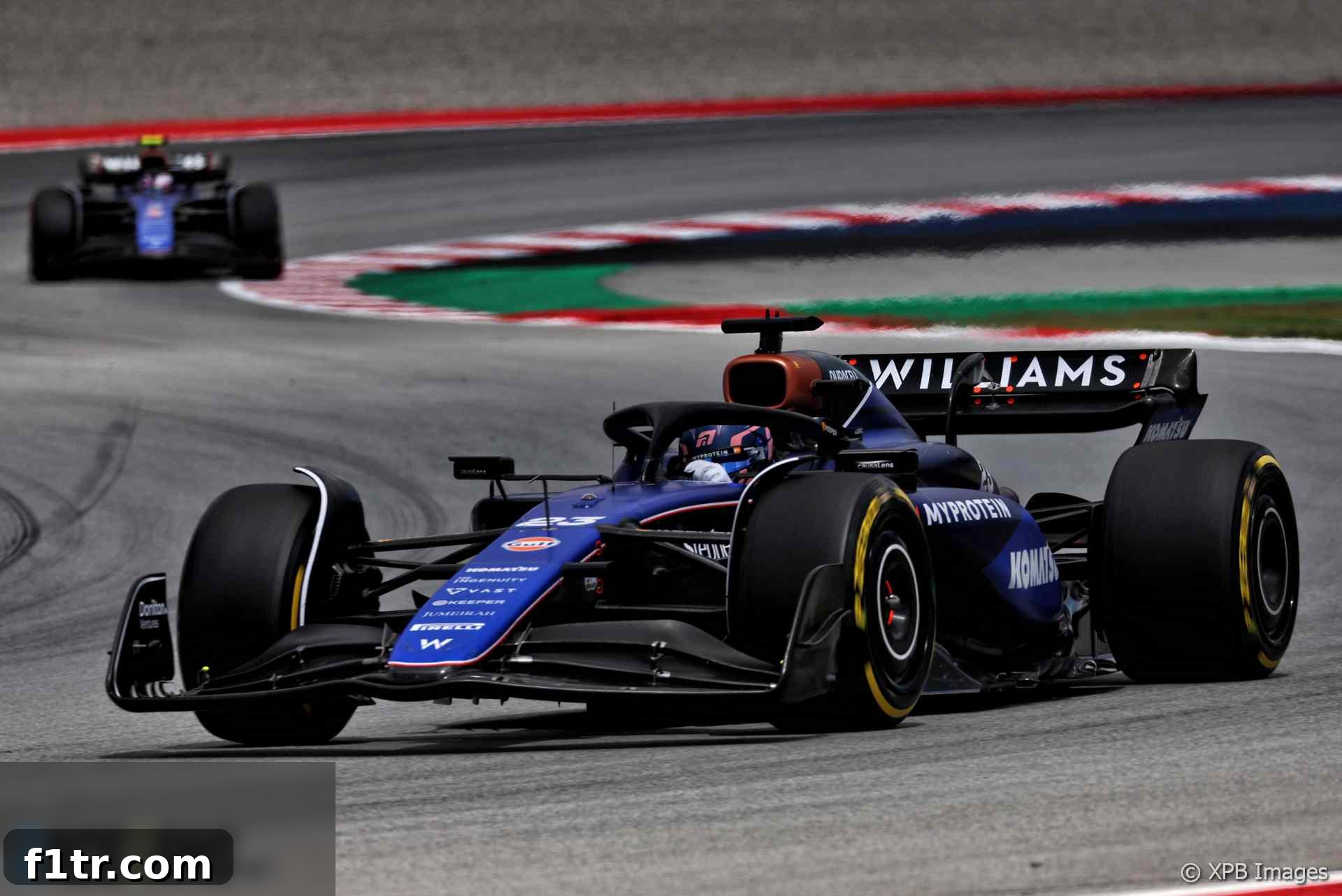
Alexander Albon, a key figure for the Williams Racing team, recently shed light on a peculiar incident that saw him unexpectedly depart the track at Turn 4 during the Spanish Grand Prix. The unforeseen excursion, which raised immediate concerns and prompted a sharp radio exchange with his race engineer, James Urwin, has since been thoroughly investigated by the team. What initially appeared to be a perplexing loss of control, triggering a flurry of questions from the frustrated driver, was ultimately attributed to a powerful gust of wind. This revelation not only clarified the cause of Albon’s off-track moment but also highlighted the intricate and often unpredictable challenges faced by Formula 1 drivers, even in seemingly stable conditions.
Advert | Become a Supporter & go ad-free
The dramatic radio conversation, broadcast globally, captured the tension and confusion in the cockpit. Albon, visibly perplexed by his car’s behavior, repeatedly sought an explanation from Urwin, demanding answers for an incident that felt entirely out of character for the car’s capabilities. For a driver of Albon’s experience, such an unexpected loss of grip pointed to something beyond typical driving error or car limitations. Williams’ subsequent investigation, leveraging extensive telemetry and weather data, confirmed their initial suspicions that a significant environmental factor – a sudden, strong gust of wind – was the culprit, a factor that can dramatically alter a car’s delicate aerodynamic balance, especially in high-speed corners.
Albon expressed his profound surprise regarding the incident, emphasizing that he was operating well within the perceived limits of his FW46 car as he navigated Turn 4. He stated unequivocally that he was in a tire-saving mode, a state where drivers typically adopt a less aggressive approach, far from pushing the absolute boundaries of grip. “I was tyre-saving through [turn] four, so it was a bit odd,” Albon explained to the official F1 channel. His insistence on finding an immediate answer stemmed from his intimate understanding of the car’s capabilities. “I wanted an answer because I know what the limit of the car is, and that wasn’t the limit,” he asserted, underlining his belief that an external force must have been at play. The subsequent confirmation of the strong wind gust provided the clarity he sought, but the initial uncertainty left a lasting impression. He admitted that every subsequent pass through Turn 4 during the remainder of the race was approached with an “extra cautious” mindset, a testament to the unsettling nature of an unexplained loss of control.
This incident serves as a stark reminder of the fine margins in Formula 1. Even the slightest alteration in environmental conditions, like a sudden shift in wind direction or velocity, can have disproportionate effects on these aerodynamically sensitive machines. For Albon, a driver known for his acute car feel and ability to extract performance from challenging machinery, the unexpected breakaway was deeply unsettling precisely because it defied his extensive experience and established feel for the car’s limits. It wasn’t merely a moment of losing grip; it was a moment where the car behaved in a way that contradicted his internal understanding of its performance envelope, necessitating a thorough investigation for both driver confidence and team understanding.
Beyond the specific incident, Albon characterized the entire Spanish Grand Prix weekend as a “reality check” for the Williams team. The circuit in Barcelona, with its mix of high-speed corners and technical sections, is traditionally considered a benchmark for car performance, offering little hiding place for deficiencies. Williams found themselves struggling significantly, qualifying slowest overall and culminating in Albon finishing 18th, only two positions ahead of his teammate, Logan Sargeant, who crossed the line last. This performance starkly highlighted the fundamental challenges currently facing the Grove-based outfit.
Albon elaborated on the team’s struggles, pointing to inherent characteristics of their current car package. “I think we’ve come to a more traditional circuit, obviously we are overweight and we are carrying, I think, a little bit less downforce than other people,” he candidly admitted. The issue of the car being “overweight” means that Williams is carrying excess mass compared to the minimum weight limit, which directly translates to slower lap times, reduced agility, and increased tire wear. This is a significant disadvantage on any track, but particularly on circuits that demand precise handling and rapid changes of direction. Coupled with “less downforce,” their car simply cannot generate the same level of grip through corners as their rivals, leading to a profound deficit in cornering speed and overall performance. These two factors combine to make their car less competitive on circuits like Barcelona, which demand a well-rounded and aerodynamically efficient package.
The team acknowledges that their car tends to “take advantage of tracks that are a little bit more different.” This often refers to circuits with unique characteristics that might mitigate their inherent weaknesses, such as very low-downforce tracks where outright aerodynamic efficiency is less critical, or street circuits where driver skill and bravery can sometimes overshadow raw car performance. However, traditional circuits like the Circuit de Barcelona-Catalunya brutally expose a car’s fundamental flaws. “It was a tough one, we knew it was going to be a tough one,” Albon conceded, indicating a pre-race understanding within the team about the difficulties they were likely to face. Despite the challenging weekend, there remains an optimistic outlook for upcoming races. Albon expressed hope for “better things for Austria and Silverstone,” suggesting that these tracks might be more forgiving to the FW46’s current characteristics or that planned upgrades could start to make a difference. The team is in a continuous battle to shed weight and improve aerodynamic efficiency, knowing these are the keys to unlocking more consistent performance.
Impact of Wind on F1 Car Performance
The impact of sudden wind gusts on a Formula 1 car, particularly one already struggling with downforce, cannot be overstated. Modern F1 cars are meticulously engineered to slice through the air, generating immense downforce that essentially glues them to the track. This aerodynamic dependency means that even minor disruptions to the airflow can have significant consequences. A strong side wind or a sudden headwind/tailwind can drastically alter the car’s balance, effectively reducing the downforce generated by the wings and floor. In a high-speed corner like Turn 4 in Barcelona, where drivers are already pushing close to the grip limit, an unexpected gust can instantaneously compromise the car’s stability, leading to an abrupt loss of traction, as experienced by Albon. The car becomes unpredictable, making it incredibly difficult for the driver to react and correct in time. Williams’ ability to pinpoint this environmental factor through detailed telemetry, cross-referencing car data with meteorological readings, speaks to the advanced analytical capabilities now common in F1, allowing them to differentiate between mechanical issues, driver error, and external influences.
Albon’s Radio Messages After He Went Off
The radio communications between Alexander Albon and his race engineer, James Urwin, immediately following the Turn 4 incident, provide a fascinating, real-time glimpse into the pressure and uncertainty experienced during a Grand Prix. Albon’s initial, frustrated query – “What the hell was that?” – perfectly encapsulates the confusion of a driver encountering unexpected car behavior. Urwin’s initial assessment, “Looks all okay from our side,” was clearly inadequate for Albon, who pressed for a more thorough explanation, highlighting the immediate need for a diagnostic beyond superficial observations.
| Urwin | Okay, Tsunoda three behind. |
| Albon | What the hell was that? |
| Urwin | Looks all okay from our side. |
| Albon | No it’s not okay. Don’t just say that within five seconds. |
| Urwin | So we see some front wing damage. |
| Albon | Yeah but what was the problem with the car. |
| Albon | I don’t care about front damage. |
| Urwin | At the moment we just think it was locking but we’re checking. |
| Urwin | Alex we are still looking at it. |
| Urwin | Four laps remaining. |
| Albon | We’re sure it’s not wind or nothing? In turn four. I don’t really understand when the car does that kind of stuff. |
| Urwin | Yeah it does look like it was probably wind. So there was a gust, 17kph, at that point. |
This exchange underscores the critical role of immediate and accurate information flow in Formula 1. As Urwin relayed information about “front wing damage,” Albon’s focus remained on the root cause of the incident: “Yeah but what was the problem with the car. I don’t care about front damage.” This prioritization of understanding the car’s behavior over immediate consequence is typical of a top-tier driver. The engineer’s subsequent updates, initially suggesting “locking” and then promising further investigation, show the real-time diagnostic process unfolding. It wasn’t until closer to the end of the race that Urwin could confirm Albon’s own suspicion of an external factor: “Yeah it does look like it was probably wind. So there was a gust, 17kph, at that point.” This confirmation, albeit delayed, validated Albon’s feel for the car and offered a clear, non-mechanical explanation for the bewildering moment.
Advert | Become a RaceFans supporter andgo ad-free
Future Hopes and Challenges for Williams
Looking ahead, Albon’s cautious optimism for Austria and Silverstone stems from a detailed understanding of these circuits’ characteristics relative to the FW46. The Red Bull Ring in Austria is a faster, more flowing track with fewer slow corners and significant elevation changes. If Williams can manage their drag effectively, the fast straights and sweeping corners might allow their package to perform more competitively, especially if they can bring targeted upgrades to reduce drag or improve straight-line speed. Silverstone, a high-speed, high-downforce circuit, might seem counter-intuitive given their stated lack of downforce. However, some sections, particularly the iconic Maggotts, Becketts, and Chapel complex, reward a stable, aerodynamically balanced car, and perhaps Williams anticipates a fundamental step forward in their aero development by then, or that the characteristics of these specific corners might play to other strengths of their chassis, or simply that the overall package will have matured.
The “reality check” in Spain serves as a crucial data point for Williams’ development path. Understanding precisely where the car struggles and why (overweight, low downforce on traditional circuits) allows the engineering team to focus their resources. The incident with Albon, specifically, provides valuable data on how external factors like wind interact with their car’s aerodynamics, an important consideration for future design and setup. For a team striving to climb the grid, every piece of information, every struggle, and every small victory contributes to a clearer picture of what needs to be done. The journey for Williams to consistently compete in the midfield is a marathon, not a sprint, and weekends like the Spanish Grand Prix, while tough, are integral to their learning and improvement process.
Albon’s role in this process is paramount. As the team’s most experienced driver, his precise feedback and ability to articulate the car’s behavior are invaluable. His frustration on the radio wasn’t just about the incident itself but about the desire for answers that would help the team understand and improve. His ability to sense that “it wasn’t the limit” of the car speaks volumes about his expertise and his commitment to pushing Williams forward. The team’s ongoing effort to optimize the FW46 involves a relentless pursuit of weight reduction, aerodynamic refinement, and a better understanding of how the car behaves across diverse track types and environmental conditions. The Spanish Grand Prix may have been a sobering experience, but it was also a crucial learning opportunity for a team determined to regain its competitive edge in Formula 1.
Miss nothing from RaceFans
Get a daily email with all our latest stories – and nothing else. No marketing, no ads. Sign up here:
2024 Spanish Grand Prix
- Russell ensures Norris has still never kept his lead from pole position
- Williams repeatedly switch floors in search for Sargeant’s missing downforce
- “Why’s he not defending?”: How Russell sank to fourth after stunning start
- What radio calls reveal about Verstappen’s controlled pace and Perez’s struggles
- 2024 Spanish Grand Prix weekend F1 driver ratings
Browse all 2024 Spanish Grand Prix articles