The Unfolding Saga: A Deep Dive into the Lewis Hamilton vs. Max Verstappen Rivalry
The 2021 Formula 1 championship battle between Max Verstappen and Lewis Hamilton captivated the world with its unparalleled intensity, marked by a series of on-track clashes, incidents, and dramatic collisions that escalated with each passing race. This bitter fight pushed both drivers to their limits, both mentally and physically. Following the conclusion of that tumultuous season, Lewis Hamilton, a seven-time world champion renowned for his strategic and often calculated driving style, openly acknowledged the need for a shift in his approach. Ahead of the 2022 season, the Mercedes driver made a bold declaration: “I will be a more aggressive driver this year. You’ll see.”
This statement set the stage for intriguing questions about how their rivalry would evolve. However, for much of the 2022 season, the competitive landscape of Formula 1 prevented a true test of Hamilton’s renewed aggression. The Mercedes W13 chassis struggled to match the pace of the dominant Red Bull RB18, meaning Hamilton rarely found himself in direct, wheel-to-wheel combat with Verstappen at the front of the field. The opportunities for the two titans to seriously dispute the same piece of asphalt, as they did so frequently in 2021, were few and far between. Yet, as the 2022 season progressed and Mercedes found improved form, the potential for a renewed clash resurfaced. Finally, at the Brazilian Grand Prix, the racing world witnessed another chapter in their storied rivalry, as contact was once again made. This latest tangle provided the first real glimpse into whether Hamilton had indeed made good on his pledge to toughen up against Verstappen. To understand the significance of this, we must revisit the history of their most notable on-track encounters, tracing the evolution of what has become one of Formula 1’s most compelling rivalries.
The Genesis of a Fierce Rivalry
While the 2021 season cemented their rivalry as legendary, the roots of the Hamilton-Verstappen dynamic stretch back years, with several notable run-ins predating their championship showdown. Early encounters offered glimpses of Verstappen’s uncompromising style and Hamilton’s initial, more cautious approach when the stakes weren’t a world championship title.
2018 Bahrain Grand Prix: The First Spark
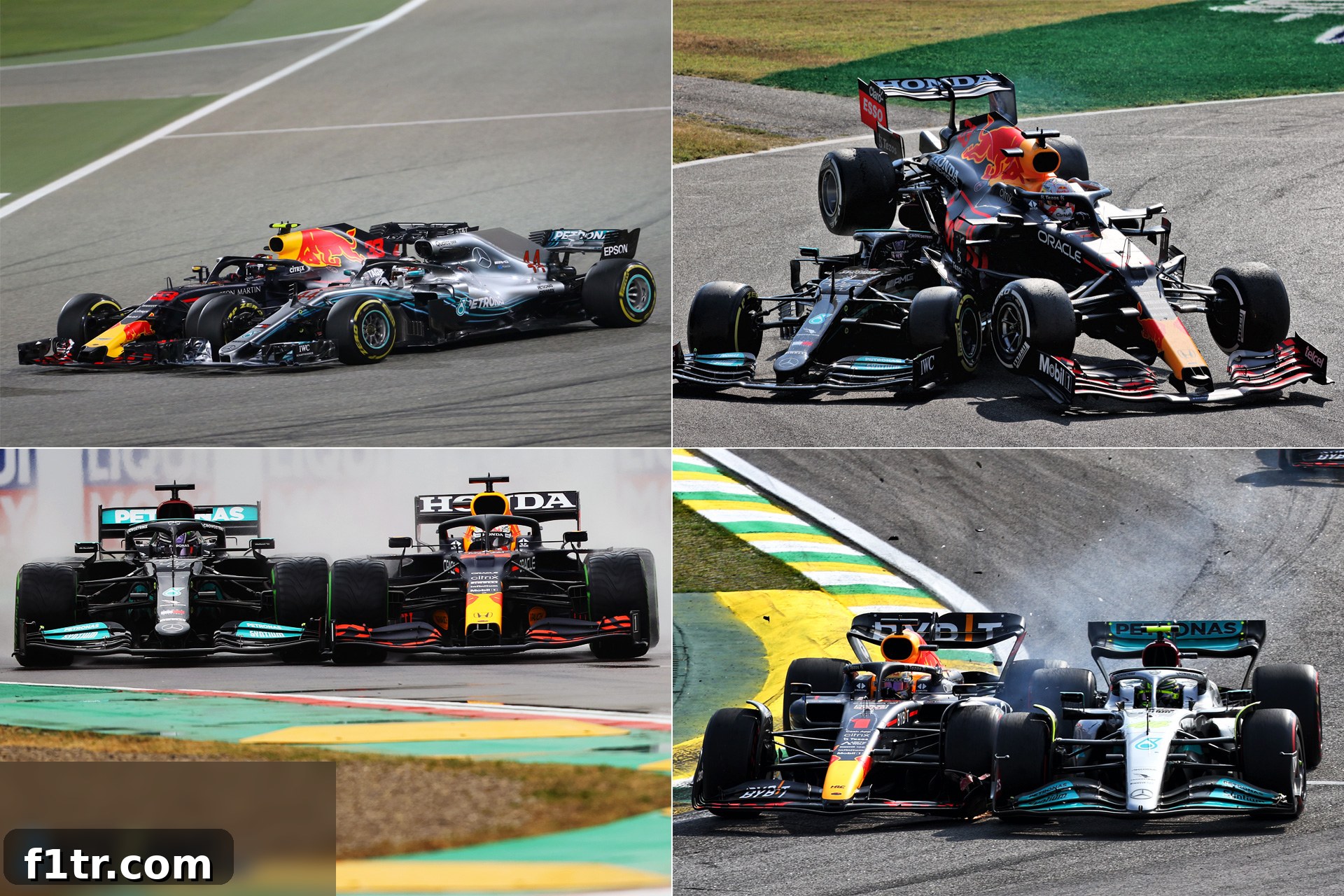
Their first significant clash occurred at the second race of the 2018 season, the Bahrain Grand Prix. Hamilton started ninth on the grid due to a gearbox change penalty, while Verstappen began from 15th after a qualifying crash. Despite their grid positions, both drivers quickly scythed through the field. By the end of lap one, Verstappen was aggressively in Hamilton’s slipstream, positioning himself for a move into turn one. He lunged down the inside, attempting to pass Hamilton. Verstappen, however, didn’t quite complete the overtake before the apex and utilized the full width of the track on the exit, leaving Hamilton with a difficult choice: back out or risk going off the circuit.
Hamilton chose to back off, but in doing so, he made slight contact with Verstappen’s rear-left tyre, resulting in a puncture for the Red Bull driver that forced him out of the race. The race stewards reviewed the incident but decided against issuing any penalty, a decision that left Verstappen visibly frustrated. “He drove into my left-rear, gave me a puncture and also destroyed the diff,” Verstappen complained, clearly believing Hamilton was at fault for not leaving him sufficient room. Hamilton, who went on to finish third, offered a different perspective, stating, “I just backed out because I knew he was going to try to run me wide. But then he just kept going. He didn’t need to keep going to the edge of the track.” He also suggested that Verstappen’s “immaturity” was costing him results, laying bare the differing philosophies and mutual frustrations that would characterize their future battles. This incident was a precursor, highlighting the contrasting approaches and the unwillingness of either driver to yield easily.
2019 Monaco Grand Prix: A Principality Tussle
The tight, unforgiving streets of Monaco are notoriously difficult for overtaking, yet this did not deter Max Verstappen from launching a daring attack on Lewis Hamilton for the lead in 2019. With only three laps remaining in the race, Verstappen, fired up by an earlier five-second time penalty for an unsafe release in the pit lane, dived for the inside line at the Nouvelle Chicane. In his aggressive maneuver, he nudged Hamilton’s left-rear tyre, sending both cars into the run-off area. Despite the contact and the hair-raising moment, Hamilton managed to hold on to secure the victory, showcasing his composure under immense pressure. Verstappen, despite his valiant effort, dropped from second to fourth in the final classification due to his earlier penalty, underscoring the fine margins and critical errors that can define a Monaco Grand Prix.
Verstappen’s comments after the race highlighted his mindset: “As soon as I heard the penalty I was just pushing Lewis really hard.” He added, “There was no one to blame, also we didn’t have any real damage.” This incident, while not ending in a catastrophic collision, demonstrated Verstappen’s relentless pursuit of victory, even in the most challenging environments, and his willingness to test the limits against an opponent of Hamilton’s caliber.
2019 Mexican Grand Prix: Championship Considerations and Contrasting Approaches
The 2019 season saw another notable incident that underlined the differing priorities and driving philosophies between Hamilton and Verstappen. Earlier that year, at the Hungarian Grand Prix, Hamilton had successfully passed Verstappen to win, largely aided by significantly fresher tyres. Reflecting on that battle, Hamilton expressed enjoyment: “As soon as I got into second I was like ‘okay, this whole battle we’ve been talking about me and Max having, we’re going to have that today’,” Hamilton said. “And it was really awesome.” However, he also admitted to playing it safe due to his championship position. “He put the car in some good places, I gave him space and more today, but that’s just from the mindset that we’re fighting slightly different,” he explained. He prophetically added, “If we were fighting over the same points it may have been a lot more aggressive but there was no need for that today.”
These words proved prophetic as, by the time Formula 1 arrived in Mexico, Hamilton was virtually assured of his sixth world title, firmly in points-collecting mode. A first-lap collision with Verstappen was the last thing he desired. The circumstances bore a striking resemblance to Bahrain a year prior: Verstappen attempted an inside pass into a tight right-hander that led into a left. On this occasion, the Red Bull driver got slightly out of shape, making contact with Hamilton, destabilizing the Mercedes, and causing a messy tangle between the pair. Regardless of how it transpired, Hamilton’s post-incident remarks made it clear he now viewed Verstappen as a driver who required “special handling.” He stated, “Every driver is slightly different. Some are smarter. Some are very smart, aggressive and some are silly with it.” This thinly veiled critique hinted at Hamilton’s growing frustration with Verstappen’s aggressive tactics, setting the stage for the dramatic clashes that would define their 2021 championship fight.
The Calm Before the Storm: 2020 and the Looming Battle
The pandemic-disrupted 2020 season, largely dominated by Lewis Hamilton and Mercedes, featured relatively few direct incidents of note between the two rivals. The Mercedes W11 was a class apart, and Verstappen, while often the “best of the rest,” rarely found himself in a position to challenge Hamilton directly for wins with the consistency required to spark renewed conflicts. This brief lull, however, was merely the calm before the storm, as the 2021 season would prove to be radically different, elevating their rivalry to unprecedented levels of ferocity and controversy.
2021: The Championship Explodes into Conflict
From the opening round in Bahrain, 2021 promised to be the year Hamilton and Verstappen would finally face each other in a close, season-long championship contest. Despite their history, few anticipated the mutual antagonism and on-track intensity would reach such a peak, with each race seemingly adding another layer to their escalating conflict.
2021 Emilia-Romagna Grand Prix: An Aggressive Opening Statement
After an opening victory for Hamilton in Bahrain where Verstappen had to cede the lead for running off track, the stage was set for the Emilia-Romagna Grand Prix at Imola. Verstappen, starting third, made a rapid getaway. As he challenged for the lead into the Tamburello chicane, he adopted an uncompromising line, forcing Hamilton onto the steep kerbs on the outside. This aggressive move secured Verstappen the lead but left Hamilton’s Mercedes with a slightly damaged front wing. The incident was a clear statement of intent from Verstappen, signaling his determination to seize every opportunity and establish dominance, even if it meant risking contact and leaving his rival little room. It set an early tone for the season, demonstrating the fierce, no-holds-barred nature of their championship fight.
2021 British Grand Prix: Silverstone’s High-Stakes Collision
The rivalry reached a fever pitch at Hamilton’s home race, the British Grand Prix at Silverstone. Verstappen arrived with a commanding 32-point lead, having secured four wins from the previous five races. He further extended his advantage by winning F1’s inaugural sprint race, putting him on pole for the grand prix. However, on Sunday, Hamilton made a superior getaway, challenging Verstappen intensely through the opening corners. As they screamed towards the ultra-fast Copse corner, Hamilton was still alongside the Red Bull. Verstappen moved back towards the racing line before swinging right into the corner, with Hamilton positioned on his inside. The ensuing contact was catastrophic for Verstappen, sending his Red Bull careening into the Copse barrier at high speed. He was later taken to hospital for precautionary checks, fortunately escaping serious injury.
To the immense fury of Verstappen and Red Bull Racing, the incident ultimately had no terminal consequence for Hamilton. The race was red-flagged, allowing Mercedes to repair the potentially race-ending damage to Hamilton’s car. The stewards ruled that Hamilton was “predominantly” to blame for the collision and issued a 10-second time penalty. Despite this setback, Hamilton delivered a sensational performance, scorching through the field to win the race, much to the delight of the home crowd. Red Bull were outraged, taking the unprecedented step of enlisting reserve driver Alexander Albon to recreate Hamilton’s line during a subsequent test session as a pretext to demand a review of the penalty decision. Their request was denied, but the incident deeply intensified the personal animosity and team rivalry, with accusations and counter-accusations flying between the two camps.
2021 Italian Grand Prix: Monza’s Horrifying Moment
Just weeks after the high-speed drama of Silverstone, the two rivals collided again at Monza, the ‘Temple of Speed,’ though this time at much lower speeds with a potentially more dangerous outcome. Verstappen had been running strongly in second place behind Daniel Ricciardo until a slow pit stop severely hampered his race. Hamilton, having completed his own pit stop, emerged from the pit lane just ahead of the Red Bull. As they approached the Rettifilo chicane, Verstappen attempted to overtake Hamilton around the outside into Turn 1, but remained behind the Mercedes on entry. He then tried to hold the inside line for the following left-hander (Turn 2), driving over the high kerb on the inside. This maneuver caused his car to ride up onto the Mercedes, with Verstappen’s Red Bull quite literally landing on top of Hamilton’s car, the rear wheel coming precariously close to Hamilton’s head. Both drivers were immediately out of the race.
The stewards again deemed Verstappen “predominantly” to blame for the collision, noting that his car “was not at all alongside car 44 [Hamilton] until significantly into the entry into Turn 1.” They further elaborated, “In the opinion of the stewards, this manoeuvre was attempted too late for the driver of car 33 [Verstappen] to have ‘the right to racing room’.” Verstappen was handed a three-place grid penalty for the subsequent race in Russia. This incident, while not as fast as Silverstone, highlighted the sheer aggression and determination of both drivers, particularly Verstappen’s relentless pursuit of an overtake, even when the space was minimal and the risks were high. It further solidified the narrative of two drivers unwilling to concede an inch to each other.
2021 Brazilian Grand Prix: Defensive Masterclass or Excessive Driving?
With just four Grands Prix remaining in the 2021 season, the championship arithmetic was stark for Hamilton: to be assured of the title, he needed to win every race, assuming Verstappen consistently finished second. At the Brazilian Grand Prix at Interlagos, the Mercedes was undoubtedly the quicker car, but Hamilton faced an uphill battle after penalties for a power unit change and a technical infringement forced him to start from the back. Verstappen was the final hurdle he needed to overcome to take the lead.
This situation presented a significant dilemma for Hamilton, a scenario that would repeat in the final races of 2021. He needed to find a way past Verstappen without risking race-ending contact. A collision that eliminated both drivers would play directly into Verstappen’s hands, as it would leave Hamilton with one less opportunity to close the points gap. Verstappen, keenly aware of this dynamic, pushed his defensive tactics to new extremes. As they approached Descida do Lado, Turn 4 at Interlagos, Hamilton moved ahead of Verstappen on the outside. In a desperate attempt to hold the position, Verstappen braked exceptionally late, missed the apex of the corner, and ran off the track on the exit. Crucially, Hamilton, anticipating this move, had left himself just enough room to avoid a collision, a testament to his experience and strategic thinking. He successfully caught and passed Verstappen later to secure a crucial victory.
To the surprise of many, the stewards took no immediate action over the incident. This decision sparked considerable debate among drivers and pundits, especially given that similar moves had resulted in penalties earlier in the year. Mercedes successfully petitioned the stewards to review their decision after new video footage from Verstappen’s forward-facing camera emerged, but after careful consideration, they ultimately upheld the decision not to penalize Verstappen. This outcome further fueled the controversy surrounding their rivalry and reinforced Verstappen’s reputation for aggressive, uncompromising defense.
2021 Saudi Arabian Grand Prix: The Controversial Brake-Test
The penultimate race of the 2021 season, the inaugural Saudi Arabian Grand Prix, delivered another dramatic and controversial chapter in their escalating rivalry. On lap 37, the increasingly familiar scenario of Hamilton attempting to pass Verstappen on the outside of a corner played out once more. This time, Verstappen again got crossed up, taking to the run-off area, while Hamilton, ever the tactician, scrabbled back onto the track as quickly as possible. Recognizing that Verstappen had gained an advantage by going off-track, Red Bull instructed their driver to give the position back to Hamilton. However, Verstappen chose to do this immediately before a DRS (Drag Reduction System) zone, a move that would grant him an instant opportunity to re-pass the Mercedes. Hamilton, anticipating this tactic, also backed off as he closed on the Red Bull, leading to a truly bizarre and dangerous sequence of events.
With both drivers seemingly trying to avoid being the one ahead into the DRS zone, Verstappen dramatically hit the brakes, causing Hamilton to run into the back of his car. The stewards unequivocally ruled that Verstappen had braked “suddenly and significantly” and “in a manner which caused a collision.” For this, he was handed a 10-second time penalty, in addition to an earlier five-second penalty for gaining an advantage by going off the track. Miraculously, Hamilton emerged from the chaos to win the race, his car still carrying visible damage from the contact. The incident ensured that both drivers headed into the final race of the season level on points, setting the stage for an unforgettable, if highly controversial, championship decider. The Saudi Arabian incident was perhaps the most psychologically charged of all their clashes, blurring the lines between racing aggression and deliberate tactics.
2021 Abu Dhabi Grand Prix: The Decisive First Lap Controversy
While the events of the final lap of the 2021 Abu Dhabi Grand Prix became infamously etched into Formula 1 history, overshadowing nearly everything else, the controversy surrounding the title contenders’ first-lap dice was equally significant, yet often overlooked. Verstappen, starting from pole position, was immediately challenged by Hamilton, who brilliantly took the lead. As they approached Turn 6, Verstappen launched a daring dive down the inside in an attempt to reclaim the position. Hamilton, finding himself with insufficient room on the exit, had no option but to cut the chicane entirely to continue, while Verstappen remained on the track.
Despite Hamilton rejoining the track ahead of his rival, the race stewards reviewed the incident. They ultimately determined that Verstappen had forced Hamilton off the circuit and that the Mercedes driver had effectively yielded the time advantage he gained by going off-track. Consequently, no penalty was issued to either driver. This decision, like several others throughout the season, sparked heated debate and illustrated the fine line between aggressive racing and exceeding track limits, particularly when two drivers of such caliber were vying for the ultimate prize. It was yet another flashpoint in a season defined by their unyielding battle.
2022: A Different Dynamic, A Familiar Clash
For much of the 2022 Formula 1 season, the direct on-track encounters between Lewis Hamilton and Max Verstappen were a rare sight. Mercedes’ struggles with their W13 car meant that Hamilton was rarely in a position to challenge Verstappen’s dominant Red Bull for race victories. However, as the season drew to a close and Mercedes found a significant upturn in performance, the opportunity for their paths to cross again finally arrived at the Brazilian Grand Prix.
In the sprint race, Hamilton impressively navigated through the field, passing a wounded Verstappen. But it was in the main event that the two rivals truly faced each other in a wheel-to-wheel battle. Following a Safety Car restart, Verstappen aggressively attempted to go around the outside of Hamilton into the left-handed Turn 1. He managed to nose ahead, braking exceptionally late, but Hamilton was back in front by the exit of the corner. Verstappen then tried to seize the inside line for Turn 2. Hamilton, however, maintained his right to the corner, aiming for the apex, where the inevitable collision occurred. The stewards quickly ruled on the incident, finding Verstappen “predominantly” at fault. They stated that he “did not complete the pass in Turn 1 and his excess speed compromised his entry into Turn 2, at which point he made contact with Hamilton.” This resulted in a five-second time penalty for Verstappen.
The collision at Interlagos carried echoes of their Monza 2021 incident, once again raising questions about Verstappen’s uncompromising style and Hamilton’s response. While Hamilton was deemed to be in the right by the stewards, the incident reignited the long-standing debate: if the positions had been reversed, would Verstappen have afforded another rival as much space at the exit of Turn 1, knowing an aggressive move would be attempted into the next corner? This latest clash provided a fresh insight into the dynamic between these two extraordinary drivers, demonstrating that despite the differing competitive levels of their cars, the underlying tension and distinct driving philosophies remain.
The Enduring Question: Hamilton’s Aggression vs. Verstappen’s Tenacity
The 2022 Brazilian Grand Prix encounter leaves us with a lingering question: has Lewis Hamilton truly become the “more aggressive driver” he vowed to be? While he was judged to be in the right in Brazil, the incident still seemed to suggest that Hamilton remains more inclined to manage risk when battling Verstappen. Max Verstappen, by contrast, continues to embody an unwavering, almost singular focus on securing track position, often pushing the boundaries of what is considered fair racing. His history shows he seems particularly firm and less yielding when battling Hamilton, exhibiting a consistent readiness to risk contact with the seven-time world champion more so than with other rivals on the grid.
For much of the intense 2021 season, Hamilton had far too much to lose in the championship fight to risk being eliminated in a collision with Verstappen. Arguably, a similar calculation was at play at the 2022 Brazilian Grand Prix, where he was keen not to squander Mercedes’ best hope of winning a race that year. Now that Mercedes has secured a victory in 2022, and with the slate wiping clean for 2023, it will be fascinating to observe how aggressive Hamilton is truly prepared to be if he and Verstappen find themselves once again disputing the same critical piece of asphalt. Their rivalry, born of contrasting styles and championship stakes, remains one of Formula 1’s most compelling narratives, promising further thrilling chapters in the seasons to come.
Become a RaceFans Supporter
RaceFans is run thanks in part to the generous support of its readers. By contributing £1 per month or £12 per year (or the same in whichever currency you use) you can help cover the costs of creating, hosting and developing RaceFans today and in the future.
Become a RaceFans Supporter today and browse the site ad-free. Sign up or find out more via the links below:
- Become a RaceFans Supporter
- RaceFans Supporter FAQ
2022 F1 season
- Mercedes told me “you’re wrong” about 2022 car’s problems – Hamilton
- FIA confirms all 10 F1 teams complied with 2022 cost cap
- Steiner “not ashamed” of panning “slow” Schumacher in Drive to Survive
- Albon believes year out of F1 improved him as a driver
- Hamilton sees diversity gains in F1 years on from his ‘traumatising’ experience of racism
Browse all 2022 F1 season articles