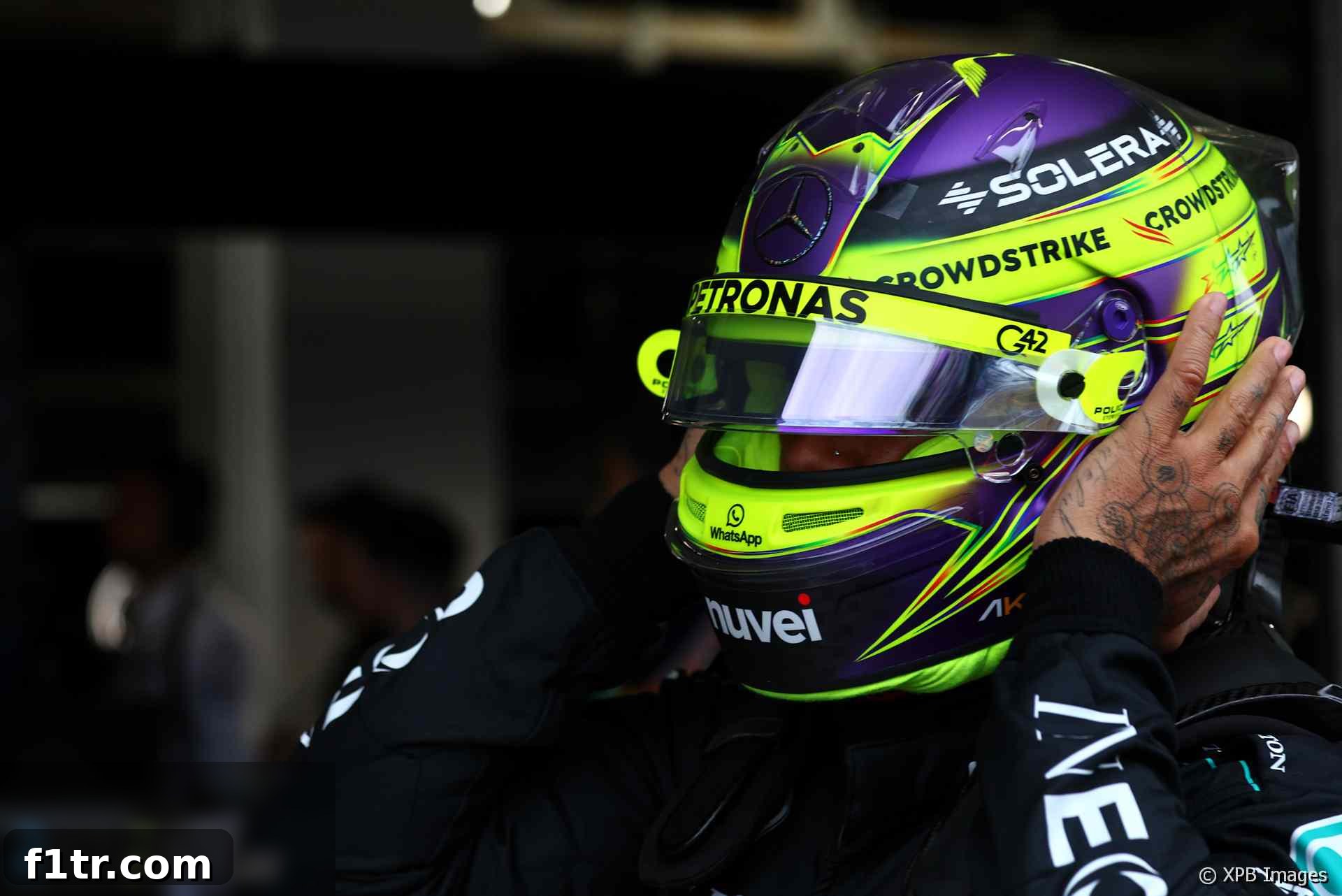
Lewis Hamilton Optimistic After Mercedes’ Strongest Practice at Suzuka
Lewis Hamilton, the seven-time world champion, expressed significant encouragement following Mercedes’ performance during the opening day of practice for the Japanese Grand Prix. The initial sessions at the iconic Suzuka Circuit provided a much-needed boost for the Silver Arrows, who have faced a challenging start to the 2024 Formula 1 season. Hamilton’s remarks highlighted a rare sense of satisfaction with the Mercedes W15, suggesting a potential turning point for the team.
Advert | Become a Supporter & go ad-free
A Breakthrough in First Practice: W15 Feels “The Best It’s Felt This Year”
In the crucial first practice session (FP1), Hamilton demonstrated a competitive pace, securing the fifth-quickest time. This performance placed him within half a second of the benchmark set by championship leader Max Verstappen, a significant improvement for Mercedes. While the later session (FP2) saw Hamilton improve to second place, most drivers were unable to set representative times due to persistently damp conditions that limited running.
Despite the mixed conditions, Hamilton’s confidence stemmed from the tangible feel of the car. He emphatically stated, “It was a great session. It was a really good session for us, it was the best session that we’ve had this year, the best the car has felt this year so far.” This declaration speaks volumes about the progress Mercedes has made behind the scenes. For a driver of Hamilton’s caliber, feeling connected to the car and having confidence in its balance is paramount, especially on a demanding track like Suzuka.
His excitement was palpable as he added, “So it felt really positive and I was really excited because this is a circuit that every driver loves to drive.” The Suzuka International Racing Course is renowned for its high-speed corners, technical sections, and flowing layout, making it a true test of a car’s aerodynamic efficiency and chassis stability. A car that feels good here often translates to strong performance elsewhere, offering a glimmer of hope for Mercedes’ development trajectory.
Addressing Past Struggles and the Road Ahead for Mercedes
Mercedes has shown intermittent flashes of potential in practice sessions throughout the current season, often topping the timesheets briefly before race performance has fallen short. Their best race finish so far has been fifth, a stark contrast to their dominant years. Hamilton was quick to acknowledge the tireless efforts of the team, particularly since the challenging Australian Grand Prix.
“The last couple of years we’ve had a really difficult balance, really difficult car and a difficult balance to drive here,” Hamilton reflected, highlighting the persistent handling issues that have plagued the W14 and early iterations of the W15. “And given the difficult last few races we’ve had, great work’s been done this past week and we just seem to have hit the ground a bit more in a sweeter spot. So I haven’t really made any changes since.” This suggests that the team has found a more stable baseline setup, allowing the car to operate within a more optimal performance window. The ability to find a “sweeter spot” on such a demanding circuit is a testament to the data analysis and development work undertaken by the engineers at Brackley and Brixworth.
Looking ahead to qualifying and the race, Hamilton emphasized the importance of maintaining this newfound stability. He believes the team needs to exercise caution and avoid over-optimizing or making drastic changes to the car’s balance. “I think we’ve got a better platform or baseline to start from,” said Hamilton. “So as long as we don’t make too many changes in and mess it up, I think probably just stay where we are.” This measured approach indicates a desire to consolidate the gains made rather than risk destabilizing the car with experimental adjustments, a strategy often employed when a team feels they have genuinely unlocked performance.
George Russell Echoes Optimism, Laments Lost FP2 Opportunity
Hamilton’s teammate, George Russell, corroborated the positive sentiments regarding their FP1 performance. Russell conceded that they “definitely performed better than we expected” in the session, describing it as “a pleasant surprise.” This shared perspective from both drivers underscores a genuine improvement in the car’s handling and overall drivability, a crucial factor for driver confidence and extracting maximum performance.
Russell further elaborated on the car’s positive attributes, stating, “The car was feeling really nice to drive and Lewis and I were really, really happy with the balance.” He noted a historical trend of the W15 performing better in cooler conditions, but emphasized the team’s ongoing efforts to address this variability: “It has been performing better when it’s been slightly colder, but we’ve been doing a lot of test items to try and make that car a little bit more consistent when conditions are variable.” Achieving consistency across a range of temperatures and track conditions is a key engineering challenge in Formula 1, and Mercedes appears to be making headway in this area.
However, Russell expressed regret over the heavily affected second practice session. The damp track conditions meant that valuable time for testing setup changes and gathering long-run data was lost. “So, time will tell. FP2 was definitely a miss for everybody as we had some interesting things we wanted to try. But that’s the nature of Formula 1 sometimes.” The unpredictable nature of weather in motorsport often throws a spanner in the works for meticulously planned test programs, forcing teams to rely more heavily on simulator data and the limited information from FP1.
The Significance of Suzuka: A True Test of Formula 1 Prowess
The Suzuka Circuit is a legendary venue in Formula 1, known for its unique figure-eight layout and a series of high-speed, flowing corners that demand exceptional aerodynamic stability and driver skill. Sections like the ‘Esses’ in sector one, the daunting Degner curves, and the iconic 130R corner are revered by drivers and fans alike. A car that performs well at Suzuka indicates strong overall performance capabilities, particularly in high-downforce, fast-cornering scenarios. For Mercedes to feel this level of confidence and balance at such a circuit is a significant indicator of progress.
The team’s efforts since the Australian Grand Prix clearly focused on understanding and rectifying the W15’s inherent characteristics. The positive feedback from Hamilton and Russell suggests that they have unlocked a greater degree of the car’s potential, especially in terms of its aerodynamic platform and mechanical grip. While one strong practice day does not guarantee race success, it certainly provides a foundation of optimism and a clear direction for the team.
The challenge now lies in translating this practice pace into competitive qualifying and race performance. With limited dry running, predicting the grid will be tougher, but Mercedes’ drivers appear ready to embrace the challenge with a car that finally feels like an ally rather than an adversary.
Advert | Become a RaceFans supporter andgo ad-free
2024 Japanese Grand Prix Articles
- “Am I in a race here or what?”: How Ferrari aced their Suzuka strategies
- Suzuka showed Mercedes “have a more stable platform” now
- Ferrari’s strategy gains in 2024 are “purely down to the car” – Sainz
- Tsunoda ‘at Verstappen and Alonso’s level’ with Suzuka performance – Marko
- Japan was first race where Red Bull’s winning margin was bigger than last year
Browse all 2024 Japanese Grand Prix articles