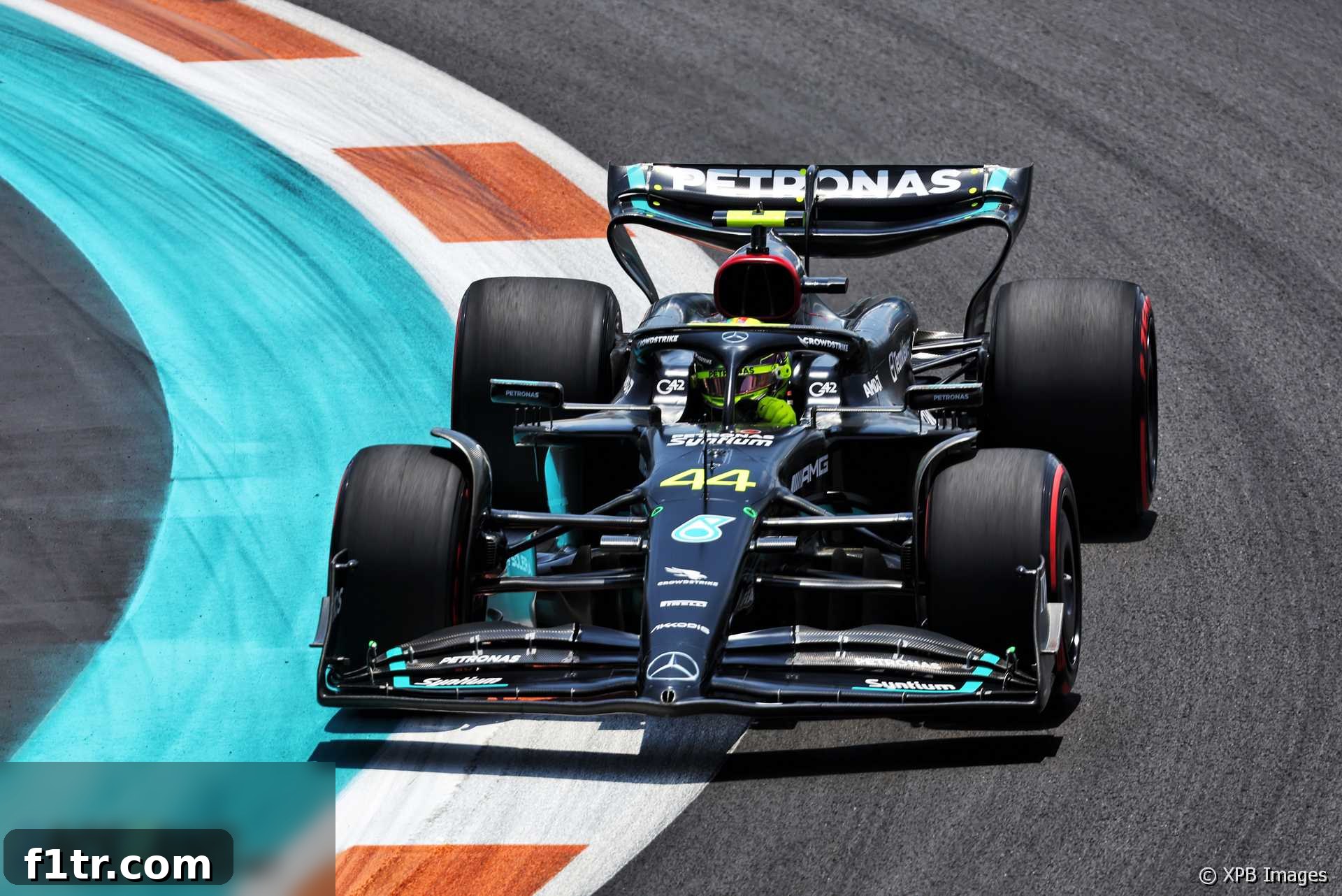
The Miami Grand Prix qualifying session proved to be a challenging affair for seven-time Formula 1 world champion Lewis Hamilton. The Mercedes-AMG Petronas F1 Team driver found himself eliminated in the second round of qualifying (Q2), securing a disappointing 13th position on the grid for Sunday’s race. Following a session fraught with difficulties, Hamilton expressed his reliance on strategic race execution to salvage points from what promises to be an uphill battle.
The streets of Miami, with their unique blend of high-speed straights and tight technical sections, often present a formidable challenge for teams and drivers alike. For Mercedes, and particularly for Hamilton, the weekend had already shown glimpses of the struggle to unlock the W14’s full potential. Heading into qualifying, expectations were cautiously optimistic, yet the reality quickly became apparent as Hamilton grappled with the car’s inherent limitations.
Hamilton’s Qualifying Ordeal: From Q1 Scare to Q2 Exit
The qualifying session began with an early scare for Hamilton in Q1. While navigating Turn 17, a critical corner on the circuit, he was forced to take evasive action to avoid Kevin Magnussen’s Haas, which was on an out-lap. In doing so, Hamilton brushed the wall, a minor but potentially costly incident that could have compromised his session entirely. This moment of quick thinking came as Hamilton was heading into the pits, having decided to adjust his front wing angle after locking up and running wide at the very same corner on his previous lap. Such mid-session adjustments highlight the delicate balance drivers and engineers seek to achieve in fine-tuning the car for optimal performance, often requiring split-second decisions under immense pressure.
Despite the contact, Hamilton managed to progress to Q2, albeit with a sense that the car was still not entirely where he needed it to be. The second segment of qualifying brought its own set of frustrations. With the clock ticking down and the battle for a top-10 spot intensifying, Hamilton’s final flying lap fell short, leaving him a quarter of a second outside the crucial Q3 cut-off. This marked the second consecutive race weekend where a Mercedes driver failed to reach the final qualifying round, following George Russell’s Q2 elimination at the previous Baku Grand Prix. This trend underscores a deeper, systemic challenge within the Mercedes camp, raising questions about their current competitive standing.
Communication Breakdown and Tyre Temperature Woes
“That felt way too late, guys,” Hamilton communicated to his race engineer, Peter Bonnington, immediately after his final Q2 run. His comment revealed a critical operational misstep by the team: sending him out of the pits too late. This untimely release placed him at the back of a train of approximately seven cars, creating a significant challenge. In Formula 1, finding clear air is paramount for a clean lap, but more importantly, traffic complicates the delicate art of optimising tyre temperature. Tyres need to be within a specific operating window to provide maximum grip, and a delay in getting them to temperature can severely compromise a driver’s ability to extract peak performance from the car. For Hamilton, starting his lap with insufficient tyre temperature meant an immediate disadvantage, contributing directly to his failure to advance.
Reflecting on the session, Hamilton shared his perspective with the media, including RaceFans. “It started out okay,” he began. “There were a couple of decent moments throughout the session. We generally have struggled to have the true pace to get into Q3 today. We were just right on the cusp of maybe not getting in. Then right at the end we’ve just gone out too late. I was at the back of maybe seven cars and I started my lap with just not enough temperature in the tyres.” This account paints a picture of a team and driver pushing hard but ultimately hindered by both inherent car performance and a critical procedural error.
The W14’s Achilles’ Heel: Lacking Pace “Everywhere”
Beyond the operational missteps, Hamilton pinpointed the fundamental issue plaguing the Mercedes W14: a lack of pace “everywhere” compared to their rivals, especially the dominant Red Bull. He elaborated on a key technical deficit, stating, “If you look at the Red Bull, for example, they can use a small rear wing and they’re fast on the straight and fast through the corners. For us, we have to have a bigger wing to get anywhere near them in the corners. So I think we’re lacking rear downforce mostly.”
This observation highlights a crucial aerodynamic compromise. A smaller rear wing typically reduces drag, leading to higher top speeds on straights. However, it also generates less downforce, which is essential for grip and stability through corners. Red Bull’s RB19 appears to achieve an exceptional balance, generating significant downforce with a relatively small wing, allowing them to be rapid in both low-drag and high-downforce sections of a track. In contrast, Mercedes’ need for a larger wing to find cornering performance inevitably means carrying more drag, making them slower on the straights. This trade-off suggests a fundamental deficiency in the W14’s aerodynamic platform, particularly in generating efficient rear downforce without excessive drag. This challenge has been a recurring theme for Mercedes since the introduction of the new aerodynamic regulations in 2022, and it continues to be their biggest hurdle in competing at the very front of the grid.
“We’re not where we want to be,” Hamilton added, his frustration palpable. “I wish we had a car that we were able to contend for wins. So it’s tough for us. But we just keep our head down, I’ve just got to keep my head down and keep pushing.” His words underscore the immense pressure on the team to close the gap to their rivals, particularly Red Bull, who have established a significant performance advantage early in the season.
Implications for the Miami Grand Prix and Beyond
Starting from 13th position places Hamilton in a difficult strategic conundrum for the Miami Grand Prix. Overtaking on this circuit can be challenging, even with multiple DRS zones. Success will largely depend on Mercedes’ ability to formulate a shrewd race strategy, manage tyre degradation effectively, and potentially capitalise on safety car periods or rival misfortunes. For Hamilton, known for his prowess in recovering from challenging grid positions, the race presents an opportunity to demonstrate his strategic acumen and exceptional racecraft, aiming to secure valuable championship points.
The consistent struggles in qualifying for both Hamilton and Russell paint a sobering picture for Mercedes. While glimpses of pace have been shown, the W14’s unpredictable nature and fundamental aerodynamic shortcomings continue to hinder their ability to consistently challenge for pole positions and race victories. The team’s ongoing development efforts, including planned upgrades throughout the season, are crucial. The Miami Grand Prix is not just another race; it’s a test of resilience, strategic foresight, and the collective will of a team accustomed to dominance now fighting in the midfield.
Looking ahead, the road to recovery for Mercedes appears long. Addressing the fundamental balance and downforce issues of the W14 will require significant engineering effort and potentially a shift in design philosophy. While Hamilton remains committed to pushing forward, the gap to the front-runners is stark, and the fight for podiums, let alone wins, will be a monumental task in the current Formula 1 landscape. The team’s focus will remain on continuous improvement, hoping to unlock the performance necessary to return to the pinnacle of motorsport.
2023 Miami Grand Prix Analysis and Related Content
For a deeper dive into the events surrounding the Miami Grand Prix and Mercedes’ ongoing challenges, explore our comprehensive coverage:
- Verstappen picks Miami Grand Prix as his best drive of 2023 so far
- Albon “maximised most races this year” despite single point scored to date
- A sign the upgrades worked? Ferrari see an upside to Leclerc’s Miami crashes
- Red Bull ‘surprised other teams under-delivered’ with their 2023 cars
- F1’s driver intros are right for US market but wouldn’t work at Silverstone – Horner
Browse all 2023 Miami Grand Prix articles