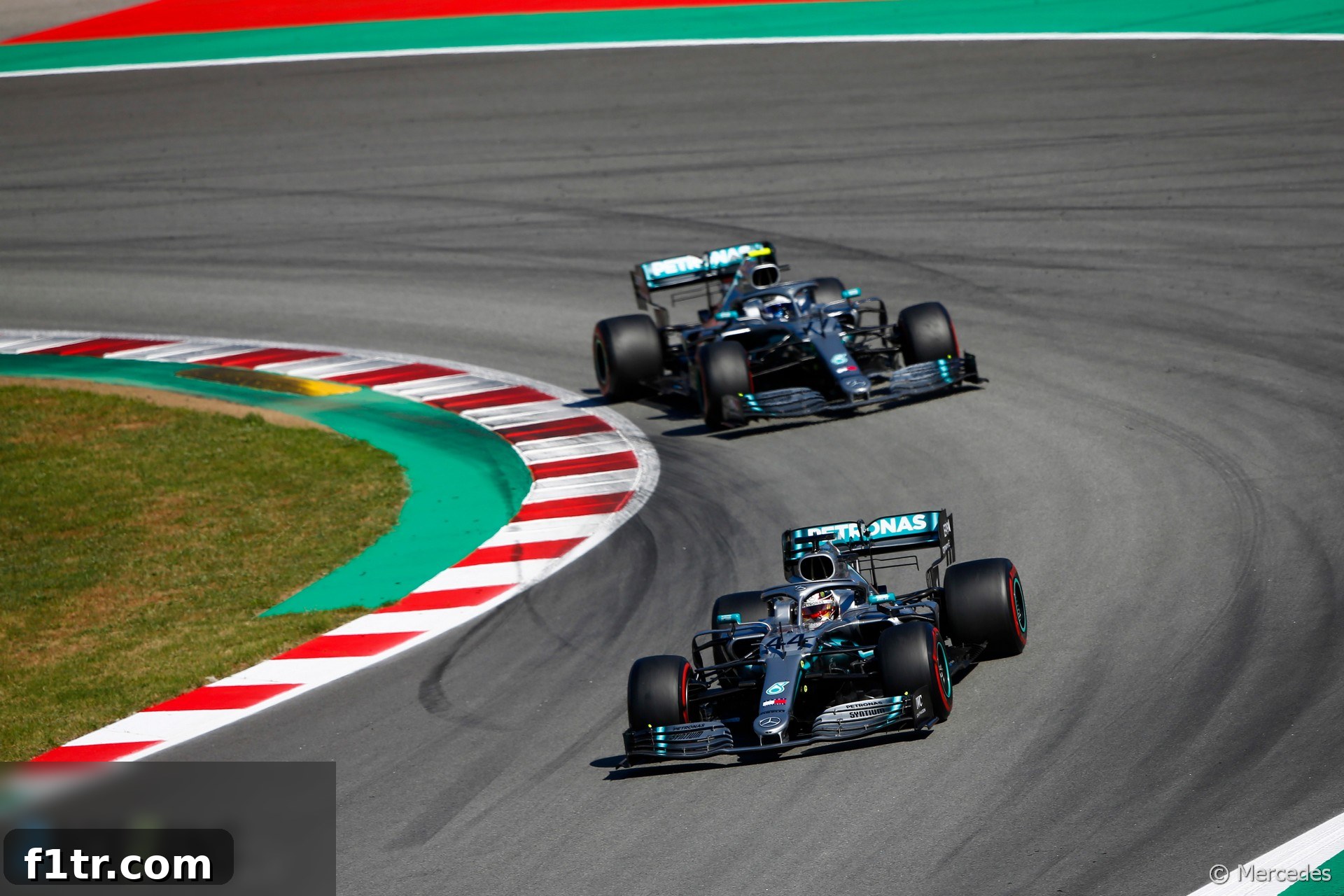
Lewis Hamilton, the reigning Formula 1 World Champion, dedicated a significant portion of his Thursday to an intensive debrief at the Mercedes factory. His mission: to deepen his understanding and ultimately master the team’s challenging W10 car. Despite securing a crucial victory at the Spanish Grand Prix, Hamilton openly admitted that he still isn’t entirely comfortable with the machine, highlighting the relentless pursuit of perfection that defines elite motorsport. This candid admission comes at a pivotal point in the 2019 season, where Hamilton holds a slender seven-point lead over his formidable teammate, Valtteri Bottas, who has remarkably claimed pole position in the last three consecutive races.
Lewis Hamilton’s Relentless Pursuit of Perfection: Tackling the Mercedes W10
The quest for every fraction of a second is an inherent part of Formula 1, and even for a driver of Lewis Hamilton’s calibre, there are always areas for improvement. His day at the Mercedes-AMG Petronas Motorsport headquarters underscored his commitment to extracting every ounce of performance from the W10. While the Spanish Grand Prix win extended his championship lead, Hamilton acknowledged that his qualifying performances and overall comfort with the car, particularly on Fridays and Saturdays, have not been consistently optimal.
Unpacking the Discomfort: Hamilton’s Challenge with the W10
Speaking before his deep-dive session at the factory, Hamilton expressed satisfaction with his race day execution but pointed to qualifying as a primary area needing attention. He revealed a persistent struggle with the car’s characteristics since the opening race in Australia. “The car is obviously great but I’ve generally struggled with the car from Australia, [I’m] having similar kind of problems with the car since Australia,” Hamilton stated. He elaborated on his Australian Grand Prix qualifying performance, noting, “My qualifying in Australia was just OK, I was only a tenth ahead. When I get things right it should be different to that.”
This discomfort often translates into a lack of confidence, particularly during the high-stakes single-lap runs of qualifying. While the Mercedes W10 has proven to be a dominant package, its specific handling characteristics might not perfectly align with Hamilton’s preferred driving style or immediate feel. Drivers rely heavily on instinct and precise feedback from the car, and even minor discrepancies can impact performance at the very highest level. For Hamilton, these “similar problems” could encompass anything from front-end stability, rear grip on corner exit, or the car’s behaviour under braking – all critical elements for shaving off those crucial milliseconds.
The Bottas Enigma: A Teammate’s Resurgence
Adding another layer to Hamilton’s challenge is the exceptional form of his teammate, Valtteri Bottas. Bottas has been a revelation in the early stages of the 2019 season, demonstrating a newfound consistency and speed, especially over one lap. His string of three consecutive pole positions is a clear testament to his adaptation to the W10 and his ability to extract its maximum potential in qualifying trim. Hamilton himself acknowledged Bottas’s comfort: “Valtteri’s settled nicely into the car, he’s quite happy.”
This immediate synergy between Bottas and the W10 has prompted Hamilton to consider whether his teammate’s driving style might be offering a distinct advantage. Understanding these nuances is precisely what his extensive factory visit aimed to achieve. Drivers often have subtle differences in how they attack corners, apply throttle, or manage tire temperatures, and sometimes a car design can inherently favor one style over another. Hamilton’s meticulous approach means he’s not just looking at raw data but also at how Bottas interacts with the car to gain an edge.
Decoding Performance: The Factory Visit and Data-Driven Insights
Hamilton’s factory visit was far from a mere public appearance; it was a deep dive into the engineering heart of Mercedes-AMG F1. He explained his intention: “But there are definitely areas I will continue to focus on in the factory this week. I’ll be dialling in to try to really understand. And ultimately I’ll go around and talk to different departments engineering-wise and try to collate as much data as possible so I can apply it better in the next race.”
Such visits involve intensive meetings with race engineers, performance engineers, tire experts, and aerodynamicists. They review vast amounts of telemetry data, compare onboard footage, and analyze simulator laps. Every data point, from steering angle to brake pressure, tire temperature, and suspension movement, is scrutinized. The goal is to identify specific moments or sequences on track where Hamilton might be losing time compared to Bottas or to the car’s theoretical maximum. This collaborative process allows the driver to articulate his subjective feelings about the car, which engineers then translate into objective data points and potential setup changes or driving technique adjustments. It’s a testament to the highly analytical nature of modern Formula 1, where marginal gains are everything.
The Art of Tire Management: Hamilton’s Race Day Advantage
While qualifying has been a hurdle, Hamilton’s race day performance has consistently been a standout. He attributes this to his unique approach to tire management. “I drive the tyres slightly differently in the race. Often I’m able to eke them out a little bit longer. That currently is still a benefit,” he revealed. This exceptional ability to preserve tire life while maintaining competitive pace is a hallmark of Hamilton’s racing craft. In a sport where tire degradation can dramatically impact strategy and performance, his skill in extending stints or delivering strong performance on older tires provides a significant strategic advantage for Mercedes.
This contrast between his single-lap qualifying struggles and his race-long tire mastery highlights a potential trade-off in car setup or driving style. A car tuned for ultimate single-lap pace might be harder on its tires over a race distance, and vice-versa. Hamilton’s innate feel for tire behaviour allows him to mitigate this, turning what might be a disadvantage for others into a strength. His consistent delivery on Sundays is a powerful reminder of his ultimate goal: championship points, which are primarily awarded on race day.
The Critical Role of Qualifying in Modern F1
Despite Hamilton’s race day brilliance, the importance of qualifying cannot be overstated. Starting from pole position or the front row significantly increases a driver’s chances of winning, especially on circuits where overtaking is challenging. It offers clean air, reduces the risk of incidents in the opening lap, and allows for more flexible race strategies. Bottas’s recent poles have not only boosted his confidence but also put Hamilton under pressure, forcing him to fight harder through the field in some races, even from second or third on the grid. This dynamic makes Hamilton’s efforts to improve his Saturday performance all the more crucial for his championship aspirations.
A History of Adaptability: Hamilton’s Track Record
It’s worth noting that Hamilton has faced similar challenges throughout his illustrious career. He has consistently demonstrated an unparalleled ability to adapt, learn, and overcome initial discomfort with new machinery. From navigating the complexities of different tire regulations to understanding radical aerodynamic changes, his dedication to working with his engineering team to fine-tune the car to his liking has been a recurring theme. This current struggle with the W10 is not an anomaly but rather another chapter in his ongoing pursuit of perfection, showcasing his resilience and analytical mindset.
The Road Ahead: Continuous Improvement in a Championship Battle
“Fridays and Saturdays have not been great days for me. The goal is to improve on them. But the races have been very strong performance-wise and pure delivery on a Sunday I’ve been really happy with,” Hamilton concluded. His words encapsulate the current state of play: a formidable challenger in Bottas, a dominant car that still demands mastery, and a championship battle that will likely be decided by marginal gains and relentless self-improvement. The intensive factory visit is a clear indication that Hamilton is leaving no stone unturned in his quest to fully unlock the W10’s potential on every single lap, from the very first practice session to the final checkered flag on Sunday.
Further Reading: Exploring the 2019 F1 Season
Discover more insights and stories from the dynamic 2019 Formula 1 season:
- Ocon’s Emotional Low Point at the 2019 Australian Grand Prix
- McLaren Racing Reports Financial Performance for 2019
- Kvyat Reflects on His Significant Hockenheim Podium in 2019
- FIA’s New Fuel Flow Meter and Its Impact on 2019 Regulations
- Key Moments and Highlights from ‘Drive to Survive’ Season Two
Browse all articles related to the 2019 F1 season