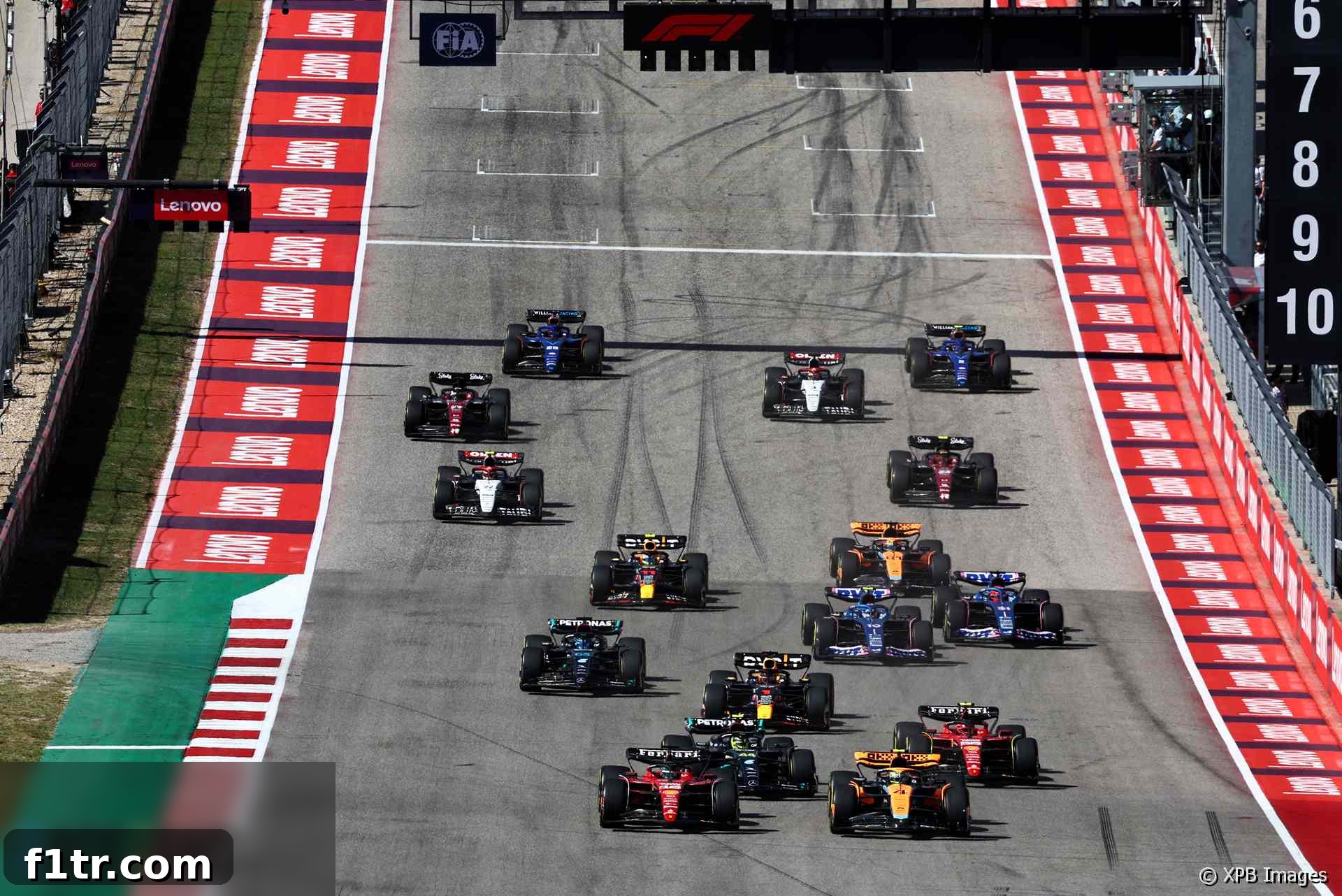
Formula 1 team Haas has encountered a significant setback in its quest to alter the outcome of the United States Grand Prix. The team’s formal request to the sport’s governing body, the FIA, for a “Right of Review” regarding the results of last month’s race has been firmly rejected. This decision by the stewards upholds the original classification of the Austin event, bringing an end to Haas’s efforts to secure crucial championship points through post-race judicial proceedings.
Haas’s US Grand Prix Review Bid Dismissed by FIA Stewards
The highly anticipated hearing, which saw representatives from several prominent F1 teams in attendance, concluded with the stewards determining that Haas had failed to present any “new, significant, and relevant” evidence required to trigger a re-evaluation of the race’s final standings. This outcome is a blow for the American squad, which had hoped to capitalize on alleged track limits infringements by rival drivers during the Circuit of the Americas event, potentially elevating their drivers into scoring positions.
The initial hearing, conducted via videoconference, commenced and was subsequently adjourned to allow the stewards ample time to independently scrutinize the extensive submissions made by the Haas team. This meticulous process underscores the FIA’s commitment to upholding the integrity of its judicial system and ensuring that any review requests meet the stringent criteria outlined in the International Sporting Code.
The Genesis of Haas’s Petition: Unpenalized Track Limits
At the heart of Haas’s appeal was a contention that numerous track limits violations by competitors had gone unpunished during the United States Grand Prix. Drivers Nico Hulkenberg and Kevin Magnussen finished the race in 11th and 14th positions respectively, tantalizingly close to, or just outside, the points-scoring places. Haas argued that if these alleged infringements had been properly identified and penalized, it would have promoted one or both of their drivers into the top ten, thereby earning valuable championship points.
The team specifically challenged two key documents issued by the stewards during the US Grand Prix weekend: the official final classification of the race and a particular decision not to impose further penalties on Alexander Albon for track limits breaches. In the latter document, the stewards themselves had acknowledged the inherent difficulties in having “sufficient evidence to judge all possible track limits violations, particularly at Turn Six on the Austin track.” This statement from the stewards was a crucial point that Haas sought to exploit, believing it opened a window for a review.
Haas’s Evidence: Onboard Videos and Trailing Footage
To bolster their case, Haas submitted a substantial collection of video evidence. This included onboard footage from the cars of drivers such as Alexander Albon, Logan Sargeant, Lance Stroll, and Sergio Perez. Furthermore, the team provided additional footage captured from cars following Albon, intending to highlight his alleged track limits transgressions from various perspectives. The expectation was that this new trove of visual material would provide irrefutable proof of widespread non-compliance with track limits, compelling the stewards to reconsider the race outcome and impose retrospective penalties.
The potential implications were significant, particularly for Haas, a team that often operates on the fringes of the points. Any promotion into the top ten would not only yield crucial championship points but also provide a morale boost and financial benefits. This ambitious bid underscored the intense competition in Formula 1, where every position, and every point, can make a tangible difference.
The Stewards’ Rejection: A Question of Novelty and Consistency
Despite Haas’s thorough presentation, the FIA stewards ultimately ruled that the evidence provided did not meet the necessary threshold for a review. Their primary contention was that none of the material presented could be considered “new or relevant,” stating explicitly that it had been available during the race itself. This directly contradicted a claim made by Haas, which asserted the newness of the evidence. While the footage showing Albon’s car from the perspective of rival cars was deemed “significant,” the stewards highlighted a crucial caveat: similar footage was not consistently available for all other cars on the grid. This inconsistency, they argued, made it impossible to consider the evidence without compromising the principle of sporting fairness.
The Intricacies of Track Limits Enforcement: A Technical Barrier
The stewards’ decision delved deeply into the technical complexities of enforcing track limits, especially concerning Turn Six at the Circuit of the Americas. They explicitly stated, “The evidence available to the stewards (both then and now) was not sufficient to accurately and consistently (meaning for every car in every lap) penalise any [track limit] breaches occurring at the apex of turn six.”
This statement clarifies a fundamental challenge in motorsport officiating. Track limit infringements, the stewards explained, are almost universally enforced based on “principal video evidence from a fixed CCTV camera of adequate resolution positioned to clearly see a car’s position in relation to the track limit boundary.” Regrettably, the CCTV camera designated for Turn Six at COTA did not meet this stringent standard, as it failed to adequately cover the apex of the corner where many of the alleged infringements occurred.
The limitations of onboard cameras were also a significant factor. The stewards noted that “onboard cameras are only useful for verifying a breach when viewing a car in front of the camera car and not the camera car itself.” This inherent design flaw prevents officials from accurately assessing a driver’s own track limits breaches using their personal onboard footage. Furthermore, the “anecdotal usage of trailing car video, which may or may not be available for any given car’s potential breach at any given time, does not meet that accurate and consistent evidence standard.”
Consequently, the stewards exercised the latitude provided within the International Sporting Code, choosing to take “no further action based on the lack of accurate and consistent evidence for all cars, in the interest of sporting fairness as stipulated in Articles 1.1.1 and 1.2.1 of the Code and delegated to the stewards in article 11.9.1 of the Code.” This emphasizes that for penalties to be applied, the evidence must be uniformly available and reliable across the entire field, ensuring all competitors are judged by the same rigorous standards.
Procedural Barriers: Review vs. Protest
Beyond the lack of new evidence, Haas faced a significant procedural hurdle concerning the scope of a “Right of Review.” The stewards firmly ruled that Haas could not request a review of the final classification to challenge the positions of drivers who had not been subjected to penalty decisions during the race – specifically mentioning Sergio Perez, Lance Stroll, and Logan Sargeant. This crucial point was strongly emphasized by the representatives of these drivers’ teams during the hearing.
“The petition for review asks for document 66 (Final Classification) to be reviewed,” the stewards elaborated. “Haas submitted that the purpose of this petition was to ask the stewards to take action on alleged track limit infringements by cars two [Sargeant], 11 [Perez] and 18 [Stroll] for which no ruling was given by the stewards during the race.”
However, the stewards clarified their position: “The stewards reaffirm that a petition to review the Final Classification must concern the classification itself. It is not possible to exercise the Right of Review on the Final Classification to question decisions taken prior to it. This also applies to incidents for which no ruling was made during an event.”
This distinction is critical in Formula 1’s judicial framework. The appropriate mechanism for raising alleged infringements during a competition is a formal protest, which must be lodged promptly after the provisional classification is issued. This was highlighted by the example of Aston Martin’s successful challenge to track limits application at the 2023 Austrian Grand Prix, where they immediately protested the provisional results. “The Right of Review,” the stewards explained, “is intended to enable competitors to seek a review for formal decision taken by the stewards in the light of any significant and relevant new evidence that was not available to the party seeking the review at the time of the decision.” This clearly delineates the specific purpose and limitations of a Right of Review, distinguishing it from a broader challenge to race incidents that went unpenalized in real-time.
Additional Submissions Deemed Irrelevant
Haas also attempted to bolster its case by presenting comments allegedly made by the FIA Race Director and the FIA Single-Seater Sporting Director during a team manager’s meeting at the subsequent Mexican Grand Prix, following the Austin race. These comments, Haas contended, offered further validation of their claims regarding track limits enforcement.
However, this piece of evidence was quickly dismissed by the stewards as not being “significant.” Their ruling stated: “The submissions allegedly made by the FIA race director and the FIA single-seater sporting director had no relevance for assessing whether the criteria of article 14.1.1 of the Code had been met for either of the decisions petitioned to be reviewed.” This decision underscores that for evidence to be considered, it must directly pertain to the specific criteria for a review, rather than general discussions or opinions.
Implications and the Finality of the Decision
The rejection of Haas’s “Right of Review” petition firmly closes the chapter on any potential changes to the 2023 United States Grand Prix results. While undoubtedly disappointing for the Haas team, the decision serves as a powerful reaffirmation of the FIA’s strict adherence to its procedural rules and the high bar set for overturning race results.
Teams are granted a two-week window following a race to submit a request for review, a deadline that Haas successfully met. However, as demonstrated in this instance, simply submitting a request within the timeframe is not enough; the substance of the petition and the nature of the evidence presented are paramount.
This ruling reinforces the importance of robust, consistent, and immediately available evidence for track limits enforcement in Formula 1. It also provides a clear precedent regarding the appropriate channels for challenging race outcomes, distinguishing between the reactive “Right of Review” and the proactive “Protest.” The finality of the decision ensures that the 2023 United States Grand Prix stands as originally classified, highlighting the challenges and stringent regulations governing every aspect of Formula 1 competition.
2023 United States Grand Prix Related Articles
- US GP was Mercedes’ best race of 2023 despite disqualification – Wolff
- Singapore and Austin retirements cost me top 10 championship place – Ocon
- United States Grand Prix result unchanged as FIA rejects Haas’ call for review
- Sargeant admits he’s ‘struggled to use all the downforce at times’ in F1
- Mercedes’ Brazilian GP set-up was “conservative” after US GP disqualification
Browse all 2023 United States Grand Prix articles