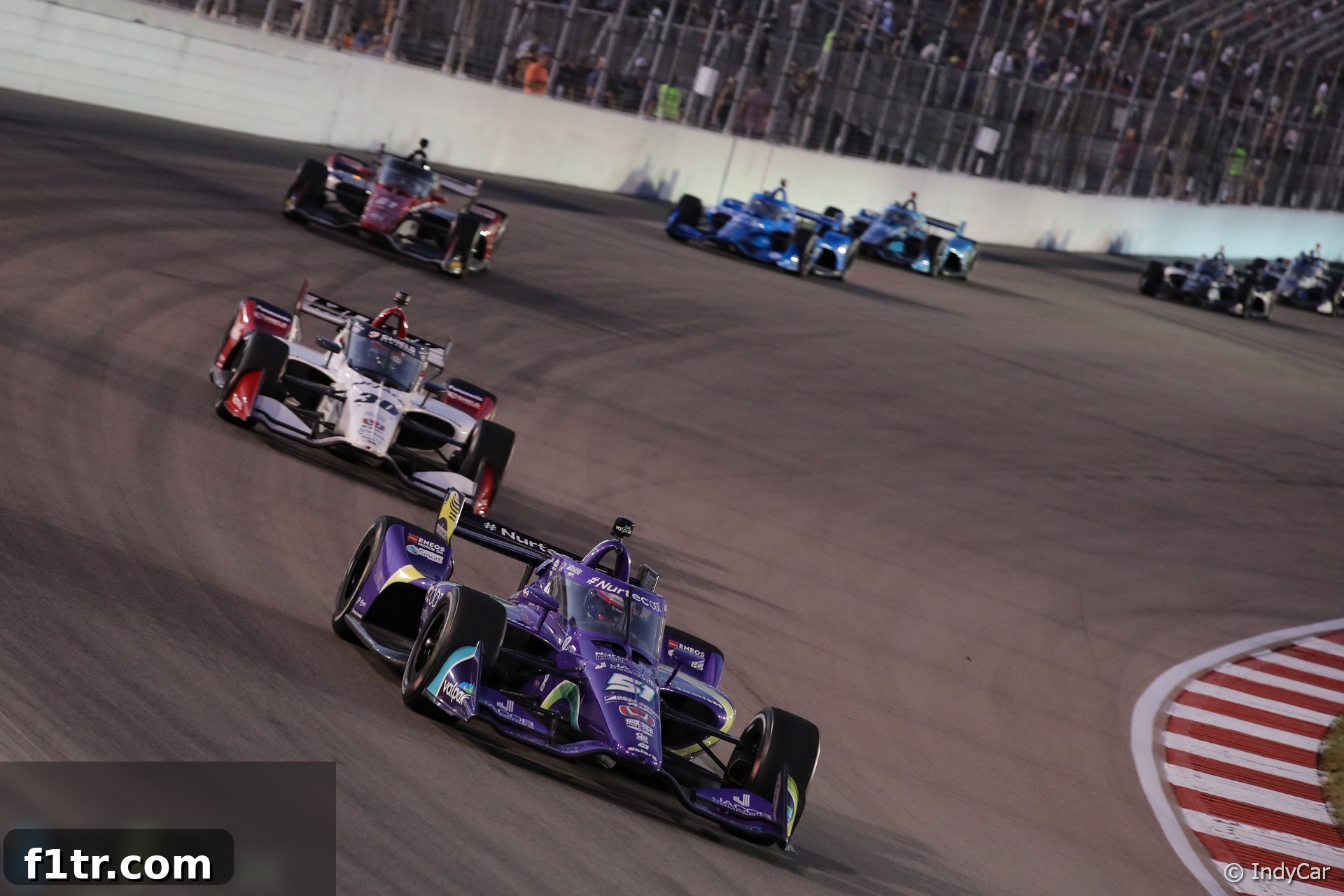
The world of motorsport held its breath as the IndyCar series witnessed one of its most highly anticipated debuts in recent memory. For the first time since Fernando Alonso famously challenged the Indianapolis 500 four years prior, a distinguished Formula 1 driver, Romain Grosjean, prepared to tackle the unique and formidable challenge of an American oval. His initiation took place at Gateway Motorsports Park, the two-kilometer (one-and-a-quarter-mile) speedway nestled in the vibrant suburbs of St Louis, Missouri.
Romain Grosjean’s Audacious Oval Debut: A New Chapter in IndyCar Racing
Romain Grosjean’s transition from the pinnacle of Formula 1 to the fiercely competitive world of IndyCar was already a captivating narrative. His decision to race only on road and street courses in his inaugural season, a choice influenced by the harrowing Bahrain Grand Prix crash, had been widely understood and respected. However, the allure of IndyCar’s diverse challenges, particularly its iconic oval circuits, proved too strong to resist entirely. His performance at Gateway marked not just a significant milestone in his individual career, but also provided a compelling chapter for motorsport enthusiasts eager to see how a modern F1 veteran would adapt to this distinct discipline.
From F1 Grand Prix to IndyCar Ovals: Grosjean’s Journey
Grosjean’s initial hesitation regarding oval racing was entirely justifiable. The brutal nature of his fiery accident in Bahrain served as a stark reminder of the inherent dangers in motorsport. When he first explored IndyCar as a post-Formula 1 career option, the Frenchman candidly admitted to assuming there were more than just four oval races on the schedule. This misconception, coupled with the profound experience of his crash, led him to initially commit only to the road and street courses for the 2021 season, prioritizing safety and a gradual acclimatization to the new machinery and racing styles.
Yet, the competitive spirit that defined his long F1 career soon resurfaced. After securing a deal to join Dale Coyne with Rick Ware Racing in February, Grosjean purposefully left the door open for an oval appearance towards the end of the season. The decision wasn’t made lightly. It involved careful consideration, discussions with his family, and rigorous preparation. A successful open test in July, where he demonstrated impressive aptitude for oval driving, ultimately paved the way. With the crucial approval of his loved ones, Grosjean officially added the Gateway 500 to his challenging 2021 schedule, setting the stage for a debut that promised both excitement and intense scrutiny.
The Gateway Gauntlet: Expectations and Realities
The motorsport community buzzed with questions: How would Grosjean truly fare in his first competitive outing on an oval? Would he echo the sensational success of legends like Nigel Mansell, who famously dominated short ovals in 1993, only to have a championship opportunity thwarted by injury? Or would he, like other F1 émigrés such as Alex Zanardi and Takuma Sato, find the unforgiving walls of an oval an immediate and harsh mistress, culminating in an early crash? The stakes were high, and the anticipation palpable, as Grosjean prepared to navigate the high-speed banking and close-quarters racing unique to oval circuits.
While his statistical results on paper—qualifying 14th out of 24 cars and finishing in the same position, one lap behind eventual winner Josef Newgarden—might not immediately scream “success,” they only tell a fraction of the story. Beneath the surface of the raw numbers were numerous instances of exceptional driving and a rapid understanding of oval nuances that hinted at a much stronger potential, perhaps even a top-10 finish, had circumstances aligned differently.
Moments of Brilliance and Hard-Learned Lessons
Grosjean’s race was punctuated by periods of intense learning and spectacular execution. The early stages were particularly challenging, as four caution periods for various incidents meant that 40 of the first 75 laps were run under yellow. This fragmented rhythm made it difficult for any driver, let alone a rookie to oval racing, to settle into a consistent pace or build confidence. However, after a lap 77 restart, Grosjean truly began to demonstrate his raw speed and burgeoning skill. His race engineer, Olivier Boisson, encouraged him over the radio: “We just need to keep digging, as they say on the oval,” a mantra Grosjean embraced wholeheartedly as he restarted 14th on a fresh set of tyres.
What followed was a masterclass in aggressive yet controlled oval racing. To break into the coveted top 10, Grosjean first had to overcome the challenge of a formidable veteran, Tony Kanaan, a past series champion and Indy 500 winner. After a few laps of intense wheel-to-wheel action, Grosjean powered past Kanaan on lap 84, showcasing his car’s speed and his own determination.
A lap later, a heart-stopping moment occurred as Grosjean and Dalton Kellett made contact, brushing wheels while diving into turn three. In oval racing, such incidents can often spell instant disaster for both drivers. Yet, Grosjean, demonstrating remarkable car control and composure, simply drove past Kellett into 12th place. This incident was a powerful testament to his recovered confidence and the clear dissipation of any lingering trepidations about hard-fought battles for position following his horrific Bahrain crash. The psychological barrier, if it existed, was undeniably breached.
His charge continued relentlessly. Within three more laps, he dispatched Conor Daly, recognized as one of the series’ most underrated oval specialists. Just two laps after that, Grosjean had officially broken into the top ten by expertly overtaking Jack Harvey. And his momentum didn’t stop there; a single lap after passing Harvey, he maneuvered past fellow rookie Scott McLaughlin, a driver whose best finish of the season at that point had been on the challenging 1.5-mile bullring at Texas Motor Speedway. This sequence of overtakes firmly established Grosjean as a serious contender, even on his first oval outing.
Grosjean then settled into a prolonged and fascinating battle with former Indy 500 winner and series champion Ryan Hunter-Reay. This was no ordinary duel; paddock whispers had long suggested that Grosjean was tipped to replace Hunter-Reay at Andretti Autosport the following season. The veteran driver, perhaps acutely aware of the implicit challenge, managed to keep his likely successor at bay until he eventually pitted for routine service, a testament to his experience and defensive prowess.
However, the unforgiving nature of oval racing provided a stark lesson on lap 173 of the 260-lap race. Grosjean’s distinctive purple No. 51 machine drifted out of the preferred racing line through turns one and two, venturing into the treacherous “marbles” – discarded bits of tire rubber that offer almost no grip – and coming perilously close, mere millimeters, from the SAFER barrier. This momentary lapse allowed Daly, Harvey, and Simon Pagenaud to pass him with relative ease, costing him valuable track position.
This incident vividly underscored a vital distinction between oval racing and road or street course racing. On a road course, a driver might miss their line through one corner, but often has numerous subsequent corners and straights to recover and compensate. On an oval, however, a single misjudgment in a corner can compromise at least half, if not an entire lap, instantly punishing any imprecision. It was a harsh but invaluable lesson, rapidly absorbed by the F1 veteran.
On lap 183, Grosjean made his final scheduled pit stop, a move that regrettably dropped him off the lead lap. He remained a lap down for the remainder of the race, partly due to a caution on lap 201 following Alexander Rossi’s accident in turn two, which prevented him from reclaiming the lost lap through strategic timing or a lucky wave-around.
Post-Race Reflections and the Rookie of the Year Showdown
Despite the challenges and the less-than-ideal final position, Grosjean’s post-race comments radiated satisfaction and a sense of accomplishment. “It was a very, very good experience,” he recalled. “We tried a strategy that didn’t quite go our way, so the end result isn’t as good as our race, but we had a fast car, we learned a lot.” He acknowledged his errors candidly: “I made a couple of mistakes on cold tyres and got into the marbles, but I was able to save it and I managed to make some good passes. I’m happy with this first oval race.” His words conveyed not just relief, but a genuine enthusiasm for the discipline, signaling his readiness for more oval challenges in the future.
The Gateway 500 was a tough race of attrition, seeing more than a third of the field retiring due to crashes or mechanical failures. Grosjean’s ability to finish, combined with his flashes of brilliance, was crucial in keeping him firmly in contention for the coveted Rookie of the Year honors against his main rival, Scott McLaughlin. McLaughlin, who finished an impressive fourth at Gateway, held a 23-point lead over Grosjean heading into the final trio of races, with a substantial 156 points still available.
The closeness of this battle was, in itself, a significant surprise given Grosjean’s deliberate decision to skip three earlier oval races, most notably the Indianapolis 500 – the only double-points race on the IndyCar calendar. The Indy 500 had been a massive missed opportunity for McLaughlin to potentially widen the gap and put the Rookie of the Year title out of reach, regardless of Grosjean’s Gateway performance. However, McLaughlin, still acclimatizing to the profound shift from Australian Supercars to open-wheel racing, had yet to record a top-five finish on a traditional road course, which played directly into Grosjean’s strengths.
Looking Ahead: The Championship Climax and Grosjean’s Future
As the season drew to a close, the championship, along with the Rookie of the Year battle, was set to be decided over a thrilling trio of races in quick succession. The final leg of the season kicked off on the technical road course at Portland, a circuit type where Grosjean’s Formula 1 background gave him a distinct advantage. The series then moved to another challenging road course, Laguna Seca, a track Grosjean had already tested at, further bolstering his prospects. The grand finale was scheduled for the iconic streets of Long Beach, a street circuit where Grosjean had already showcased his incredible speed and car control earlier in the season, securing impressive podium finishes.
Romain Grosjean’s audacious oval debut at Gateway was more than just a single race; it was a bold statement. It demonstrated his profound commitment to mastering every facet of IndyCar racing, his unwavering courage in the face of past adversity, and his undeniable talent. His performances, particularly on road and street courses, put significant pressure on his Penske rival, Scott McLaughlin, in the standings. As he continued to adapt and learn, Grosjean not only proved his mettle as a formidable competitor but also solidified his place as one of IndyCar’s most compelling figures, injecting new energy and excitement into the series.
Related IndyCar Content
- IndyCar driver McLaughlin cleared of injury after crashing through barrier at Barber
- Schumacher says his IndyCar feels like ‘an F2 car, just with better tyres’
- IndyCar “way faster than Formula 1” in some corners, says Grosjean
- FIA to award more F1 superlicence points to IndyCar drivers from 2026
- Schumacher to race full-time in IndyCar with RLL in 2026
Browse all IndyCar articles