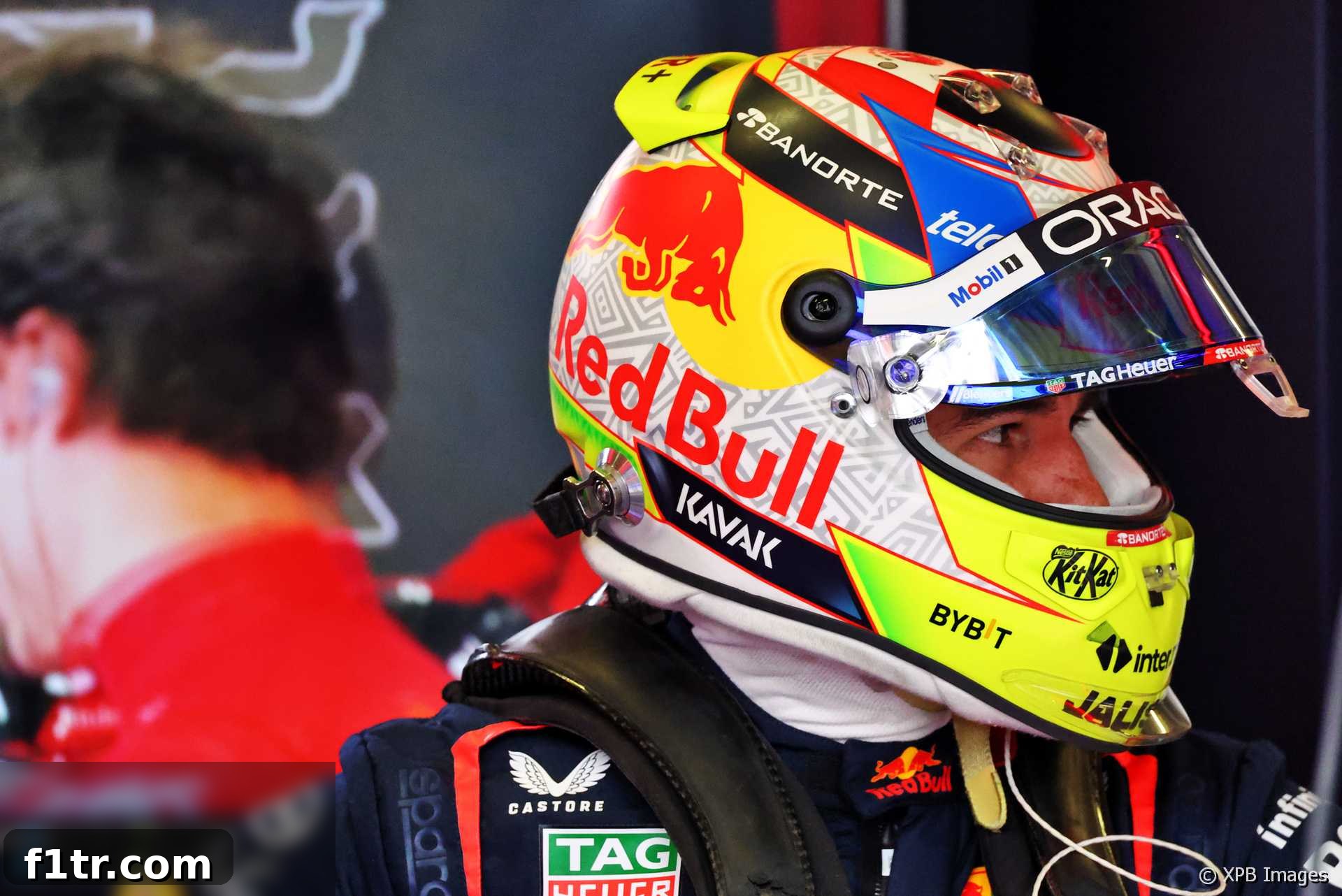
Red Bull Racing’s team principal, Christian Horner, expressed profound disappointment following Sergio Perez’s failure to secure a front-row starting position for the Austrian Grand Prix. The incident, which saw Perez qualify a dismal 15th for Sunday’s race, underscored a growing concern within the championship-leading team regarding the Mexican driver’s recent qualifying performance.
Advert | Become a Supporter & go ad-free
Perez’s struggles stemmed from a series of track limits infringements during the crucial Q2 session. Each of his fastest flying laps was deleted, ultimately costing him a spot in the top 10 shootout. Horner was unequivocal in his assessment, stating that the team had made it “crystal clear” to Perez the necessity of leaving sufficient margin to ensure a valid lap time that would propel him into Q3.
Perez’s Pace Undeniable, Precision Lacking
Speaking to Sky Sports after qualifying, Horner lamented the situation: “He’s got the pace today. He’s got a car that was easily capable of being on the first or second row, he was matching Max’s times – stay in the white lines.” This statement highlights the core of the problem: Perez undeniably possessed the raw speed to compete at the very front, yet his execution faltered due to a lack of precision. The Red Bull Ring, known for its unforgiving nature regarding track limits, had caught out multiple drivers throughout the day, but for a driver in a top-tier car, such errors proved exceptionally costly.
Horner further elaborated on the repeated warnings given to Perez: “It was strike one, strike two – ‘Checo, just stay in the white lines’, strike three – and that was it.” This vivid description paints a picture of a driver repeatedly pushing the boundaries, despite explicit instructions and the obvious risks involved. While Max Verstappen, Perez’s teammate, secured the fastest time in Q2 with a 1’04.951, Perez needed only a 1’05.386 to advance. Horner confidently asserted that Perez was more than capable of achieving this target, even while adopting a more conservative approach in the two high-speed corners at the end of the lap, where most of the track limits violations occurred.
“It’s hugely frustrating because the frustrating thing is we know he can do it,” Horner reiterated. “He did a [one minute] 4.9 on that lap, he was three hundredths off Max. He could have been four tenths slower and still been in. In Q2, that’s not the time to be doing it. So that was the frustrating thing because he could have done it today.” This sentiment underscores the team’s belief in Perez’s capability, making the unforced errors even more exasperating for the Red Bull hierarchy.
The Albon Incident and Broader Implications
Perez, in his own defense, pointed to an incident involving Alexander Albon at Turn 10 during his final Q2 attempt, suggesting it hampered his run. While Horner acknowledged that this “is not going to have helped,” he quickly added a crucial caveat: “but then you build in a little bit more margin.” This implies that even with a minor obstruction, a driver of Perez’s caliber should have had enough buffer built into his lap to mitigate such external factors and still post a valid time. Ultimately, the onus was on Perez to manage the risks and ensure his lap counted.
Advert | Become a RaceFans supporter andgo ad-free
Horner concluded his immediate thoughts by stating, “So Checo’s frustrated, we’ll turn the page, he’ll race hard tomorrow, but it’s just annoying because we know he could have been there.” This reflects a pragmatic yet undoubtedly vexed stance. While the team must move forward, the missed opportunity to have both cars at the sharp end of the grid is a significant strategic blow.
A Pattern of Qualifying Misfortune
The Austrian Grand Prix qualifying marked a continuation of a worrying trend for Sergio Perez. He has now failed to reach Q3 in more than half of the events this season, including all of the last four races. This run of poor qualifying form is particularly detrimental in a championship where every point counts and where his teammate, Max Verstappen, has consistently dominated. Horner suggested that Perez might be placing an excessive amount of pressure on himself in an attempt to directly challenge Verstappen, who has built a substantial lead in the Drivers’ Championship.
The Weight of Expectation and Self-Imposed Pressure
“The pressure he’s under is the pressure he puts on himself,” Horner observed. “Today he had the pace. In practice one he was right there. The lap times he was doing, he was tenth for tenth with Max today. So that’s the annoying thing, that’s the frustration, he can do it.” This highlights the psychological aspect of elite-level motorsport. Despite demonstrating the inherent speed in practice sessions, the heightened intensity of qualifying, coupled with the desire to perform at his absolute best, appears to be leading to critical errors for Perez.
The mental toll of consistently competing against a driver of Verstappen’s caliber, especially within the same machinery, can be immense. The desire to match or even surpass his teammate, while laudable, might be pushing Perez beyond a point of controlled risk-taking, resulting in these repeated track limits infringements. This self-imposed pressure, according to Horner, is hindering Perez’s ability to convert his proven pace into consistent qualifying results.
Strategic Impact on Red Bull Racing
The consequence of Perez’s poor qualifying is not merely a personal disappointment; it has significant strategic ramifications for Red Bull Racing. Horner articulated this clearly: “I think it’s just a great shame because I think this would have really kick-started things for him. And of course, the frustration for us as a team is now we have two Ferraris who are a little closer versus one Red Bull with Checo out of position.”
In a championship battle, having two cars at the front of the grid provides a substantial tactical advantage. It allows a team to split strategies, cover off rivals, and put immense pressure on the competition. With Perez starting from 15th, Red Bull’s strategic options are curtailed. Max Verstappen will be left to battle single-handedly against potentially two Ferraris, or other strong contenders, in the initial stages of the race, making his path to victory potentially more challenging and less secure.
Verstappen’s Controlled Approach
Interestingly, Max Verstappen also encountered track limits issues during qualifying. However, a key difference emerged in his response to team warnings. Horner noted, “At least he responded. We said ‘stay in the white lines’ and he did that. He built a conservatism into his laps to make sure that he had a wheel inside the line.”
This illustrates Verstappen’s ability to adapt and manage risk effectively, even when pushing the limits. He understood the imperative of a valid lap and adjusted his driving accordingly, sacrificing a fraction of potential lap time for certainty. “I think there was a little bit more time in the car, in that last sector, if he [had] gone for it. So, it was driving with a bit of restraint,” Horner added. This contrast starkly highlights where Perez went wrong: failing to heed the warnings and find the right balance between raw speed and necessary caution.
Advert | Become a RaceFans supporter andgo ad-free
Looking Ahead to Race Day
Starting from 15th on the grid at the Red Bull Ring presents a formidable challenge for Sergio Perez. While the Red Bull RB19 is undeniably fast and capable of carving its way through the field, overtaking opportunities can be limited, and the risk of getting caught in midfield incidents increases significantly. Perez will need to demonstrate exceptional race craft, strategic acumen, and perhaps a touch of good fortune to recover a strong points finish. His primary objective will be to climb as high as possible without damaging the car, thereby mitigating the strategic disadvantage his qualifying performance has imposed on the team.
For Red Bull, the Austrian Grand Prix qualifying serves as a stark reminder that even with the most dominant car on the grid, human error can still introduce significant hurdles. While Max Verstappen continues to perform at an extraordinary level, consistent performances from both drivers are crucial for maintaining an iron grip on the Constructors’ Championship and providing strategic flexibility in races.
Ultimately, Christian Horner’s frustration is understandable. Sergio Perez had the pace, the car, and the warnings to avoid his predicament. The focus now shifts to how Perez responds on race day and whether he can begin to reverse this troubling trend of qualifying inconsistency, which is proving to be a persistent headache for Red Bull Racing.
2023 Austrian Grand Prix News & Analysis
- Mercedes left scratching heads by lack of performance at Austrian GP
- Verstappen’s determination to grab every point makes him a record-breaker
- Austrian GP track limits farce was avoidable like ‘IndyGate’ and Spa 2021 – Brown
- Alpine now “definitely beatable” for McLaren after upgrade – Brown
- Paddock Diary: 2023 Austrian Grand Prix
Browse all 2023 Austrian Grand Prix articles