In the high-octane world of Formula 1, every race, every manoeuvre, and every comment holds immense significance. The 2018 Bahrain Grand Prix was no exception, becoming a focal point for a burgeoning rivalry and a platform for seasoned wisdom to clash with youthful exuberance. Following a dramatic on-track encounter that ended Max Verstappen’s race prematurely, five-time world champion Lewis Hamilton didn’t mince words, articulating his belief that the Red Bull driver was, at times, squandering potential results due to what he perceived as immaturity. This sentiment, delivered amidst the adrenaline and strategic considerations of an early-season championship battle, resonated deeply within the F1 paddock and among fans alike.
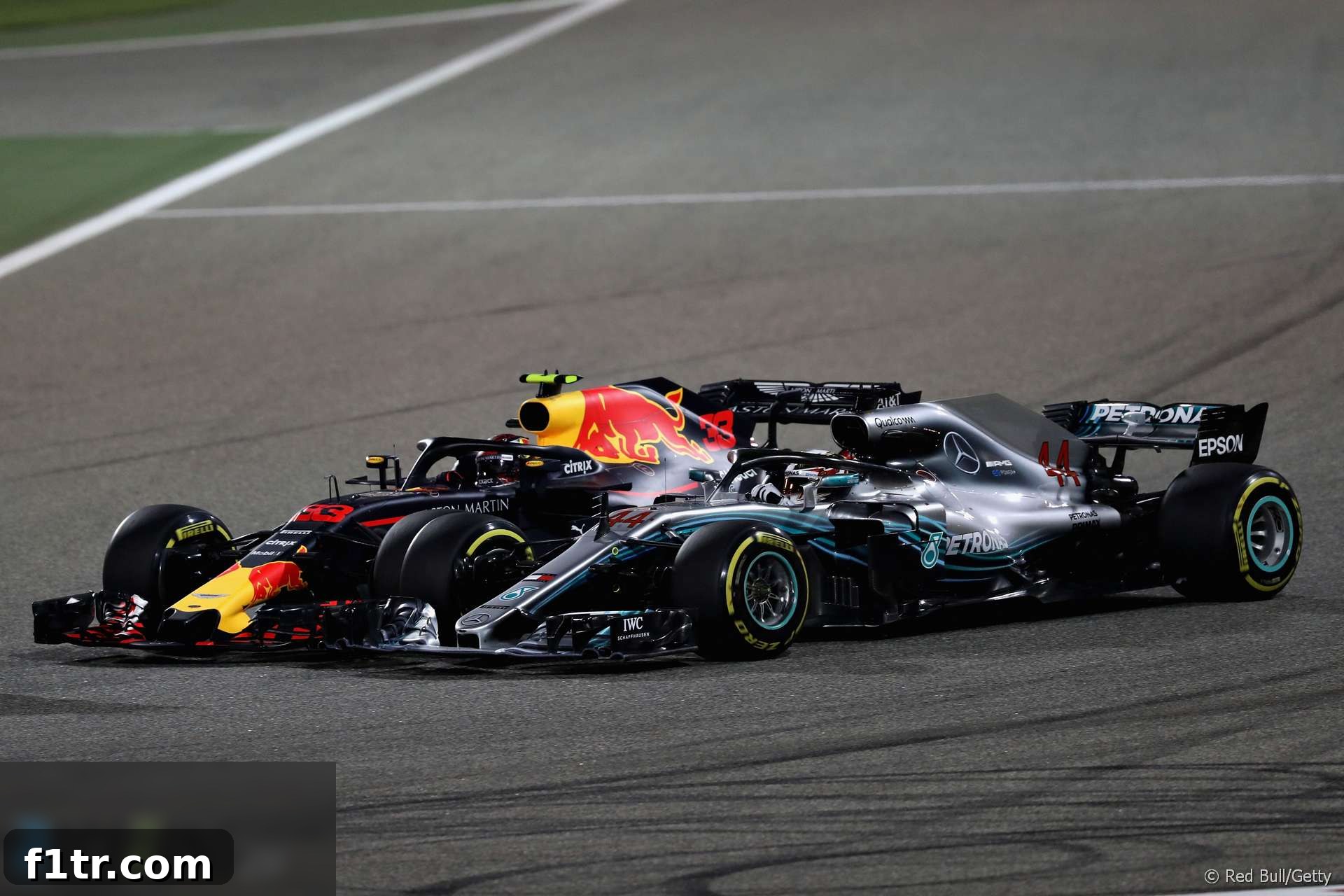
The incident occurred on just the second lap of the Bahrain Grand Prix, a clash between the Mercedes of Hamilton and Verstappen’s Red Bull that ultimately forced the young Dutchman into retirement. For Hamilton, this was more than just a racing incident; it was a symptom of a larger pattern. He suggested that despite Verstappen’s undeniable raw talent and formidable pace, a lack of composure and mature decision-making was preventing him from consistently delivering the results that his highly capable Red Bull machinery was truly capable of achieving. This perspective from a driver of Hamilton’s stature, known for his strategic acumen and championship-winning consistency, carries considerable weight.
“He’s a young driver, he’s going to be learning all the time, he’s got fantastic pace,” Hamilton acknowledged, recognizing Verstappen’s inherent talent. However, he quickly pivoted to the critical caveat: “But as youngsters, we don’t always make the right decisions.” This reflection highlighted a universal truth in competitive sports, where the hunger to win can sometimes overshadow the prudence required for long-term success. In Formula 1, where margins are infinitesimally small and consequences are dire, a single miscalculation can cost not only a race but also crucial championship points, not to mention significant damage to multimillion-dollar machinery.
Hamilton’s observations extended beyond mere critique, venturing into a comparative analysis that underscored the value of experience. He referenced comments from Red Bull team principal Christian Horner, suggesting that even within the Red Bull camp, there might be an acknowledgment of missed opportunities. “It’s interesting to hear from Christian [Horner] because they’ve got a car that should be getting good results and through these kind of – I don’t know if they’re inexperienced or not potentially mature decisions – they’re not getting the results they would have,” Hamilton commented. This implied a potential disconnect between the raw speed of the Red Bull package and the ultimate delivery of points, a chasm that often comes down to driver execution and racecraft.
To further illustrate his point, Hamilton invoked the name of another highly respected veteran of the sport: “Today he should have finished a decent race really because he’s good enough to do that. And I think to myself if Fernando [Alonso] was in that car today he would have finished a decent race and got points for Red Bull. I like to think if I was in the car today I’d’ve got points for Red Bull.” This hypothetical scenario served to highlight the contrast between a driver known for their aggressive yet calculated approach and one, in Hamilton’s view, still refining that balance. Fernando Alonso, a two-time world champion, is renowned for his ability to maximize any car he drives, often securing points even in challenging situations through sheer tactical brilliance and controlled aggression. Hamilton’s self-comparison further cemented his belief that a more measured approach would have yielded a better outcome for Red Bull.
Hamilton’s empathy, forged through his own journey in F1, shone through his critique. He reflected on his early career, acknowledging that he too had gone through similar phases of learning and occasionally making impetuous decisions. “I just hope that he is learning through whatever situation he is going through. I went through that stuff when I was younger so I know how it is and it’s easy to also get ahead of yourself and forget also to respect the other guy’s situation.” This statement underscored a crucial element of racecraft: understanding and respecting the spatial awareness and intentions of competitors, especially when battling wheel-to-wheel. In the heat of the moment, the desire to gain or defend a position can sometimes override the prudence of avoiding unnecessary contact, particularly in the initial laps of a long race where championship aspirations loom large.
Miraculously, Hamilton’s Mercedes survived the contact with the Red Bull, allowing him to continue the race and ultimately secure a valuable third-place finish. His relief was palpable, not just for the immediate result but for the broader implications for his championship campaign. “I’m just grateful that the car was still OK,” he stated. “I had no intentions of touching him. I was super-cautious in the first lap. I’m thinking about the world championship. And in that moment I’m like, that could have been a big, big blow in the championship. Fortunately, it wasn’t.” This introspection revealed the mindset of a championship contender – balancing the instinct to race hard with the imperative to protect the car and minimize risks, particularly at the beginning of a season where every point counts towards the ultimate goal.
Revisiting the collision itself, Hamilton’s perspective remained firm and unchanged. He elaborated on the dynamics of the incident, providing a detailed account of how he perceived the interaction. “We were racing which was all fine. Often when the car is on the outside [it] should end up running out of road,” he explained, referring to a common understanding in circuit racing where the outside car in a corner naturally has less track to work with. However, he stressed that in this particular instance, Verstappen’s actions went beyond reasonable racing limits. “If you look at it I was actually ahead for quite a period of time and then I accepted defeat and I just backed out because I knew he was going to try to run me wide. But then he just kept going. He didn’t need to keep going to the edge of the track.”
This detailed recollection painted a picture of Hamilton attempting to avoid contact, conceding the corner, only for Verstappen to continue pushing the limits excessively. “Supposedly he said he left room but he didn’t, he was right to the white line but he didn’t need to go there because I’d already backed out.” This point was critical for Hamilton, highlighting a perceived lack of judgment from Verstappen – an unnecessary move that led to an avoidable collision, despite Hamilton’s efforts to prevent it. Such incidents, especially early in a Grand Prix, can shape the narrative of a season and fuel the rivalries that make Formula 1 so compelling.
The Bahrain Grand Prix clash was more than just a single moment in time; it was an early chapter in what would become one of Formula 1’s most intense and captivating rivalries. Hamilton’s comments, though critical, were rooted in a desire for safe and fair racing, emphasizing the fine line between aggressive driving and reckless maneuvers. For Max Verstappen, this incident, and the subsequent commentary from a multiple world champion, likely contributed to his ongoing learning curve, shaping his approach to wheel-to-wheel combat in the years to come. The lessons learned on tracks like Bahrain, often under immense pressure and scrutiny, are invaluable in forging the champions of tomorrow.
Hamilton-Verstappen Clash in Pictures
Go ad-free for just £1 per month> > Find out more and sign up
Related 2018 F1 Season Content
- F1 feared “death knell” for Drive to Survive after Ferrari and Mercedes snub
- McLaren staff told us we were “totally crazy” to take Honda engines in 2018 – Tost
- ‘It doesn’t matter if we start last’: How Red Bull’s junior team aided Honda’s leap forward
- Honda’s jet division helped F1 engineers solve power unit problem
- McLaren Racing losses rise after Honda split
Browse all 2018 F1 season articles