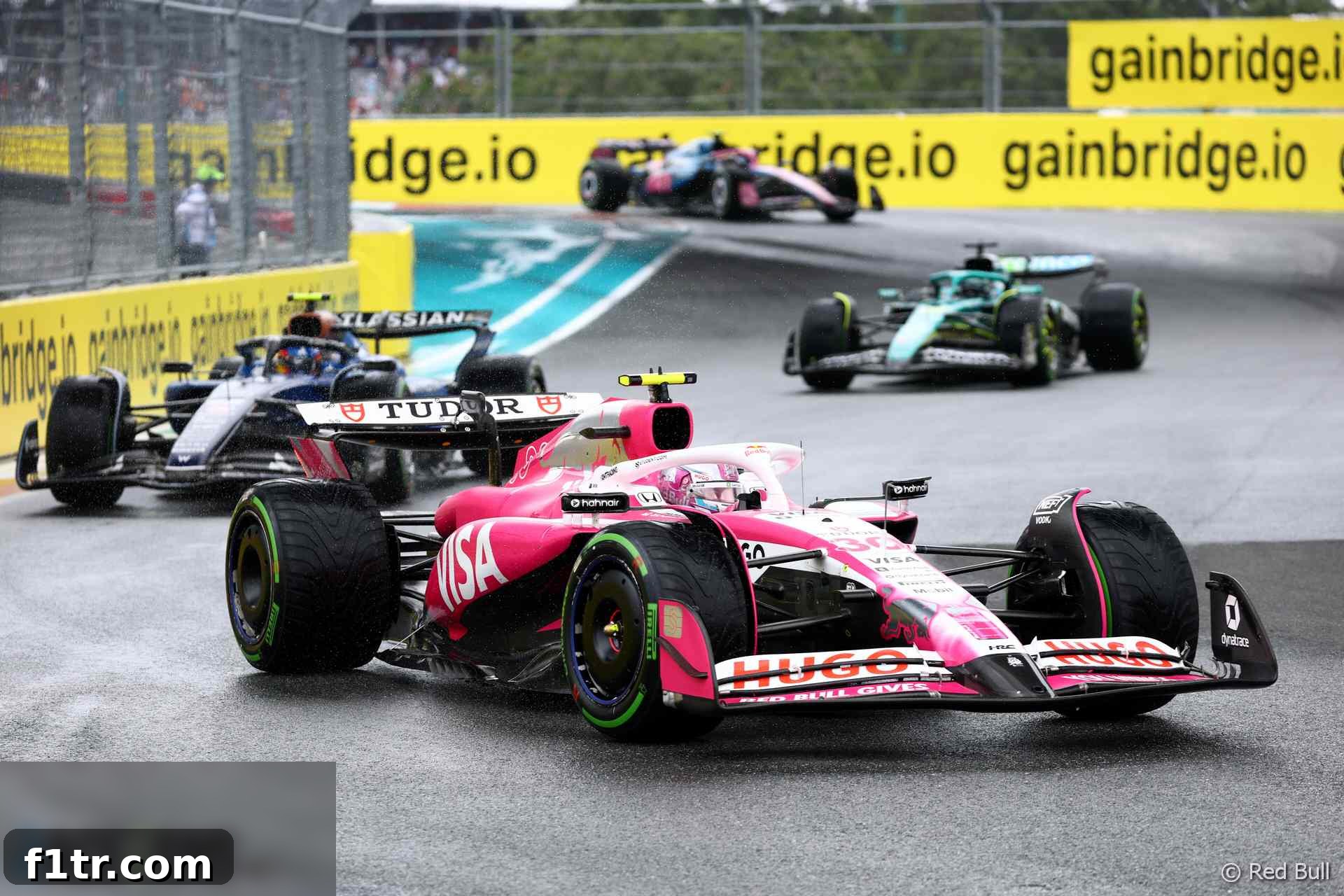
The exhilarating Miami Grand Prix sprint race delivered its usual dose of drama and fierce competition, but for one promising young driver, it concluded with a bitter taste. Liam Lawson, driver for the RB Formula 1 team, found his hard-earned points finish snatched away after stewards deemed him responsible for a collision with seasoned veteran Fernando Alonso. The incident, which unfolded during the hotly contested sprint event, led to a five-second time penalty and a critical penalty point on his Super Licence, significantly altering the outcome of his race.
Liam Lawson Penalized in Miami Sprint: A Controversial Collision with Fernando Alonso
A Promising Start Derailed
Liam Lawson had reason to celebrate moments after crossing the finish line in the Miami sprint race. Having qualified 14th, the young New Zealander masterfully navigated the challenging Miami International Autodrome circuit, showcasing impressive race craft and determination to climb seven positions and secure a provisional seventh place. This result would have marked his first points of the Formula 1 season, a significant milestone for any driver, especially one looking to solidify his place in the sport. However, the post-race investigation quickly overshadowed his on-track success, turning a moment of triumph into one of frustration.
The incident in question involved a high-speed encounter with Aston Martin’s Fernando Alonso, a two-time world champion renowned for his aggressive and uncompromising racing style. Such clashes between drivers of different experience levels often ignite debate, and this particular episode was no exception, prompting a thorough review by the FIA race stewards.
The Incident: A Clash at Turns 11 and 12
The pivotal moment occurred at the challenging Turn 11 and Turn 12 complex, a sequence of corners that demands precision and commitment. Lawson, driving with a tactical advantage of warmer tires after a strategic pit stop, was actively pursuing Alonso, who had just emerged from the pits on colder rubber. Recognizing an opportunity, Lawson attempted an ambitious overtake on the outside of Turn 11. This maneuver saw him pull alongside the Aston Martin, pushing the boundaries of the track. As he rounded Turn 11, the RB car momentarily ran wide, exceeding the track limits on the outside. Upon rejoining the circuit and heading into Turn 12, the two cars made contact.
The collision, though seemingly minor, disrupted both drivers’ lines and ultimately attracted the attention of the race officials. The incident underscored the fine margins in Formula 1 racing, where every inch and every millisecond can dictate success or failure, and crucially, determine fault in the eyes of the stewards.
Lawson’s Defense: An Interpretation of Racing Guidelines
Following the race, a visibly disappointed Liam Lawson articulated his perspective on the incident, firmly believing he had adhered to the established F1 racing guidelines. His defense hinged on the principle that if a driver manages to get their wheels ahead of a rival’s car on the approach to a corner, particularly at the apex, they are entitled to racing room. Lawson felt he had achieved this critical positioning against Alonso, therefore expecting the veteran driver to yield space.
“He came out on cold tyres and I’d done a lap [since pitting], so I was trying to get by early in the lap,” Lawson explained, detailing the strategic context of his move. “I waited for DRS, made sure to get my wheels ahead at the apex when I’m trying to overtake, and I feel I did that. Then I got squeezed off. At that point, honestly, I was heading for the concrete wall and I was trying to get out, but he just left me no space. So obviously it was not my intention, but I do feel like I had my wheels ahead.”
Lawson’s comments highlighted the intense pressure and split-second decision-making involved in wheel-to-wheel combat. His perception was that he had committed to the overtake, gained the necessary advantage in positioning, and was subsequently forced into a dangerous situation by Alonso’s perceived lack of cooperation. This interpretation of the rules, focusing on the moment of the apex, forms a cornerstone of modern F1 racing standards, designed to encourage aggressive but fair overtaking.
Stewards’ Verdict: A Strict Adherence to the Rules
Despite Lawson’s compelling argument, the race stewards reached a different conclusion. Their analysis of the telemetry data and on-board footage painted a picture that diverged from Lawson’s interpretation of the “wheels ahead” rule. The official statement from the stewards clarified their stance:
“Car 30 [Lawson] was attempting an overtake on the outside of Car 14 [Alonso] into Turn 11. Although being able to pull fully alongside, the front axle of Car 30 was not ahead of the front axle of Car 14 at the apex as required per the Driving Standards Guidelines.”
This nuanced distinction proved critical. The stewards emphasized that merely being “fully alongside” was insufficient; the specific criterion of having the “front axle ahead of the front axle” at the apex was not met by Lawson. Consequently, they ruled that Lawson was “not entitled to be given room at the exit.” Furthermore, due to the continuous nature of the Turn 11-12 complex, the car with the right to the racing line in Turn 11 also maintained that right into Turn 12. As Lawson drove to the very edge of the track between these turns and collided with Alonso, the stewards determined that “Car 30 was predominantly at fault.”
The penalty imposed was a five-second time addition to Lawson’s race time, along with one penalty point on his Super Licence. This decision highlighted the FIA’s strict interpretation of driving standards, particularly when track limits and positioning at critical corner phases are concerned. It served as a reminder to all drivers about the precise requirements for initiating and completing overtakes without incurring sanctions.
The Aftermath: Loss of Points and Penalty Points Accumulation
The consequences of the stewards’ ruling were immediate and significant for Liam Lawson. His provisional seventh-place finish, which would have awarded him six valuable championship points, was revoked. With the five-second penalty applied, Lawson’s final classification plummeted to 13th position, leaving him outside the points-paying places. This was a particularly bitter pill to swallow, as it denied him his first points of the season and the momentum that comes with such an achievement.
Beyond the immediate loss of points, the penalty point on his Super Licence also carries broader implications. Formula 1 drivers accumulate penalty points for various infringements, and if a driver accrues 12 penalty points within a 12-month period, they face a mandatory one-race ban. This latest point brought Lawson’s total to six, marking exactly half the threshold for a suspension. While not an immediate threat, it means he must exercise extreme caution in subsequent races to avoid further infractions that could jeopardize his participation.
For the RB team, the penalty meant the loss of crucial constructor points, impacting their standing in the fiercely competitive mid-field battle. It was a stark reminder of how quickly fortunes can change in Formula 1, and how even minor contact can have a cascading effect on a team’s championship aspirations.
Alonso’s Race: Missed Opportunities and Tire Strategy
Fernando Alonso, while not penalized in the incident, also expressed his disappointment with his overall race outcome. The Spanish driver’s primary concern revolved around Aston Martin’s tire strategy, specifically the timing of his switch to slick tires. In a sprint race that featured a damp track at the start, making the right call on tire compounds was paramount.
“It was a good drive today and unfortunately we stopped way too late to fit the dry tyres,” Alonso told the official F1 channel. This strategic misstep, in his view, compromised his potential to score significant points. He recounted battling with other prominent drivers like Lewis Hamilton and Alex Albon earlier in the race, only to find himself embroiled in the incident with Lawson later on.
Despite the challenges, Alonso maintained that he was “driving my maximum,” underscoring his characteristic dedication and relentless pursuit of performance. While he avoided a penalty from the contact, the incident with Lawson, coupled with the sub-optimal tire strategy, meant that he too missed out on valuable championship points in Miami.
The Broader Implications for F1 Racing Standards
This incident between Liam Lawson and Fernando Alonso, and the subsequent stewards’ decision, reignites discussions surrounding racing standards and their consistent application in Formula 1. The fine line between aggressive, hard racing and maneuvers deemed overly optimistic or dangerous remains a constant challenge for both drivers and officials.
For young talents like Lawson, these experiences are crucial learning opportunities. Navigating the complex rulebook and understanding the precise interpretation of racing guidelines by the FIA stewards is as vital as raw speed. Every incident, every penalty, contributes to a driver’s education on how to push the limits without crossing the line, especially when battling seasoned competitors who are masters of track position and race craft.
The Miami Sprint penalty serves as a potent reminder of the high stakes in Formula 1, where a single misjudgment can erase a strong performance and have lasting implications for championship hopes and licence points. It emphasizes the need for absolute precision and adherence to regulations, even in the heat of battle, as the margins for error are almost non-existent.
Looking Ahead: Lessons Learned on the Global Stage
As the Formula 1 season progresses, both Liam Lawson and Fernando Alonso will undoubtedly reflect on their Miami sprint race experiences. For Lawson, the focus will be on learning from the stewards’ detailed reasoning, refining his overtaking technique, and managing his penalty points tally. His raw pace and initial charge through the field demonstrated his undeniable talent, and translating that into consistently clean and points-scoring performances will be his next challenge.
Alonso will continue to extract every ounce of performance from his Aston Martin, likely pushing his team for more incisive strategic calls in future races. The incident, while disappointing for both, underscores the fierce competition and the unwavering commitment required to succeed at the pinnacle of motorsport.
More on the Miami Grand Prix
- Nothing for Ferrari to learn from Miami team orders episode – Vasseur
- Hamilton proud of Ferrari as ‘we’re taking a beating from media and people’s comments’
- McLaren legality never in doubt says Piastri as FIA’s post-race check clears car
- Albon did not disobey team orders in Miami says Vowles after Sainz’s complaint
- McLaren score their most emphatic win since Hamilton’s 2008 Silverstone triumph
Browse all 2025 Miami Grand Prix articles