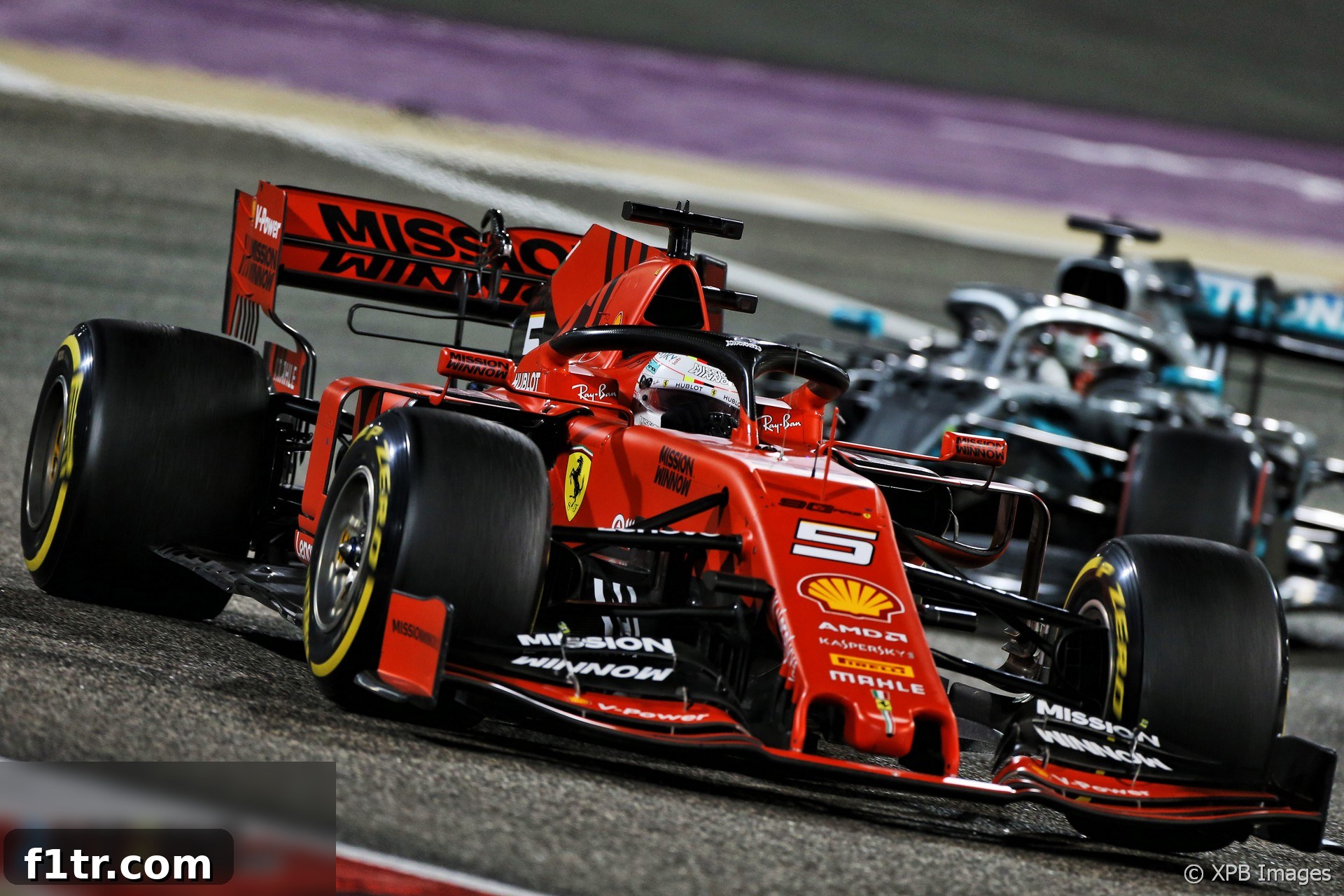
In the fiercely competitive arena of Formula 1, where glory and defeat often hinge on the smallest of margins, the actions of its elite drivers are under constant, intense scrutiny. Such was the case at the 2019 Bahrain Grand Prix, an event that saw Sebastian Vettel, a four-time world champion, spin out during a crucial battle for second place. This incident was notably his fourth such error in just ten races, prompting widespread discussion and concern across the motorsport community. Yet, amidst the rising tide of commentary, his greatest rival, Lewis Hamilton, stepped forward not to criticize, but to defend. Hamilton’s perspective offered a rare glimpse into the mutual respect among champions and illuminated the complex factors – from technical car setups to immense pressure – that can influence even the most seasoned drivers in F1.
Hamilton’s Take on the Bahrain Spin: A Closer Look
The pivotal moment unfolded at turn four of the Sakhir International Circuit. Hamilton and Vettel, driving their Mercedes and Ferrari machines respectively, were locked in a wheel-to-wheel contest when Vettel’s car suddenly lost control, resulting in an unexpected spin. Hamilton, who had a direct view of the incident, later recounted his observations. “I looked at the replay and we didn’t touch,” he affirmed, dispelling any notion of contact between their cars contributing to the spin. This immediately shifted the focus from driver interaction to other potential causes. Hamilton then highlighted a subtle yet significant environmental detail: “It was really windy there.” In a sport where aerodynamics are paramount, even strong gusts of wind can critically destabilize a car operating at its absolute limit, making precise control incredibly challenging. For a driver like Vettel, pushing hard in a battle for position, such external factors can be the difference between a clean maneuver and a costly error.
Understanding Vettel’s Recent String of Errors
The Bahrain incident, while notable, was not an isolated occurrence for Sebastian Vettel. It fit into a pattern of similar errors that had surfaced over the preceding months, creating a narrative of uncharacteristic mistakes for a driver of his stature. A significant prior spin happened at Monza during the previous season, where Vettel again spun while fiercely contending with Hamilton. This particular error had substantial championship implications, costing him valuable points. In the nine races leading up to Bahrain, Vettel also found himself spinning while battling other rising stars on the grid. He tangled with Max Verstappen at the challenging Suzuka Circuit and later with Daniel Ricciardo at the Circuit of the Americas (COTA). These incidents, all occurring in high-pressure, wheel-to-wheel racing situations, fueled speculation about Vettel’s confidence, consistency, and overall form. For a four-time world champion renowned for his precision and calculated aggression, these repeated errors were a stark departure from his usual faultless performances, drawing sharp focus from fans and media alike.
Hamilton’s Perspective: A Defense Rooted in Respect and Experience
Despite the apparent pattern, Lewis Hamilton offered a nuanced and empathetic defense of his rival. When asked directly about Vettel’s recent spins, Hamilton downplayed their significance within the broader context of Vettel’s illustrious career. “There’s too few of them to really look too much into it,” he remarked, emphasizing that a handful of incidents should not overshadow a decade of excellence. This stance highlighted Hamilton’s sportsmanship and his deep understanding of the demanding nature of Formula 1 racing. He was quick to point out that these occasional mistakes “pale in comparison” to Vettel’s formidable achievements. Indeed, Sebastian Vettel’s resume boasts four Formula 1 World Championships and an astonishing 52 Grand Prix victories, statistics that firmly place him among the pantheon of racing legends. Hamilton’s argument was clear: the narrative should not be dominated by a few missteps but by the overwhelming testament of his sustained success.
The Inevitability of Error: Even Champions Are Human
Hamilton further elaborated on the inherent human element in top-tier sports, suggesting that making mistakes is simply part of the game, even for the most accomplished athletes. “It happens to all of us,” he shared, a candid admission from a driver who has himself faced immense pressure and scrutiny throughout his career. “Just because you’re a multiple world champion doesn’t mean you’re not going to have off weekends.” This powerful statement resonated with the universal truth that perfection is unattainable, especially in a sport as unpredictable and demanding as Formula 1. Hamilton encouraged a more holistic view of a driver’s career, one that considers the entirety of their performance rather than isolated incidents. “It’s more cumulative,” he explained. “Look at Vettel’s career, he’s had stunning performances that far more outweigh the weaker races and when he’s spun, for example. They’re miniscule on the status he’s accumulated and created.” This perspective underscores the resilience required to compete at the highest level, where sustained excellence over years far eclipses sporadic moments of vulnerability. It’s a testament to the belief that true champions are defined not by the absence of error, but by their overall body of work and their ability to consistently perform at an elite level.
The Intricate World of F1 Car Setup and Balance
Beyond the psychological aspects and the pressures of racing, Lewis Hamilton also offered a crucial technical explanation for Vettel’s performance issues in Bahrain, particularly the noticeable gap in pace between Vettel and his junior teammate, Charles Leclerc. Hamilton strongly suggested that Vettel’s struggles stemmed from an unfavorable car setup and balance, articulating that Vettel was likely “unhappy with his car’s balance.” In Formula 1, a car that doesn’t provide the driver with confidence or the right feel can be incredibly difficult to extract maximum performance from, regardless of the driver’s inherent talent.
The Unseen Battle: Optimizing an F1 Machine
Hamilton delved into the often-overlooked complexities of car setup, a crucial battle fought away from the public eye. “There are always times when you just happen to not get the right car set-up, which you guys don’t get to see,” he explained, addressing the media and fans directly. He elaborated on how the minute adjustments made to an F1 car – encompassing everything from suspension geometry and aerodynamic configurations to differential settings and brake bias – are incredibly sensitive. “All these little things that we’re doing, it just doesn’t happen to work that weekend and the differences are so small yet they look so big.” This statement perfectly encapsulates the fine margins in Formula 1; a barely perceptible imbalance in the car can translate into a significant loss of driver confidence and, consequently, lap time. A car that feels “on a knife-edge” is notoriously challenging to drive consistently at the limit, dramatically increasing the propensity for driver errors like spins.
To further reinforce his point, Hamilton shared a personal anecdote, drawing from his own extensive career experiences. “I don’t know why their car was so different in pace but I’ve had races,” he recalled. “I remember looking back on me and Nico [Rosberg] in Barcelona, we were quick in testing and then there was massive differences in the car in the race and you’re just literally driving with your hands behind your back, you’ve got no grip.” This vivid description paints a compelling picture of the profound frustration and even helplessness a driver experiences when their meticulously engineered car simply refuses to perform as expected, irrespective of their skill or effort. He continued, highlighting the variability, “And then another race it’s the other way.” This underlines the often-unpredictable nature of car performance across diverse circuits and fluctuating conditions, making the synergy between engineer and driver, along with the ability to adapt, absolutely paramount. While great drivers can often compensate for a sub-optimal package, there are inherent limits to what even the most gifted can achieve when the car balance is fundamentally off.
The Enduring Spirit of a Champion: Vettel’s Road to Recovery
Concluding his thoughtful assessment, Lewis Hamilton expressed unshakeable confidence in Vettel’s capacity to bounce back from these recent setbacks. “I don’t know why that happens but today was one of those for him,” Hamilton acknowledged, recognizing the capricious nature of motorsport. However, his tone quickly shifted to a powerful affirmation of Vettel’s fundamental strengths: “But he’s a world champion and great athlete, he will recover and keep pushing.” This declaration not only cemented Hamilton’s profound respect for his rival but also underscored the indispensable mental fortitude and resilience required to succeed at the pinnacle of global motorsport. True champions are not defined by the absence of mistakes, but by their unwavering ability to learn from adversity, adapt their approach, and return to the track stronger and more determined than ever. For Sebastian Vettel, the 2019 season indeed presented a unique set of challenges, including the formidable rise of Charles Leclerc within the Ferrari team, adding an intriguing internal dynamic to his external battles for supremacy. Yet, the annals of Formula 1 history are rich with tales of drivers who have navigated slumps to reclaim their former glory, and Hamilton’s words served as a potent reminder of Vettel’s proven capability to exemplify this very spirit of resurgence.
2019 F1 season Related Articles
- Crying in the Melbourne car park at 2019 grand prix was my career low – Ocon
- McLaren Racing reports reduced £71 million loss in 2019
- Kvyat: Hockenheim podium last year was “my biggest achievement” so far
- How the FIA’s new encrypted fuel flow meter targets Ferrari’s new ‘aliasing’ trick
- “He smashed my office door”: 23 must-see moments from ‘Drive to Survive’ season two
Browse all 2019 F1 season articles