Carlos Sainz Receives Formal Reprimand After Controversial Brazilian Grand Prix Incident
In a significant development following the drama-filled 2024 Brazilian Grand Prix, Ferrari driver Carlos Sainz Jnr has been issued a formal reprimand by the race stewards. The decision comes after a thorough investigation into his actions subsequent to crashing out of the race, specifically citing a lapse in judgment that led to a “potentially dangerous situation” involving track marshals during the recovery of his car. This incident underscores the critical importance of safety protocols and clear communication in the demanding world of Formula 1.
Advert | Become a Supporter & go ad-free
The stewards’ ruling highlights the unwavering commitment of the FIA to ensuring the safety of all participants, from the elite drivers to the dedicated trackside personnel. Such reprimands, while not carrying immediate sporting penalties like grid drops, serve as an official warning and contribute to a driver’s disciplinary record, emphasizing that safety infringements are taken with the utmost seriousness in motorsport’s pinnacle category. The events at Interlagos have sparked further discussion on driver conduct under pressure and the intricacies of car recovery procedures on a live racetrack.
Unpacking the Incident: A Breakdown of Events at Laranjinha
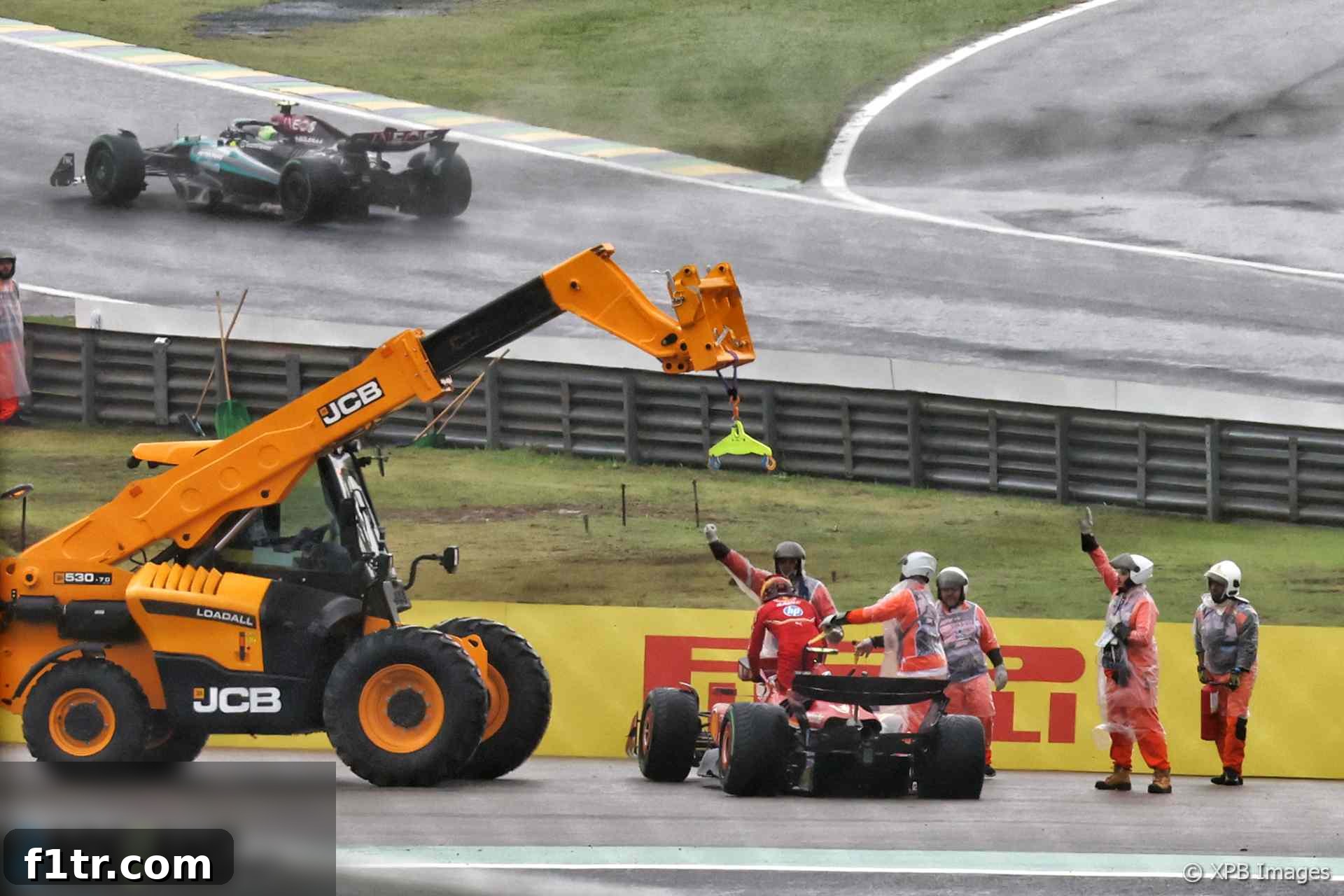
The sequence of events that led to Sainz’s reprimand unfolded on the 39th lap of the Brazilian Grand Prix. Driving in challenging wet conditions, Carlos Sainz lost control of his Ferrari SF-24 at the notorious Laranjinha corner, resulting in a significant impact with the barriers. Immediately following the crash, the highly trained track marshals swiftly deployed to the scene. Their primary objective is always to secure the site, ensure driver safety, and initiate the recovery process as per stringent F1 regulations, protecting both the driver and themselves from further hazards.
According to the detailed report from the stewards, a key factor in the incident was a crucial miscommunication. Upon crashing, Sainz initially removed his steering wheel from the cockpit. In Formula 1, this action is widely understood and recognized as a definitive signal that a driver is abandoning their car, indicating they will not attempt to restart or rejoin the race. Interpreting this clear signal, the marshals proceeded to begin feeding a recovery loop through the roll hoop of the Ferrari, preparing to safely remove the damaged car from the track. This is a standard and necessary step to clear the circuit and ensure the continuation of the race without obstruction or danger.
The Attempted Restart and Marshal Reaction
However, the situation took an unexpected and potentially hazardous turn. While the marshals were actively engaged in attaching the recovery equipment, Carlos Sainz received communication from his Ferrari team, suggesting that his car might still be salvageable and safe to drive. Prompted by this information, Sainz re-entered his cockpit, replaced the steering wheel, and attempted to drive away. This sudden movement, while marshals were physically working on his car, created an immediate and acute safety risk for the personnel on track.
The stewards’ investigation meticulously detailed this critical moment: “The team then informed the driver that they thought the car was safe to continue. The driver replaced the steering wheel while the marshals had started to feed the recovery loop through the roll hoop of the car.” Recognizing the imminent danger of the car moving with marshals in close proximity, the trackside officials were forced to abruptly abort their recovery attempt. This rapid reaction from the marshals prevented a potentially serious incident, highlighting their vigilance and quick thinking under pressure.
The Stewards’ Rationale and F1 Safety Implications
Following discussions with Sainz, the stewards noted that “the driver admitted that he was not aware that the marshals had commenced the recovery procedure.” Furthermore, Sainz “accepted that removing the steering wheel was a clear indication of his intention to abandon the car.” This acknowledgment was crucial in the stewards’ assessment. They concluded that regardless of the subsequent team communication, the initial signal given by Sainz created a reasonable expectation for the marshals, and his later actions, without confirming the status of their operation, constituted a breach of safety protocols.
Advert | Become a RaceFans supporter andgo ad-free
The ultimate verdict from the stewards was succinct and clear: “A potentially dangerous situation was created that was avoidable by the driver solely.” This statement underscores the high degree of responsibility placed on Formula 1 drivers to be acutely aware of their surroundings and the actions of marshals, especially during moments of distress or car recovery. The sport has learned hard lessons from past incidents regarding trackside safety, and strict enforcement of these rules is non-negotiable to protect all personnel working in a highly hazardous environment.
A formal reprimand, while not impacting championship points or grid positions, is a significant entry on a driver’s record. It signifies a serious breach of regulations and serves as a stern warning. Accumulating multiple reprimands can lead to harsher penalties, including grid place deductions or even race bans, reinforcing the FIA’s zero-tolerance policy on safety violations. This ruling sends a clear message across the paddock: driver awareness and strict adherence to marshal instructions are paramount for the integrity and safety of Formula 1.
Carlos Sainz’s Challenging Brazilian Grand Prix Weekend
The Brazilian Grand Prix weekend was, by all accounts, a weekend to forget for Carlos Sainz. His race-ending crash and subsequent reprimand capped off a difficult few days that also saw him crash out during Saturday’s qualifying session at the Interlagos circuit. Speaking to the official F1 channel after the race, Sainz expressed his profound frustration and bewilderment regarding his performance in the adverse conditions. “I had two crashes that honestly I cannot explain very well,” he admitted, reflecting a genuine struggle to comprehend his loss of control.
Sainz further elaborated on the specific difficulties he faced, pointing directly to the characteristics of his Ferrari car. “It’s very unpredictable, this car this year in the wet has been extremely difficult to drive,” he stated. This candid assessment highlights a recurring theme for Ferrari in the current season, where their car has often struggled to find optimal performance and stability in challenging wet weather conditions, putting their drivers at a significant disadvantage compared to rivals. Such performance fluctuations can be incredibly frustrating for a driver like Sainz, who is known for his consistency.
Despite the inherent difficulties with the machinery, Carlos Sainz demonstrated commendable accountability. He took full responsibility for his errors, offering a sincere apology to his team: “At the same time I apologise to the team for two mistakes because obviously it cost us.” This self-reflection, even amidst technical struggles, is a hallmark of a professional F1 driver. He also recognized the broader context, acknowledging that even without the incidents, scoring substantial points from his grid position in the wet race would have been a formidable challenge. Concluding with a forward-looking statement, “So turn the page and come back stronger,” Sainz showed his determination to move past this difficult weekend and focus on future opportunities.
The Broader Context of F1 Safety and Communication Protocols
Formula 1 has a long and complex history with safety, constantly evolving its regulations and technologies to protect drivers and personnel. Incidents like the one involving Carlos Sainz serve as crucial reminders that despite all advancements, human factors – communication, awareness, and decision-making under pressure – remain central to maintaining a safe environment. The role of track marshals, often volunteers, is absolutely vital. They are the first responders, the eyes and ears of race control, and their ability to execute recovery procedures without interference is paramount.
The clear signals and procedures for car recovery are ingrained in F1 protocols precisely to avoid misunderstandings that could lead to injury. When a driver removes their steering wheel, it is a definitive act that informs marshals they can approach the car without fear of it suddenly moving. Any deviation from this established understanding, even if unintentional or due to conflicting information from the team, can create extremely dangerous scenarios. This incident will likely prompt further review of communication channels between drivers, teams, and race control, particularly regarding the status of a disabled car and the presence of marshals.
Ensuring that drivers are fully aware of their surroundings, especially when their car is stationary or partially disabled, is a continuous training point for all F1 competitors. The pressure of wanting to rejoin a race, to salvage points, can sometimes override caution. However, the FIA and the stewards are clear: safety of personnel always takes precedence. The reprimand issued to Sainz is a reinforcement of this core principle, emphasizing that drivers must exercise extreme caution and judgment when interacting with marshals on track, irrespective of team instructions.
Looking Ahead: Impact on Ferrari and Sainz’s Season Trajectory
For Ferrari, the Brazilian Grand Prix represented a missed opportunity to score crucial points in the Constructors’ Championship. With both cars facing challenges and Sainz’s DNF, the team will need to thoroughly analyze the weekend’s events, paying particular attention to their car’s wet-weather performance and the communication protocols that may have contributed to the post-crash incident. As the season progresses, every point becomes more critical, and minimizing such costly errors will be essential for their championship ambitions.
For Carlos Sainz, this incident, culminating in a formal reprimand, is a valuable lesson. While the frustrations of a difficult car in challenging conditions are understandable, it highlights the unwavering standard of safety and accountability expected from every Formula 1 driver. Sainz’s public apology and commitment to moving forward are positive signs of his professionalism. Fans and the team will be eager to see him put this challenging weekend behind him and demonstrate his renowned consistency and performance in the remaining races of the season, aiming to finish stronger and prove his resilience in the face of adversity.
Don’t Miss a Moment from RaceFans: Subscribe for Daily Updates
Stay connected with all the latest stories, news, and analysis from the world of Formula 1. Receive our daily email newsletter, delivering essential updates directly to your inbox – no marketing, no ads, just pure F1 content. Sign up today and ensure you’re always informed.
Advert | Become a RaceFans supporter andgo ad-free
More from the 2024 Brazilian Grand Prix
- “I didn’t really want to come back” – Hamilton explains cryptic Brazil radio message
- Ocon’s role in Gasly’s Q2 exit was almost another ‘flare-up’ at Alpine – Oakes
- Interlagos must improve “very bad” new track surface for 2025, say F1 drivers
- “That’s how we silence them”: Verstappen’s stunning Brazil win from start to finish
- Verstappen now has as many wins as F1’s first six world champions combined
Browse all 2024 Brazilian Grand Prix articles