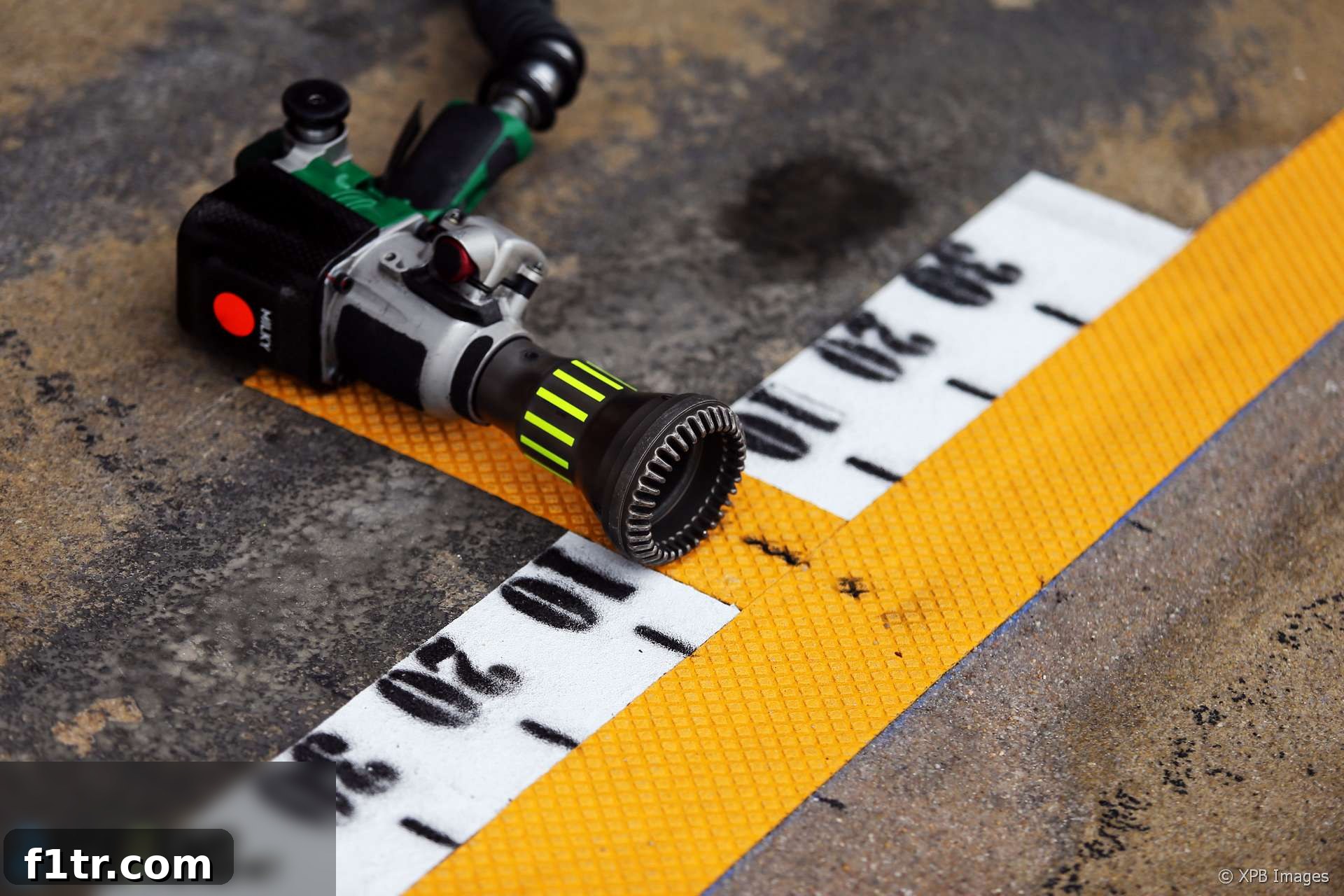
In the dynamic world of Formula 1, change is constant, but sometimes, stability is sought to level the playing field and manage costs. One such significant development is the impending ban on upgrading pit stop equipment, a move designed to streamline operations and ensure fairer competition across the grid. This comprehensive round-up delves into this crucial regulatory update, alongside the latest buzz from drivers on social media, pressing news from the broader motorsport arena, and a thought-provoking discussion on the future of F1 fuels.
F1 Pit Stop Equipment Freeze: Enhancing Fairness and Managing Costs
Formula 1 teams are facing a new regulatory challenge as a ban on upgrading their pit stop equipment is set to come into effect from September. This directive is part of a broader initiative within the sport to control expenditure and ensure a more equitable competitive environment. By freezing development in this critical area, the FIA and Formula 1 aim to prevent an escalating ‘arms race’ in pit lane technology, which often favors wealthier teams and contributes to ever-increasing budgets.
The freeze means that from September 30th onwards, only minor modifications will be permitted, such as adjustments to jacks to accommodate varying car ride heights. Even these minor changes will not be automatic, as they will require explicit approval from the governing body, emphasizing the strict adherence to the new rules. The underlying principle is to standardize the tools and equipment used in pit stops, shifting the focus back to human skill, precision, and the collective teamwork of the pit crew rather than technological superiority of the equipment itself.
This move is particularly relevant as Formula 1 continues to grapple with the complexities of its budget cap regulations. By limiting technological advancements in areas like pit stop equipment, the sport hopes to create a more level playing field, where innovative engineering solutions in car design remain paramount, but auxiliary equipment costs are contained. This could foster greater competition among teams and potentially lead to more unpredictable and exciting races, as the margins between teams become even finer.
Teams will now need to optimize their existing equipment and hone their crew’s techniques to maintain their lightning-fast pit stop performance, rather than relying on iterative upgrades to their gear. This shift demands a different kind of innovation – one focused on process and human performance – ensuring that the spectacle of a sub-two-second pit stop remains a testament to coordinated human effort.
Social Media Spotlight: Drivers Back in Action
As the motorsport world geared up for the restart of various championships, drivers took to social media to share their excitement, preparations, and initial experiences of returning to the track. Social media platforms like Twitter and Instagram have become indispensable channels for F1 fans to connect directly with their heroes and get behind-the-scenes glimpses of their lives and work.
He’s back.
🏎 R.S.18
📍 Red Bull Ring
📊 500km
🦡 115 laps#RSspirit @DanielRicciardo pic.twitter.com/mZREmbRAnW— BWT Alpine F1 Team (@AlpineF1Team) June 16, 2020
Daniel Ricciardo, then driving for Renault (now Alpine F1 Team), offered fans an exciting update from the Red Bull Ring. His tweet showcased a successful test session in the R.S.18, covering 500km and completing 115 laps. These testing opportunities are invaluable for drivers to shake off any rust, regain peak physical and mental sharpness, and provide crucial feedback to the team’s engineers, even when using an older specification car. It’s a vital step in preparing for the intense demands of a Formula 1 race weekend, ensuring both driver and team are perfectly synchronized for the upcoming season.
Feels good to be back! Now let’s get to work 💪 pic.twitter.com/R8vonYQEet
— George Russell (@GeorgeRussell63) June 16, 2020
Similarly, George Russell, a rising star in the F1 paddock, shared his enthusiasm about returning to the cockpit. His message, “Feels good to be back! Now let’s get to work 💪”, resonated with fans eager to see their favorite drivers back on track. Such posts highlight the universal passion and dedication of F1 drivers, showcasing their unwavering commitment to competition and their meticulous preparation for every race.
Beyond Twitter, platforms like Instagram serve as a rich source of visual content, offering glimpses into drivers’ training regimes, travel, and candid moments. While the specific content of this Instagram post (https://www.instagram.com/p/CBfNJdtlNPG/) isn’t detailed here, it likely contributed to the broader narrative of drivers re-engaging with their sport and fans ahead of a highly anticipated return to racing.
- For a wider network of official F1 accounts and driver profiles, explore the comprehensive F1 Twitter Directory, a valuable resource for any motorsport enthusiast.
Advert | Become a RaceFans supporter andgo ad-free
Key Motorsport Headlines and Developments
Beyond the immediate driver updates, the motorsport world is constantly buzzing with regulatory changes, social discussions, and operational challenges. Here’s a deeper look at some of the pressing topics making headlines:
Advert | Become a Supporter & go ad-free
Development of Formula 1 pit equipment to be frozen in September (F1)
Further elaborating on the earlier announcement, Formula 1’s official channels confirmed that the freeze on pit equipment development will be strictly enforced. After September 30th, teams will be limited to only minor alterations, such as adjusting jacks for different car ride heights, all of which will require explicit approval from the governing body. This ruling underscores F1’s commitment to cost control and competitive parity, ensuring that resource-heavy technological arms races in non-performance-critical areas are curtailed.
Hamilton will ‘take a knee’ on return to Formula One action in Austria (Daily Mail)
Lewis Hamilton, a vocal advocate for social justice and equality, announced his intention to “take a knee” upon his return to Formula 1 action in Austria. This powerful gesture, symbolic of solidarity with anti-racism movements, highlights the growing intersection of sports and social activism. F1, along with many other sports organizations, has expressed its support for drivers and individuals who wish to demonstrate their stance against racism, recognizing the platform and influence motorsport personalities wield in promoting positive societal change. This commitment reflects a broader shift towards diversity and inclusion within the sport.
Prema Powerteam and Roman Stanek part ways (Prema)
In the junior motorsport categories, significant news emerged as Prema Powerteam announced a mutual agreement to part ways with driver Roman Stanek. This decision came ahead of the 2020 Formula Regional European Championship. Driver changes and team reshuffles are common in the fiercely competitive junior formulas, where young talents strive to climb the ranks towards Formula 1. Such separations often reflect strategic realignments, budget considerations, or performance evaluations, significantly impacting a young driver’s career trajectory and necessitating new opportunities to continue their development.
Hockenheim wants swift call on 2020 F1 prospects (Motorsport Week)
Circuit operators, like Hockenheim, faced immense uncertainty during periods of global disruption, particularly concerning the viability of hosting major events like Formula 1 races. Hockenheim issued a call for a swift decision regarding its prospects for hosting an F1 Grand Prix in 2020. Circuits operate on tight financial margins, and keeping unconfirmed dates available for extended periods can severely impact their economic utilization and planning. This situation underscored the complex logistical and financial challenges faced by race organizers globally as they navigated the unprecedented circumstances.
Works At Mulsanne Corner Near Completion (Daily Sportscar)
Legendary circuits are continuously upgraded to enhance safety and spectator experience. News from Le Mans highlighted that works at the iconic Mulsanne Corner were nearing completion. While the track layout itself remained unchanged, significant improvements included extending the gravel trap at the most exposed point, moving back the fence line, and upgrading safety fencing. These meticulous safety enhancements are crucial for high-speed endurance racing, ensuring driver protection and modernizing track infrastructure to meet contemporary safety standards.
Red Bull Ring: Wirbel um Test von Renault (Speedweek – German)
A minor stir was caused by Renault’s testing activities at the Red Bull Ring, with Red Bull advisor Helmut Marko describing the opportunity as a ‘generous gesture’ by the circuit operators. While teams often test at various circuits, a rival team utilizing a facility closely associated with another manufacturer (Red Bull owns the Red Bull Ring) can sometimes raise eyebrows. Such arrangements, however, are often standard practice, allowing teams valuable track time for development and driver acclimatization, even if they sometimes prompt good-natured comments from competitors.
We always endeavour to credit original sources. If you have a tip for a link to feature in the next RaceFans round-up please send it in via the contact form.
Advert | Become a RaceFans supporter andgo ad-free
The Future of F1 Fuels: A Critical Discussion
One of the most pressing and widely debated topics in modern Formula 1 revolves around its commitment to sustainability and the long-term future of its power units. The discussion often centers on what kind of fuels will power the pinnacle of motorsport in the coming decades, particularly as the world transitions away from fossil fuels. A recent insightful comment from our community perfectly encapsulates this complex debate:
I could see biofuels or synthetic fuels playing a role in a transitional period between fossil fuels and full hydrogen/electric F1 cars. Maybe this is something being considered for the 2026 formula, dependent on the performance of these fuels and their appeal to manufacturers.
At the end of the day though, even though the lifecycle may be described as carbon neutral, biofuels and synthetic fuels still result in emission of CO2 and other potentially harmful gases at point of use. So I think it’s likely these would only be used in an interim period, and won’t be the long term future of either conventional transport or F1.
Keith Campbell (@Keithedin)
Keith’s comment highlights the nuanced challenges and potential pathways for Formula 1’s sustainable future. The concept of biofuels and synthetic fuels as a transitional solution for the 2026 regulations is gaining significant traction. These “drop-in” fuels offer the advantage of being compatible with existing engine architectures, potentially reducing the development burden for manufacturers while significantly lowering the net carbon footprint through sustainable production methods. They are designed to achieve carbon neutrality on a lifecycle basis, meaning the CO2 emitted during combustion is offset by the CO2 captured during their production.
However, as Keith rightly points out, while their lifecycle might be carbon neutral, these fuels still produce emissions at the point of use. This aspect raises questions about their ultimate role in a truly zero-emission future, especially when compared to completely emission-free alternatives like hydrogen or electric power. While electric powertrains are proving highly effective in series like Formula E, their application to F1 presents unique challenges concerning battery weight, charging infrastructure, and the desire to maintain the characteristic speed, sound, and range of an F1 car. Hydrogen, either as a fuel for internal combustion engines or for fuel cells, represents another exciting but technologically demanding frontier.
The decision for the 2026 power unit regulations will be critical. It must balance environmental responsibility with the core DNA of Formula 1: cutting-edge technology, thrilling performance, and intense competition. The chosen path will not only define the sport for decades to come but also influence the broader automotive industry as F1 continues to serve as a high-speed laboratory for future mobility solutions. The debate around biofuels, synthetic fuels, hydrogen, and electrification is far from over, underscoring F1’s commitment to pushing technological boundaries for a sustainable tomorrow.
Celebrations: Happy Birthday to Our Community Members!
We love celebrating our dedicated community members! A very happy birthday goes out to Beninlux, Jonathanproc, and Vikenbauer. We hope you all have a fantastic day filled with joy and perhaps some motorsport-themed festivities!
If you’d like a birthday shout-out in a future round-up, be sure to let us know your special day via our contact form, or add your details to our ongoing birthday list here.
On This Day in F1 & Motorsport History
- Exactly 30 years ago today, motorsport history was made at the iconic Le Mans 24 Hours. The legendary trio of Martin Brundle, John Nielsen, and Price Cobb clinched a magnificent victory in their powerful Jaguar XJR-12. This particular race was notable as it was the first Le Mans event to feature chicanes on the formidable Mulsanne straight, a change implemented to reduce excessive speeds and enhance safety. Brundle’s participation was particularly dramatic, as he stepped in to replace Eliseo Salazar after his original car encountered unforeseen electrical problems. Their triumph remains a testament to endurance, skill, and the relentless spirit of competition that defines the Le Mans 24 Hours.