In the high-octane world of Formula 1, where split-second decisions and intricate regulations govern every aspect of racing, a crucial safety measure has come under intense scrutiny. The black-and-orange flag, a directive for a driver to pit immediately for repairs due to mechanical damage, has sparked considerable debate and controversy, prompting the sport’s governing body, the Fédération Internationale de l’Automobile (FIA), to initiate a comprehensive review of its application. This pivotal re-examination aims to establish clearer guidelines and ensure consistent enforcement, particularly in the wake of significant protests lodged by the Haas F1 team following the United States Grand Prix.
Advert | Become a Supporter & go ad-free
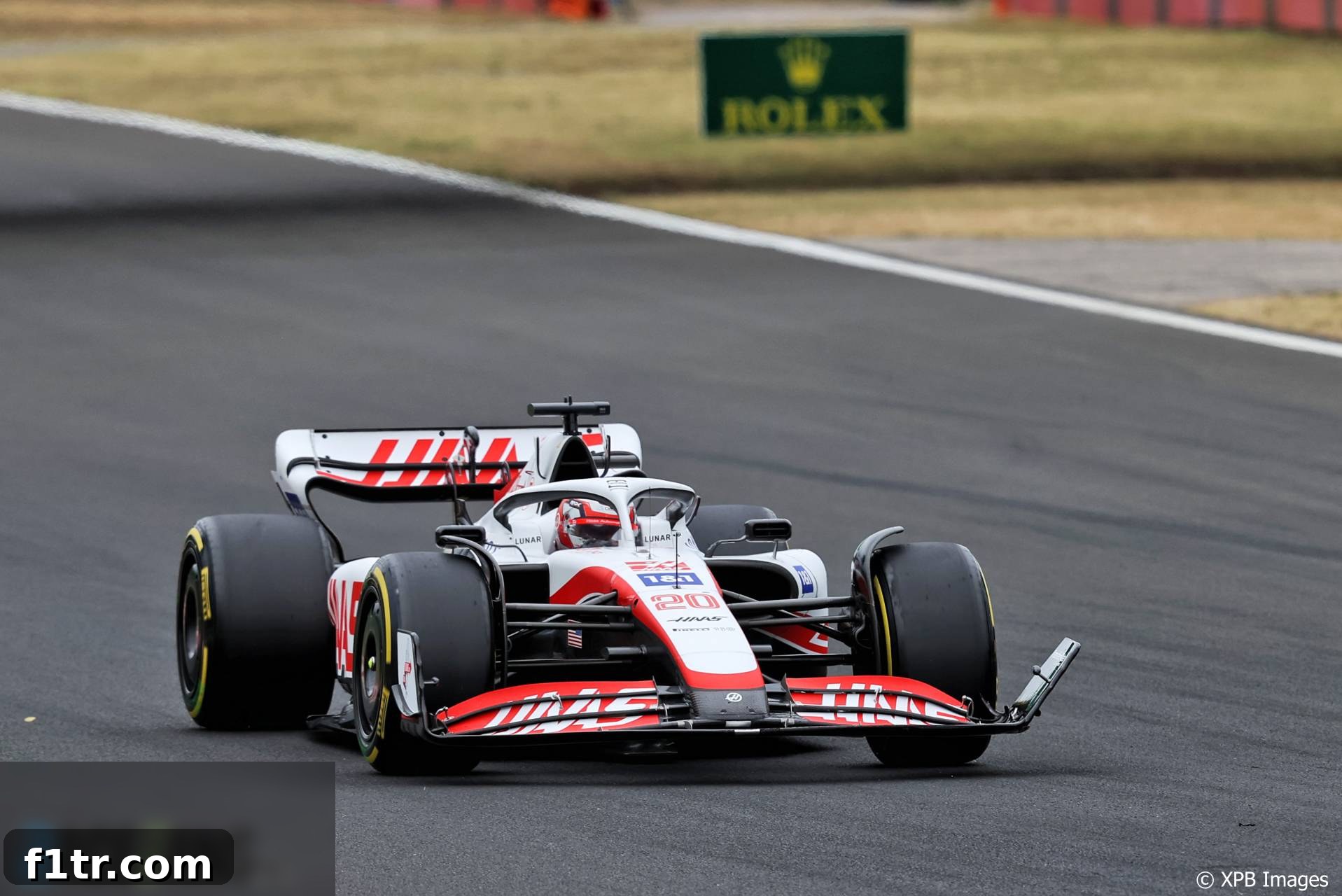
The core of the issue revolves around the interpretation of what constitutes ‘unsafe’ damage and the subsequent, often race-altering, penalty. Haas driver Kevin Magnussen has been a central figure in this unfolding drama, having been shown the black-and-orange flag on three separate occasions during the current season. Each instance stemmed from damage to the front wing endplates of his VF-22, mandating pit stops that severely compromised his race performance and results. These repeated penalties, contrasted with incidents involving other teams where similar damage went unflagged, fueled Haas’s frustration and culminated in their formal protests in Austin.
The Austin Aftermath: Haas’s Protests and the Call for Consistency
The United States Grand Prix became a pivotal moment in the black-and-orange flag saga. Following Magnussen’s own experiences, Haas took the proactive step of protesting Red Bull Racing and Alpine. Their contention was clear: parts had detached from cars belonging to both teams during the race, specifically a front wing component from a Red Bull and a wing mirror from Fernando Alonso’s Alpine, yet neither driver was issued the black-and-orange flag. Haas argued this represented a glaring inconsistency in the application of a safety rule that had previously cost their own driver dearly.
While Haas’s protest against Red Bull was promptly dismissed by the race stewards, their challenge against Alpine and Fernando Alonso initially proved successful. Stewards sided with Haas regarding Alonso’s car, which had lost its right-hand wing mirror, and imposed a penalty. However, the decision was later controversially overturned on a technicality, with stewards ruling that Haas had lodged their protest beyond the permissible timeframe. Despite this reversal, the stewards’ official statement was highly significant; they reiterated their profound concerns that Alonso had not been shown the black-and-orange flag during the race itself. This clearly indicated that while the appeal was dismissed on procedural grounds, the underlying safety and consistency issues raised by Haas held merit in the eyes of the officials.
The stewards’ decision in the appeal included a strong recommendation that has galvanized the FIA’s review. They explicitly stated, “We strongly recommend procedures be put in place to monitor such matters and where necessary, require the problem to be rectified as has been done multiple times in the past, through either a radio call to the team or display of the black and orange flag.” This recommendation not only underscored the need for standardized protocols but also validated the core argument put forth by Haas regarding the perceived arbitrary nature of the flag’s deployment. Crucially, their statement also confirmed a major development: “We also understand the FIA president has initiated a review into the use of the black and orange flag.” This official announcement brought the issue to the forefront, signaling a serious commitment from the highest levels of motorsport governance to address these critical concerns.
Driver Perspectives: Kevin Magnussen’s Plea for Fair Play
For Kevin Magnussen, the repeated application of the black-and-orange flag has been a source of immense frustration and a significant talking point. His core argument is rooted in the principle of fairness and consistency across the grid. He firmly believes that if such a minor infringement warrants a compulsory pit stop for his car, then all other competitors exhibiting similar damage should be subjected to the same rule without exception.
Magnussen articulated his position clearly: “If it’s actually because of safety, then safety first, I absolutely understand.” He emphasized his unwavering commitment to safety protocols. However, he quickly added a critical nuance, stating, “And I’m happy either way, if the FIA decide not to, then stop us from running with little parts [loose].” This reflects his desire for a definitive and uniformly applied standard, regardless of which direction the FIA ultimately takes. He voiced his belief that some of the calls against him for minor flapping components were “a bit over the edge,” distinguishing them from more substantial structural damage that might genuinely compromise safety. “But if the front wing is flapping, the whole thing or something like that, then I get it,” he clarified. The crux of his appeal remains steadfast: “Anyway I’m good with either direction they take as long as it’s the same for everyone.”
His experience at the United States Grand Prix particularly highlighted the inconsistency he was challenging. “Clearly in Austin, it wasn’t the same for everyone. I’ve had this flag three times this year. Which I’m annoyed with myself damaging the front wing but still, I got these flags, and then it’s not fair when you see a race like Austin and quite a few cars have damage and they don’t get it.” This disparity not only directly impacts race outcomes but also erodes trust in the officiating process among drivers and teams. Magnussen further suggested that a slightly more lenient approach to minor contact and damage would enhance racing, provided genuine safety risks are not introduced. “I would prefer it to be a little more free so you can actually have a little bit of contact and you’re still okay,” he explained. He argues that driving with a damaged end plate is often imperceptible from the cockpit and does not significantly compromise the car’s performance or overall safety. “Because driving with that thing, the end plate off, you almost don’t feel it. It’s fine, the car is still race-able and fast. I obviously get the argument if it hits someone in the head, but I don’t know if that piece is big enough to actually do any damage.” He also points to the robust design of modern F1 components, suggesting that the likelihood of minor detached pieces actually causing further harm is often low: “There’s also the thing about it not actually falling off so easily because of the way it’s structured. It’s very low chance it will fall off. So anyway, it just has to be the same for everyone either way.”
Advert | Become a RaceFans supporter andgo ad-free
Fernando Alonso’s Nuanced View: Aerodynamics and Race Control’s Dilemma
Fernando Alonso, a two-time world champion and one of the most experienced drivers on the grid, offered a more nuanced perspective on the black-and-orange flag, emphasizing the complexities faced by both drivers and race control. He highlighted the inherent difficulty for drivers to accurately assess damage while operating a car at extreme speeds. “Inside the car, we don’t know sometimes even what damage we have, what aerodynamic devices are ready to fall behind the next car,” he explained. This lack of real-time visibility places a significant responsibility on the race director and race control, as drivers “just rely on the race director and we just drive the car as fast as we can.”
Alonso acknowledged the imperative for a thorough review of the flag’s usage. “We maybe need to use that flag more often, or not, it’s a decision that the FIA and teams need to check,” he stated, indicating that the current situation is far from ideal. He drew attention to the radical transformation of Formula 1 car design over the decades, particularly the proliferation of complex aerodynamic devices. “I think Formula 1 has changed a lot in the last 40, 50 years, there are a lot of aerodynamic devices now they are borderline in the races, so we need to make sure that we have a proper rule on that.” The intricate and often fragile nature of modern F1 aerodynamics means that even seemingly minor contact can result in parts detaching, creating potential debris fields and safety hazards that demand clear guidelines.
However, Alonso also sounded a note of caution against an overly aggressive application of the black-and-orange flag, warning that it could lead to a substantial increase in race retirements, thereby impacting the spectacle and sporting integrity. “When you see the black-and-orange flag you have to stop and probably retire the car because I think it’s very difficult to fix some of those,” he observed. While relatively simple damage, such as a broken front wing, might be repairable with a swift pit stop, many other types of damage could necessitate a complete withdrawal from the event. “Maybe the front wing is the easiest one, but apart from that I think it is difficult.” This underscores the profound practical consequences for teams and the overall competitive narrative of races if cars are frequently pulled out for issues that, while technically damaging, might not pose an immediate catastrophic threat to safety.
The FIA’s Mandate: Crafting Clearer, Consistent Safety Protocols
The decision by the FIA President to launch a comprehensive review into the black-and-orange flag’s deployment underscores the seriousness with which this issue is being addressed. This review will be a collaborative effort, involving extensive consultations with Formula 1 teams, drivers, technical experts, and race officials to formulate objective and unambiguous criteria for its usage. The paramount challenge for the FIA will be to meticulously balance the unwavering commitment to safety on track with the imperative of maintaining sporting fairness and absolute consistency in the application of regulations.
Several critical factors will dominate the discussions. Firstly, the precise definition of “unsafe” damage must be established with unprecedented clarity. This involves moving beyond subjective interpretations to objective parameters, potentially specifying criteria related to the size, weight, and material of detaching components, as well as a quantified assessment of the likelihood of these parts causing injury or further car damage. Secondly, the practical feasibility of real-time monitoring by race control presents a significant hurdle. Given the extreme speeds of F1 cars and the dynamic nature of race conditions, accurately identifying and evaluating damage from various camera angles in the heat of the moment is inherently complex. The review may explore advanced technologies or enhanced procedural guidelines to assist race control in making these critical calls.
Thirdly, and perhaps most importantly for the integrity of the sport, the consistency of application must be absolute. Any perception of favoritism, bias, or arbitrary decision-making rapidly erodes trust among competitors and fans alike. Revised guidelines must be applied uniformly and transparently to all teams and drivers, irrespective of their championship position, team stature, or historical track record. Finally, the significant sporting impact of such decisions cannot be understated. Forcing a driver to pit or retire from a race due to mechanical damage can dramatically alter the course of a Grand Prix, influence championship battles, and impact team standings, thereby necessitating robust, well-reasoned, and transparent decision-making processes.
The FIA’s review is expected to explore a wide array of potential solutions. These might include the implementation of clearer visual benchmarks for race control to identify dangerous damage, a multi-tiered warning system before a mandatory black-and-orange flag is issued, or even specific technical directives concerning the structural integrity and design of certain aerodynamic components to minimize the risk of dangerous detachments. The overarching goal is to eliminate ambiguity, ensuring that when the black-and-orange flag is displayed, its necessity is universally understood, accepted, and fundamentally justified by genuine safety concerns.
Advert | Become a RaceFans supporter andgo ad-free
Shaping the Future: The Evolution of Safety Flags in Formula 1
The outcome of the FIA’s ongoing review will undoubtedly have far-reaching implications for the future of Formula 1. A meticulously defined and consistently applied regulation regarding mechanical damage will serve multiple vital purposes: it will significantly enhance the safety for all participants on track, bolster driver confidence in the fairness and reliability of officiating, and contribute to a more equitable and transparent sporting environment. This is a complex undertaking, demanding a thoughtful integration of cutting-edge technical expertise, profound sporting wisdom, and an acute understanding of the high-stakes, fast-paced nature of Formula 1 racing. As the sport continues its relentless pursuit of technological advancement and ever-increasing speeds, the regulations governing safety must evolve in parallel, ensuring that the inherent thrill and intense competition of Formula 1 never come at the expense of its heroes’ well-being and the sport’s fundamental integrity.
2022 Mexican Grand Prix
- How many victory chances did Hamilton have in his first winless F1 season?
- Delay in producing new parts held up Alfa Romeo upgrade
- Doohan’s practice run earns praise, but Alpine undecided over reserve role
- ‘I was in the fight, which hasn’t been often this year’: Ricciardo’s Mexican GP transcript
- Verstappen “will continue to break records for the rest of his career” – rivals
Browse all 2022 Mexican Grand Prix articles