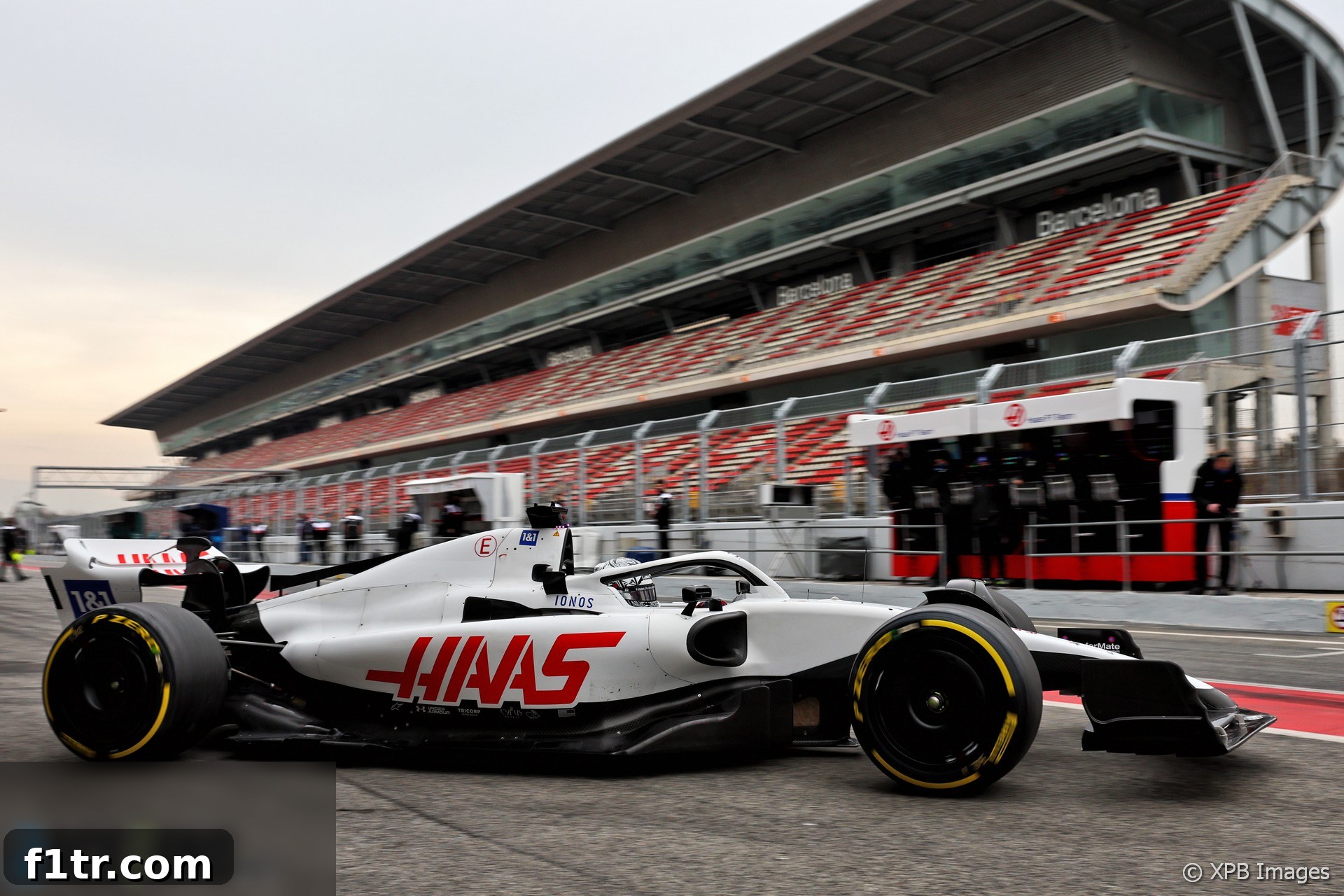
Haas F1 Unveils Striking New Livery Amid Geopolitical Tensions: A New Era for the VF-22
The Haas Formula 1 team has officially unveiled a significantly revised livery for its VF-22 challenger, a move that starkly signals a departure from its previous identity tied to Russian sponsorship. Following Russia’s invasion of Ukraine, the team has taken decisive action, removing all Uralkali sponsorship logos and discontinuing the prominent Russian flag color scheme that adorned its cars and facilities. This strategic and symbolic rebranding marks a pivotal moment for Haas F1 as it navigates a complex global landscape, focusing on a more neutral and unified aesthetic for the upcoming 2022 Formula 1 season.
The newly revealed car now features a predominantly plain white body, accented by sleek black wings, presenting a crisp and understated design. While the bold Russian flag colors—red, white, and blue—are conspicuously absent, certain sponsor identities remain. The logos of the German web hosting company, 1&1, are still visible, alongside those of the team’s various technical partners and suppliers. This updated appearance was first showcased during the final day of the inaugural pre-season testing session at the Circuit de Catalunya in Barcelona, drawing immediate attention from media and fans alike.
The Uralkali Partnership: A Brief History and Its Abrupt End
The partnership between Haas F1 and Uralkali, a Russian potash fertilizer producer, began in 2021 and quickly became one of the most visible sponsorships in Formula 1. This deal was not merely a commercial agreement but also intrinsically linked to the career of Nikita Mazepin, whose father, Dmitry Mazepin, is a major shareholder in Uralkali. The sponsorship transformed the Haas car’s livery into a design heavily inspired by the Russian national flag, often referred to as the “Russian rocket” or “Soviet missile” by fans and commentators. While the team maintained that the livery was a technical design interpretation and not an overt political statement, its strong visual resemblance to the Russian flag, especially during a time when Russian athletes and symbols faced scrutiny, often sparked debate.
The Uralkali sponsorship was not just about aesthetics; it was a significant financial lifeline for the independent American team, one of the smaller outfits on the F1 grid. It provided crucial funding, allowing Haas to invest in development and operational costs. However, the rapidly evolving geopolitical situation, specifically Russia’s full-scale invasion of Ukraine, rendered the continuation of this partnership untenable. The global outcry and the swift imposition of international sanctions on Russia led to an immediate re-evaluation by many sports organizations and businesses worldwide.
Haas F1 confirmed its decision to alter the livery and remove all Uralkali branding yesterday, just ahead of the final day of testing. This action extended beyond the track, as Uralkali logos were also systematically removed from the team’s garage, hospitality areas, and other facilities at the Circuit de Catalunya. The team’s prompt and unequivocal response underscored the seriousness with which the situation was being treated, prioritizing its brand image and ethical stance over the commercial implications of ending a major sponsorship.
The VF-22’s New Identity: Simplicity and Serenity
The transformation of the Haas VF-22 is more than just a paint job; it’s a statement of neutrality and a fresh start. The car’s previous red, white, and blue design, while vibrant, carried a specific nationalistic connotation. The new livery, dominated by a clean white base and stark black wings, offers a minimalist yet striking aesthetic. This choice of colors reflects a universal design language, free from political association, and allows the car’s aerodynamic lines and the remaining sponsor logos to stand out more prominently. The 1&1 logos, a long-standing partner, maintain their visibility, along with other technical suppliers, indicating the stability of these ongoing relationships.
The visual impact of this change is considerable. In a sport where every detail is scrutinized, a team’s livery is a crucial part of its identity and marketing. The shift to a “blank slate” white and black design could be seen as a conscious effort by Haas to project an image of professionalism and detachment from the geopolitical turmoil, allowing the focus to return squarely to the racing itself. This simplified design might even gain unexpected popularity among fans who appreciate its clean lines and absence of busy branding, providing a fresh canvas as the team gears up for the stringent new technical regulations of the 2022 season.
Drivers in Focus: Mazepin’s Uncertain Future and Schumacher’s Consistency
The livery change brought immediate attention to the team’s driver lineup, particularly Nikita Mazepin. His presence in Formula 1 was directly linked to the Uralkali sponsorship, and with the termination of that agreement, questions about his future with Haas F1 naturally arose. The sport’s governing body, the FIA, had already announced that Russian and Belarusian drivers would be allowed to compete only under a neutral flag, without national symbols, anthems, or colors. This decision, while allowing Mazepin to potentially continue, did not address the contractual implications of his father’s company withdrawing its primary financial backing.
As of the time of the livery reveal, Nikita Mazepin was still scheduled to drive for the team alongside Mick Schumacher on the final day of testing at Circuit de Catalunya. However, speculation mounted regarding the stability of his position for the upcoming season. Haas F1’s principal, Guenther Steiner, acknowledged the complexity of the situation and indicated that the team would provide further updates on their driver lineup and contractual obligations in due course. The situation for Mazepin was exceptionally challenging, as he found himself at the nexus of a global political crisis and its sporting ramifications.
Mick Schumacher, the son of legendary Michael Schumacher, continued his preparations for his second season in Formula 1 largely unaffected by the sponsorship upheaval, though undoubtedly aware of the broader team context. His consistent development and strong performances during his rookie year have positioned him as a crucial asset for Haas. With the focus potentially shifting even more towards pure sporting merit and team performance, Schumacher’s role in driving the team forward becomes even more significant.
Formula 1’s Broader Response and the Implications for the Season
The Haas F1 team’s decision to remove Russian branding is part of a wider response across the sport. Formula 1 itself, along with the FIA, took a firm stance against the events unfolding in Ukraine. Notably, the sport officially announced the cancellation of the 2022 Russian Grand Prix, which was scheduled to be held in Sochi. This move followed extensive discussions among teams, the FIA, and Formula 1 management, concluding that it would be “impossible” to hold the race under the prevailing circumstances. The cancellation of such a high-profile event, a significant fixture on the F1 calendar since 2014, underlined the gravity of the situation and the sport’s commitment to aligning with international condemnation.
Furthermore, various national sporting federations also implemented their own bans or restrictions on Russian and Belarusian athletes. While the FIA initially allowed drivers to compete under a neutral flag, this decision was met with mixed reactions, with some advocating for a complete ban. The evolving situation indicated that the sporting world was adapting dynamically, with commercial, ethical, and political considerations deeply intertwined. For Haas F1, these external pressures, coupled with internal financial considerations, made the termination of the Uralkali partnership an almost inevitable, albeit painful, decision.
Navigating the Financial and Strategic Challenges Ahead
Losing a title sponsor of Uralkali’s magnitude presents significant financial challenges for Haas F1, a team that has historically operated on one of the smaller budgets in Formula 1. The immediate impact will be the need to find alternative funding streams or to operate with a reduced budget, at least temporarily. Team owner Gene Haas and principal Guenther Steiner will undoubtedly be exploring all options, from securing new sponsors to potentially re-evaluating internal financial structures.
However, this situation also presents an opportunity for a strategic reset. By shedding the politically sensitive branding, Haas F1 enhances its appeal to a broader range of international sponsors who might have been hesitant to associate with the previous livery. The team’s swift and decisive action in response to the conflict could also be viewed positively by potential partners and the global fan base, aligning with contemporary corporate social responsibility values. The focus for Haas will now be on maximizing on-track performance with their new VF-22, demonstrating resilience, and attracting new commercial partners who share the team’s refined brand vision.
Pre-Season Testing: A Crucial Period Amidst Distraction
The pre-season testing period is notoriously critical for all Formula 1 teams, offering the only opportunity to gather vital data on their new cars before the competitive season begins. For Haas F1, this period was compounded by the intense focus on its livery and sponsorship situation. Despite the off-track distractions, the team aimed to maximize its track time at Circuit de Catalunya, evaluating the VF-22’s performance under the radical new technical regulations for 2022. The car, designed to fundamentally change the aerodynamic philosophy of F1, requires extensive setup work, data collection, and driver feedback to unlock its full potential.
Both Nikita Mazepin and Mick Schumacher, during their allotted sessions, focused on understanding the new car’s characteristics, conducting long runs, and refining setups. While the headlines were dominated by the livery change, the engineers and mechanics continued their relentless work in the garage, a testament to the demanding nature of Formula 1. The challenge for Haas was to ensure that the external pressures did not unduly compromise their technical preparations, making every lap count as they head towards the first race of the season.
The new white and black livery on the Haas VF-22 is more than just an aesthetic change; it symbolizes a team adapting to unprecedented global events. It’s a bold statement of autonomy and a commitment to maintaining a neutral stance in sports amidst political turmoil. As Formula 1 enters a new era of technical regulations, Haas F1 aims to present a refreshed image, ready to face the challenges of the 2022 season with renewed determination.
Related Articles: Explore the 2022 F1 Season
- Mercedes told me “you’re wrong” about 2022 car’s problems – Hamilton
- FIA confirms all 10 F1 teams complied with 2022 cost cap
- Steiner “not ashamed” of panning “slow” Schumacher in Drive to Survive
- Albon believes year out of F1 improved him as a driver
- Hamilton sees diversity gains in F1 years on from his ‘traumatising’ experience of racism
Browse all 2022 F1 season articles