Advert | Become a Supporter & go ad-free
Carlos Sainz Calls for Faster Marshalling Response After Alarming Austrian Grand Prix Engine Fire
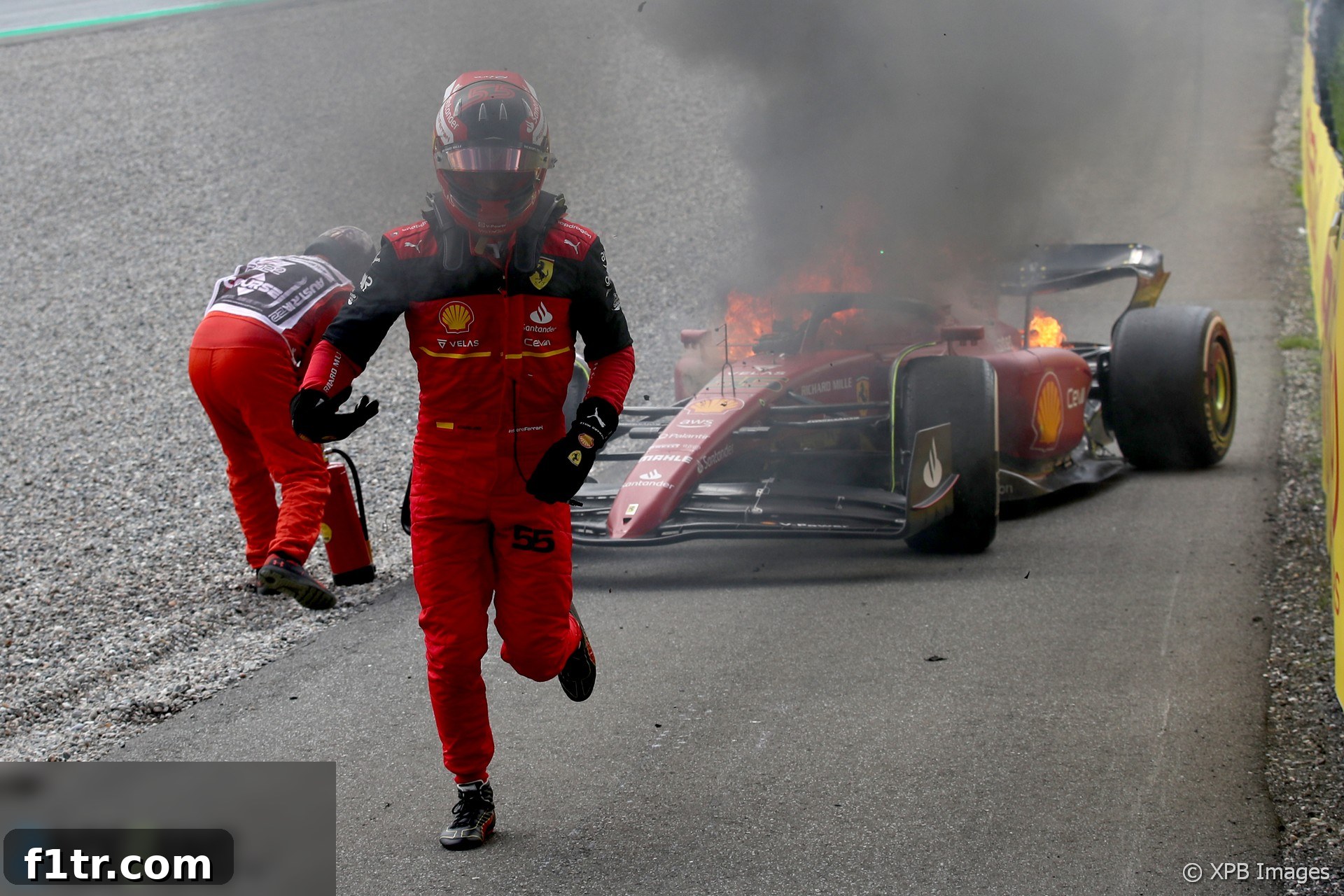
Carlos Sainz Jnr has voiced significant concern regarding the speed of the marshalling reaction to his dramatic engine fire during the 2022 Austrian Grand Prix. The Ferrari driver’s car burst into flames on the Red Bull Ring circuit, leading to a perilous situation where he was trapped between an escalating fire and the risk of his car rolling backwards into oncoming traffic.
The incident, which occurred during the latter stages of the race on Sunday, saw Sainz’s Ferrari F1-75 develop a catastrophic engine failure. After pulling off track at Turn 4, the car came to a halt on a slope in the run-off area. What followed was a tense few moments that highlighted potential shortcomings in emergency response protocols, prompting Sainz to call for an urgent review.
A Driver’s Dilemma: Fire and Rollback
Sainz’s car stopped precariously on an incline, a critical detail that complicated the immediate safety procedures. As flames began to erupt from the rear of the vehicle, a marshal quickly approached, attempting to place a wheel chock behind the front-right tyre. However, as the marshal worked, the car began to roll backwards, creating an immediate and alarming hazard.
This dynamic situation presented Sainz with a terrifying dilemma: should he prioritize his own escape from the burning car, or try to prevent his uncontrolled vehicle from potentially rolling back onto the active race track? Speaking to media, including RaceFans, after the event, Sainz articulated the severity of those moments.
“It was not an ideal and an uneasy situation for sure because I saw in my mirrors that the car was catching fire, but at the same time I was pressing the brake,” Sainz explained. “As soon as I tried to jump out, I saw that the car was rolling backwards and I didn’t want to leave the car completely free, out of control, rolling backwards while jumping out.”
His immediate instinct was to call for assistance, urging marshals to secure the car before he fully exited. “I was calling the marshals to come and help me to put something on the tyres to stop the car rolling down. But I think the whole process was a bit slow,” he elaborated, stressing the delay in securing the vehicle.
Escalating Flames and Eventual Escape
The fire continued to intensify rapidly, making Sainz’s position increasingly untenable. Despite his concerns about the car’s movement, the overwhelming nature of the blaze eventually forced his hand. “At some point there was so much fire that I had to really get a move on and jump out independently,” Sainz recounted. He noted that it was only “at the time that the first marshal arrived and stopped the car” that he felt it was safe enough to fully escape.
Miraculously, Sainz emerged from the harrowing incident unharmed. His F1-75 eventually came to a stop against a barrier, where marshals finally managed to douse the substantial flames. The dramatic images of the fire, with Sainz still partially in the cockpit, quickly circulated, sparking widespread discussion about safety protocols.
Calls for Review and Enhanced Safety Protocols
The Spanish driver emphasized that the incident is “definitely something we need to look” into. He believes it is crucial to consider “what we could have done a bit faster because it was not the easiest situation to be in.” This sentiment underscores a critical need for continuous evaluation and improvement of motorsport safety standards, particularly concerning rapid incident response.
The role of track marshals in Formula 1 is paramount. These volunteer heroes are the first responders to incidents, often putting themselves in harm’s way to ensure driver safety and clear the track. Their training covers a wide array of scenarios, from minor track incursions to major accidents involving fire and wreckage. However, the unique combination of a car on fire, stopped on a slope, and rolling backwards presented an unusually complex and dangerous situation at the Red Bull Ring.
FIA (Fédération Internationale de l’Automobile) regulations and safety protocols are among the most stringent in global sports, continuously evolving in response to incidents and technological advancements. While the swift action of the marshals to approach the burning car is commendable, Sainz’s experience suggests that there may be areas for refining procedures, especially regarding immediate vehicle stabilization in unpredictable circumstances like an incline.
Implications for Ferrari and the F1 Championship
Beyond the safety concerns, the engine fire marked a significant blow for Ferrari and Sainz’s race. The DNF meant a loss of crucial points in both the Drivers’ and Constructors’ Championships. Ferrari had been enjoying a period of strong performance, with Sainz himself securing his maiden F1 victory just a week prior at the British Grand Prix. The reliability issues highlighted by this engine failure, following similar concerns earlier in the season, pose a serious challenge to their championship aspirations.
For Sainz, it was a bitter end to what could have been a strong points finish, potentially a second-place behind teammate Charles Leclerc. The incident not only robbed him of points but also forced a high-stress, dangerous exit from his car, something no driver wishes to experience. It serves as a stark reminder of the inherent dangers of Formula 1, even with all the modern safety advancements.
The Ferrari team will undoubtedly conduct a thorough investigation into the cause of the engine failure, working in conjunction with the FIA to understand and prevent future occurrences. Lessons learned from such incidents are vital for the ongoing development of safer race cars and more effective emergency response systems across all motorsport categories.
Ultimately, Sainz’s candid remarks serve as a valuable feedback loop for the sport’s governing bodies and race organizers. Ensuring that safety procedures are not just robust but also executed with maximum efficiency and speed in real-world, high-pressure scenarios is a constant, evolving challenge. The well-being of drivers and trackside personnel depends on it.
Advert | Become a RaceFans supporter andgo ad-free
Dramatic Moments: Pictures from Sainz’s Engine Fire at the Austrian Grand Prix
Advert | Become a RaceFans supporter andgo ad-free
Further Reading: 2022 Austrian Grand Prix Insights
- FIA affirms three sprint races on 2023 Formula 1 calendar
- “Oh, so unlucky!” How Alonso’s cursed Austrian Grand Prix unfolded on his radio
- Ferrari believe their performance deficit to Red Bull is now “negligible”
- Another fan’s experience of harassment last weekend – and why F1 must act
- AlphaTauri “desperately” need upgrades after “disaster” weekend, urges Gasly
Browse all 2022 Austrian Grand Prix articles