Aston Martin Protests Chinese GP Qualifying Results After Carlos Sainz’s Controversial Rejoin
In a dramatic turn following the action-packed qualifying session for the 2024 Chinese Grand Prix, the Aston Martin Formula 1 team has officially lodged a protest against the results. The contention revolves around the handling of Carlos Sainz Jnr’s incident during Q2, specifically his ability to rejoin the session after an apparent crash and subsequent stop on the track.
The protest has cast a shadow of uncertainty over the grid for Sunday’s main race, focusing intently on a crucial aspect of the FIA’s sporting regulations. The governing body confirmed that Aston Martin’s challenge directly concerns Article 39.6 of the Formula 1 Sporting Regulations. This particular clause states unequivocally: “Any driver whose car stops on the track during the qualifying session or the sprint qualifying will not be permitted to take any further part in that session.”
The Incident: Sainz’s Q2 Scare and Remarkable Recovery
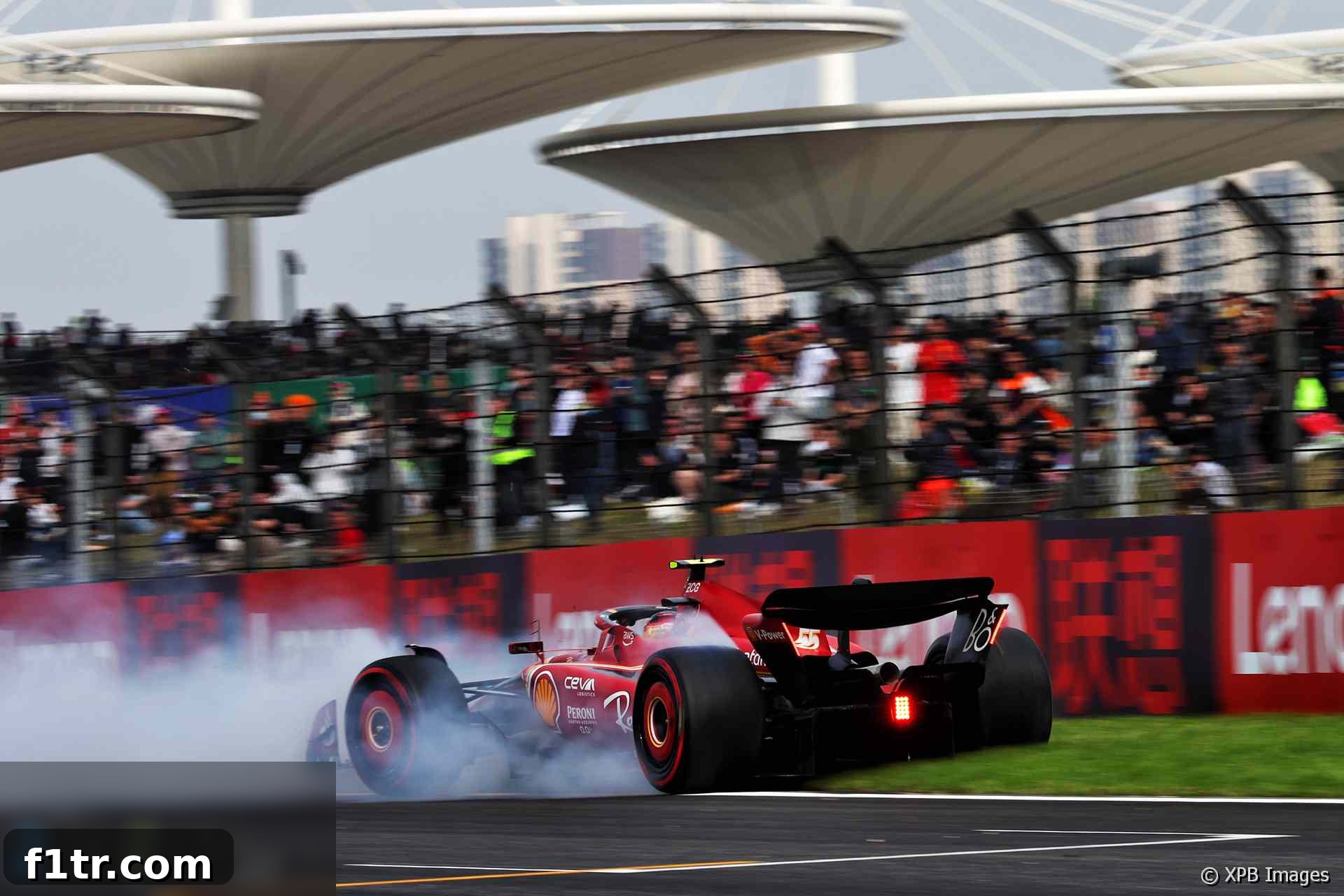
The incident in question occurred during the intense Q2 segment of qualifying. Carlos Sainz Jnr, piloting his Ferrari, lost control and spun into the barrier on the final corner of the Shanghai International Circuit. The impact brought out the red flag, temporarily halting the session as marshals and medical teams assessed the situation. Race control promptly issued a message noting that Sainz’s car had ‘stopped on the start/finish straight’ following his shunt.
What followed was a moment of remarkable quick thinking and car control from the Spanish driver. Despite the significant impact and the initial perception that his session was over, Sainz managed to restart his car. Crucially, and central to the protest, he was able to reverse out of the barrier, execute a complex maneuver to turn his damaged car around, and drive back to the pit lane without any apparent external assistance from marshals or a recovery vehicle. This self-recovery allowed him to continue in qualifying, a feat that surprised many onlookers and eventually saw him progress to Q3. Ultimately, Sainz put in a strong performance to qualify in seventh position on the grid, a result that would have been impossible if Article 39.6 had been interpreted differently in the moment.
Aston Martin’s Position: A Direct Impact on Stroll’s Grid Slot
Aston Martin’s protest is not merely an academic exercise in rule interpretation; it has direct and significant implications for their own team and driver, Lance Stroll. Had Sainz not been permitted to continue in the session after his crash, the qualifying landscape would have shifted considerably. Stroll, who finished Q2 in a respectable but ultimately non-qualifying 11th place, would have been promoted into Q3. For a team battling for crucial championship points and grid position, an additional Q3 appearance represents a major strategic advantage and a significant boost in morale.
The team believes that the spirit and letter of Article 39.6 should have prevented Sainz from rejoining. From their perspective, a car stopping on track after a crash, even if it can be restarted, constitutes a stoppage that should trigger the regulation. Their argument likely hinges on the principle of fairness and the clear wording that “any driver whose car stops on the track… will not be permitted to take any further part in that session.” They argue that Sainz’s car undeniably “stopped” on the track following his collision, regardless of his subsequent ability to restart and drive away. The competitive implications for Lance Stroll and the Aston Martin team are at the forefront of their formal challenge to the stewards.
The FIA’s Interpretation: The “Assistance” Clause
The complexity of this case lies in the nuance of interpretation. An FIA spokesperson, in an earlier statement to RaceFans, provided clarification on the intent behind Article 39.6. According to the spokesperson, the regulation is primarily designed to prohibit drivers from rejoining a session if their car comes to a halt and requires assistance from marshals or a recovery vehicle to be moved or returned to the pits. The key differentiator, in this interpretation, is the presence or absence of outside aid.
Sainz’s incident presents a significant grey area. While his car certainly came to a stop, his remarkable ability to extract himself from the barrier and return to the pit lane without any visible marshal intervention or recovery vehicle assistance challenges a straightforward application of this interpretation. The FIA’s stance suggests that if a driver can self-recover, even after an incident that brings out a red flag, they might be deemed eligible to continue. This interpretation, however, appears to be at odds with the literal wording of the regulation which simply states “stops on the track” without explicitly mentioning external assistance as a condition for exclusion.
Carlos Sainz’s Account: Skillful Damage Limitation
Adding another layer to the controversy is Carlos Sainz’s own explanation of the incident. Speaking to the official F1 channel, Sainz revealed that his quick thinking and precision driving played a crucial role in his ability to continue. He explained that as he approached the barrier, he deliberately altered the angle of his car to minimize the potential damage, focusing on protecting critical components like the rear suspension and rear wing.
“I managed to crash just in the right angle,” Sainz stated, detailing his split-second decision-making. “In the last moment I turned the wheel a bit to make sure that the crash was in the best possible angle and managed to hit the right angle there to don’t damage the rear suspension and the rear wing.” This calculated maneuver allowed him to maintain sufficient functionality in his car to drive it back to the pits, where his Ferrari mechanics could assess and make any necessary repairs during the red flag period. Sainz’s account underscores a high level of skill and presence of mind under pressure, but it does not directly address the regulatory question of whether his car “stopped on the track” in a manner that should have prevented his return.
The Hearing: Awaiting the Stewards’ Decision
Representatives from both Aston Martin and Ferrari have been summoned to a formal hearing to discuss the protest. This crucial meeting is scheduled to take place at 6:00 PM local time at the Shanghai International Circuit. During the hearing, both teams will present their arguments, supported by telemetry data, video evidence, and their interpretations of the FIA Sporting Regulations. Aston Martin will likely emphasize the literal wording of Article 39.6 and the precedent it could set, while Ferrari will undoubtedly highlight Sainz’s unassisted recovery and the FIA’s internal interpretation regarding marshal intervention.
The outcome of this hearing holds significant weight. If Aston Martin’s protest is upheld, Carlos Sainz’s qualifying results could be invalidated, potentially promoting Lance Stroll into Q3 and altering the starting grid for the Grand Prix. Such a decision would also send a strong message regarding the strict enforcement of sporting regulations. Conversely, if the protest is dismissed, it would validate the FIA’s more nuanced interpretation and Sainz’s ability to self-recover, potentially influencing how similar incidents are judged in the future. The racing world eagerly awaits the stewards’ decision, which could have ripple effects throughout the season and impact the ongoing debate surrounding consistency in Formula 1 stewarding.
Pictures: Sainz crashes in Q2
Related Articles: 2024 Chinese Grand Prix & F1 Regulations
Dive deeper into the events and regulations surrounding the Chinese Grand Prix and other Formula 1 controversies:
- Alonso and Sainz incidents prompt changes to Formula 1’s rules
- Aston Martin fail in bid to have Alonso’s Shanghai penalty reviewed
- Mercedes cleared over Hamilton pit stop infraction as ‘nearly all teams in breach’
- Aston Martin petitions FIA to review Alonso’s penalty for Sainz collision
- “You need to be more on it”: 12 unheard radio exchanges from the Chinese GP
Browse all 2024 Chinese Grand Prix articles