Romain Grosjean’s Miraculous Escape: Inside the Bahrain Grand Prix Fireball Crash
The world watched in collective horror and then profound relief as Romain Grosjean emerged from the burning wreckage of his Haas F1 car at the start of the 2020 Bahrain Grand Prix. What unfolded on that fateful day was an incident of unimaginable terror and an extraordinary testament to modern Formula 1 safety. Grosjean’s harrowing escape from a fiery inferno, which saw him trapped for a staggering 28 seconds, quickly became one of the most iconic and pivotal moments in the sport’s recent history. For the first time since the shocking accident, Grosjean has shared the chilling details of his fight for survival, offering a vivid glimpse into the heart of the flames and the thoughts that spurred his miraculous escape.
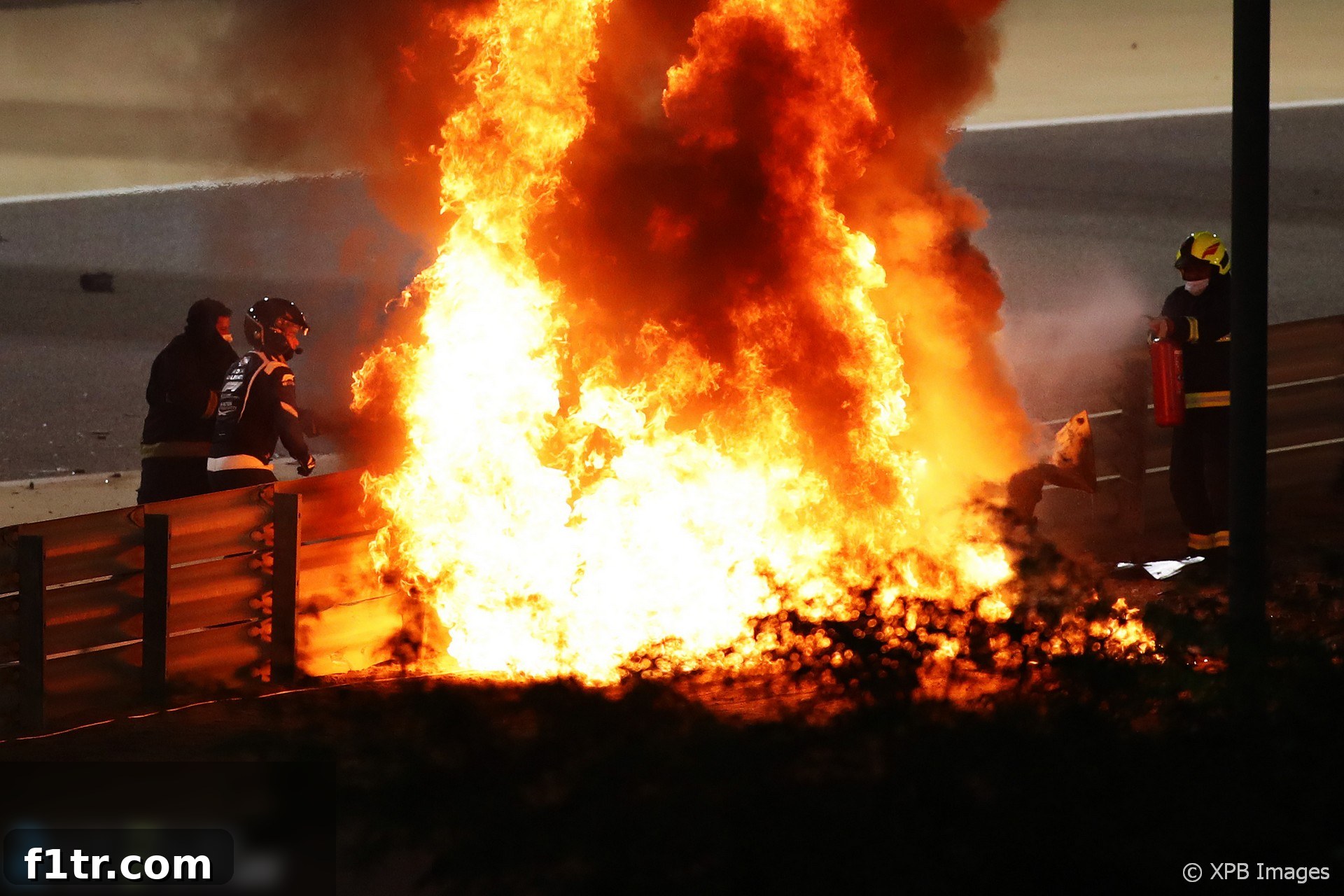
On that fateful Sunday, December 1st, 2020, mere seconds into the Bahrain Grand Prix race, Grosjean’s car made contact with Daniil Kvyat’s AlphaTauri. This contact sent him veering sharply off track at high speed, directly into the Armco barrier on the right side of the circuit. The impact with the barrier was devastating, ripping his Haas car in two and instantly igniting a massive fireball. The sheer force of the collision, later estimated at a staggering 67G, would have been unsurvivable just a few decades prior. Yet, against all odds, the resilient French driver, encapsulated within his advanced carbon fiber survival cell, began an unimaginable struggle against the raging inferno surrounding him.
The Inferno: A Fight for Life in 28 Seconds
Recounting the terrifying moments from his hospital bed, Grosjean vividly described the immediate horror of being engulfed by flames. “I saw my visor was all orange and the flames around me,” he revealed in a candid interview with French broadcasters TF1 and LCI. The experience was so intense, so visceral, that it immediately brought to mind one of Formula 1’s most infamous accidents: Niki Lauda’s near-fatal crash at the 1976 German Grand Prix. Lauda suffered severe burns and life-threatening injuries, an outcome Grosjean was desperately determined to avoid at all costs.
“The accident of Niki Lauda came to mind,” Grosjean continued, his voice still reflecting the gravity of the moment. “I didn’t want to end up like that. I had to get out for my children.” This primal instinct, driven by the profound thought of his family – his wife Marion and their three children – provided the critical motivation to fight through the excruciating pain, confusion, and fear. Trapped within the shattered remains of the cockpit, his efforts to escape were met with significant obstacles. The steering wheel, designed to detach in a high-impact scenario, had likely flown off during the initial impact, a small mercy that prevented it from further impeding his exit. However, the inferno was relentless, and the wreckage was incredibly tight, making every movement a Herculean task.
He described trying to extricate himself from the burning tub not once, not twice, but three times. Each attempt was a desperate struggle against the crushing forces of the barrier, the intense, suffocating heat, and the thick, blinding smoke that filled the air. The 28 seconds he spent in the flames, though a remarkably short duration when measured by a clock, felt like an eternity for Grosjean. “I stayed 28 seconds in the flames but it seemed much longer, as I tried to get out of the tub three times. After this accident, I’m happy to be alive,” he stated, underlining the sheer intensity and trauma of his ordeal. The sheer power of adrenaline and the will to survive propelled him forward.
Physical and Emotional Scars: The Immediate Aftermath
Upon finally forcing himself free from the burning debris, aided by the heroic efforts of the medical car crew, Grosjean’s injuries were immediately apparent. One of his racing boots had been torn off during the chaotic escape, a stark testament to the violent forces at play during the impact and his struggle to free himself. His hands, crucial tools for any racing driver, bore the brunt of the fire, sustaining significant second-degree burns, particularly on his left hand. He also suffered a large sprain in his left ankle, initially fearing he had broken his foot due to the immense pain and the incredible impact force.
The emotional toll was equally profound. While fighting for his life, Grosjean wasn’t primarily focused on his own demise, but rather the grief his absence would cause those he loved. “I was more afraid for my relatives, my children in the first place, but also my father and my mother,” he confessed. “I was not really afraid for myself. I saw death coming, I had no other option but to get out of there.” This powerful and raw admission highlights the extraordinary will to survive that propelled him through those terrifying seconds, a testament to the strength of human spirit in the face of imminent danger.
A Triumph of F1 Safety: How Modern Innovations Saved a Life
Romain Grosjean’s survival was nothing short of miraculous, but it was not purely down to luck. It was a direct and undeniable consequence of decades of relentless dedication to driver safety by the FIA, Formula 1 teams, and countless engineers. The crash became an immediate and powerful validation of numerous safety innovations, chief among them the controversial HALO device.
The HALO, a titanium structure designed to protect the driver’s head in impacts, was controversially introduced in 2018 and initially met with resistance from some fans and even drivers due to its perceived aesthetic impact. However, in Bahrain, it proved its worth beyond any doubt. As Grosjean’s car sliced through the Armco barrier, the HALO deflected the metal railing, creating a vital survival space around his head. Without it, the outcome would almost certainly have been fatal, as the barrier would have intruded directly into the cockpit. This single device, combined with the incredibly robust carbon fiber survival cell (monocoque), ensured the structural integrity of the driver’s environment despite the car splitting violently in two.
Beyond the HALO: A Network of Protection in Formula 1
While the HALO grabbed headlines, other crucial elements contributed significantly to Grosjean’s escape:
- Fire-Resistant Overalls and Equipment: His multi-layered race suit, gloves, helmet, and balaclava provided critical protection against the intense heat and flames. These fire-resistant materials bought him precious seconds to escape before the flames could inflict more severe, life-threatening damage.
- Automatic Fire Extinguisher System: While the explosion was massive and immediate, the car’s onboard fire suppression system likely activated upon impact, helping to manage the initial blaze and reduce the inferno’s intensity within the cockpit.
- Reinforced Fuel Cell: Despite the car splitting dramatically, the integrity of the fuel cell, specifically designed to prevent leakage and explosion even under extreme forces, was maintained for long enough to allow Grosjean to escape, preventing an even worse, prolonged conflagration.
- Crash Barrier Design: Although the Armco barrier was breached, its inherent energy-absorbing properties, combined with the controlled deformation of the car’s chassis, helped dissipate a tremendous amount of kinetic energy, slowing the car down and preventing a more instantaneous, fatal stop.
Equally vital was the rapid response of the F1 Medical Car team, led by FIA Medical Delegate Dr. Ian Roberts and driver Alan van der Merwe. They arrived at the scene within a mere 11 seconds of the impact, their preparedness, training, and bravery instrumental in Grosjean’s rescue. Dr. Roberts, without hesitation, rushed towards the burning car, assisting Grosjean in his final push to climb over the melted barrier to safety. This immediate medical presence, a cornerstone of F1 safety protocols refined over decades, averted what could have been a catastrophic delay in treatment, making a crucial difference in the outcome.
The Road to Recovery and Future Aspirations
Following his dramatic escape, Romain Grosjean was immediately transferred to the Bahrain Defence Force (BDF) Hospital for comprehensive treatment of his burns and sprained foot. Despite the severity of the incident and the visible injuries, his spirit remained remarkably unbroken. Even while recovering, his focus quickly turned back to racing. His immediate hope was to make a remarkable return to the cockpit for the very next race, the Abu Dhabi Grand Prix, which was scheduled for a mere week after his fiery ordeal. This desire underscored not only his incredible resilience but also the deep passion and unwavering commitment that drives Formula 1 drivers to push the limits of speed and personal endurance.
While his injuries ultimately prevented him from competing in Abu Dhabi, his aspiration to do so spoke volumes about his mental strength and determination to overcome adversity. The outpouring of support from fellow drivers, team personnel, and millions of fans across the globe was immense, highlighting the deep camaraderie within the motorsport community and the universal relief at his miraculous survival. Grosjean’s journey through recovery has been transparent and inspiring; he has shared updates on his healing hands and psychological well-being, further cementing his status as a symbol of courage and perseverance in the face of extreme trauma.
His story serves as a powerful reminder of the inherent dangers of motorsport, but also of the incredible, life-saving strides made in safety. It highlights the human element of racing – the bravery and mental fortitude of the drivers, and the dedication of countless individuals who constantly strive to make the sport safer. Romain Grosjean’s Bahrain crash will forever be etched in Formula 1 history, not just as a terrifying incident, but as a defining moment that showcased the triumph of human spirit and the invaluable impact of relentless safety innovation and protocol.
The incident also spurred further scrutiny and potential improvements in barrier design and safety protocols, ensuring that lessons learned from Grosjean’s near-tragedy would contribute to an even safer future for all drivers in motorsport.
More on the 2020 Bahrain Grand Prix
- Grosjean reunited with helmet which saved him from huge fire in 2020 Bahrain crash
- Pictures: Wrecked chassis from Grosjean’s Bahrain fireball crash to go on display
- Grosjean reveals extent of burns to right hand
- ‘I put both my hands in the fire’: Grosjean describes his 28 seconds trapped in an inferno
- “Thank you for saving my life” Grosjean tells crash scene marshals
Browse all 2020 Bahrain Grand Prix articles