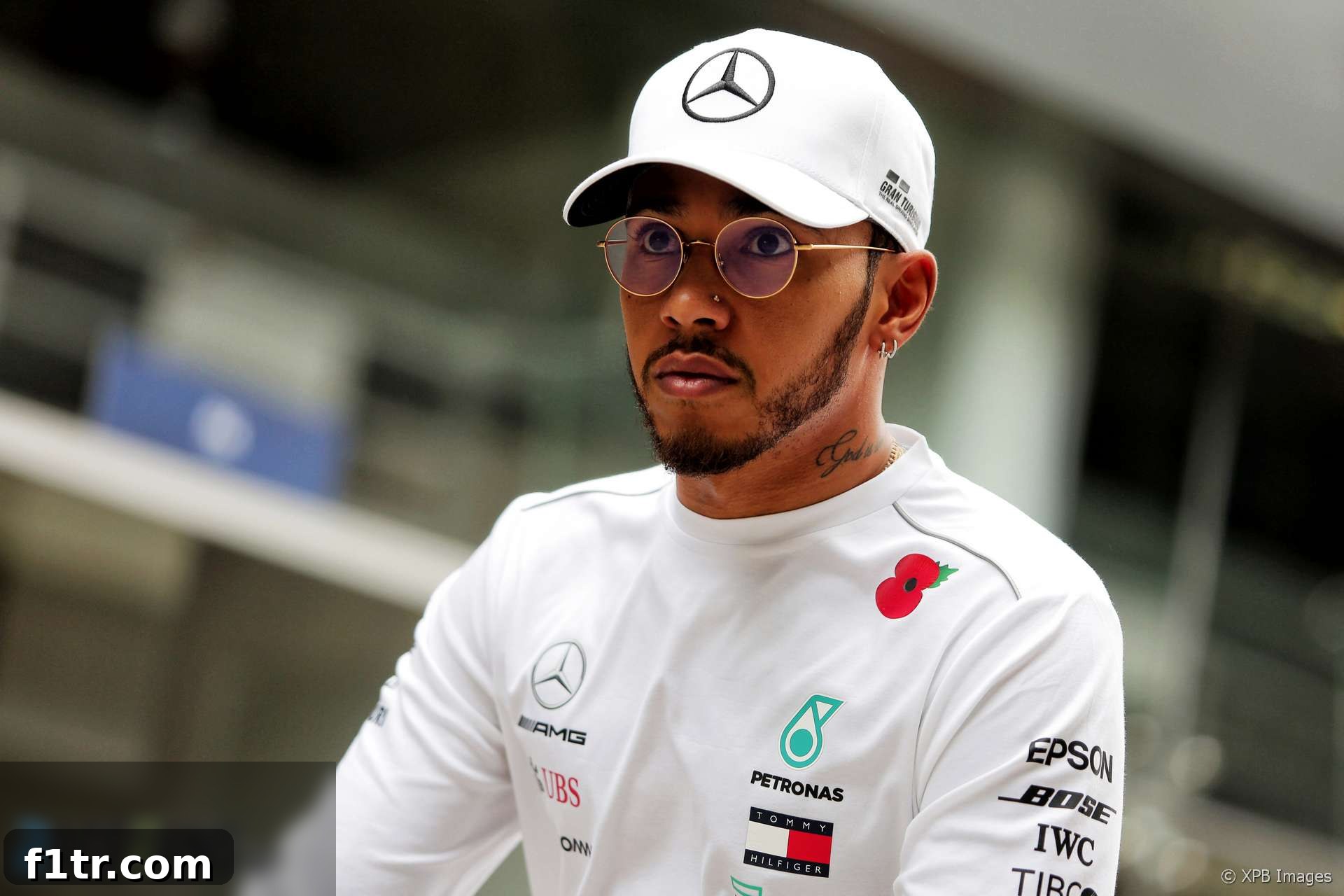
Lewis Hamilton, the reigning Formula 1 champion at the time, openly expressed his dissatisfaction with Williams driver Sergey Sirotkin following a contentious moment during the qualifying session for the Brazilian Grand Prix. Hamilton emphatically branded Sirotkin’s actions as “disrespectful” after an on-track encounter that left the Mercedes-AMG Petronas driver frustrated and questioning his rival’s judgment.
The Inciting Incident: A Clash During Q2 in Brazil
The incident that sparked Hamilton’s ire occurred during the crucial Q2 segment of qualifying at the iconic Interlagos circuit. As drivers navigated their out-laps, carefully managing their track position and tire temperatures ahead of a flying lap, the British superstar found himself unexpectedly confronted by Sergey Sirotkin’s Williams. The Russian rookie, pushing hard to prepare his car, momentarily put two wheels off the grass as he converged with Hamilton at the end of a preparatory lap.
Hamilton’s primary contention was that Sirotkin had not been on a timed lap when the potentially impeding maneuver took place. This distinction is crucial in Formula 1 qualifying, where unwritten rules and established protocols dictate how drivers should behave when not actively setting a lap time, particularly concerning faster-approaching cars or those attempting to find clear air.
“Everyone was on an out-lap,” recalled Hamilton, detailing the scenario. “Me, Sergey and everyone in front of me.” He continued, explaining the standard procedure: “Valtteri [Bottas] was ahead of me and he was backing off to get his gap so I had to back off. I was making sure I had the gap but then all of a sudden I saw a car coming at high speed and I was like: ‘Oh my God. Is that someone coming on a lap?’”
Hamilton’s immediate reaction was to avoid a collision or impede the potential flying lap of the other car. “So I went left, but he was going left. But he wasn’t on a lap, so I don’t know what his thinking was.”
Hamilton’s Strong Reaction: A Question of Driver Etiquette
The veteran driver did not mince words in his assessment of Sirotkin’s conduct. For Hamilton, the incident went beyond a mere on-track misunderstanding; it touched upon fundamental principles of respect and awareness that are expected of every competitor in Formula 1. He elaborated on his stance, highlighting the shared understanding among drivers regarding track behavior during qualifying sessions.
“We all know to keep a gap. It was a disrespectful move. I was trying to get out of his way and then he got to the corner and slowed up.” Hamilton’s frustration was palpable. “It was kind of strange. It was completely unnecessary because behind him there was a bit of a space so ultimately his lap and my lap weren’t great so hopefully he can learn from it.”
This “disrespectful” label from a driver of Hamilton’s stature carries significant weight. In the high-stakes environment of F1, where every tenth of a second can mean the difference between pole position and a mid-grid start, clear communication and predictable behavior on track are paramount. An out-lap is not just a casual drive around the circuit; it’s a carefully orchestrated sequence designed to bring tires and brakes up to optimal operating temperature, clear of traffic, before unleashing the car’s full potential on a flying lap. Any disruption, especially one deemed avoidable, can ruin a driver’s preparation and compromise their qualifying attempt.
Hamilton’s experience dictates a certain level of awareness, particularly from rookie drivers like Sirotkin, regarding the surrounding traffic. While all drivers are pushing the limits, there’s an unspoken code that prioritizes safety and fair play, especially when some cars are on hot laps and others are preparing for one. The concern wasn’t just about his own lap being compromised, but also the potential for a more serious incident, emphasizing the need for all drivers to maintain situational awareness at all times.
Sergey Sirotkin’s Perspective: The Tire Temperature Challenge
Responding to Hamilton’s criticism, Sergey Sirotkin offered his explanation for the incident, citing the unique pressures and conditions of qualifying that day. The Williams driver emphasized that his actions were a direct consequence of trying to extract maximum performance from his car, particularly in changeable weather conditions that demanded aggressive tire warming strategies.
“We went into Q2 thinking the rain would come and when I exited the pits, due to the changeable conditions the scrubbed tyres were cold meaning I had to push hard to generate temperature,” he explained.
Sirotkin further clarified the sequence of events from his point of view: “On my lap, I had to slow down to avoid Lewis, which in turn meant putting a wheel on the grass and ruining the lap. Overall, it was a good session and we are happy with the performance.”
Sirotkin’s account sheds light on the intense technical demands placed on Formula 1 drivers. Tires are incredibly sensitive components, and bringing them into their optimal operating window – a process known as “tire warming” – is a critical task during out-laps. This involves a combination of weaving, braking, and accelerating to generate friction and heat. In conditions where rain is anticipated or track temperatures are fluctuating, this task becomes even more urgent and aggressive. A driver might feel compelled to push harder on their out-lap to ensure their tires are ready for their timed lap, leading to situations where they might unintentionally interfere with others.
For a rookie like Sirotkin, navigating the complexities of F1 qualifying while also battling the elements and managing track traffic presents an immense learning curve. His primary focus was likely on optimizing his own performance and ensuring his tires were ready to deliver a competitive lap, especially given the threat of rain that could shorten the qualifying window. The incident highlights the fine line F1 drivers walk between aggressive preparation and maintaining awareness of their competitors, especially during the frantic moments of qualifying.
The Dynamics of Formula 1 Qualifying: Traffic Management and Etiquette
The clash between Hamilton and Sirotkin underscores a recurring theme in Formula 1: the delicate balance of traffic management and driver etiquette during qualifying sessions. F1 qualifying is a high-octane ballet of precision, strategy, and sheer speed, often complicated by a crowded track.
During Q1, Q2, and Q3, drivers embark on a series of laps that typically involve:
- Out-lap: Exiting the pits, drivers slowly build speed while warming tires and brakes. They aim to create a sufficient gap to the car in front to ensure clean air for their flying lap.
- Flying Lap: This is the timed lap where drivers push the car to its absolute limit, aiming for the fastest possible time. Clear track is paramount.
- In-lap: After completing the flying lap, drivers slow down to cool the car and tires before returning to the pits or preparing for another flying lap.
The challenge arises when drivers on out-laps or in-laps encounter those on flying laps. An unwritten rule dictates that drivers not on a timed lap should make every effort to get out of the way of those who are, without compromising safety. However, the exact execution of this can be contentious. Drivers preparing for a hot lap often need to generate significant tire temperature, which might involve weaving or sudden changes in speed, potentially leading to unforeseen encounters.
Team radio plays a crucial role in these scenarios, with engineers constantly updating drivers on traffic ahead and behind. However, in the heat of the moment, with adrenaline pumping and focus hyper-tuned to track limits and car performance, misjudgments can occur. The pressure to deliver a quick lap, especially for teams battling to escape the elimination zones of Q1 or Q2, can push drivers to take risks, occasionally leading to “disrespectful” moments as described by Hamilton.
Aftermath and Official Scrutiny: No Further Action
Despite the strong words exchanged and the clear frustration expressed by Lewis Hamilton, there was no official indication that the incident involving him and Sergey Sirotkin was noted or placed under investigation by the FIA race stewards following the qualifying session. This outcome suggests that, while the encounter caused friction between the drivers, it did not meet the criteria for a formal breach of sporting regulations that would warrant a penalty.
Formula 1 stewards review incidents based on several factors, including whether a driver was dangerously impeded, if there was an obvious attempt to unfairly gain an advantage, or if safety was compromised. In many cases, minor clashes or perceived impediments that don’t directly impact a competitor’s ability to complete a lap or pose a significant safety risk are often deemed “racing incidents” or simply part of the cut and thrust of competitive qualifying. For rookie drivers, such incidents are often treated as learning experiences, highlighting the steep learning curve required to master F1’s unique track etiquette.
This lack of official action suggests that, from a regulatory standpoint, the incident was likely viewed as a borderline case, or perhaps a misjudgment rather than a deliberate act of dangerous or unfair driving. While Hamilton’s comments highlight the personal impact and his view on driver respect, the absence of an investigation closed the book on the matter from a sporting penalty perspective, allowing both drivers to focus on the Grand Prix race ahead.
Such instances are not uncommon in Formula 1, serving as a reminder of the intense pressures and intricate dynamics that unfold on track, particularly during the critical qualifying sessions where every position can make a significant difference to a team’s race prospects.
2018 F1 season
- F1 feared “death knell” for Drive to Survive after Ferrari and Mercedes snub
- McLaren staff told us we were “totally crazy” to take Honda engines in 2018 – Tost
- ‘It doesn’t matter if we start last’: How Red Bull’s junior team aided Honda’s leap forward
- Honda’s jet division helped F1 engineers solve power unit problem
- McLaren Racing losses rise after Honda split
Browse all 2018 F1 season articles