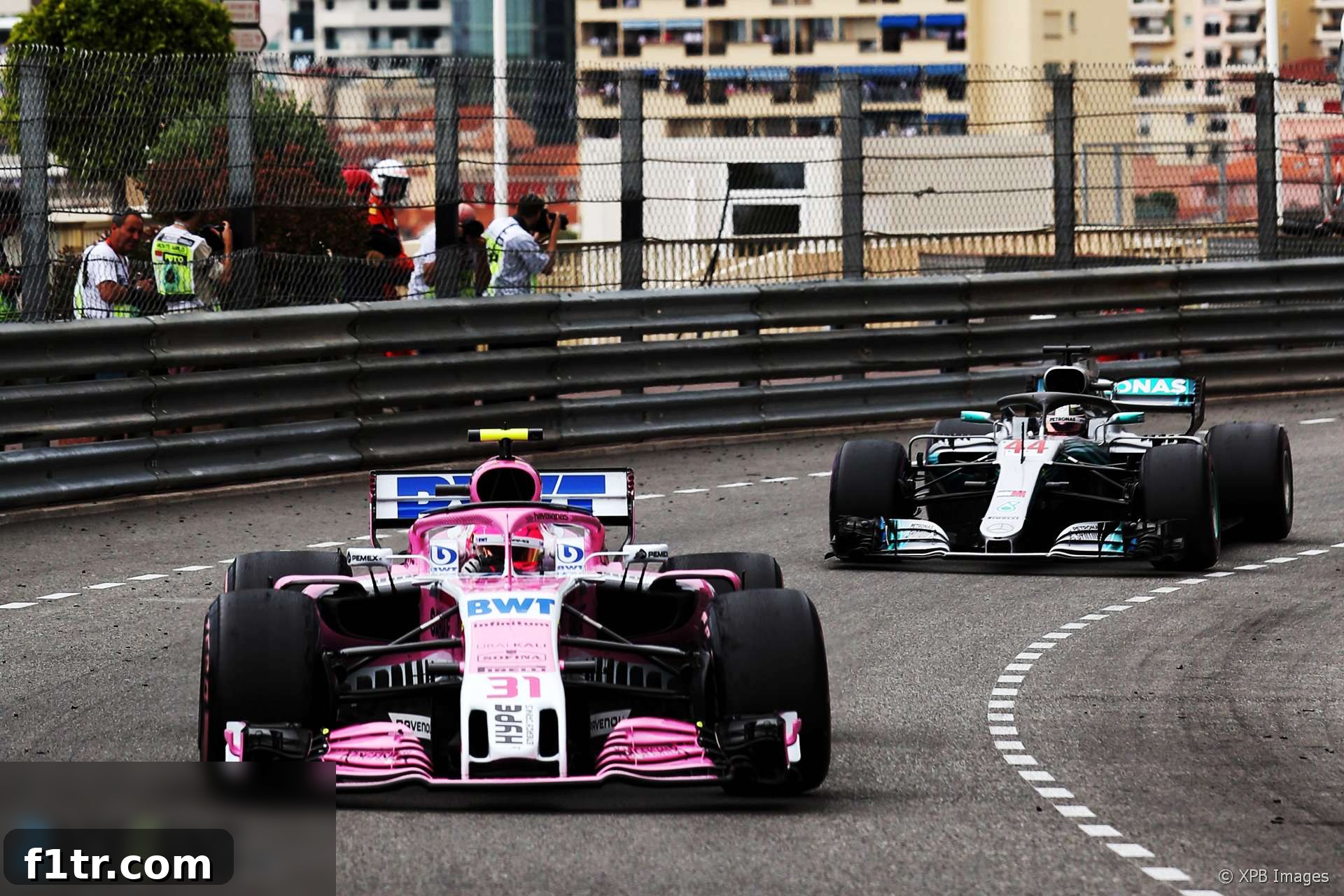
In the high-stakes world of Formula 1, every millisecond and every strategic decision can be dissected under a microscope, especially when it involves championship contenders and the intricate web of team relationships. Such was the case during the 2018 Monaco Grand Prix, where an apparently innocuous overtaking maneuver by Lewis Hamilton on Esteban Ocon sparked a minor but telling controversy, leading Force India to vehemently deny accusations of giving special treatment to its engine supplier, Mercedes.
The Monaco Grand Prix is famously known for its incredibly challenging street circuit, making overtaking one of the rarest spectacles of the F1 calendar. This inherent difficulty amplifies any passing move, drawing immediate attention and scrutiny. It was in this unique context that Hamilton, then driving for the Mercedes-AMG Petronas Formula One Team, executed a pass on Force India’s Esteban Ocon following his crucial first pit stop. The ease with which Hamilton navigated past Ocon – a Mercedes customer team driver – ignited claims that Force India had offered a helping hand to its engine provider, subtly influencing the race in favor of the factory outfit.
The incident quickly caught the attention of rivals, most notably Ferrari’s Kimi Raikkonen, who was locked in a strategic battle with Hamilton at the time. Raikkonen’s race strategy hinged on trying to ‘undercut’ Hamilton through the pit stops, a common tactic in F1 where a driver pits earlier to benefit from fresh tires and gain track position. However, his efforts were seemingly thwarted by what he perceived as a favorable pass for Hamilton. “Obviously they pitted in the traffic but it was a Force India car and they got let by him,” Raikkonen commented, voicing his suspicion that Ocon had intentionally yielded track position. He elaborated on his team’s counter-strategy, stating, “We stayed two laps out but it takes such a long time to clean the front that it didn’t really give us any opportunity [to pass].” This sentiment underscored the competitive tension and the perceived disadvantage Ferrari faced in that critical moment.
Force India, however, was quick to push back against these insinuations. Bob Fernley, the deputy team principal at the time, offered a pragmatic explanation to diffuse the controversy. He emphasized that Force India operated on a completely different competitive plane than the front-running Mercedes and Ferrari cars. Their strategic objectives diverged significantly from those vying for podium finishes or championship points at the very top. “We were looking at tyre strategies,” Fernley stated, highlighting the team’s focus on optimizing their own race rather than interfering in the battles of the leading teams. The tight confines of Monaco meant that tyre management was paramount, and Force India’s primary goal was to ensure Ocon completed his race efficiently, ideally on a comfortable one-stop strategy.
Fernley further clarified Force India’s stance, asserting that holding up a car like Hamilton’s would have been illogical and detrimental to their own race. In a circuit where every second counted and tyre degradation was a constant concern, disrupting Ocon’s rhythm to momentarily impede a Mercedes car would have served no strategic benefit for Force India. “There’s just no point [to hold Hamilton up] because we needed to get him home with a comfortable one-stop,” he explained. The implication was clear: Ocon’s race was his own, and his team’s strategy prioritized his optimal finish. Fernley then broadened the perspective, adding, “[Hamilton] could have been anybody, it could have been Ricciardo or Vettel.” This statement aimed to decouple the incident from any notion of favoritism, suggesting that Ocon would have ceded track to any faster car on a different strategy to avoid compromising his own race.
From Hamilton’s perspective, the pass was merely a fleeting moment of excitement in an otherwise processional race, which is often characteristic of the Monaco Grand Prix. Known for its glamorous setting but less for thrilling on-track action, Monaco frequently sees drivers struggling to find opportunities to overtake. Hamilton himself reflected on the pass, calling it the “most exciting part of the race, I got to overtake someone!” His tone, however, was tinged with realism about the ease of the move. “I was excited for a second. But he didn’t put up a big fight or anything like that so it wasn’t too difficult,” he admitted. This comment inadvertently fueled the speculation further, as it reinforced the perception that Ocon had not made a strenuous effort to defend his position, whether by choice or necessity.
The incident at Monaco, though minor in the grand scheme of the 2018 championship, underscored the intricate dynamics of Formula 1, particularly concerning the relationship between factory teams and their customer outfits. While customer teams pay for engines and technical support, there’s an inherent power dynamic. Accusations of preferential treatment, whether real or perceived, highlight concerns about sporting integrity and fair play. F1 operates under strict regulations against explicit team orders that could manipulate race outcomes, yet subtle strategic decisions can often appear ambiguous. The challenge lies in distinguishing between a team optimizing its own race strategy and one potentially acting in the broader interests of its technical partner. In this instance, Force India maintained that their actions were solely driven by their own race objectives, irrespective of the driver or team behind Ocon.
The 2018 Monaco Grand Prix itself was a demonstration of strategic prowess, ultimately won by Daniel Ricciardo for Red Bull Racing, who managed severe power unit issues throughout the race to hold off Sebastian Vettel. Hamilton eventually finished third, a valuable result in his intense championship battle against Vettel that year. The Ocon incident, while a talking point, did not significantly alter the immediate race outcome at the front, but it did expose the underlying tensions and suspicions that can arise when competitive lines are blurred by technical partnerships.
2018 F1 Season Context
The 2018 Formula 1 season was a fascinating period for both Mercedes and Force India. For Mercedes, it marked another year of fierce competition with Ferrari, with Lewis Hamilton ultimately securing his fifth World Championship. Every point, every strategic advantage, and every clean race was crucial in their pursuit of glory. For Force India, however, the season was characterized by significant financial challenges that ultimately led to the team entering administration and being reborn as Racing Point F1 Team later that year. Amidst these difficulties, the team, with drivers Sergio Perez and Esteban Ocon, was constantly battling to maximize its points tally and secure its position in the constructors’ championship standings. In this context, any decision made on track, particularly concerning tyre strategy and track position, would have been acutely focused on their own survival and performance, rather than on actively assisting a rival, even a technical partner.
The Monaco controversy serves as a stark reminder of the unique pressures and complexities within F1. Beyond the raw speed and driver skill, it is a sport of intricate strategies, delicate team relationships, and constant scrutiny from competitors and fans alike. The denial from Force India, coupled with Raikkonen’s suspicions and Hamilton’s honest assessment, paint a vivid picture of a moment where perceptions of fair play and strategic imperatives collided, leaving lingering questions about the unwritten rules and unspoken understandings that sometimes govern the pinnacle of motorsport.
Browse all 2018 F1 season articles