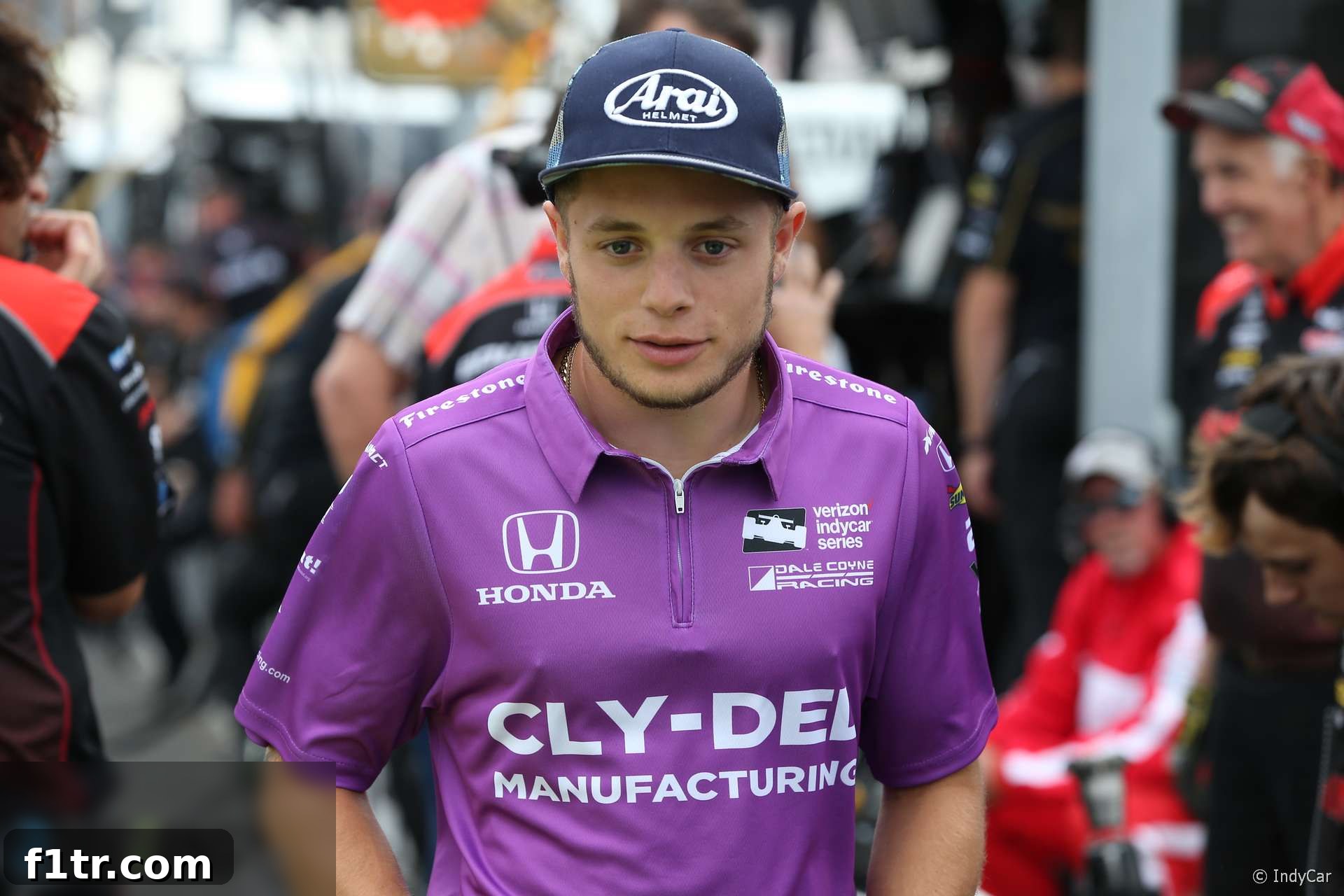
In a candid discussion, former F2 driver Santino Ferrucci has opened up about the controversial events that led to his four-race ban from the highly competitive series and his subsequent departure from the Trident team. While taking full responsibility for a collision with his then-teammate Arjun Maini, Ferrucci vehemently denied accusations of racial abuse, shedding light on a tumultuous period in his burgeoning career. The incident at Silverstone became a focal point, drawing significant attention to driver conduct and the pressures within motorsport’s feeder categories.
Ferrucci’s detailed account, given during an exclusive interview for the Marshall Pruett Podcast, provided his perspective on the on-track altercation that ultimately cost him his F2 seat. The Silverstone collision was not an isolated event but part of a series of transgressions that culminated in a severe four-race ban and his eventual dismissal from the Trident team. This period marked a significant crossroads for the young American driver, forcing him to confront the consequences of his actions and the harsh realities of professional racing.
Ferrucci explained that the animosity with Maini had been building, citing an earlier incident in the weekend’s feature race where he felt he had been unfairly shoved by his teammate. The retaliation, Ferrucci confessed, occurred after the sprint race, fueled by Maini’s aggressive maneuver at turn four during the race itself. This sequence of events highlights the intense rivalries and high stakes often present in junior single-seater categories, where every position can make a critical difference to a driver’s career trajectory.
Recalling the specific moment, Ferrucci stated, “He threw a pass right up the inside, drove into my car and bent my front suspension which put me off the track. When we finished the race, I was very, very furious and very emotional. It’s just a very dirty move towards me.” This visceral reaction, he admitted, led to his ill-advised response. “After the chequered flag I got behind him initially to show him I was pissed. I wanted to put up a hand gesture. I had just thought ‘all right, go around’ and when I went to go around I clipped him.” This admission confirms the intentional nature of the contact, albeit with an attempt to downplay its severity, a crucial point in the subsequent disciplinary action by the F2 stewards.
Ferrucci elaborated on his aggressive racing philosophy, honed during his extensive karting career. “My whole karting career I took nothing from nobody,” he asserted. “I was one of those people if you tap me I put you in the fence. I just refused to have a gasp of air for anybody. I was super-aggressive, super-mindset of focused, this is my world.” However, he acknowledged the fundamental difference between karting and high-speed car racing: “In cars you can’t have that mindset. You can’t go around just hitting people, you’re going upwards of 200mph in some places, parts fall off and people could get seriously injured. You should display that aggressiveness in difference was by closing doors, blocking, different techniques. Not necessarily driving over people. I’ve had my fair share of moments in go-karts where I’ve been driven over and I’ve driven over people.” This reflection demonstrates a nascent understanding of the heightened responsibility that comes with racing powerful open-wheel cars, an important lesson learned through a difficult experience. He concluded, in a rather stark declaration, “Trust me, if I wanted to hit him I would have done it the correct way and wrote off the cars.”
Beyond the collision, Ferrucci faced further repercussions for failing to attend a stewards’ hearing immediately after the race. His absence contributed to the severity of his punishment, leading to a ban from the next two double-header rounds. Ferrucci provided an emotional explanation for his non-attendance, revealing he had to leave urgently to visit his uncle, who had just been diagnosed with pancreatic cancer. This family emergency, he argued, was critical and overshadowed his racing obligations at that moment.
The young driver placed blame on his former Trident F2 team for a critical communication breakdown. “I had emailed the stewards prior saying I had a serious family emergency to get home for,” he explained. “The email was never received through my team, they never sent it, because we don’t have the stewards information personally.” He claimed to have made strenuous efforts to rectify the situation: “I had apologised on the Monday and Tuesday to all of the stewards to go out of my way to find and email them. They had emailed me back saying they were unmoved and did not care for my other responsibilities, which is pretty harsh. That’s why I missed the meeting, which I wish I never did. But you live and learn.” This account points to systemic issues within team-steward communication channels, particularly when dealing with unexpected personal emergencies, and highlights the unforgiving nature of top-tier motorsport regulations.
Adding another layer of controversy, Ferrucci’s Trident team issued a strong statement publicly criticising his overall conduct towards Maini. More gravely, insinuations that Ferrucci had used racially-charged language against his team mate also surfaced, leading to a serious ethical and professional challenge. Ferrucci adamantly denied these grave allegations, emphasizing the detrimental impact such claims could have on his career and reputation. “I wouldn’t even know where to start with that,” he stated emphatically. “What people are calling me is not true.” The sensitivity surrounding such accusations in modern sports makes his denial crucial for his future prospects.
Ferrucci contextualized these accusations within his personal experience as an American competing in a predominantly European motorsport environment. “I’ve been going over to England since I was 10 years old. I’ve been judged because I was the only American. I’ve been called a Yankee. I’ve been called a ‘fucking American’, it’s an actual term. That’s what I’ve been called my entire life being over there because they don’t like us there. That was the only comment that was flipped upside down on me pretty badly.” This sheds light on the cultural clashes and nationalistic sentiments that can sometimes permeate international sports, which Ferrucci suggests may have been misconstrued or manipulated in this context.
Despite the significant controversy, Ferrucci remarkably retained his position alongside Maini within Haas’s junior driver development programme. This decision by the American F1 team underscored their belief in Ferrucci’s potential and perhaps a more nuanced understanding of the allegations. Haas team principal Guenther Steiner publicly addressed the situation at Spa, explaining, “The guy is trying to make a career and we don’t want to pull the rug under his feet.” This statement indicated a level of support and a desire to give Ferrucci an opportunity to learn from his mistakes and rebuild his career. Ferrucci himself emphasized that his continued involvement with Haas was proof of his innocence regarding the racial allegations, stating he would have been immediately dismissed if the claims were true.
He further elaborated on the gravity of such accusations, particularly for an American driver linked to a prominent American F1 team. “In our country the racial topic is very sensitive,” he stressed, reiterating the point for emphasis. He referenced recent events involving Conor Daly, which highlighted the enduring impact of past actions and words related to race. “I feel a lot of people don’t understand that when you’re driving also for an American team – I’m representing Haas F1 as an American – so if that was a true thing I don’t think I would still be a development driver. I don’t think that would be in anyone’s best interests and I don’t think I would even be a racing driver if that was true, because of how sensitive that topic is. So for people to come out and say and express that is really upsetting.” His argument underscores the severe professional consequences of substantiated racism allegations in motorsport, particularly in a politically charged environment, and how his continued association with Haas served as a powerful counter-narrative to the claims.
Following the F2 ban and the escalating controversy, Trident officially announced they had fired Ferrucci. Their stated reasons included not only his conduct during the Silverstone weekend but also a “serious breach of [the] driver’s payment obligations.” However, Ferrucci countered this narrative by asserting that he already had a pre-existing agreement to leave F2 and transition back to IndyCar, where he had made two starts earlier in the year, showcasing his versatility and ambition across different racing disciplines. “Silverstone was technically my last race by contract because I was going to come back here,” he clarified. “I had made a deal with them and it was said and done.” This suggests a more pre-meditated career move rather than a forced exit, though the circumstances of his F2 departure undeniably cast a shadow.
Ferrucci quickly made his return to IndyCar, competing for Dale Coyne Racing. His first race back, at Portland, saw him finish 20th after encountering a technical problem that forced him to stop on-track during the event. This incident marked the beginning of a new chapter in his career, leaving the F2 controversies behind as he sought to establish himself in the premier American open-wheel series. The move to IndyCar represented both a challenge and an opportunity for Ferrucci to redefine his image and demonstrate his racing talent away from the intense scrutiny of the European junior formulas.
2018 F1 season
- F1 feared “death knell” for Drive to Survive after Ferrari and Mercedes snub
- McLaren staff told us we were “totally crazy” to take Honda engines in 2018 – Tost
- ‘It doesn’t matter if we start last’: How Red Bull’s junior team aided Honda’s leap forward
- Honda’s jet division helped F1 engineers solve power unit problem
- McLaren Racing losses rise after Honda split
Browse all 2018 F1 season articles