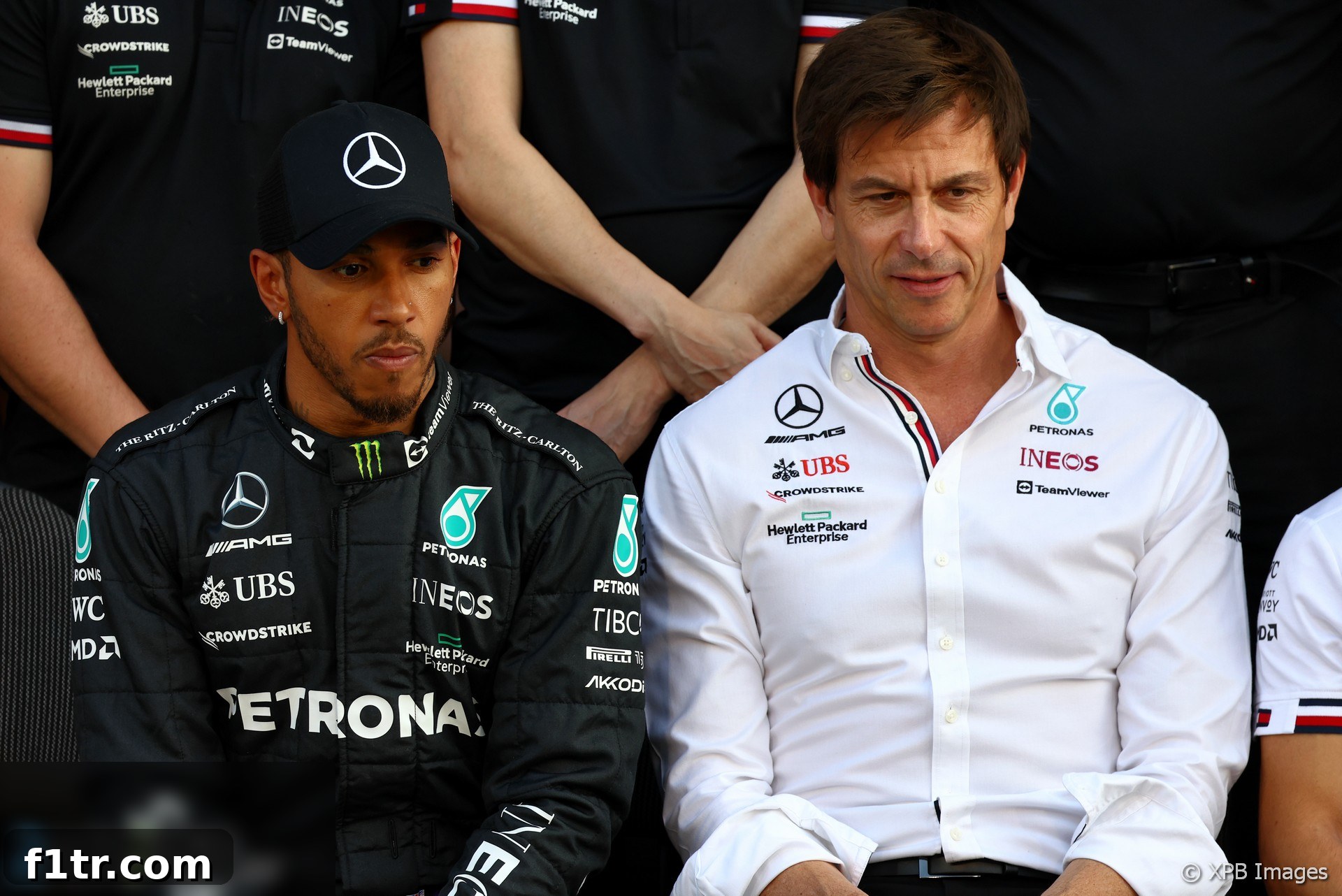
The announcement of Lewis Hamilton’s departure from Mercedes to join Ferrari sent shockwaves through the world of Formula 1. While undoubtedly a profound disappointment for Team Principal and co-owner Toto Wolff, who has nurtured Hamilton’s career at Mercedes for over a decade, the move was perhaps not entirely unforeseen by those who have closely followed the sport and the intricacies of Hamilton’s ambitions.
Advert | Become a Supporter & go ad-free
For a driver who, until the conclusion of the 2021 season, rarely went more than a few months without a Grand Prix victory, the subsequent two winless years must have felt like an eternity. This unprecedented drought marked a stark contrast to his previous illustrious career, where he transformed from a single-time champion into the most successful driver in the sport’s history between 2014 and 2020. While it would be an oversimplification to solely attribute this downturn to Mercedes – given George Russell’s impressive victory in Brazil, which showcased the car’s potential on occasion – the undeniable truth remains that the team has struggled to produce a consistently competitive car over the last two seasons, failing to provide Hamilton with the machinery needed to challenge for an eighth world title.
Wolff, a shrewd observer of driver psychology and team dynamics, understood the implications of this performance dip for a competitor of Hamilton’s caliber. His insights from early last year now appear remarkably prescient. In March 2023, as Mercedes grappled with the sobering reality that its W14 chassis, designed under the new ground effect regulations, offered no significant competitive advantage over its troubled predecessor, Wolff openly discussed Hamilton’s contractual future. He articulated a clear, albeit difficult, truth: “If he wants to win another championship, he needs to make sure that he has the car. And if we cannot demonstrate that we are able to give him a car in the next couple of years, then he needs to look everywhere.”
Wolff added, with a striking display of understanding and pragmatism, “I don’t think he’s doing it at that stage, but I will have no grudge if that happens in a year or two.” These words, spoken almost a year before the Ferrari announcement, underscore a deep appreciation for Hamilton’s competitive drive and his ultimate goal: to win championships. It highlighted a mutual respect built on transparency and an understanding that professional ambitions sometimes diverge from loyalty. This foresight provides critical context for the eventual decision, framing it less as a betrayal and more as an inevitable consequence of competitive pressures.
Advert | Become a RaceFans supporter andgo ad-free
Indeed, Hamilton did initially extend his contract with Mercedes. In September of last year, the team proudly declared, “Lewis will drive for the team in the 2024 and 2025 seasons.” However, as it was revealed today, this announcement deliberately overlooked a crucial detail: Hamilton had a meticulously negotiated release option allowing him to depart after just one more year. The team’s subsequent statement, confirming that “Lewis has activated a release option in the contract announced last August,” paints a clearer picture of Hamilton’s long-term intentions and his cautious commitment to Mercedes, even at the point of signing the extension. It suggests that deep down, he was already keeping his options open, dependent on Mercedes’ ability to deliver a championship-contending car.
So, barely four months after publicly recommitting to Mercedes, Hamilton has chosen the dramatic path of switching allegiances to Ferrari. The fundamental question then becomes: did Mercedes fail to convince him, as Wolff had indicated, that it would achieve a competitive resurgence within “the next couple of years”? Mercedes certainly acknowledged its disappointing start to the 2023 season with serious intent. The team undertook an extensive overhaul of the W14, famously ditching its distinctive ‘zero’ sidepod concept mid-season. Significant changes were also made to the top technical leadership, with James Allison being reinstated as technical director in place of Mike Elliott, and, as recently as last month, securing a contract extension.
Yet, the most striking aspect of Hamilton’s decision, its timing, strongly implies that these considerable efforts were not enough to secure his unwavering faith. The decision comes on the very eve of the new season, just weeks before he would have had his first real taste of the W15 and a definitive sense of whether the team was genuinely on track to close the gap to the dominant Red Bull. For Hamilton to seize the opportunity to move to Ferrari so soon after agreeing to his previous Mercedes contract extension, and with the new season looming, represents a profound and bitter blow for the Silver Arrows. It is an unequivocal signal of his waning confidence in their ability to swiftly recover from their prolonged competitive dip and return to championship-winning form.
The Irresistible Allure of Ferrari: A Timeless ‘Pull’ Factor
While the “push” factor, driven by Mercedes’ recent struggles, has only become acutely apparent in the last two years, the “pull” factor, the irresistible allure of Scuderia Ferrari, has been a constant presence throughout Hamilton’s career, a dynamic Wolff has long understood and acknowledged. Ferrari’s iconic status transcends mere racing. It embodies passion, history, and a legendary mystique that resonates deeply within the sport and with every driver who aspires to greatness.
Back in 2019, when Mercedes was at the zenith of its dominance, Wolff candidly addressed this pull. He told media, including RaceFans, “We have to simply acknowledge that probably it’s in every driver’s head to drive with Ferrari one day. It’s the most iconic Formula 1 brand, the most historic Formula 1 brand out there and I totally respect that a driver has a desire to drive with Ferrari.” This statement was not mere platitude; it was an acknowledgment of a universal truth in Formula 1. Legends like Michael Schumacher, Alain Prost, Fernando Alonso, and Sebastian Vettel have all answered Ferrari’s call, drawn by the unique challenge and prestige of wearing the Prancing Horse.
Advert | Become a RaceFans supporter andgo ad-free
Wolff further elaborated on the transparent relationship he shared with Hamilton regarding this very topic. “Within the team we have discussed it and with Lewis we have discussed it and we have agreed on the topic. We had the discussion when we negotiated the last contract. I think that you just have to be open-minded and understand that drivers will understand opportunities that exist and benchmark themselves.” This level of open communication is rare in the cutthroat world of F1, highlighting the profound respect and understanding between Wolff and Hamilton, even as they navigated the possibility of an eventual parting of ways. Wolff knew that while Mercedes was the team to beat at the time, should that dynamic change, the magnetic pull of Maranello would become a formidable force.
He continued, “What I see is strong between Lewis and ourselves is that we have always been very transparent with each other in the whole discussion. At the moment everything is great. I think we are providing him with a car which is capable of achieving his objectives. If we continue to have a car that is performing on that level I think there is no reason to go and we would love him to stay. And if one day ways part it will be very positive and then each of us will try to achieve success with a different set-up. So no drama.” This statement, delivered with such clarity and poise years ago, now serves as a testament to the long game being played by one of Formula 1’s most strategic minds.
The Weight of Legacy: A New Chapter and a Calculated Gamble
Hamilton’s decision to move to Ferrari isn’t just a simple team switch; it’s a bold career move loaded with historical significance and echoing his audacious transfer from McLaren to Mercedes in 2013. That initial move, seen by many as a risky gamble at the time, ultimately redefined his legacy and ushered in an era of unprecedented dominance. Could this move to Ferrari, at this stage of his career, be another masterstroke designed to secure an unparalleled eighth world championship and cement his status as the greatest of all time, perhaps even achieving the dream of winning a title with the sport’s most legendary team?
The challenge of bringing Ferrari back to the pinnacle of Formula 1, a feat last achieved consistently by Michael Schumacher, is immense. It requires not just driving prowess but also leadership, vision, and an ability to galvanize an entire team. Hamilton’s extensive experience, technical understanding, and unyielding drive could be precisely what Ferrari needs to transform its potential into consistent success. For Hamilton, it represents a fresh start, a new mountain to climb, and a chance to reignite his competitive fire in a different environment, potentially against the very team he is leaving.
Now that this predicted parting of ways has come to pass, the crucial question remains: will there truly be “no drama” between Lewis Hamilton and Mercedes? How smoothly and successfully will they navigate the forthcoming 2024 season, a year they both know will ultimately culminate in a significant “divorce”? The dynamics of this final season together will be fascinating to observe. Will Hamilton, fully aware of his future in red, maintain his absolute commitment to Mercedes’ development and success? How will the team manage confidential information and future strategies, knowing their star driver will soon be a direct rival?
The implications stretch beyond the immediate 2024 season. Mercedes will embark on a crucial search for a replacement, a task made even more challenging by the departure of a generational talent like Hamilton. The ripple effect on the driver market, team sponsorships, and the overall competitive landscape of Formula 1 will be profound. As the sport prepares for one of its most anticipated seasons, all eyes will be on Lewis Hamilton, not just for his performance on track, but for how he manages this extraordinary transition, a move that promises to redefine legacies and reshape the future of Formula 1.
Become a RaceFans Supporter
RaceFans thrives thanks to the invaluable support of its dedicated readers. By contributing just £1 per month or £12 per year (or the equivalent in your local currency), you can play a crucial role in covering the ongoing costs of creating, hosting, and continually developing RaceFans, both today and for generations of F1 enthusiasts to come.
Join the RaceFans Supporter community today and enjoy an ad-free browsing experience across the site. Learn more or sign up instantly via the links below:
- Become a RaceFans Supporter
- RaceFans Supporter FAQ
Advert | Become a RaceFans supporter andgo ad-free
More from Formula 1
- Exploring the future of F1 regulations and team strategies
- The impact of driver changes on team performance and morale
- Historical analysis: Iconic moves that shaped F1 history
- What makes Ferrari so unique in the world of motorsport?
- A deep dive into Mercedes’ recent technical challenges
Browse all Formula 1 articles