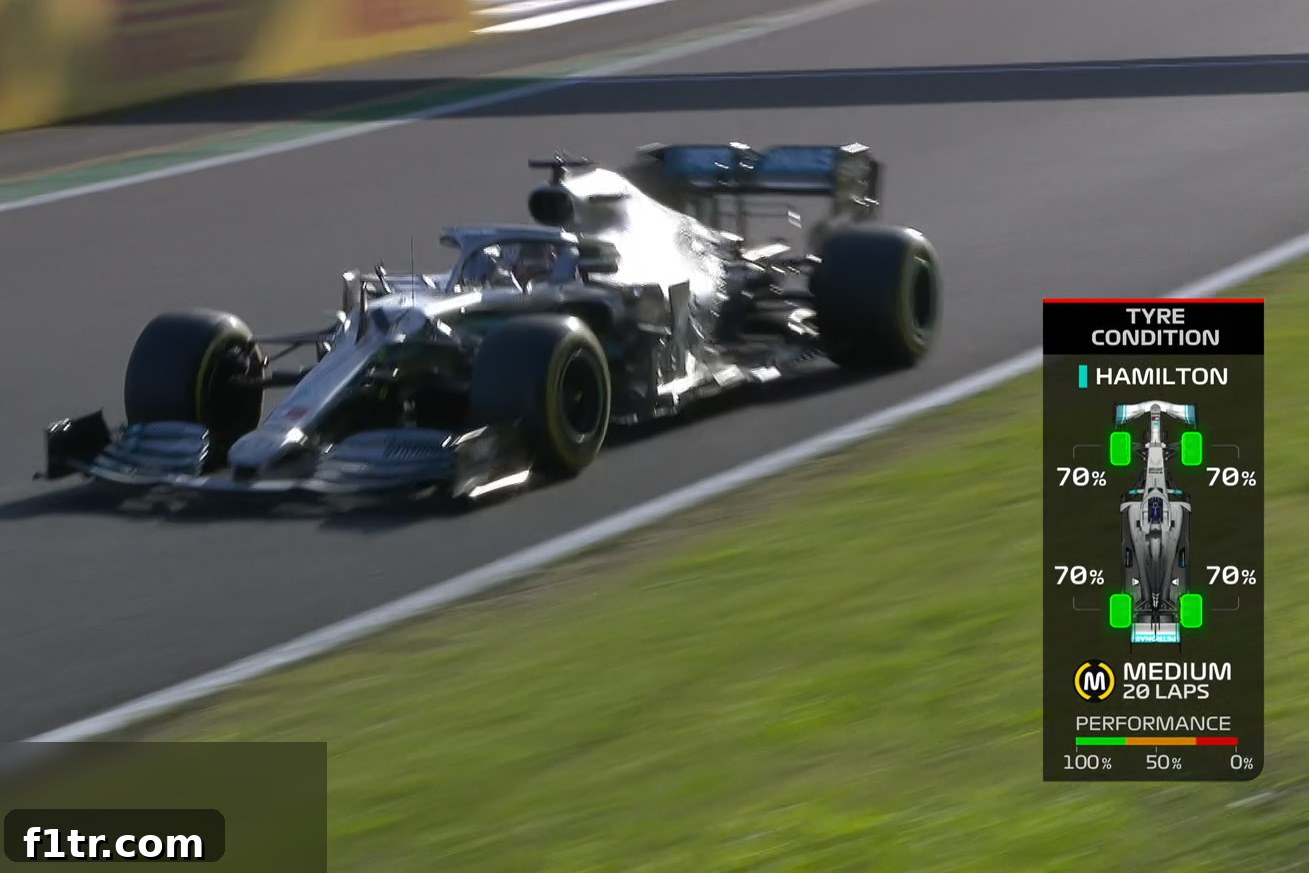
Unpacking the Enigma: Why Formula 1’s Tyre Performance Graphic Still Confuses Fans, According to Pirelli
Despite efforts to enhance fan engagement and provide deeper insights into Formula 1 racing, a relatively new addition to broadcast graphics continues to baffle viewers. The “Tyre Performance” graphic, designed to illustrate the remaining performance potential of a driver’s tyres, has been a source of significant discussion, particularly from the sport’s sole tyre supplier, Pirelli. The Italian manufacturer believes that a fundamental misunderstanding persists among fans regarding how these crucial percentages truly reflect tyre status and impact race strategy.
Advert | Become a Supporter & go ad-free
Introduced during the high-stakes Japanese Grand Prix, the Tyre Performance graphic aims to provide a real-time snapshot of tyre health, displaying percentage values for each car. This visual aid is a proprietary product of F1, crafted using publicly available data and independent of any direct information or input from Pirelli. While the intention is noble – to demystify one of the most critical aspects of modern Formula 1 strategy – Pirelli’s head of F1 and car racing, Mario Isola, voices ongoing concerns that the graphic’s nuanced meaning has yet to fully resonate with the global F1 fanbase.
The Nuance of “Performance Life” vs. Common Perception
Isola emphasizes that the graphic’s core objective is to convey the “performance life” of a tyre. This concept, he explains, is far more intricate than a simple measure of wear or degradation. “What they want to show is the performance life of the tyre,” Isola stated. “And the performance life of the tyre is an interesting number because the idea is to give the spectator the feeling [whether] a car can fight with another car, what [might] happen in a few laps’ [time]?” The challenge lies in bridging the gap between this technical reality and the typical fan’s intuitive understanding of percentages.
The common misconception, Isola observes, is that fans expect a linear progression: tyres start at 100% and inevitably decline to 0% with each passing lap, akin to a fuel gauge or a battery level indicator. However, this simplification drastically overlooks the dynamic interplay of factors that influence a tyre’s effective performance throughout a stint. Unlike a straightforward wear indicator, the performance life graphic attempts to encapsulate how much competitive potential remains in a tyre, and this is where its non-linear nature becomes paramount and often misunderstood.
The Art of Tyre Management and Its Impact on Performance Values
One of the most critical elements that confound the linear expectation is the practice of “pace management” by drivers. Formula 1 drivers are not merely pushing flat out; they are constantly managing their tyres, fuel, and energy. A driver might intentionally reduce their pace for a few laps to cool the tyres, manage blistering, or reduce overall degradation. This strategic compromise directly impacts the “performance life” displayed on screen.
Isola elaborates on this complex scenario: “The performance life of the tyre is also influenced by the pace management. So if for any reason a driver that has 30 percent of performance life in the tyre realises that he will have degradation of the tyre in a few laps he can drive the car in a way that reduces this degradation.” What this means for the on-screen graphic is revolutionary yet perplexing to many. “That means that the 30 percent stay can stay as 30 percent for a number of laps. That’s probably the most difficult part to explain to spectators.” This ability for a percentage value to stabilize, or even slightly “recover” in effective performance terms, defies the expected constant downward trend, leading to confusion among an audience accustomed to simpler metrics.
External Factors and the Non-Linear Degradation Curve
Beyond driver input, various external factors significantly alter the tyre’s performance curve. Isola highlights how ambient conditions and track interactions play a crucial role: “Everybody has in mind that you start from one hundred percent and you finish at zero percent. But it’s not linear.” He further explains that the reality is “this curve can be different if you are in free air, if you follow another car, if you are pushing with the level of fuel, with the energy that you’re putting into the tyre.”
For instance, a car running in “free air” – without another car directly ahead generating turbulent “dirty air” – will experience different tyre temperatures and less slip, potentially preserving tyre performance more effectively. Conversely, following another car closely can overheat tyres rapidly, causing a sharper drop in performance life. Similarly, a heavy fuel load at the start of a stint puts more stress on the tyres than a lighter car later in the race. The driver’s aggression level and how they apply power and braking also directly influence the energy transmitted to the tyres, thus altering their performance lifespan. These variables create a dynamic, multi-faceted degradation curve that is anything but linear, making a single percentage value difficult to interpret without deeper context.
Initial Revisions and the Call for Further Simplification
Pirelli’s initial reaction to the graphic after its debut at Suzuka was quite pointed, describing it as “misleading.” This frank feedback prompted Formula 1 to revisit and implement improvements to the graphic, acknowledging the need for greater clarity. However, even with these adjustments, Mario Isola maintains that further simplification is essential to achieve true fan understanding.
“If you remember the first time at Suzuka we had the graphic on the screen, it was a bit of a surprise because in our understanding it was related to the wear life,” Isola recalled. “Then we had meetings where they explained the system and it is clear that is related to the performance life.” While the distinction between “wear life” (physical degradation) and “performance life” (effective competitive potential) was clarified in subsequent discussions, this internal understanding has not fully translated to the viewing audience. The next crucial step, according to Isola, is “to understand how to give this information in a way that is easy, on one side and also is telling you exactly what is going to happen.” This implies a need for a design that not only displays data but also intuitively communicates its immediate and future implications for race outcomes.
Advert | Become a RaceFans supporter andgo ad-free
Towards a More Transparent Fan Experience
The challenge for Formula 1 broadcasting lies in simplifying highly complex technical data into easily digestible visual information for a diverse global audience. Tyres are arguably the most critical component in Formula 1 racing, directly influencing strategy, pace, and driver performance. Misinterpretations of tyre status can lead to a misunderstanding of strategic decisions, driver performance, and overall race dynamics.
For Pirelli, as the exclusive tyre supplier, accurate representation of tyre behavior is not just about avoiding confusion; it’s about showcasing the sophistication and integral role of their product in the sport. They bring decades of motorsport expertise, designing tyres that push the boundaries of performance while navigating extreme conditions. Helping fans grasp the nuances of “performance life” versus simple “wear” is vital for appreciating the strategic chess match unfolding on track. Potential solutions could involve more elaborate on-screen explanations during critical moments, simplified graphical representations that use color coding or trend indicators instead of raw percentages, or even brief commentator interjections specifically designed to interpret the graphic’s dynamic nature.
Ultimately, the goal is to empower fans with the knowledge to better anticipate race developments – understanding why a car with seemingly low tyre performance might still be competitive, or why a driver might suddenly drop pace to save their rubber. As Formula 1 continues to innovate its broadcast package, the evolution of the tyre performance graphic stands as a testament to the ongoing quest for ultimate fan engagement, ensuring that the intricacies of race strategy are not lost in translation but rather celebrated as part of the sport’s enduring appeal. Achieving this clarity will enhance the viewing experience, allowing fans to delve deeper into the strategic genius and driving skill that defines Formula 1.
2019 F1 season
- Crying in the Melbourne car park at 2019 grand prix was my career low – Ocon
- McLaren Racing reports reduced £71 million loss in 2019
- Kvyat: Hockenheim podium last year was “my biggest achievement” so far
- How the FIA’s new encrypted fuel flow meter targets Ferrari’s suspected ‘aliasing’ trick
- “He smashed my office door”: 23 must-see moments from ‘Drive to Survive’ season two
Browse all 2019 F1 season articles