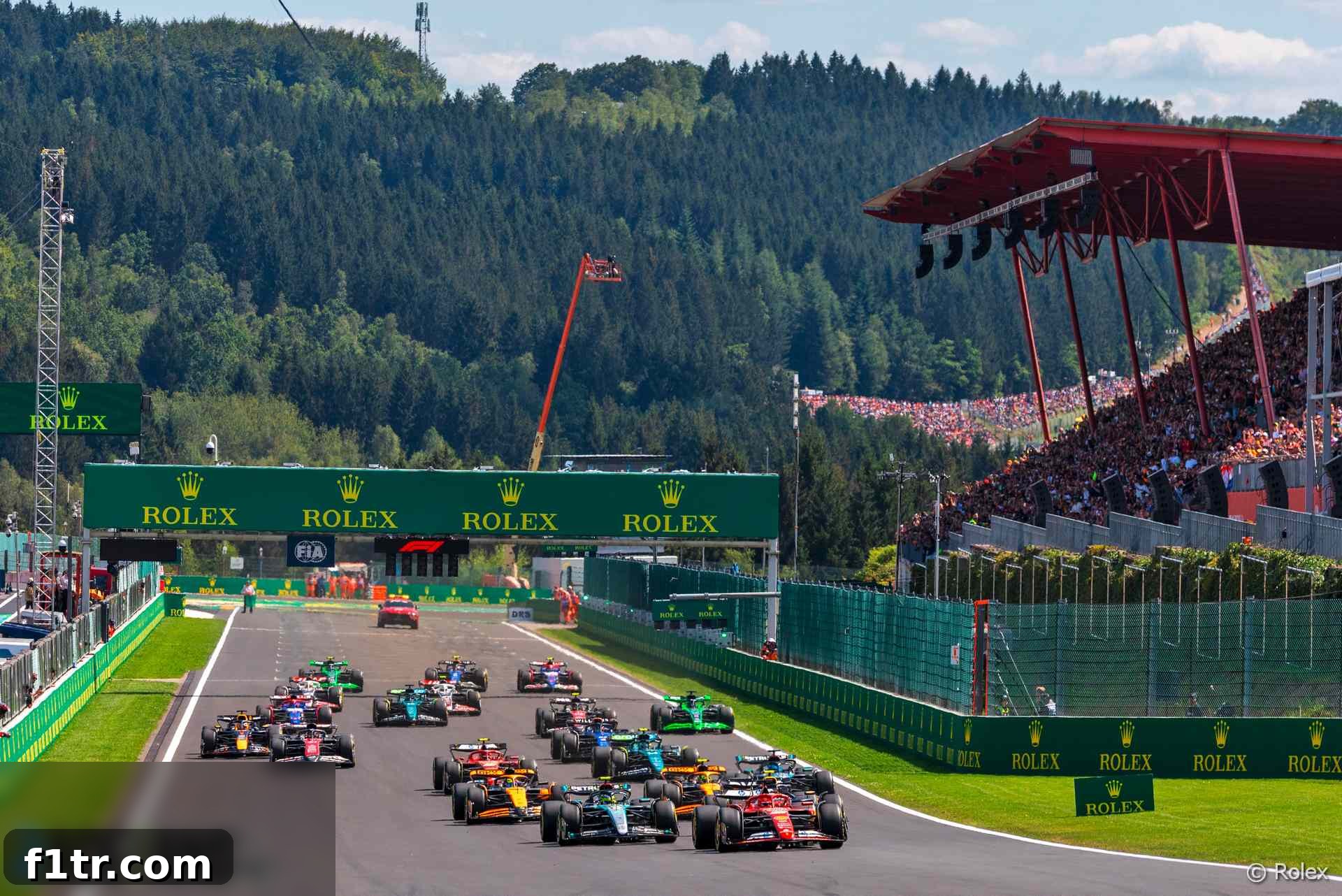
The landscape of the 2026 F1 calendar promises a familiar rhythm, echoing much of the current season with only a handful of anticipated or confirmed adjustments. However, the subsequent year, the 2027 F1 calendar, is poised to usher in a new era for Formula 1, marking a significant departure from tradition and setting a fresh course for the sport’s global footprint.
Formula 1’s commercial rights holder, Liberty Media, has been strategically reshaping the calendar. By concluding agreements with certain venues and transitioning others to a rotational basis, F1 has deliberately created what it terms “headroom” beneath its self-imposed upper limit of 24 Grand Prix rounds. This strategic opening allows the sport to entertain new bids and expand into key markets, ensuring a dynamic and highly competitive selection process for future host cities and circuits.
F1 CEO Stefano Domenicali has frequently highlighted the immense global interest in hosting a Formula 1 race, at one point boasting of dozens of venues vying for a spot on the coveted calendar. This overwhelming demand underscores Liberty Media’s current direction, focusing on high-value “destination cities” and regions capable of generating substantial revenue and fan engagement. Recent developments offer clear insights into this strategic shift.
The Miami Grand Prix, often criticized for its temporary “parking lot” circuit, initially represented F1’s second choice for a prominent US ‘destination’ city. However, its immense commercial success and high profile within the crucial American market led F1 to extend its contract last month by a full decade, securing its place on the calendar until Fernando Alonso, a current F1 star, would theoretically be in his sixties. This extension vividly illustrates F1’s commitment to the American market and its appetite for glamorous, city-based events.
In stark contrast, Zandvoort, a circuit steeped in history, underwent significant modernization just five years ago to meet contemporary Formula 1 standards. As the home track for F1’s reigning four-time world champion, Max Verstappen, it consistently draws an electrifying atmosphere with packed grandstands of passionate Dutch fans. Yet, despite its popularity and recent upgrades, the upcoming race in 2026 will regrettably be its last. This decision underscores the harsh financial realities faced by many traditional European circuits in the face of ever-increasing hosting fees and the global clamor for F1 events.
The confirmed disappearance of the Dutch venue from the 2027 schedule is just one piece of a larger puzzle. Further shifts are highly probable. Imola, another historic Italian circuit, will not feature on the calendar next year, and its long-term prospects of returning while F1 simultaneously holds a race at Monza appear increasingly dim. Stefano Domenicali has openly stated that the demand for Formula 1 races is so high that it has become challenging to justify hosting multiple races within the same country, with one notable exception: the priority market of the USA, where F1 currently enjoys an unprecedented surge in popularity.
Spain, for instance, is set to host two rounds in 2026, but this arrangement is widely expected to be a one-off transition. Madrid will assume the mantle of the Spanish Grand Prix from next year onwards, bringing the race to a new street circuit in the capital. Meanwhile, the Circuit de Catalunya, which has been the proud host of the Spanish Grand Prix for an unbroken run of 35 years, will stage a valedictory round in 2026 under a yet-to-be-announced title. This move further exemplifies F1’s strategy of diversifying its European presence and embracing urban circuits that offer unique spectacle and commercial opportunities.
Beyond these confirmed changes, several existing events are still in negotiations for F1’s return after the 2026 season. While many of these renewals are likely to be mere formalities due to their commercial significance or strategic importance, such as Formula One Management’s flagship event in Las Vegas and the highly lucrative visit to Baku, their unconfirmed status adds to the anticipation. In the United States, if F1 intends to maintain its current roster of three annual rounds, it will need to either secure a new deal with the Circuit of the Americas (COTA) in Austin or identify another suitable venue to complete its American trifecta. COTA has been a staple since 2012 and represents a more traditional road course alongside the newer street circuits, offering a diverse appeal within the US market.
Even if all these existing slots are successfully filled, Formula 1 is likely to experience a net reduction of at least two European rounds for the 2027 season. An additional slot will become available in alternating years after 2026, as the iconic Spa-Francorchamps circuit will only host the Belgian Grand Prix in odd-numbered seasons, beginning with 2027. This introduces a unique challenge: what event could realistically take over the unused mid-July slot left open by Spa in even years?
Taking the series outside Europe for a single, intermittent slot would significantly complicate F1’s efforts to streamline freight movement and logistics between races, a key objective for environmental sustainability and operational efficiency. However, a return to venues like Catalunya or Imola would not only contradict Domenicali’s stance on holding multiple races in the same country but also risk placing two visits within a few weeks of each other, given that the Monza and Madrid rounds are already scheduled for September next year. This delicate balance highlights the complex decision-making involved in crafting a truly global yet logistically sensible calendar.
Ironically, Zandvoort, the circuit confirmed to be leaving, might have been an ideal candidate for this alternating European slot. However, as its promoters highlighted last year upon the announcement of its impending departure, the financial risks associated with hosting a Formula 1 race are considerable. These risks are not necessarily mitigated by hosting a race only in alternate years; while operational costs might see a reduction, the income generated from tickets and local tourism would also be halved, making the venture less financially viable for many promoters. This economic reality is a crucial factor shaping F1’s future calendar.
As for the other two regular slots that are projected to open up, several ambitious venues worldwide have declared their keen interest in welcoming Formula 1.
Thailand has recently made the latest in a series of determined attempts to join the Formula 1 calendar. Its previous endeavors to host F1 encountered significant political hurdles, dating back to its initial plan for a street race in Bangkok over a decade ago. A fresh initiative to organize a Thai Grand Prix hit a snag last year when then-Prime Minister Srettha Thavisin, who had met with Domenicali to discuss the project, was forced out of office after Thailand’s constitutional court found he had violated ethical rules. Despite these setbacks, after meeting Thavisin’s successor, Paetongtarn Shinawatra, earlier this year, Domenicali offered favorable comments about their “impressive plans to host a race in Bangkok.” Shinawatra further demonstrated her commitment by attending the Monaco Grand Prix last month and meeting Thai-licensed racer Alexander Albon in the Williams garage, signaling serious intent.
While the stars appear to be aligning for Thailand, the same cannot yet be definitively said for F1’s frequently stated ambition to add a race in Africa. Securing an African Grand Prix would undeniably cement F1’s status as a truly ‘world’ championship, boasting events on every inhabited continent. Historically, only South Africa (from 1962-1993) and Morocco (1958) have previously hosted Formula 1 Grands Prix. The South African government has recently requested expressions of interest, with possible options including a nostalgic return to the classic Kyalami road course outside Johannesburg or an entirely new street race concept in the vibrant city of Cape Town. The logistical challenges and infrastructure requirements for such a venture are significant, but the symbolic importance and untapped market potential are immense.
Then there is Saudi Arabia’s monumental, money-no-object Qiddiya project. The original plan envisioned its extravagant, purpose-built track taking over the slot currently held by Jeddah, as initially scheduled for 2027. However, discussions have also emerged about the possibility of Saudi Arabia hosting two Formula 1 races, effectively bookending the championship season. The regime’s budget for ‘sportswashing’ through major international sports events is seemingly limitless, and such financial might would undoubtedly be sufficient to alleviate any qualms Formula 1 might have about holding more than one race in the same country, especially given its strategic importance in the Middle East.
The COVID-19 pandemic momentarily disrupted Liberty Media’s ambitious plans to significantly increase Formula 1’s revenues by expanding the calendar and adding more commercially valuable races. Now, with the world returning to a semblance of normality, F1 is back on track with a full roster of two dozen races. The scarcity value of these coveted slots is rapidly increasing, with more than half of them already booked up well into the 2030s. At a time when global interest in Formula 1 is soaring to unprecedented levels, any aspiring host city or nation that desires a piece of this action will undoubtedly have to pay top dollar, reflecting the sport’s robust health and global appeal. The future of the F1 calendar is a testament to strategic expansion, balancing heritage with new horizons, and the undeniable commercial prowess of Formula 1.