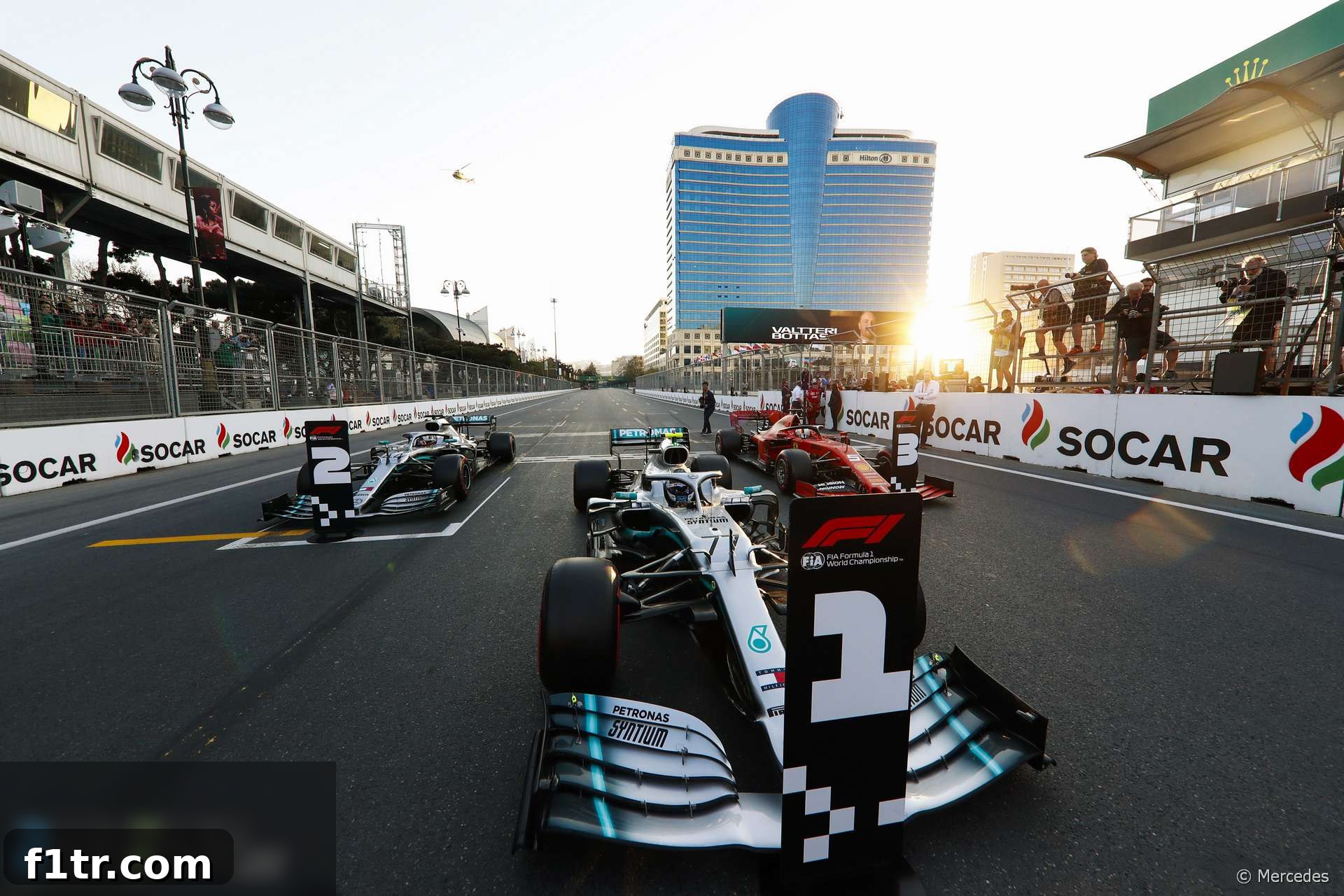
The exhilarating qualifying session for the 2019 Azerbaijan Grand Prix delivered a significant blow to Ferrari’s championship aspirations, as Mercedes once again showcased their formidable pace, locking out the front row of the grid. This result came as a surprise to many, especially after Ferrari had appeared dominant throughout all three practice sessions leading up to qualifying. The immediate question on everyone’s mind was: had Lewis Hamilton and Valtteri Bottas been strategically concealing their true performance until the crucial moment?
Indeed, it’s a well-known tactic that Mercedes often operates its power units with more conservative settings during practice compared to Ferrari, a fact the team has openly acknowledged. However, the one-and-a-half-second performance gap observed between the two teams in the final practice session was unusually large, raising eyebrows across the paddock. Even Max Verstappen’s Red Bull had managed to slot in ahead of the Silver Arrows during that session, suggesting a genuine struggle for Mercedes at the time.
A pivotal factor in this dramatic shift in fortunes appears to have been the track conditions, particularly the ambient and track temperatures. Ferrari’s SF90 seemed to thrive in the warmer temperatures prevalent during the earlier practice sessions. However, as the late afternoon qualifying session progressed, the track temperature began to drop. This cooling trend was exacerbated by two red flag incidents during Q3, which delayed the session’s start by approximately an hour, giving the circuit even more time to cool down. Mercedes team principal Toto Wolff later confirmed that these cooler conditions significantly benefited their car, allowing them to unlock performance that had been elusive earlier in the day.
Sebastian Vettel, Ferrari’s lead driver, voiced his challenges after qualifying, stating, “It was tricky for us with the track conditions, with the temperatures dropping.” While a significant portion of his time deficit to Mercedes occurred in the final sector – a long straight where he lacked the benefit of a slipstream – Vettel also admitted to struggling through the more technical middle section of the lap. He elaborated, “Obviously in sector two you have more so the corners, so it’s quite normal when you struggle with the car and don’t have the confidence around here, the place you lose most is sector two.” This indicated a deeper issue with the car’s balance and the drivers’ confidence in colder track conditions, highlighting Ferrari’s sensitivity to temperature fluctuations.
Hope for Ferrari: Race Day Conditions and Vettel’s Starting Advantage
Despite the qualifying setback, there is a silver lining for Vettel and Ferrari heading into Sunday’s race. The race is scheduled to begin almost an hour earlier than qualifying, which should translate to warmer track temperatures, potentially playing into Ferrari’s hands. Furthermore, Vettel will start from the cleaner, right-hand side of the grid, a crucial advantage on the dusty Baku Street Circuit. This optimal starting position, combined with the expected warmer conditions, will undoubtedly embolden Vettel to mount an immediate challenge to Lewis Hamilton as soon as the lights go out, setting the stage for a thrilling opening lap.
The other Ferrari driver, Charles Leclerc, also harbors hopes for warmer race conditions, albeit from a less advantageous starting position. Leclerc can consider himself fortunate to be starting as high as ninth on the grid, particularly after his unfortunate crash during Q2, which abruptly ended his dominant weekend up to that point. His incident, a costly error in a session where he was expected to challenge for pole, was a stark reminder of the unforgiving nature of the Baku circuit. However, Leclerc’s race takes on an intriguing strategic dimension: he will start on the medium compound tyres.
Leclerc’s Strategic Gamble: Medium Tyres and Fresh Softs
This medium tyre choice was Ferrari’s initial preferred strategy for both drivers, as evidenced by both Sebastian Vettel and Charles Leclerc commencing Q2 on the harder rubber. While Vettel switched to softs for Q3, Leclerc’s crash inadvertently locked him into this strategy. The advantage for Leclerc is that he will complete his mandatory stint on the medium tyre earlier in the race, while the drivers ahead of him who reached Q3 will be forced to run their medium or hard compound tyres later, potentially when the track is cooler or their car’s performance might be less optimized on that compound. This strategic divergence could significantly play into Leclerc’s hands, offering him a clear pathway back into contention in a weekend he had, until his accident, thoroughly dominated.
Adding to Leclerc’s strategic advantage is the availability of two fresh sets of soft tyres. In contrast, most of the drivers starting ahead of him have exhausted their supply of new softs during the intense Q3 battle. This gives Leclerc immense flexibility for the latter stages of the race, allowing him to push harder on his medium tyres in the initial stint, knowing he has fresh, faster rubber for a potential late-race charge or to react to a safety car period. His ability to extend his first stint on the mediums and then unleash new softs could prove to be a powerful tool for climbing through the field.
Red Bull and Baku’s Unpredictable Charm
Beyond the Mercedes-Ferrari battle, it would be a mistake to discount Max Verstappen and Red Bull Racing from the fight for victory or at least a podium finish. Red Bull’s qualifying deficit of half a second to pole position is consistent with their performance in China, suggesting a stable baseline. Crucially, their long-run pace observed during Friday practice sessions looked highly competitive, often a stronger indicator of race performance than single-lap qualifying speed. Given Baku’s history, Red Bull’s strong race craft and strategic prowess could easily elevate them into contention.
The Baku Street Circuit has, since its rather lacklustre inaugural race in 2016, cultivated a well-deserved reputation for delivering highly unpredictable and often chaotic races. High-speed straights coupled with tight, unforgiving corners consistently lead to incidents and safety car periods, which can dramatically shake up the running order. However, a subtle but significant change in the regulations since last year might alter the dynamics of these thrilling races. Drivers must now wait until they cross the physical start/finish line before they are permitted to overtake another car at a safety car restart, as opposed to the previous rule of Safety Car Line One.
This regulatory tweak empowers the race leader at a restart to exercise much greater control over the pace, allowing them to wait significantly longer before accelerating away. This reduces the threat from cars behind, as they have less opportunity to build momentum or anticipate the leader’s move, thereby making the restarts potentially less dramatic and less prone to multi-car incidents. While not all drivers in the Formula 2 support race appeared to have fully absorbed this new directive – with Sergio Sette Camara famously being punted into a wall during one restart today – it is almost certain that all the experienced F1 drivers will be acutely aware of and adhere to these revised rules, adding another layer of strategic consideration to the race.
Qualifying Times in Full
| Driver | Car | Q1 | Q2 (vs Q1) | Q3 (vs Q2) | ||
| 1 | Valtteri Bottas | Mercedes | 1’42.026 | 1’41.500 (-0.526) | 1’40.495 (-1.005) | |
| 2 | Lewis Hamilton | Mercedes | 1’41.614 | 1’41.580 (-0.034) | 1’40.554 (-1.026) | |
| 3 | Sebastian Vettel | Ferrari | 1’42.042 | 1’41.889 (-0.153) | 1’40.797 (-1.092) | |
| 4 | Max Verstappen | Red Bull | 1’41.727 | 1’41.388 (-0.339) | 1’41.069 (-0.319) | |
| 5 | Sergio Perez | Racing Point | 1’42.249 | 1’41.870 (-0.379) | 1’41.593 (-0.277) | |
| 6 | Daniil Kvyat | Toro Rosso | 1’42.324 | 1’42.221 (-0.103) | 1’41.681 (-0.540) | |
| 7 | Lando Norris | McLaren | 1’42.371 | 1’42.084 (-0.287) | 1’41.886 (-0.198) | |
| 8 | Antonio Giovinazzi | Alfa Romeo | 1’42.140 | 1’42.381 (+0.241) | 1’42.424 (+0.043) | |
| 9 | Kimi Raikkonen | Alfa Romeo | 1’42.059 | 1’42.082 (+0.023) | 1’43.068 (+0.986) | |
| 10 | Charles Leclerc | Ferrari | 1’41.426 | 1’41.995 (+0.569) | ||
| 11 | Carlos Sainz Jnr | McLaren | 1’41.936 | 1’42.398 (+0.462) | ||
| 12 | Daniel Ricciardo | Renault | 1’42.486 | 1’42.477 (-0.009) | ||
| 13 | Alexander Albon | Toro Rosso | 1’42.154 | 1’42.494 (+0.340) | ||
| 14 | Kevin Magnussen | Haas | 1’42.382 | 1’42.699 (+0.317) | ||
| 15 | Pierre Gasly | Red Bull | Honda | 1’41.335 | ||
| 16 | Lance Stroll | Racing Point | Mercedes | 1’42.630 | ||
| 17 | Romain Grosjean | Haas | Ferrari | 1’43.407 | ||
| 18 | Nico Hulkenberg | Renault | Renault | 1’43.427 | ||
| 19 | George Russell | Williams | Mercedes | 1’45.062 | ||
| 20 | Robert Kubica | Williams | Mercedes | 1’45.455 |
The qualifying times clearly illustrate Mercedes’ advantage in the final segment, with Bottas and Hamilton delivering exceptional improvements from Q2 to Q3. Sebastian Vettel’s third place showed Ferrari’s inherent speed, but the gap of nearly three-tenths to pole position was indicative of their struggles with optimal tyre temperature and balance. Max Verstappen secured a strong fourth, consistent with Red Bull’s typical Saturday performance, while Sergio Perez impressed with a brilliant fifth for Racing Point, showcasing the car’s potential on this street circuit. Charles Leclerc’s Q1 time highlighted his raw pace, being the fastest in that segment, but his Q2 crash prevented him from translating that into a top starting position.
Sector Times Breakdown: Where Laps Were Won and Lost
| Driver | Sector 1 | Sector 2 | Sector 3 |
|---|---|---|---|
| Valtteri Bottas | 35.359 (2) | 40.400 (2) | 24.736 (3) |
| Lewis Hamilton | 35.384 (3) | 40.253 (1) | 24.698 (2) |
| Sebastian Vettel | 35.326 (1) | 40.473 (4) | 24.764 (4) |
| Max Verstappen | 35.482 (4) | 40.462 (3) | 24.985 (13) |
| Sergio Perez | 35.688 (8) | 40.928 (7) | 24.836 (5) |
| Daniil Kvyat | 35.648 (7) | 40.761 (5) | 25.091 (17) |
| Lando Norris | 35.646 (6) | 40.981 (8) | 25.071 (16) |
| Antonio Giovinazzi | 36.099 (12) | 41.296 (11) | 24.614 (1) |
| Romain Grosjean | 36.391 (16) | 41.580 (16) | 24.982 (10) |
| Kevin Magnussen | 36.100 (13) | 41.386 (13) | 24.884 (6) |
| Carlos Sainz Jnr | 35.872 (10) | 41.041 (9) | 24.888 (8) |
| Daniel Ricciardo | 36.014 (11) | 41.348 (12) | 24.984 (12) |
| Alexander Albon | 35.784 (9) | 41.261 (10) | 25.001 (15) |
| Kevin Magnussen | 36.100 (13) | 41.386 (13) | 24.884 (6) |
| Pierre Gasly | 35.565 (5) | 40.866 (6) | 24.904 (9) |
| Lance Stroll | 36.164 (15) | 41.464 (15) | 24.987 (14) |
| Romain Grosjean | 36.391 (16) | 41.580 (16) | 24.982 (10) |
| Nico Hulkenberg | 36.496 (18) | 41.730 (18) | 25.201 (18) |
| George Russell | 36.696 (19) | 42.304 (19) | 25.564 (19) |
| Robert Kubica | 36.930 (20) | 42.361 (20) | 25.982 (20) |
Analyzing the sector times provides deeper insight into the strengths and weaknesses of each car. Sebastian Vettel’s fastest Sector 1 time highlights Ferrari’s exceptional straight-line speed, particularly crucial on Baku’s long main straights. However, Lewis Hamilton’s leading Sector 2 time demonstrates the Mercedes W10’s superior aerodynamic efficiency and balance through the circuit’s more technical, corner-laden middle section. Interestingly, Antonio Giovinazzi recorded the fastest Sector 3 time, which is predominantly another long straight leading to the finish line. This suggests that Alfa Romeo, powered by Ferrari, might have opted for a lower downforce setup or benefited from a perfect slipstream, giving them remarkable top-end speed in that segment despite their overall car performance.
Speed Trap: Unveiling Raw Power and Aerodynamic Choices
| Pos | Driver | Car | Engine | Speed (kph/mph) | Gap |
|---|---|---|---|---|---|
| 1 | Carlos Sainz Jnr | McLaren | Renault | 323.9 (201.3) | |
| 2 | Sergio Perez | Racing Point | Mercedes | 321.8 (200.0) | -2.1 |
| 3 | Kimi Raikkonen | Alfa Romeo | Ferrari | 321.4 (199.7) | -2.5 |
| 4 | Antonio Giovinazzi | Alfa Romeo | Ferrari | 321.2 (199.6) | -2.7 |
| 5 | Romain Grosjean | Haas | Ferrari | 320.0 (198.8) | -3.9 |
| 6 | Sebastian Vettel | Ferrari | Ferrari | 320.0 (198.8) | -3.9 |
| 7 | Kevin Magnussen | Haas | Ferrari | 317.2 (197.1) | -6.7 |
| 8 | Pierre Gasly | Red Bull | Honda | 316.5 (196.7) | -7.4 |
| 9 | Lance Stroll | Racing Point | Mercedes | 316.5 (196.7) | -7.4 |
| 10 | Charles Leclerc | Ferrari | Ferrari | 316.4 (196.6) | -7.5 |
| 11 | Lewis Hamilton | Mercedes | Mercedes | 315.5 (196.0) | -8.4 |
| 12 | Valtteri Bottas”>Valtteri Bottas | Mercedes | Mercedes | 315.0 (195.7) | -8.9 |
| 13 | Alexander Albon | Toro Rosso | Honda | 313.5 (194.8) | -10.4 |
| 14 | Max Verstappen | Red Bull | Honda | 313.4 (194.7) | -10.5 |
| 15 | Daniil Kvyat | Toro Rosso | Honda | 313.4 (194.7) | -10.5 |
| 16 | Nico Hulkenberg | Renault | Renault | 312.8 (194.4) | -11.1 |
| 17 | Daniel Ricciardo | Renault | Renault | 312.8 (194.4) | -11.1 |
| 18 | George Russell | Williams | Mercedes | 309.8 (192.5) | -14.1 |
| 19 | Lando Norris | McLaren | Renault | 309.6 (192.4) | -14.3 |
| 20 | Robert Kubica | Williams | Mercedes | 303.8 (188.8) | -20.1 |
The speed trap figures further corroborate the sector analysis. Carlos Sainz Jnr topping the speed trap in his McLaren, powered by Renault, is notable, potentially indicating a very low-drag setup or a significant tow. However, the prevalence of Ferrari-powered cars (Alfa Romeo, Haas, and Ferrari itself) within the top 10 reinforces the strength of the Ferrari engine in terms of raw power. Conversely, the Mercedes cars of Hamilton and Bottas are found lower down the speed trap list, suggesting they opted for higher downforce setups to maximize their performance through Baku’s numerous corners, prioritizing grip over ultimate straight-line speed. This difference in philosophy could make for fascinating battles during the race, especially in overtaking zones.
Drivers’ Remaining Tyres: A Strategic Chess Match
| Driver | Team | Hard | Medium | Soft | |||
|---|---|---|---|---|---|---|---|
| New | Used | New | Used | New | Used | ||
| Lewis Hamilton | Mercedes | 1 | 0 | 1 | 0 | 0 | 4 |
| Valtteri Bottas | Mercedes | 1 | 0 | 1 | 0 | 0 | 4 |
| Sebastian Vettel | Ferrari | 1 | 0 | 1 | 1 | 0 | 3 |
| Charles Leclerc | Ferrari | 1 | 0 | 1 | 1 | 2 | 1 |
| Max Verstappen | Red Bull | 0 | 1 | 2 | 0 | 0 | 3 |
| Pierre Gasly | Red Bull | 1 | 0 | 2 | 0 | 3 | 1 |
| Daniel Riccairdo | Renault | 0 | 1 | 1 | 0 | 1 | 4 |
| Nico Hulkenberg | Renault | 1 | 0 | 1 | 0 | 3 | 2 |
| Kevin Magnussen | Haas | 0 | 1 | 1 | 0 | 1 | 4 |
| Romain Grosjean | Haas | 0 | 1 | 1 | 0 | 3 | 2 |
| Carlos Sainz Jnr | McLaren | 1 | 0 | 1 | 0 | 1 | 4 |
| Lando Norris | McLaren | 1 | 0 | 1 | 0 | 0 | 4 |
| Sergio Perez | Racing Point | 1 | 0 | 1 | 0 | 0 | 4 |
| Lance Stroll | Racing Point | 1 | 0 | 1 | 0 | 3 | 2 |
| Kimi Raikkonen | Alfa Romeo | 0 | 1 | 1 | 0 | 0 | 4 |
| Antonio Giovinazzi | Alfa Romeo | 0 | 1 | 2 | 0 | 0 | 3 |
| Daniil Kvyat | Toro Rosso | 0 | 1 | 1 | 0 | 0 | 4 |
| Alexander Albon | Toro Rosso | 0 | 1 | 1 | 0 | 1 | 4 |
| George Russell | Williams | 0 | 1 | 2 | 0 | 1 | 3 |
| Robert Kubica | Williams | 1 | 0 | 2 | 0 | 1 | 3 |
The tyre allocation for the race introduces a critical strategic layer. Mercedes and most Q3 runners, having used multiple sets of soft tyres in qualifying, are left with primarily used softs and one new set of mediums or hards. This suggests a likely two-stop strategy, or a very long first stint on their chosen compound before switching. In contrast, Charles Leclerc’s unique position, starting on new medium tyres with two fresh sets of softs remaining, offers incredible strategic flexibility. He can push aggressively on the mediums, aiming for a longer first stint, and then unleash the superior pace of new softs later in the race, potentially even saving one set for a late sprint or a safety car intervention. This could be a powerful tool for him to cut through the field.
Other midfield drivers like Pierre Gasly, Nico Hulkenberg, Lance Stroll, and Romain Grosjean also have multiple new sets of soft tyres, presenting them with strategic opportunities to try alternative tyre management or react to race events. Max Verstappen, with one used hard and two new medium sets, also has a different portfolio to work with, possibly leaning towards a medium-to-hard or medium-to-medium-to-soft strategy, depending on how tyre degradation unfolds. The varying tyre inventories ensure that the race will not be a simple procession, but rather a dynamic chess match where tyre management and strategic calls will be paramount, particularly on a circuit notorious for its unpredictability and potential for safety cars.
Over to You: Predictions for the Azerbaijan Grand Prix
As the grid lines up for the Azerbaijan Grand Prix, the stage is set for a captivating battle. Will Mercedes maintain their flawless record of one-two finishes in 2019, or can Ferrari turn the tables with warmer track conditions and strategic gambles? Which of the Ferrari drivers – Sebastian Vettel starting from third with a clean side of the track, or Charles Leclerc with his advantageous medium tyre strategy and fresh softs – is best-placed to challenge the Silver Arrows? And with his impressive qualifying performance and Baku’s history of surprising podiums, can Sergio Perez once again snatch a coveted top-three finish?
Share your insights and predictions for what promises to be an enthralling Azerbaijan Grand Prix in the comments section below.
2019 Azerbaijan Grand Prix
- Leclerc impressed by Binotto’s handling of Baku crash
- Top ten pictures from the 2019 Azerbaijan Grand Prix
- 2019 Azerbaijan Grand Prix Star Performers
- Mercedes start season with record-breaking fourth consecutive one-two
- Paddock Diary: Azerbaijan Grand Prix day four
Browse all 2019 Azerbaijan Grand Prix articles