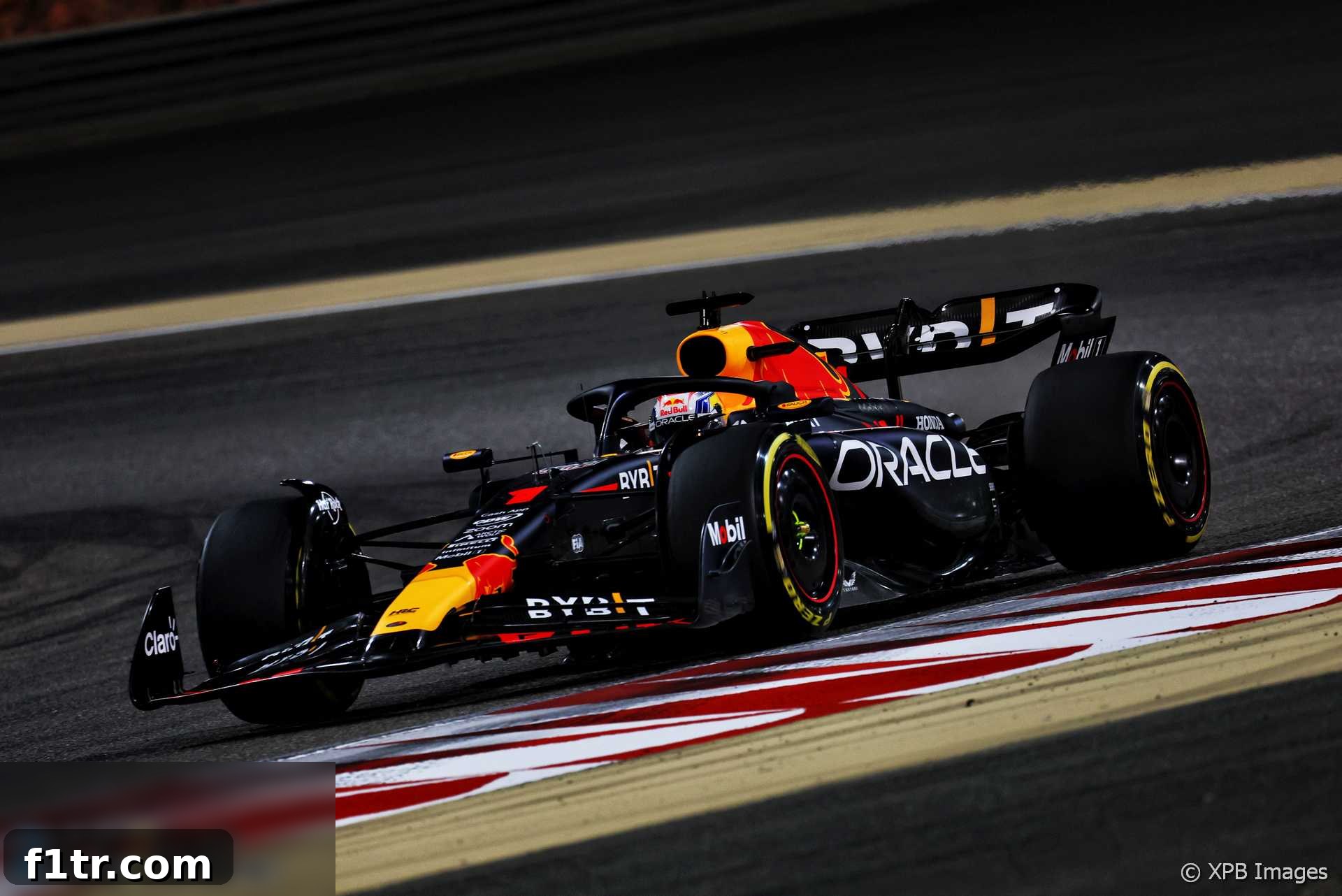
The highly anticipated 2023 Formula 1 season kicked off with its crucial pre-season testing in Bahrain, offering the first real glimpse into the competitive landscape of the year. On a scorching Sakhir International Circuit, reigning world champion Max Verstappen immediately asserted Red Bull’s formidable presence, topping the timesheets on the opening day. His blistering pace left competitors scrambling, though a surprising challenger emerged in the form of veteran driver Fernando Alonso, who guided his Aston Martin to an incredibly close second, just under three-hundredths of a second adrift.
The first day of testing is always a blend of excitement and trepidation for teams and fans alike. It’s the moment where months of meticulous design, rigorous development, and intense anticipation culminate in the cars finally hitting the track in anger. For many, it’s about validating simulation data, understanding the nuances of new aerodynamic packages, and establishing a baseline setup for the grueling season ahead. The primary focus isn’t solely on outright speed, but rather on crucial aspects such as reliability, consistency over long runs, and efficient data gathering. However, topping the timesheets on day one undeniably provides a significant psychological boost and sets an early benchmark for rivals.
Advert | Become a Supporter & go ad-free
Verstappen’s performance throughout the day was a masterclass in efficiency, consistency, and raw speed. Having taken on the demanding task of driving both the morning and afternoon sessions – a rare and physically taxing occurrence in pre-season testing, where teams often split duties between two drivers – he capitalized on every minute of available track time. He consistently improved upon his own benchmark from the earlier session, culminating in a scorching lap that placed Red Bull firmly at the summit. Fernando Alonso, showcasing his enduring talent in the all-new AMR23, demonstrated a remarkable turn of pace, clocking a time only 0.029 seconds slower than Verstappen’s ultimate best. This unexpected competitiveness from Aston Martin instantly ignited fervent conversations in the paddock and among fans about their potential for a vastly improved season. Meanwhile, the two Ferraris, piloted by Carlos Sainz Jnr and Charles Leclerc, showed promising speed and reliability, but were both approximately four-tenths of a second behind the world champion, indicating they still had some ground to make up or different programs to complete.
The morning session unfolded under bright Bahraini skies, with track temperatures steadily rising as the sun climbed higher. Verstappen was an early pace-setter, quickly establishing Red Bull’s formidable intentions, signaling that their new RB19 package was potent straight out of the box. He was followed by Carlos Sainz Jnr in the Ferrari and a surprisingly strong showing from Alexander Albon in the Williams, hinting at potential improvements for the Grove-based squad in the coming season. This initial phase allowed teams to perform crucial installation laps, check basic systems, and begin their aerodynamic correlation tests, ensuring the data gathered aligned with their factory simulations. With the exception of Verstappen, most teams opted to split driving duties, allowing both their race drivers to get an essential feel for the new machinery and provide diverse feedback. Lewis Hamilton, Charles Leclerc, Lando Norris, Fernando Alonso, Valtteri Bottas, Esteban Ocon, Kevin Magnussen, Nyck de Vries, and Logan Sargeant were among the drivers who took over from their teammates for the more representative afternoon session, aiming to maximize their personal track time and contribute to the team’s data coffers.
Following a well-deserved hour-long lunch break, the pit lane went green again, signaling the official commencement of the second four-and-a-quarter-hour running period. However, a noticeable calm initially settled over the circuit as none of the ten teams rushed out immediately. This typical testing strategy often involves a calculated wait for track temperatures to cool slightly, making conditions more representative of potential race scenarios later in the day. It also allows for longer, more focused runs that are less impacted by peak heat degradation, and crucially, it gives mechanics essential time to make precise setup adjustments based on the morning’s collected data and driver feedback.
After a patient and strategic wait, just shy of 15 minutes into the afternoon session, Max Verstappen once again broke the silence, becoming the first driver to venture back onto the circuit. He was soon joined by a procession of other afternoon drivers, including Lando Norris, Lewis Hamilton, Nyck de Vries, Esteban Ocon, Charles Leclerc, and Logan Sargeant. In these early stages of the afternoon, the focus for many drivers was less about setting blistering lap times and more about achieving driver familiarity with their new machines, understanding handling characteristics, and completing initial setup programs. Consequently, none of the drivers who started their day in the afternoon managed to immediately break into the top ten on the timing screens during this initial phase, preferring longer stints, systematic data collection, and system checks over single-lap heroics to truly understand their new challengers.
Despite the generally smooth running and impressive reliability seen across the grid, a few teams encountered minor setbacks that underscored the inherent challenges of pre-season testing. Aston Martin’s reserve driver, Felipe Drugovich, who took part in the morning session, was unfortunately hampered by unexpected electrical problems, significantly limiting his valuable track time and data gathering opportunities. His seasoned teammate, Fernando Alonso, faced a similar frustration in the afternoon, reportedly held up with minor floor damage on his AMR23. This unexpected delay meant a significant portion of Alonso’s highly anticipated session was spent frustratingly in the garage, with mechanics diligently working against the clock to repair the damage. However, demonstrating the team’s resilience and determination, after almost a full hour of painstaking work, Alonso was able to rejoin the circuit, quickly getting up to speed to gain crucial experience with their new challenger. McLaren also faced challenges, with Lando Norris experiencing a frustrating lack of running across the opening two hours of his session, as mechanics were seen working intensely on the front of his MCL60, highlighting the early teething problems many teams navigate during these critical pre-season tests.
As the sun began its majestic descent below the Bahraini horizon, casting long, dramatic shadows across the track and ushering in gradually cooler temperatures, the conditions became increasingly favorable for faster lap times. This period often sees drivers push harder, simulating qualifying runs or late-race scenarios, taking advantage of the increased grip. Lewis Hamilton was one of the first to truly capitalize on these improved conditions, moving his Mercedes W14 up to an impressive provisional third position with a lap time of 1’33.671, placing him a quarter of a second behind Sainz’s earlier best. However, the true pace-setter, Max Verstappen, was far from content with his earlier benchmark. Bolting on a fresh set of the C3 compound tyres – typically the medium compound, which offers a good balance of grip and durability, serving as a strong indicator of race pace potential – he unleashed another devastatingly quick lap. Improving significantly through the challenging first two sectors, he lowered the overall best time of the day to an astonishing 1’32.837, unequivocally signaling Red Bull’s ominous form and intent for the season.
With the impressive floodlights illuminating the Sakhir circuit, creating a dramatic and electrifying atmosphere, the final hour of testing saw a spectacular flurry of fast laps from several drivers. Fernando Alonso, having successfully overcome his earlier technical issues, truly came alive in the cooler, faster conditions. Pumping in the fastest final sector of the entire day, he dramatically surged up the leaderboard to secure a phenomenal second position, an almost unbelievable 0.029 seconds shy of Verstappen’s ultimate best. This late charge from the two-time world champion sent ripples of excitement and speculation through the F1 community, strongly suggesting Aston Martin could be a dark horse contender for strong results this year. Charles Leclerc also found more pace in his Ferrari, improving to a 1’33.287, almost perfectly matching his teammate Carlos Sainz’s best time from the early session, indicating strong and consistent performance for the Scuderia. Lando Norris, despite his earlier mechanical woes, managed to put in a respectable effort, moving his McLaren MCL60 into fifth place, while Lewis Hamilton improved slightly to secure the sixth fastest time, moving ahead of Alexander Albon’s impressive morning effort for Williams, highlighting the competitive nature of the field.
One of the most encouraging and significant aspects of the day’s running was the impeccable reliability displayed by the new generation of Formula 1 cars. There were no red flag stoppages or significant on-track incidents for any of the ten drivers participating in the second half of the day, allowing for continuous and productive data collection. This speaks volumes about the robustness of the 2023 machinery, a positive sign for the demanding season ahead and a testament to the comprehensive preparations undertaken by all teams. In terms of mileage, Max Verstappen proved to be the undisputed workhorse of the day, completing an astounding 157 laps for Red Bull – a distance equivalent to almost three full Grand Prix races. Mercedes also demonstrated strong endurance and data-gathering capabilities, covering an impressive 152 laps, closely followed by Williams with a solid 149 laps, and Alfa Romeo logging a respectable 138. McLaren, unfortunately, covered the least distance over the day’s running, recording only 92 laps, which was nine fewer than Aston Martin, underscoring their earlier technical frustrations and emphasizing the critical need to maximize track time in the remaining test days.
Advert | Become a RaceFans supporter andgo ad-free
2023 F1 Pre-Season Bahrain Test – Day One Official Times
The following table provides a comprehensive overview of the lap times, the time gaps to the fastest driver, and the total laps completed by each participant on the thrilling opening day of the 2023 F1 pre-season test in Bahrain. These statistics are crucial for understanding each team’s initial performance, reliability, and the sheer amount of data they managed to gather, offering valuable insights into the potential competitive order heading into the new season and sparking intense debate among analysts and fans alike.
| Pos. | Car number | Driver | Team | Model | Best time | Gap | Laps |
|---|---|---|---|---|---|---|---|
| 1 | 1 | Max Verstappen | Red Bull | RB19 | 1’32.837 | 157 | |
| 2 | 14 | Fernando Alonso | Aston Martin | AMR23 | 1’32.866 | 0.029 | 60 |
| 3 | 55 | Carlos Sainz Jnr | Ferrari | SF-23 | 1’33.253 | 0.416 | 72 |
| 4 | 16 | Charles Leclerc | Ferrari | SF-23 | 1’33.267 | 0.430 | 64 |
| 5 | 4 | Lando Norris | McLaren | MCL60 | 1’33.462 | 0.625 | 40 |
| 6 | 44 | Lewis Hamilton | Mercedes | W14 | 1’33.508 | 0.671 | 83 |
| 7 | 23 | Alexander Albon | Williams | FW45 | 1’33.671 | 0.834 | 74 |
| 8 | 24 | Zhou Guanyu | Alfa Romeo | C43 | 1’33.723 | 0.886 | 67 |
| 9 | 63 | George Russell | Mercedes | W14 | 1’34.174 | 1.337 | 69 |
| 10 | 2 | Logan Sargeant | Williams | FW45 | 1’34.324 | 1.487 | 75 |
| 11 | 27 | Nico Hulkenberg | Haas | VF-23 | 1’34.424 | 1.587 | 51 |
| 12 | 77 | Valtteri Bottas | Alfa Romeo | C43 | 1’34.558 | 1.721 | 71 |
| 13 | 21 | Nyck de Vries | AlphaTauri | AT04 | 1’34.559 | 1.722 | 85 |
| 14 | 34 | Felipe Drugovich | Aston Martin | AMR23 | 1’34.564 | 1.727 | 40 |
| 15 | 22 | Yuki Tsunoda | AlphaTauri | AT04 | 1’34.671 | 1.834 | 46 |
| 16 | 10 | Pierre Gasly | Alpine | A523 | 1’34.822 | 1.985 | 60 |
| 17 | 31 | Esteban Ocon | Alpine | A523 | 1’34.871 | 2.034 | 53 |
| 18 | 81 | Oscar Piastri | McLaren | MCL60 | 1’34.888 | 2.051 | 52 |
| 19 | 20 | Kevin Magnussen | Haas | VF-23 | 1’35.087 | 2.250 | 57 |
As the first day of pre-season testing concludes, the Formula 1 paddock is abuzz with speculation and anticipation. Max Verstappen’s dominant performance and Red Bull’s strong mileage immediately position them as formidable front-runners, reinforcing their champion status and sending a clear message to their rivals. However, the undisputed standout story of the day was undoubtedly Fernando Alonso’s astonishing pace in the Aston Martin, hinting at a potential shake-up in the pecking order and a more competitive midfield or even front. Ferrari demonstrated solid, if not headline-grabbing, consistency, while Mercedes and other teams continue to fine-tune their new challengers, suggesting there’s still more to come. With two more crucial days of testing ahead, teams will continue to push the boundaries of their new machines, gather vital data, and refine their strategies before the lights go out for the season-opening Bahrain Grand Prix. The stage is emphatically set for an electrifying 2023 F1 season, promising fierce competition, unexpected narratives, and a thrilling battle for supremacy.
Advert | Become a RaceFans supporter andgo ad-free
2023 F1 Season Related Content
Delve deeper into the thrilling world of Formula 1 with our comprehensive coverage of the 2023 season. From in-depth race reviews to exclusive driver insights and intricate team analyses, stay updated on every twist and turn of the championship battle. Explore a curated selection of articles that provide essential context, delve into controversies, and offer a closer look at the key moments, performances, and personalities that defined the unforgettable 2023 Formula 1 season.
- FIA president cleared of alleged interference in two 2023 races
- First week viewing figures for new Drive to Survive season fall again
- Max who? Drive to Survive season six prefers its favourite faces
- RaceFans’ complete 2023 season review
- The F1 drivers who pulled off the 10 biggest charges through the field in 2023
Browse all 2023 F1 season articles