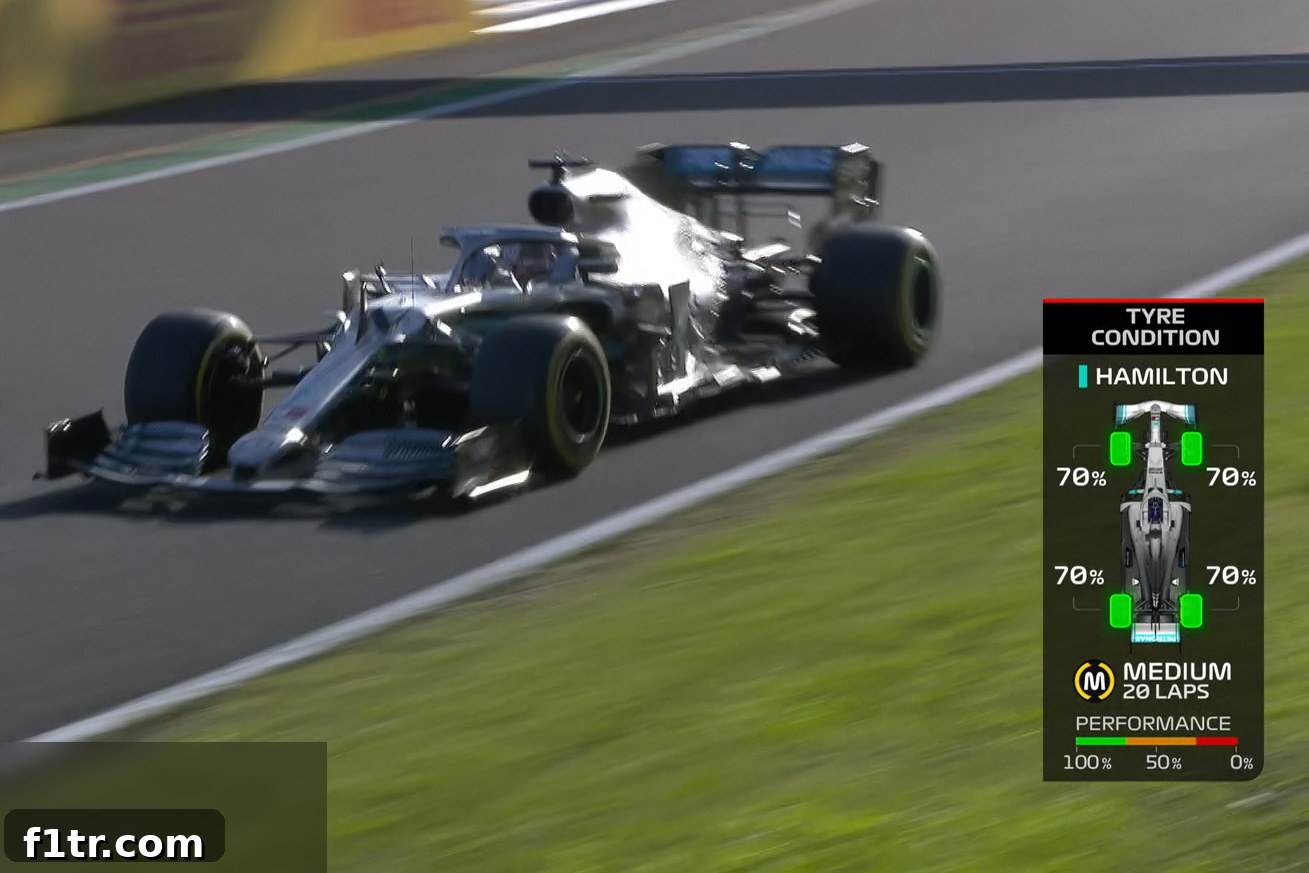
Formula 1, a sport synonymous with cutting-edge technology and relentless innovation, continuously strives to enhance the fan experience through advanced broadcast features. Among these, the relatively new Tyre Performance graphic has emerged as a significant talking point, aiming to offer unprecedented insight into one of the most critical aspects of F1 racing: tyre management and strategy.
Initially met with scrutiny, particularly from the sport’s official tyre supplier, Pirelli, this graphic has quickly become a recognizable element of F1 broadcasts. It made its debut during the championship round in Japan and has since been seen in subsequent races, including the Mexican Grand Prix broadcast. Its primary function is to provide real-time percentage values reflecting the ‘condition’ – or more accurately, the performance capability – of each tyre on a driver’s car. This level of detail offers a unique window into the dynamic and often decisive world of F1 race strategy, allowing viewers to track the subtle yet crucial degradation of tyre performance in real-time.
The introduction of such a prominent new feature naturally sparked considerable discussion within the F1 community. Pirelli motorsport director Mario Isola publicly expressed his “surprise” at the graphic’s appearance during the Suzuka race. He notably emphasized that Pirelli had no involvement in its creation, and critically, raised concerns that the data presented could be “misleading.” This sentiment highlighted a potential disconnect between the data interpretation by the series promoter and the specialist knowledge of the tyre manufacturer, underscoring the complexities involved in communicating technical information to a broad audience.
However, Formula 1 has remained steadfast in its commitment to the graphic, asserting its value in enriching the viewer experience and deepening their understanding of race dynamics. Following the initial feedback and an evaluation period, F1 confirmed that the Tyre Performance graphic had been “improved” since its debut at the Japanese Grand Prix. In a detailed statement, F1 clarified the graphic’s precise meaning: it delivers “detailed, real-time information on the current condition for all four individual tyres on a chosen car, presented as a percentage value on a scale between ‘new tyre with no wear’ (100%) and a ‘used tyre’ at the end of its effective performance lifespan (0%).”
Crucially, F1 explicitly defined what these percentages signify, distinguishing them from simple physical wear: “The % value indicates how much of the tyre performance capability has been used thus far into the stint; this value is not to be confused with tyre wear which instead refers to the amount of actual rubber removed from the tyre during the usage period. Lower values indicate a proportional loss in tyre performance via tyre degradation.” This distinction is vital for understanding the graphic’s true purpose – it’s less about the physical state of the rubber and more about its declining ability to deliver optimal lap times, which directly impacts a car’s speed and handling.
The Advanced Technology and Data Behind the Graphic
What makes this Tyre Performance graphic particularly innovative is its independence from Pirelli’s proprietary data. Formula 1 exclusively utilizes publicly available data, which is then meticulously analyzed through sophisticated algorithms to generate the real-time insights displayed on screen. This advanced data processing and visualization capability is carried out with the backing and branding of sponsor AWS (Amazon Web Services), underscoring the significant analytical power and cloud computing resources deployed to bring this feature to life.
Dean Locke, Formula 1’s esteemed director of broadcast media, offered further clarification on the precise methodology and intricate process behind the ‘tyre condition’ figures in an interview. He explained that F1 bases these critical figures on “what the teams do in their strategy.” This implies a deep and comprehensive analysis of various data streams, including team telemetry, historical race data, and an understanding of how different teams and drivers typically manage their tyres throughout a Grand Prix weekend. It’s not merely a direct sensor reading, but rather the output of a complex computational model designed to interpret a multitude of inputs.
Locke detailed the rigorous development process that went into creating this insightful tool: “We took all the parameters we had, put them in this huge algorithm, a model, plotted that model, ran [and] tested that model for eight to 12 weeks using all the different races that we can and trying to see what we got.” This extensive period of testing, refinement, and validation speaks volumes about the complexity and paramount importance of accuracy in presenting such critical race data to a global audience. The algorithm integrates a vast array of constantly changing factors and real-time parameters:
- The specific actions the car is undertaking (e.g., speed, braking force, acceleration rates).
- Its precise position on the track (e.g., tight corners, long straights, areas prone to high tyre stress).
- Ambient conditions and track temperatures, which significantly influence tyre behavior.
- The inherent tyre drop-off characteristics for different compounds (soft, medium, hard) under varying conditions.
- Historical performance data from previous races and testing sessions.
Locke emphatically emphasized the core focus of the graphic: “It’s about performance of the tyre.” He also took the opportunity to address a common initial misunderstanding that emerged among some viewers: “There was a slight misconception of ‘the tyre’s about to explode’: It is the lap time drop-off that tyre.” This crucial distinction is key for viewers to grasp; the graphic is designed to predict and illustrate a decline in a tyre’s optimal performance, signaling when it’s no longer delivering peak lap times, rather than indicating an imminent structural failure or safety concern.
Bridging the Gap: Simplifying Complex F1 Strategies for Fans
Tyre management is consistently heralded as one of the most intricate, strategic, and often decisive elements of modern Formula 1 racing. Factors such as initial compound choice, the rate of degradation, opportune pit stop timings, and individual driver technique all converge to dictate race outcomes. For casual viewers, or even seasoned fans, deciphering these highly nuanced and dynamic strategic elements in real-time can be a significant challenge, often requiring extensive knowledge of the sport’s intricacies.
The Tyre Performance graphic serves as an invaluable and intuitive tool for bridging this understanding gap. By presenting highly complex information in an easily digestible percentage format, it empowers viewers to better comprehend a driver’s current pace relative to their overarching tyre strategy. When a driver’s tyre percentage drops significantly, it immediately signals that their optimal performance window is closing, potentially prompting a strategic pit stop or explaining a sudden and otherwise mysterious loss of pace on track. This clear visual cue can dramatically enhance the viewing experience, transforming abstract strategic decisions into tangible, easy-to-follow on-screen data.
Enhancing Strategic Awareness and Race Narrative
In the past, viewers would largely rely on commentators’ expert insights or their own estimations based on lap times to gauge tyre wear and strategic implications. Now, with the continuous display of the Tyre Performance graphic, fans can directly observe the relative performance capabilities of different drivers’ tyres. This allows for a much more informed and immediate assessment of critical race events, such as overtakes, defensive driving maneuvers, and the overall ebb and flow of a race’s rhythm. For instance, if one driver is showing a 30% tyre performance capability while another pursuing him is still at 70%, the graphic instantly highlights a significant strategic advantage, making the impending battle, a potential pit stop, or a change in track position more predictable, exciting, and understandable.
Aiding New Viewers and Broadening Appeal
For newcomers to the thrilling world of Formula 1, the sheer complexity of the sport, with its myriad rules, technical jargon, and strategic nuances, can often be intimidating. The Tyre Performance graphic significantly simplifies a critical aspect of racing, making it far more accessible and welcoming. Instead of struggling with abstract concepts like “graining,” “blistering,” or “thermal degradation,” viewers can simply track a clear, intuitive percentage value. This straightforward and intuitive design helps demystify a crucial element of race strategy, thereby making F1 a more engaging and enjoyable sport for a broader, more diverse audience, fostering deeper engagement and appreciation.
The Ongoing Dialogue: Balancing Innovation with Expertise
The initial friction and public dialogue with Pirelli highlight a broader and essential theme in Formula 1 broadcasting: the delicate balance between pushing the boundaries of innovative data presentation and respecting the deep expertise and perspectives of key stakeholders. While F1’s overarching objective is unequivocally to enhance fan understanding and engagement, Pirelli, as the sole and exclusive tyre supplier, possesses a fundamental vested interest in the accurate, fair, and non-misleading representation of their highly specialized product. This ongoing dialogue, although initially a point of contention, ultimately serves as a constructive process to refine the graphics and improve clarity for the global audience, ensuring that the information conveyed is both insightful and precise.
The fact that F1 consciously chose to develop its own independent algorithm and data model, rather than relying solely on Pirelli’s internal, proprietary data, speaks volumes about its commitment to providing a unique, data-driven perspective tailored specifically for broadcast audiences. It also underscores the exceptional sophistication and capability of F1’s internal broadcast technology teams and their ability to extract actionable and meaningful insights from publicly available information, seamlessly combined with extensive historical and real-time telemetry data.
The Future of F1 Data Visualization and Fan Immersion
The Tyre Performance graphic is almost certainly just one pioneering step in Formula 1’s ongoing and ambitious journey to transform how fans experience the sport. As data analytics, artificial intelligence, and real-time processing capabilities continue to advance at a rapid pace, we can confidently anticipate even more sophisticated, insightful, and immersive graphics being integrated into future broadcasts. Imagine dynamic visuals that predict optimal pit windows with even greater precision, display real-time fuel consumption rates, or even illustrate intricate driver energy management strategies in the highly complex hybrid powertrains.
The potential for interactive elements, personalized data feeds, and augmented reality overlays in future broadcasts is immense, promising an even deeper and more personalized immersion into the high-octane, technologically driven world of F1. Ultimately, the Tyre Performance graphic represents F1’s proactive and visionary approach to continually elevating the fan experience. By demystifying crucial race elements and presenting them in an engaging, intuitive, and data-rich format, F1 continues to cement its position at the absolute forefront of sports broadcasting innovation. While its initial journey involved overcoming some critical feedback and refining its presentation, the commitment to continuous improvement has yielded a powerful tool that genuinely enhances viewers’ understanding and appreciation of Formula 1’s intricate strategic battles.
2019 F1 Season Insights
Explore more compelling content from a memorable year in Formula 1 history and delve deeper into key moments:
- Crying in the Melbourne car park at 2019 grand prix was my career low – Ocon
- McLaren Racing reports reduced £71 million loss in 2019
- Kvyat: Hockenheim podium last year was “my biggest achievement” so far
- How the FIA’s new encrypted fuel flow meter targets Ferrari’s suspected ‘aliasing’ trick
- “He smashed my office door”: 23 must-see moments from ‘Drive to Survive’ season two
Browse all 2019 F1 season articles