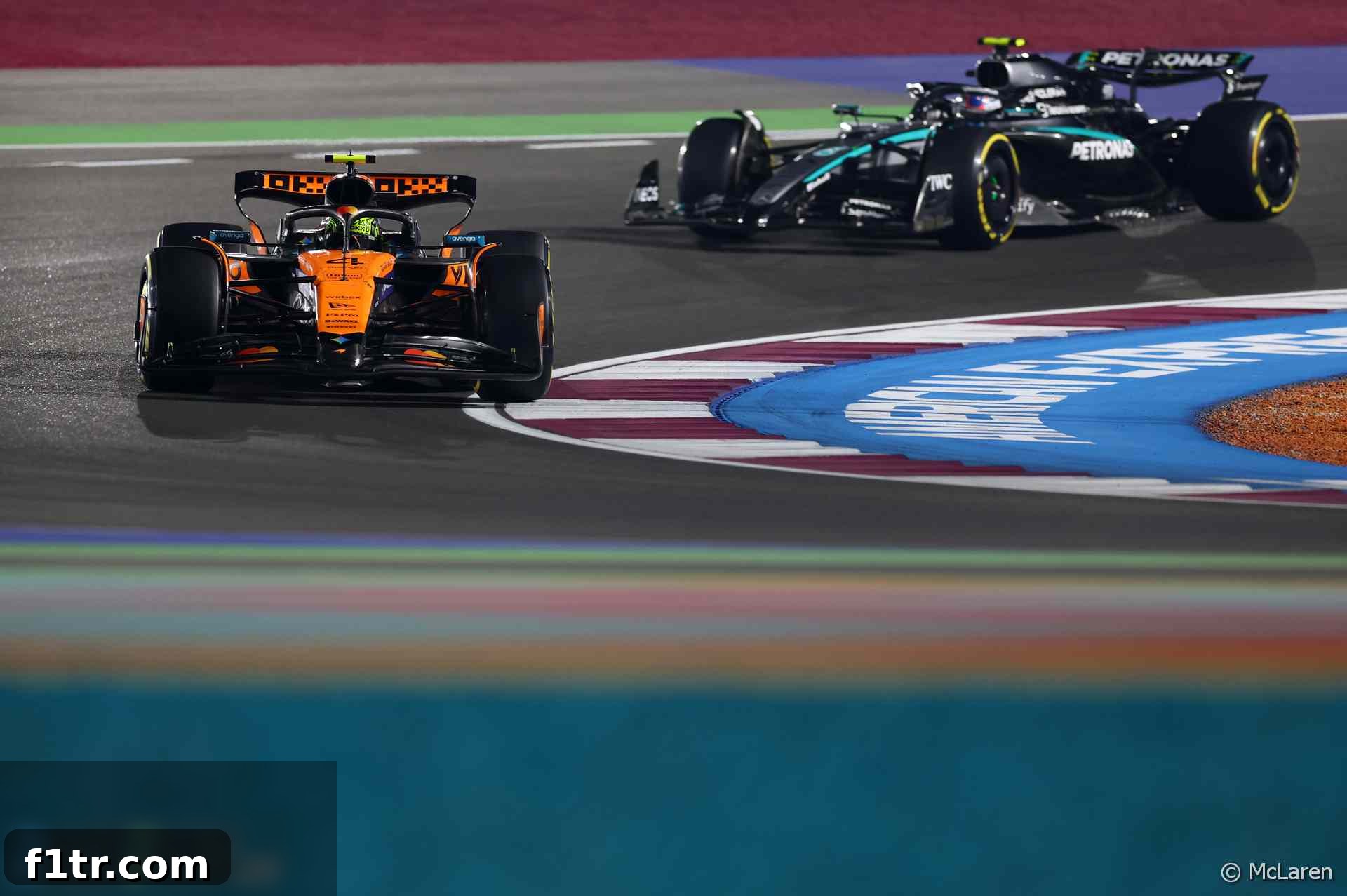
The high-octane world of Formula 1 is a crucible of speed, precision, and unwavering pressure. At the heart of this intense competition, even the most promising talents can find themselves grappling with the fine margins between glory and frustration. Such was the case for Andrea Kimi Antonelli at the recent Qatar Grand Prix, where a crucial error in the closing stages saw him surrender a coveted fourth-place position to the relentless Lando Norris, igniting a brief but potent wave of speculation that was swiftly clarified.
The incident unfolded during a particularly demanding phase of the race, a battle that had seen Antonelli, piloting his Mercedes, fending off Norris’s McLaren for several laps. Both drivers were pushing their limits on a challenging circuit, extracting every ounce of performance from their machinery. The stakes were high; fourth place represents a significant haul of points for a team and a valuable affirmation of a driver’s capabilities in the fiercely competitive midfield.
Norris, known for his tenacious driving style and ability to maintain pressure, had been a constant threat in Antonelli’s mirrors. The McLaren driver sensed an opportunity, relentlessly hounding the Mercedes, waiting for any chink in his rival’s armour. The physical and mental strain on Antonelli must have been immense, managing tyre degradation, fuel levels, and the ever-present threat of a faster car closing in. This cat-and-mouse game reached its dramatic crescendo on the penultimate lap.
As Antonelli navigated the challenging Turn 9, a corner demanding precise entry and braking, the critical moment arrived. Footage of the incident revealed that Antonelli briefly lost control of his Mercedes as he entered the braking zone for the subsequent corner. The car appeared unsettled, a fleeting moment of instability that proved costly. This initial wobble was then compounded by a more significant snap of oversteer at the exit of Turn 10, sending the young driver wide and off the track. It was a visible and undeniable mistake, a clear loss of grip and control at a critical juncture.
Lando Norris, with the predatory instincts of a top-tier racing driver, wasted no time. Having closely shadowed Antonelli for lap after lap, the McLaren ace seized the momentary lapse with clinical efficiency, powering past the struggling Mercedes to claim fourth position. The shift in dynamics was instantaneous, a testament to the unforgiving nature of Formula 1 where fractions of a second and millimetres of precision can dictate destiny.
The immediate aftermath of the incident sparked an unexpected flurry of conjecture, particularly from the Red Bull garage. Max Verstappen’s astute race engineer, Gianpiero Lambiase, observing the sequence of events unfold, offered a surprising initial assessment over the team radio. “Not sure what happened to Antonelli, Max,” Lambiase remarked, “looks like he just pulled over and let Norris through.” This statement, though likely a spontaneous observation in the heat of the moment, carried significant implications. The suggestion that Antonelli might have deliberately yielded position to Norris quickly became a talking point, raising questions about potential team orders or strategic manoeuvres – scenarios that are always closely scrutinised within the F1 paddock.
However, any notion of foul play or strategic collusion was swiftly debunked. There was absolutely no indication from Antonelli’s Mercedes radio communications that he had received any instruction to assist Norris, a rival team’s driver, even if McLaren is an engine customer of Mercedes. Mercedes, like any competitive constructor, would have no logical reason to instruct one of its drivers to give up a hard-fought position to a competitor, especially one as valuable as fourth place. The very idea ran contrary to the fiercely competitive ethos of Formula 1.
Antonelli’s own visceral reaction on the team radio painted a vivid picture of genuine frustration and self-reproach. His expletive-laden outburst, “Ah fuck I had a massive…,” before being cut off by his race engineer, Peter Bonnington, conveyed the raw emotion of a driver who knew he had just made a costly error. Bonnington, understanding the heat of the moment, offered a brief but empathetic acknowledgment: “Yeah, saw it mate.” This exchange underscored the personal anguish Antonelli felt, far removed from any calculated manoeuvre.
After crossing the finish line behind Norris, a dejected Antonelli reflected further on the incident, his voice still tinged with disappointment. “Ah man I cannot believe it,” he lamented. “I tried.” Bonnington, ever supportive, sought to reassure him, “It just looked like it spun up and then a big snap.” These comments from both driver and engineer highlighted the shared understanding of a genuine driving mistake, rather than any deliberate action.
In his post-race debrief with the media, Antonelli provided a more detailed and candid account of what he described as a “pretty frustrating race” overall. He pinpointed a series of compounding factors that contributed to his eventual error. Firstly, an unfortunate pit stop had severely compromised his track position and strategy. “We were unlucky with the pit stop, having to hold for so long at the box and losing many places,” he explained. “That was a shame on that side.” A slow or mistimed pit stop can unravel an entire race strategy, forcing a driver to fight through traffic and lose precious time and tyre life, setting a challenging tone for the remainder of the event.
Following this setback, Antonelli found himself embroiled in a difficult battle, specifically struggling in the turbulent air generated by Carlos Sainz’s Ferrari. Racing in “dirty air” – the disturbed airflow coming off a preceding car – significantly reduces a following car’s aerodynamic performance, making it incredibly difficult to get close enough to overtake. “After that the race was a bit compromised because I was stuck in Carlos [Sainz’s] dirty air and I was really struggling to get close,” Antonelli revealed. “Obviously I was a bit annoyed with that.” The constant fight against aerodynamic inefficiency, coupled with the frustration of being unable to make progress, likely contributed to a build-up of pressure and mental fatigue.
It was against this backdrop of accumulating frustration and relentless pressure that the final, decisive error occurred. “Then obviously with two laps to go I went in a bit quick into turn nine and lost the rear and went off track,” Antonelli admitted openly. “So definitely it was a mistake and I need to move forward now.” This frank self-assessment provided a clear explanation for the incident, aligning perfectly with his radio communications and the on-track footage. It was a driver pushing the limits, perhaps slightly overdriving in an attempt to compensate for earlier misfortunes, leading to a momentary lapse of concentration and control that F1’s unforgiving nature instantly punished.
The initial speculation from Gianpiero Lambiase, while quickly becoming a talking point, was subsequently clarified. Red Bull Racing, through official channels, later admitted that Antonelli had not intentionally helped Norris, completely dispelling the claims made by team members in the heat of the moment. This official statement from a rival team was crucial in clearing Antonelli’s name and reinforcing the integrity of the racing. Mercedes themselves expressed gratitude for Red Bull’s clarification, particularly in light of the “disappointing” online abuse Antonelli had faced as a result of the initial, unfounded claims. This resolution underscores the importance of accurate information and the rapid spread of misinformation in the digital age, especially concerning high-profile sporting events.
Andrea Kimi Antonelli’s experience in Qatar serves as a poignant reminder of the immense pressures and razor-thin margins that define Formula 1. It highlights the unforgiving nature of the sport, where even a slight misjudgment can have significant consequences for a driver and their team. For a young driver like Antonelli, still early in his top-tier racing career, such incidents are often painful but invaluable learning experiences. They forge resilience and provide critical insights into managing pressure, understanding car limits, and maintaining composure throughout a gruelling race weekend.
Ultimately, the Qatar Grand Prix incident, while momentarily clouded by speculation, stands as a clear case of a genuine driver error. Antonelli, under intense pressure and battling a challenging race, simply pushed slightly beyond the limits, an outcome familiar to every racing driver who has ever dared to compete at the pinnacle of motorsport. Lando Norris capitalised on the opportunity with skill and precision, securing a well-deserved fourth place. As Antonelli looks ahead, this moment will undoubtedly serve as a crucial lesson, contributing to the development of a promising talent in the world of Formula 1, proving that even in defeat, valuable experience is gained.